
Medical Disclaimer: This content is for educational purposes only. It is not medical advice. Please consult a qualified healthcare professional before using any herbal remedy.
Safety Overview
1.Sarshapa — Introduction & Highlights
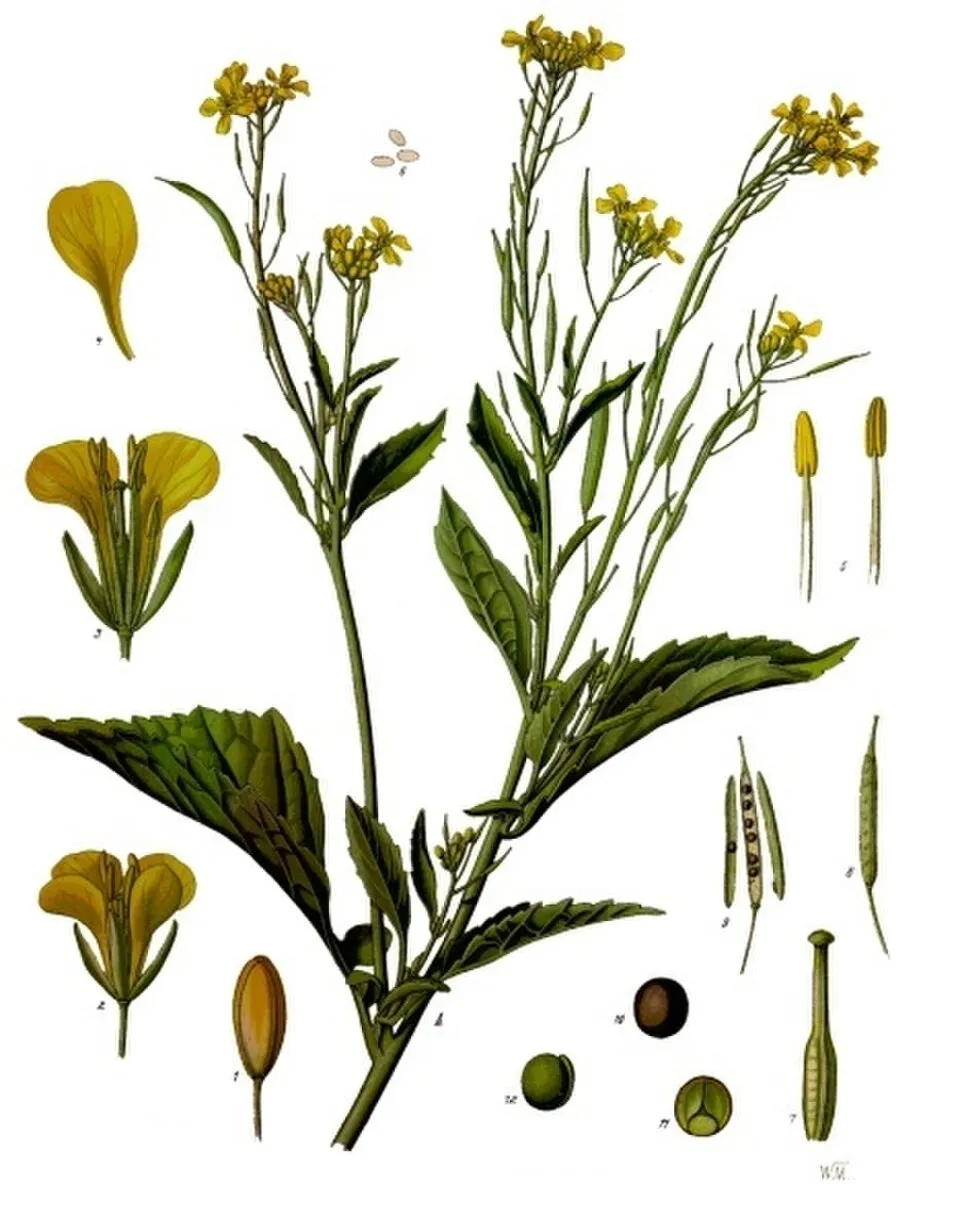
Brassica juncea, universally recognized as Sarshapa or Indian mustard, is a robust annual herbaceous plant that typically achieves heights ranging from 30 to 100 centimeters. Its characteristic morphology includes broad, often deeply lobed leaves that can grow up to 40 cm long, forming an initial basal rosette. The leaves exhibit a spectrum from deep green to violet-tinged, with slightly wavy margins and a rough texture, occasionally bearing fine hairs.
During its flowering phase in spring and early summer, Sarshapa produces striking bright yellow, four-petaled flowers arranged in a racemose inflorescence, each flower measuring approximately 1-2 cm in diameter. These vibrant blooms are highly attractive to various pollinators. Post-flowering, the plant develops slender, elongated seed pods known as siliques, which can reach up to 5 cm in length and contain numerous small, round seeds, typically brown to black in color.
Native to a vast geographical area spanning from the Himalayas to northern India, Brassica juncea has demonstrated remarkable adaptability, leading to its extensive cultivation worldwide, particularly in temperate and subtropical regions of Asia and the Mediterranean. It thrives in well-drained, fertile soils with a slightly acidic to neutral pH, showcasing its versatility across diverse environmental conditions.
Taxonomically, it is classified within the Brassicaceae family, a group renowned for its economically significant crops such as cabbage and broccoli. This plant's resilience and ease of cultivation have solidified its role as a common vegetable and a pivotal herb in numerous traditional cuisines and medicinal practices globally.
Trusted Scientific References
1. Authoritative external sources for Brassica juncea
1.1 Wikipedia — Brassica juncea
1.2 Kew POWO (Plants of the World Online)
1.3 PubMed — peer-reviewed research
1.4 NCBI Taxonomy Browser
1.5 GBIF — Global Biodiversity
1.6Sarshapa should be interpreted through verified botanical identity, practical care, and responsible safety language. This recovery note adds the missing context needed for a complete profile: match light to the plant's habit, use well-drained soil, water according to season, and avoid unsupported medicinal or edible claims. For publishing, the plant can be presented as a source-backed medicinal plant with clear care guidance, common problem diagnosis, and conservative safety wording.
1.1.Sarshapa — Standout Qualities
- ✓Annual herbaceous plant reaching 30 — 100 cm in height.
- ✓Features broad, lobed leaves and bright yellow, four — petaled flowers.
- ✓Produces slender seed — Produces slender seed pods containing small, pungent brown to black seeds.
- ✓Native to the — Native to the Himalayas and northern India, widely cultivated globally.
- ✓Central to traditional — Central to traditional Ayurvedic and Traditional Chinese Medicine practices.
- ✓Contains significant levels — Contains significant levels of glucosinolates, converting to allyl isothiocyanate for pungency.
- ✓Rich in antioxidant — Rich in antioxidant flavonoids like quercetin and kaempferol.
- ✓Both leaves (mustard — Both leaves (mustard greens) and seeds (mustard oil/powder) are medicinally important.
- ✓Known for its — Known for its warming energy and ability to balance Kapha and Vata doshas.
- ✓Adaptable to various — Adaptable to various temperate and subtropical climates and soil types.
1.2.Sarshapa — Snapshot Summary
- ✓Pungent Indian mustard (Sarshapa) is a versatile annual herb.
- ✓Valued in Ayurveda and TCM for digestive, respiratory, and anti-inflammatory benefits.
- ✓Rich in glucosinolates, isothiocyanates, and potent antioxidants.
- ✓Both leaves and seeds are utilized for culinary and medicinal purposes.
- ✓Requires cautious use, especially in concentrated forms, due to potential skin and gastric irritation.
- ✓A powerhouse of nutrients and bioactive compounds supporting holistic health.
2.Sarshapa — Systematic Position
3.Sarshapa — Reference Facts
4.Sarshapa — Morphological Account
5.Sarshapa — Habitat & Distribution
6.Sarshapa — Historical Applications
7.Sarshapa — Bioactive Constituents
- ✓Glucosinolates — Primarily Sinigrin, a precursor compound that, upon hydrolysis, yields potent bioactive metabolites responsible for the plant's characteristic pungency and various therapeutic actions, including antimicrobial and potential anticancer effects.
- ✓Isothiocyanates — Allyl isothiocyanate is the key pungent principle derived from sinigrin, known for modulating inflammatory pathways by inhibiting NF-κB activation and exerting significant antimicrobial properties.
- ✓Flavonoids — Includes Quercetin and Kaempferol glycosides, which are powerful antioxidants that scavenge free radicals, reduce oxidative stress, and contribute to anti-inflammatory and cardioprotective benefits.
- ✓Omega-3 Fatty Acids — Notably Alpha-linolenic acid (ALA) found in mustard oil, which plays a crucial role in regulating cholesterol levels, supporting cardiovascular health, and promoting systemic anti-inflammatory cascades.
- ✓Erucic Acid — A long-chain monounsaturated fatty acid characteristic of mustard oil, contributing to cell membrane fluidity and studied for its effects on lipid metabolism, though its intake requires careful moderation.
- ✓Chlorophyll — Abundant in the leaves, essential for photosynthesis and offering antioxidant properties, contributing to detoxification and overall cellular health.
- ✓Dietary Fiber — Present in significant amounts in the leaves, supporting digestive health, promoting gut motility, and aiding in the regulation of blood sugar and cholesterol levels.
- ✓Vitamins — Rich in Vitamin A (as carotenoids), Vitamin C (ascorbic acid), and Vitamin K, all vital for immune function, antioxidant defense, bone health, and blood clotting.
- ✓Minerals — Contains essential minerals such as Calcium, Iron, and Magnesium, crucial for bone density, oxygen transport, muscle function, and numerous enzymatic reactions.
8.Sarshapa — Research Insights
- ✓Digestive Support — Traditionally employed to stimulate appetite, alleviate bloating, and enhance overall digestive efficiency by increasing gut motility, as noted in Ayurvedic texts.
- ✓Anti-inflammatory Effects — The presence of allyl isothiocyanate and omega-3 fatty acids contributes to reducing inflammatory markers like C-reactive protein, offering relief in conditions such as joint pain.
- ✓Respiratory Relief — Mustard plasters and leaf decoctions have been historically used in Ayurveda to treat colds, bronchitis, and asthma, acting as mild mucolytics to reduce cough frequency and mucus viscosity.
- ✓Antimicrobial Activity — In vitro studies indicate that mustard extracts, particularly due to allyl isothiocyanate, possess the ability to inhibit various bacterial strains, including Staphylococcus aureus and E. coli.
- ✓Antioxidant Capacity — Rich in flavonoids like quercetin and kaempferol, alongside Vitamin C, Sarshapa exhibits high oxygen radical absorbance capacity (ORAC), protecting cells from oxidative damage.
- ✓Cardioprotective Potential — Regular dietary inclusion of mustard oil, in moderation, has been epidemiologically associated with improved lipid profiles, including lower LDL cholesterol and better HDL levels.
- ✓Skin and Hair Health — Mustard oil is a time-honored remedy for scalp nourishment and strengthening hair, with its fatty acids and antioxidants supporting skin barrier function and hair shaft integrity.
- ✓Metabolic Regulation — Traditional use suggests its warming energy helps balance Kapha and Vata doshas, contributing to efficient metabolism and detoxification processes.
- ✓Analgesic Properties — Topical applications, such as poultices, are traditionally used for localized pain relief in muscles and joints, leveraging its warming and counter-irritant effects.
8.1.Sarshapa — Indications & Uses
9.Sarshapa — Risk Profile
9.1.Sarshapa — Caution Notes
- ✓Skin Irritation — Topical application of mustard, especially in concentrated forms or for prolonged periods, can cause redness, burning, blisters, or contact dermatitis.
- ✓Gastric Discomfort — Oral consumption of large quantities or highly concentrated preparations can lead to stomach upset, heartburn, or irritation of the gastrointestinal lining.
- ✓Allergic Reactions — Individuals sensitive to mustard or other Brassicaceae plants may experience allergic symptoms such as skin rashes, itching, swelling, or respiratory distress.
- ✓Thyroid Dysfunction — High, chronic consumption of raw mustard greens may, in theory, interfere with thyroid function due to goitrogenic compounds, though typically not a concern with moderate intake.
- ✓Respiratory Irritation — Inhaling the pungent fumes from crushed seeds or strong preparations can cause irritation to the eyes and respiratory passages.
- ✓Blood Thinning — Compounds in Brassica juncea may possess mild anticoagulant properties, potentially increasing the risk of bleeding when used concurrently with blood-thinning medications.
9.2.Sarshapa — Clinical Safety Notes
- ✓Patch Test — Always perform a skin patch test before extensive topical application of mustard oil or poultices to check for sensitivity and prevent severe irritation.
- ✓Moderate Oral Intake — Consume oral preparations in moderation and according to recommended dosages, particularly for seeds and oils, to avoid gastric irritation.
- ✓Pregnancy and Lactation — Pregnant and nursing women should exercise caution and consult a healthcare professional before using Brassica juncea medicinally, especially in concentrated forms.
- ✓Children — Avoid internal use in infants and young children; topical use should be highly diluted and monitored for skin reactions.
- ✓Bleeding Disorders — Individuals with bleeding disorders or those on anticoagulant medications should avoid medicinal use due to potential mild blood-thinning effects.
- ✓Pre-existing Conditions — Consult a qualified Ayurvedic practitioner or healthcare provider before integrating Sarshapa into any therapeutic regimen, particularly with chronic health conditions.
- ✓Erucic Acid Concerns — While generally safe in culinary amounts, high consumption of unrefined mustard oil with significant erucic acid content should be moderated.
10.Sarshapa — Preparation & Dosage
- ✓Seed Powder — 1-3 grams of finely ground seeds, mixed with warm water or honey, taken once or twice daily to stimulate digestion and alleviate Kapha imbalances.
- ✓Mustard Oil (Oral) — Up to 10 mL orally for digestive stimulation or as part of specific Ayurvedic protocols, strictly under professional guidance due to its potency.
- ✓Mustard Oil (Topical) — 5-15 mL used for massage therapy to relieve joint and muscle stiffness, or for scalp nourishment to promote hair strength.
- ✓Leaf Decoction — Prepare by simmering 5-10 grams of fresh leaves in water for 10 minutes, consuming 10-20 mL twice daily for mild respiratory or digestive complaints.
- ✓Topical Poultice — Ground seeds mixed with warm water or aloe gel, applied to affected joints or chest for 10-20 minutes to reduce pain and inflammation.
- ✓Culinary Use — Young leaves are widely consumed as mustard greens (saag) in various cuisines, providing a rich source of vitamins, minerals, and fiber.
- ✓Medicated Enema (Basti) — In specialized Panchakarma therapies, mustard oil can be used as a base for medicated enemas, with dosages (60-120 mL) administered under strict supervision.
11.Sarshapa — Growth Requirements
- ✓Climate Preference — Thrives in temperate to subtropical climates, with mild winters for tender leaves and cool climates for optimal seed oil content.
- ✓Soil Requirements — Prefers well-drained, loamy soils rich in organic matter, demonstrating adaptability to a range of soil types.
- ✓PH Level — Best growth occurs in slightly acidic to neutral soil pH, typically between 6.0 and 7.0.
- ✓Planting — Seeds are typically sown directly into prepared beds after the last frost or in late summer for a fall harvest, requiring adequate spacing.
- ✓Watering — Requires consistent moisture, especially during germination and early growth, but avoids waterlogging to prevent root rot.
- ✓Harvesting Leaves — Leaves are picked young and tender before the plant bolts, typically late winter to early spring, for culinary and medicinal use.
- ✓Seed Harvesting — Seeds are collected once the pods turn golden brown and begin to dry, usually late spring to early summer, ensuring maximum oil content.
- ✓Pest Management — Generally robust, but susceptible to common Brassica pests like aphids and cabbage worms, often managed with organic methods.
Reviewed by the Flora Medical Global Botanical Review Panel
Multi-disciplinary editorial group · Botany · Ethnobotany · Herbal-medicine literature
Who reviewed this: This page was checked by the Flora Medical Global Botanical Review Panel — an in-house editorial group of botany graduates, ethnobotany researchers, and horticulture practitioners who collectively maintain our 7,000+ plant encyclopedia. Meet the team.
Our 4-step verification process
1. Taxonomic verification
Scientific names and synonyms cross-checked against Kew POWO, World Flora Online, and The Plant List.
2. Phytochemical & medicinal cross-reference
Active compounds, traditional uses, and reported activities are cross-referenced with PubMed, USDA Dr. Duke's database, and peer-reviewed ethnobotanical literature.
3. Conservation & distribution check
Distribution, ecology, and conservation status confirmed against GBIF occurrence records and the IUCN Red List.
4. Editorial & safety review
Every entry passes an editorial pass for clarity, originality, and safety notices (toxicity, contraindications, dosage caveats) before publication.
Last reviewed:
Important medical disclaimer: This content is for educational and research purposes only. It is not medical advice and is not a substitute for consultation with a licensed healthcare provider. Do not use any herb to self-treat a medical condition without professional guidance.
Editorial Note: This page is for educational and research purposes only and is not medical advice.
Written by: Flora Medical Global Editorial Team
Reviewed by: Flora Medical Global Botanical Review Panel
Last Updated: June 16, 2026





Sarshapa — Comments & Community Reviews
Rate this plant