
Medical Disclaimer: This content is for educational purposes only. It is not medical advice. Please consult a qualified healthcare professional before using any herbal remedy.
Safety Overview
1.Senna — Essential Profile
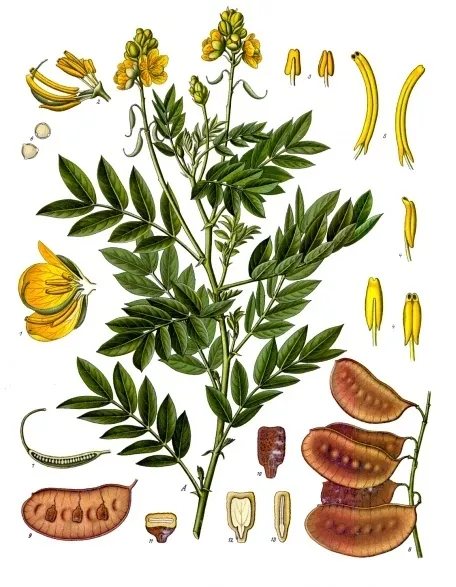
Senna, known scientifically as Cassia angustifolia Vahl., is a prominent medicinal plant belonging to the Fabaceae family, widely recognized for its potent purgative qualities. This resilient perennial shrub typically grows to a height of 0.6 to 1 meter (2 to 3 feet), exhibiting a slightly bushy growth habit. Its distinctive foliage consists of pinnate leaves, each composed of 4 to 8 pairs of lanceolate to ovate-lanceolate leaflets.
Individual leaflets measure approximately 2.5 to 7.5 cm (1-3 inches) in length and 1 to 2.5 cm (0.4-1 inch) in width, characterized by a smooth, somewhat leathery texture and prominent venation. The stems are slender, often displaying a pale green to greenish-brown hue, sometimes with fine pubescence. Cassia angustifolia produces vibrant, showy racemes of bright yellow, bilaterally symmetrical flowers, each about 2.5 to 5 cm (1-2 inches) in diameter, borne on short pedicels.
After pollination, the plant develops oblong, flattened pods, approximately 3 to 6 cm long, which enclose several seeds and are also utilized medicinally.
Native to the arid and semi-arid regions of the Indian subcontinent, particularly Southern India (Tamil Nadu and Rajasthan), Northeast Africa (Sudan, Egypt), and the Arabian Peninsula, Senna thrives in hot, dry climates with minimal humidity. It prefers well-drained, sandy or loamy soils and requires full sunlight for optimal growth, often found flourishing in scrublands and disturbed areas up to 1200 meters above sea level. The plant exhibits remarkable drought tolerance, making it a sustainable crop in semi-arid agricultural zones with annual rainfall of 400-600 mm.
Its root system is typically fibrous and somewhat shallow, adapting to its preferred soil conditions. The bark, when present on older stems, is generally smooth and greenish-brown. Taxonomically, while historically placed in Caesalpinaceae, modern phylogenetics often places it within a broader Fabaceae classification.
Trusted Scientific References
1. Authoritative external sources for Cassia angustifolia
1.1 Wikipedia — Cassia angustifolia
1.2 Kew POWO (Plants of the World Online)
1.3 PubMed — peer-reviewed research
1.4 NCBI Taxonomy Browser
1.5 GBIF — Global Biodiversity
1.1.Senna — Notable Characteristics
- ✓Stimulant Laxative Action — Primary use for fast-acting relief from constipation.
- ✓Anthraquinone — Rich — Contains sennosides A and B as main active constituents.
- ✓Traditional Medicinal Herb — Valued in Ayurvedic and Unani systems for centuries.
- ✓Drought — Tolerant Plant — Thrives in arid and semi-arid climates.
- ✓Medicinal Parts — Dried leaflets and seed pods are the main parts utilized.
- ✓FDA — Approved — Recognized for short-term use in many Western pharmacopeias.
- ✓Predictable Efficacy — Offers reliable bowel evacuation within 6-12 hours.
- ✓Morphological Characteristics — Distinctive pinnate leaves and bright yellow flowers.
- ✓Global Distribution — Native to India, Africa, Arabian Peninsula, cultivated worldwide.
1.2.Senna — Concise Overview
- ✓Potent natural stimulant laxative primarily used for occasional constipation.
- ✓Active compounds are sennosides, found in dried leaves and pods.
- ✓Traditionally used in Ayurveda (Swarnapatri) and Unani medicine for purgation.
- ✓Effective for bowel preparation before diagnostic procedures.
- ✓Crucial for short-term use only to prevent dependency and electrolyte imbalances.
- ✓FDA-approved for over-the-counter short-term constipation relief.
2.Senna — Botanical Identity
3.Senna — Key Data
4.Senna — Physical Description
5.Senna — Origin & Spread
6.Senna — Folk Medicine Applications
7.Senna — Chemical Profile
- ✓Anthraquinone Glycosides — The primary active compounds are Sennosides A and B, which are responsible for Senna’s potent laxative effect by stimulating peristalsis and inhibiting water reabsorption in the colon.
- ✓Free Anthraquinones — These include Rhein, Aloe-emodin, and Chrysophanol, which are metabolites of sennosides and contribute to the purgative and potentially antimicrobial properties.
- ✓Flavonoids — Compounds such as kaempferol and isorhamnetin glycosides are present, offering antioxidant and anti-inflammatory benefits.
- ✓Naphthalene Glycosides — These are less prominent but contribute to the overall phytochemical profile of the plant.
- ✓Polysaccharides — Mucilaginous compounds that can contribute to stool bulk and soothing effects, though not the primary laxative mechanism.
- ✓Tannins — Present in smaller amounts, tannins can exert mild astringent effects.
- ✓Resins — Contribute to the overall plant extract composition and may have minor therapeutic roles.
- ✓Volatile Oils — Present in trace amounts, contributing to the plant’s aroma but not its primary medicinal action.
8.Senna — Evidence-Based Benefits
- ✓Relief from Occasional Constipation — Senna is a powerful stimulant laxative, effectively promoting bowel movements within 6-12 hours, making it ideal for temporary or travel-related constipation.
- ✓Bowel Preparation Before Diagnostic Procedures — Its predictable and thorough purgative action makes it a standard choice for clearing the colon before medical examinations like colonoscopies or abdominal surgeries.
- ✓Support in Hemorrhoids and Anal Fissures — By softening stools and reducing the need for straining, Senna helps alleviate discomfort and promotes healing in individuals suffering from hemorrhoids or anal fissures.
- ✓Antimicrobial and Antiparasitic Actions — Traditional uses suggest mild antimicrobial activity against certain gut pathogens and efficacy in expelling intestinal worms, though this is a secondary effect.
- ✓Detoxification in Traditional Systems — In Ayurveda, Senna (Swarnapatri) is a key herb in Virechana Karma (therapeutic purgation) for deep detoxification, expelling excess Pitta and metabolic waste.
- ✓Improves Stool Passage — It significantly enhances stool frequency and consistency, particularly beneficial for individuals with sedentary lifestyles or those experiencing temporary digestive sluggishness.
- ✓Stimulates Peristalsis — The active compounds, sennosides, directly stimulate the enteric nerves in the colon, increasing muscle contractions that push fecal matter through the intestines.
- ✓Reduces Water Reabsorption in Colon — Sennosides also inhibit water and electrolyte reabsorption from the colon, leading to increased fecal bulk and a softer, easier-to-pass stool.
8.1.Senna — Conditions Traditionally Used For
9.Senna — Safety Considerations
9.1.Senna — Side Effects & Warnings
- ✓Abdominal Cramps and Discomfort — Common, especially at higher doses, due to increased intestinal contractions.
- ✓Diarrhea — Excessive bowel movements can occur, leading to fluid and electrolyte loss.
- ✓Nausea and Vomiting — Some individuals may experience gastrointestinal upset.
- ✓Electrolyte Imbalance — Prolonged or excessive use can lead to significant potassium depletion, affecting heart and muscle function.
- ✓Dehydration — Severe diarrhea can result in loss of body fluids.
- ✓Discoloration of Urine — Harmless reddish-brown discoloration of urine may occur due to anthraquinone metabolites.
- ✓Laxative Dependency — Chronic use can lead to a 'lazy bowel' syndrome, where the colon becomes dependent on stimulant laxatives.
9.2.Senna — Safety Overview
- ✓Short-Term Use Only — Senna is generally safe for short-term use (up to one week); prolonged use is strongly discouraged due to dependency and side effect risks.
- ✓Contraindicated in Pregnancy and Breastfeeding — May stimulate uterine contractions and transfer active compounds into breast milk; use only under strict medical supervision.
- ✓Avoid in Children Under 12 — Pediatric use requires specific formulations and strict medical guidance.
- ✓Caution with Inflammatory Bowel Disease (IBD) — Should not be used in conditions like Crohn's disease, ulcerative colitis, or appendicitis, as it can worsen intestinal irritation.
- ✓Avoid in Kidney or Heart Conditions — The risk of electrolyte imbalance, particularly potassium loss, can be dangerous for individuals with these conditions.
- ✓Drug Interactions — Can interact with diuretics, corticosteroids, cardiac glycosides, and antiarrhythmics, potentiating electrolyte imbalances.
- ✓FDA Approved — Senna is one of the few herbal laxatives recognized by the FDA for short-term over-the-counter use for constipation.
10.Senna — Preparation Methods
- ✓Infusions and Teas — Dried Senna leaves or pods are commonly steeped in hot water to create a tea, typically consumed at bedtime for morning relief.
- ✓Standardized Capsules and Tablets — Available in precise dosages, often standardized for sennoside content, offering convenient and consistent administration.
- ✓Liquid Extracts and Syrups — Formulations suitable for individuals who have difficulty swallowing pills, including children (under medical guidance) or the elderly.
- ✓Powdered Form — Dried leaves and pods can be powdered and mixed with water or honey, particularly in traditional Ayurvedic and Unani practices.
- ✓Herbal Blends — Often combined with carminative herbs like fennel, ginger, or licorice to mitigate potential abdominal cramping.
- ✓Dosage Guidance — Generally taken as a single dose at night; adherence to recommended short-term use (typically not more than one week) is crucial to avoid dependency.
- ✓Bowel Preparation Protocol — Specific, higher doses may be prescribed by healthcare professionals for pre-procedure bowel cleansing, often in combination with other laxatives.
11.Senna — Garden Cultivation
- ✓Climate Preference — Thrives in hot, dry climates with minimal humidity, characteristic of arid and semi-arid zones.
- ✓Soil Requirements — Prefers well-drained, sandy or loamy soils, making it adaptable to less fertile agricultural lands.
- ✓Sunlight Exposure — Requires full sunlight for optimal growth and development, essential for robust flowering and pod production.
- ✓Water Management — Exhibits high drought tolerance, requiring minimal irrigation once established, making it suitable for water-scarce regions.
- ✓Altitude Range — Can be cultivated successfully at altitudes up to 1200 meters above sea level.
- ✓Rainfall Needs — Optimal growth occurs with annual rainfall between 400–600 mm, but it can withstand periods of lower precipitation.
- ✓Propagation — Primarily propagated from seeds, which are sown directly into the soil after light scarification to aid germination.
Reviewed by the Flora Medical Global Botanical Review Panel
Multi-disciplinary editorial group · Botany · Ethnobotany · Herbal-medicine literature
Who reviewed this: This page was checked by the Flora Medical Global Botanical Review Panel — an in-house editorial group of botany graduates, ethnobotany researchers, and horticulture practitioners who collectively maintain our 7,000+ plant encyclopedia. Meet the team.
Our 4-step verification process
1. Taxonomic verification
Scientific names and synonyms cross-checked against Kew POWO, World Flora Online, and The Plant List.
2. Phytochemical & medicinal cross-reference
Active compounds, traditional uses, and reported activities are cross-referenced with PubMed, USDA Dr. Duke's database, and peer-reviewed ethnobotanical literature.
3. Conservation & distribution check
Distribution, ecology, and conservation status confirmed against GBIF occurrence records and the IUCN Red List.
4. Editorial & safety review
Every entry passes an editorial pass for clarity, originality, and safety notices (toxicity, contraindications, dosage caveats) before publication.
Last reviewed:
Important medical disclaimer: This content is for educational and research purposes only. It is not medical advice and is not a substitute for consultation with a licensed healthcare provider. Do not use any herb to self-treat a medical condition without professional guidance.
Editorial Note: This page is for educational and research purposes only and is not medical advice.
Written by: Flora Medical Global Editorial Team
Reviewed by: Flora Medical Global Botanical Review Panel
Last Updated: June 16, 2026





Senna — Comments & Community Reviews
Rate this plant