

Medical Disclaimer: This content is for educational purposes only. It is not medical advice. Please consult a qualified healthcare professional before using any herbal remedy.
Safety Overview
1.Sundew — Botanical Snapshot
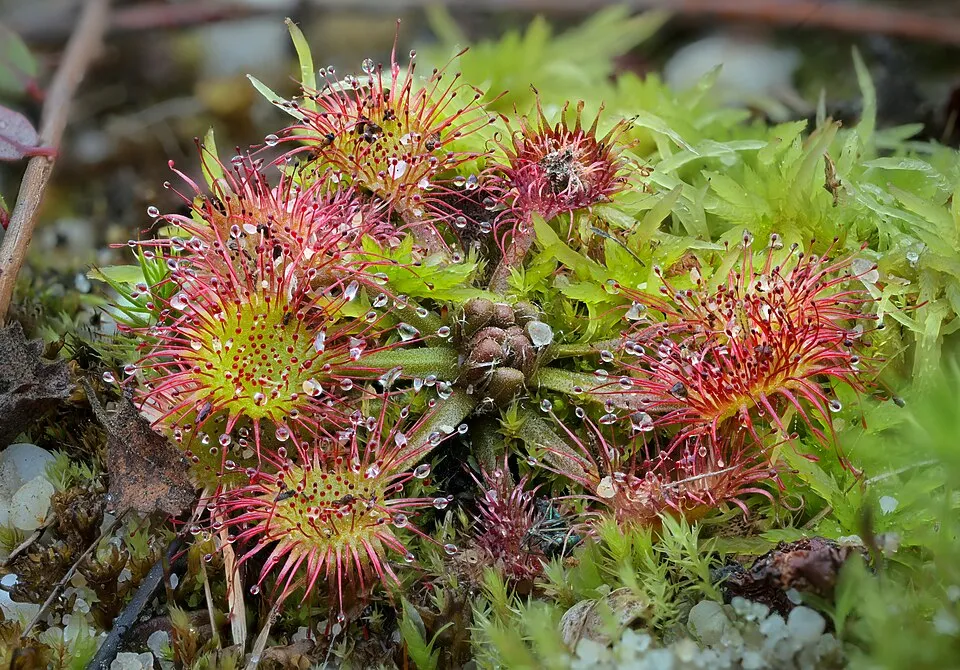
Drosera rotundifolia, commonly known as sundew, is an intriguing perennial carnivorous plant belonging to the Droseraceae family. Typically reaching a modest height of 10 to 30 centimeters, this species is characterized by its distinctive basal rosette of rounded leaves, each measuring approximately 1 to 5 centimeters in diameter. These leaves are a vibrant green, often acquiring a reddish hue when exposed to ample sunlight, and are densely covered with specialized glandular tentacles.
These tentacles secrete a sticky, mucilaginous fluid that glistens like dew, effectively attracting and trapping small insects. The plant's small, delicate flowers, ranging from pink to white, are borne on slender, upright stems that can extend up to 30 centimeters, appearing in loose clusters above the foliage. Sundew thrives in highly specific, nutrient-poor, acidic bog habitats, where it is frequently found nestled among sphagnum moss and peat soils.
Its natural distribution spans across extensive regions of Europe, Northern America, and various parts of Asia. This unique adaptation to nutrient-deficient environments, relying on entomophagy for essential nitrogen and phosphorus, makes Drosera rotundifolia a crucial component of its wetland ecosystems and a fascinating subject of botanical study.
Trusted Scientific References
1. Authoritative external sources for Drosera rotundifolia
1.1 Wikipedia — Drosera rotundifolia
1.2 Kew POWO (Plants of the World Online)
1.3 PubMed — peer-reviewed research
1.4 NCBI Taxonomy Browser
1.5 GBIF — Global Biodiversity
1.6Sundew should be interpreted through verified botanical identity, practical care, and responsible safety language. This recovery note adds the missing context needed for a complete profile: match light to the plant's habit, use well-drained soil, water according to season, and avoid unsupported medicinal or edible claims. For publishing, the plant can be presented as a source-backed medicinal plant with clear care guidance, common problem diagnosis, and conservative safety wording.
1.1.Sundew — Distinguishing Points
- ✓Carnivorous Plant — Unique method of trapping and digesting insects for nutrients.
- ✓Respiratory Remedy — Highly regarded in traditional medicine for treating various lung and throat conditions.
- ✓Antitussive Action — Effectively suppresses spasmodic and irritating coughs.
- ✓Expectorant Properties — Aids in the loosening and expulsion of mucus from the airways.
- ✓Anti — inflammatory — Reduces inflammation in the bronchial tubes and other tissues.
- ✓Naphthoquinone Content — Contains plumbagin and droserone, key compounds with medicinal activity.
- ✓Wetland Habitat — Thrives in acidic, nutrient-poor bog environments.
- ✓Rosette Leaf Arrangement — Distinctive basal rosette of glandular, sticky leaves.
- ✓European Herbalism — Extensive historical use in European traditional medicine.
- ✓Syrups and Tinctures — Common and effective forms of preparation for internal use.
1.2.Sundew — Concise Overview
- ✓Drosera rotundifolia, or sundew, is a carnivorous bog plant with a long history in herbal medicine.
- ✓Primarily valued for its efficacy in treating respiratory conditions like coughs, bronchitis, and asthma.
- ✓Rich in bioactive compounds including naphthoquinones (plumbagin, droserone) and mucilages.
- ✓Exhibits potent antitussive, expectorant, anti-inflammatory, and antispasmodic properties.
- ✓Commonly prepared as infusions, syrups, or tinctures for soothing respiratory passages.
- ✓Requires careful professional guidance for safe use, especially during pregnancy or in children, due to potential side effects.
2.Sundew — Nomenclature & Classification
3.Sundew — Fact Sheet
4.Sundew — Botanical Features
5.Sundew — Origin & Spread
6.Sundew — Heritage Uses
7.Sundew — Key Phytochemicals
- ✓Naphthoquinones — Key active compounds including plumbagin, droserone, and hydroxydroserone, known for their significant antitussive, anti-inflammatory, and antimicrobial properties.
- ✓Flavonoids — Such as hyperoside, quercetin, isoquercetin, and kaempferol, contribute to the plant's antioxidant, anti-inflammatory, and antispasmodic effects.
- ✓Mucilages — High concentrations of polysaccharides provide demulcent and expectorant actions, soothing irritated mucous membranes and aiding in mucus clearance.
- ✓Tannins — Including gallic acid and ellagic acid, which impart astringent properties and contribute to the plant's overall protective effects on tissues.
- ✓Organic Acids — Various organic acids like citric acid, malic acid, and tartaric acid are present, contributing to the plant's biochemical profile and stability.
- ✓Proteolytic Enzymes — Enzymes like droserin, crucial for the plant's carnivorous digestion, may also contribute to the breakdown of mucus in the respiratory system.
- ✓Resins — Complex mixtures of organic compounds that contribute to the plant's overall therapeutic properties and traditional applications.
- ✓Volatile Oils — Present in trace amounts, these essential oils may contribute to the plant's subtle aroma and minor therapeutic actions.
- ✓Carotenoids — Pigments responsible for the reddish coloration of the leaves, offering additional antioxidant potential.
- ✓Minerals — Various trace elements are absorbed from the plant's specialized habitat, contributing to its nutritional and biochemical makeup.
8.Sundew — Pharmacological Findings
- ✓Antitussive — Sundew effectively suppresses various types of coughs, particularly spasmodic and irritating ones, by soothing irritated mucous membranes and reducing bronchial spasms.
- ✓Expectorant — The mucilaginous compounds in sundew help to loosen and thin tenacious mucus in the respiratory tract, facilitating its expulsion and clearing airways.
- ✓Anti-inflammatory — Active constituents like naphthoquinones and flavonoids exhibit anti-inflammatory effects, reducing swelling and irritation in the bronchial passages.
- ✓Antispasmodic — Sundew helps to relax the smooth muscles of the bronchial tubes, alleviating spasms that contribute to coughing fits and difficulty breathing.
- ✓Bronchodilatory — By reducing spasms and inflammation, it can contribute to the widening of airways, improving airflow and easing respiratory distress.
- ✓Antimicrobial — Traditional uses and some studies suggest that sundew possesses mild antimicrobial properties, potentially inhibiting the growth of certain bacteria.
- ✓Immunomodulatory — While not fully elucidated, some components may support or modulate immune responses, contributing to overall respiratory health.
- ✓Astringent — Due to the presence of tannins, sundew can exert a mild astringent effect, which may help to tone and protect mucous membranes.
- ✓Antioxidant — Flavonoids and other phenolic compounds provide antioxidant protection, scavenging free radicals and reducing oxidative stress in the body.
- ✓Demulcent — The high mucilage content offers a soothing, protective coating to irritated mucous membranes in the throat and respiratory passages.
8.1.Sundew — Health Applications
9.Sundew — Safety & Side Effects
9.1.Sundew — Warnings
- ✓Nausea and Vomiting — Can occur with higher doses or in sensitive individuals, attributed to the presence of naphthoquinones.
- ✓Gastrointestinal Upset — Mild stomach discomfort, indigestion, or diarrhea may be experienced by some users.
- ✓Allergic Reactions — Rare but possible allergic responses, including skin rash, itching, or mild respiratory irritation.
- ✓Oral Irritation — Direct contact with fresh plant material or highly concentrated extracts may cause irritation to the mouth or throat.
- ✓Photosensitivity — In rare cases, naphthoquinones can induce increased skin sensitivity to sunlight, leading to sunburn-like reactions.
- ✓Drug Interactions — Potential to interact with certain medications, particularly those affecting blood clotting or liver enzymes, due to active compounds.
- ✓Hypotension (Theoretical) — While not clinically established, some constituents might theoretically contribute to a mild lowering of blood pressure.
9.2.Sundew — Risk Assessment
- ✓Professional Guidance — Always consult a qualified healthcare professional or medical herbalist before using sundew, especially for therapeutic purposes.
- ✓Pregnancy and Lactation — Sundew is contraindicated during pregnancy and breastfeeding due to insufficient research and potential risks to the fetus or infant.
- ✓Children — Use in children should only be undertaken with extreme caution and under the direct supervision of a healthcare provider.
- ✓Pre-existing Conditions — Individuals with stomach ulcers, autoimmune diseases, or bleeding disorders should avoid sundew preparations.
- ✓Dosage Adherence — Strict adherence to recommended dosages is crucial; excessive intake can lead to adverse effects like nausea and vomiting.
- ✓Quality and Sourcing — Ensure that sundew products are sourced from reputable suppliers to guarantee purity, potency, and absence of contaminants.
- ✓Self-medication Warning — Not recommended for self-treatment of serious or chronic respiratory conditions; medical diagnosis and supervision are essential.
10.Sundew — Usage Guide
- ✓Herbal Infusion (Tea) — Dried aerial parts of sundew are steeped in hot water to create a tea, commonly used for respiratory ailments.
- ✓Tincture — An alcohol-based extract of sundew is prepared for a more concentrated form, typically taken in drops diluted in water.
- ✓Syrup — Often formulated with honey or other demulcent agents, sundew syrup is a popular preparation for soothing coughs, especially in children.
- ✓Decoction — While less common for the delicate aerial parts, a decoction might be used for tougher plant materials or roots, though rarely for sundew.
- ✓External Compress — Traditionally, fresh or rehydrated leaves could be applied externally as a compress for minor skin irritations, though with caution.
- ✓Commercial Preparations — Sundew is available in standardized extracts, capsules, or homeopathic remedies from reputable herbal suppliers.
- ✓Dosage — Always follow the guidance of a qualified healthcare professional or herbalist, as standardized dosages are not universally established and can vary by preparation.
- ✓Duration of Use — Typically used for acute respiratory conditions; prolonged use should be discussed with a healthcare provider.
11.Sundew — How to Grow
- ✓Substrate — Requires highly acidic, nutrient-poor soil, typically a mix of sphagnum peat moss and perlite or coarse sand, avoiding standard potting soil.
- ✓Watering — Must be watered exclusively with distilled, demineralized, or rainwater; keep the substrate consistently moist, often by placing pots in a tray of water.
- ✓Light — Demands bright, direct sunlight for at least 6-8 hours daily to ensure vigorous growth and the characteristic reddish coloration of its leaves.
- ✓Temperature — Prefers cool to moderate temperatures, ideally between 10-25°C (50-77°F), with a distinct winter dormancy period being crucial for temperate species.
- ✓Humidity — Thrives in high humidity, mimicking its natural bog environment; this can be achieved with terrariums or frequent misting.
- ✓Feeding — Do not fertilize; the plant obtains necessary nutrients by catching insects, which can be supplemented if grown indoors without natural prey.
- ✓Propagation — Can be readily propagated from seeds, leaf cuttings, or root cuttings, with seeds requiring stratification for optimal germination.
- ✓Dormancy — Temperate Drosera rotundifolia requires a cold dormancy period (0-10°C) for 3-5 months, during which growth slows significantly or ceases.
Reviewed by the Flora Medical Global Botanical Review Panel
Multi-disciplinary editorial group · Botany · Ethnobotany · Herbal-medicine literature
Who reviewed this: This page was checked by the Flora Medical Global Botanical Review Panel — an in-house editorial group of botany graduates, ethnobotany researchers, and horticulture practitioners who collectively maintain our 7,000+ plant encyclopedia. Meet the team.
Our 4-step verification process
1. Taxonomic verification
Scientific names and synonyms cross-checked against Kew POWO, World Flora Online, and The Plant List.
2. Phytochemical & medicinal cross-reference
Active compounds, traditional uses, and reported activities are cross-referenced with PubMed, USDA Dr. Duke's database, and peer-reviewed ethnobotanical literature.
3. Conservation & distribution check
Distribution, ecology, and conservation status confirmed against GBIF occurrence records and the IUCN Red List.
4. Editorial & safety review
Every entry passes an editorial pass for clarity, originality, and safety notices (toxicity, contraindications, dosage caveats) before publication.
Last reviewed:
Important medical disclaimer: This content is for educational and research purposes only. It is not medical advice and is not a substitute for consultation with a licensed healthcare provider. Do not use any herb to self-treat a medical condition without professional guidance.
Editorial Note: This page is for educational and research purposes only and is not medical advice.
Written by: Flora Medical Global Editorial Team
Reviewed by: Flora Medical Global Botanical Review Panel
Last Updated: June 16, 2026





Sundew — Comments & Community Reviews
Rate this plant