


Medical Disclaimer: This content is for educational purposes only. It is not medical advice. Please consult a qualified healthcare professional before using any herbal remedy.
Safety Overview
1.Tagar (Indian Valerian) — At a Glance
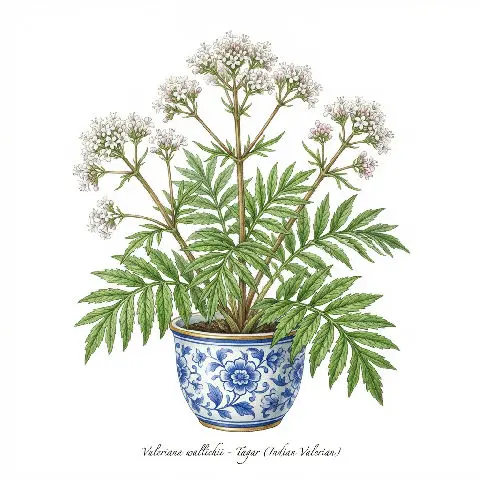
Tagar, scientifically identified as Valeriana wallichii, is a resilient perennial herb indigenous to the temperate zones of the Himalayas, thriving at elevations typically ranging from 2400 to 3600 meters (8000 to 12000 feet). This striking plant generally attains a height of 1 to 1.5 meters (3 to 5 feet) and is characterized by its distinct foliage and floral display. Its leaves are arranged spirally and are pinnate, measuring 20 to 30 centimeters (8 to 12 inches) in length. Each leaf is composed of 9 to 15 bright green, lanceolate leaflets with finely serrated margins.
During late summer to early fall, Valeriana wallichii produces dense clusters of small, exquisitely fragrant tubular flowers that range in color from delicate pink to pristine white, each approximately 2 to 3 centimeters (0.8 to 1.2 inches) long. These blossoms are highly attractive to various pollinators, including bees and butterflies. The plant's stem is notably sturdy, with a smooth texture and often displaying a subtle reddish tint. Tagar prefers moist, well-drained soils and is commonly found flourishing in meadows, along riverbanks, and within the understories of forests throughout its native range, which spans from Kashmir to Bhutan.
Taxonomically, Valeriana wallichii belongs to the family Valerianaceae, a classification recognized for encompassing species with notable medicinal properties. The roots and rhizomes of Tagar are the primary parts harvested, esteemed in traditional herbal medicine for their profound calming and sedative effects.
Trusted Scientific References
1. Authoritative external sources for Valeriana wallichii
1.1 Wikipedia — Valeriana wallichii
1.2 Kew POWO (Plants of the World Online)
1.3 PubMed — peer-reviewed research
1.4 NCBI Taxonomy Browser
1.5 GBIF — Global Biodiversity
1.6Tagar (Indian Valerian) should be interpreted through verified botanical identity, practical care, and responsible safety language. This recovery note adds the missing context needed for a complete profile: match light to the plant's habit, use well-drained soil, water according to season, and avoid unsupported medicinal or edible claims. For publishing, the plant can be presented as a source-backed medicinal plant with clear care guidance, common problem diagnosis, and conservative safety wording.
1.1.Tagar (Indian Valerian) — Highlights
- ✓Potent Natural Sedative — Potent Natural Sedative
- ✓Effective Anxiolytic Herb — Effective Anxiolytic Herb
- ✓Supports Healthy Sleep — Supports Healthy Sleep Cycles
- ✓Rich in Valerenic — Rich in Valerenic Acid
- ✓Traditional Ayurvedic Remedy — Traditional Ayurvedic Remedy
- ✓Anti — inflammatory Properties
- ✓Indigenous to Himalayan — Indigenous to Himalayan Regions
- ✓Versatile Topical and — Versatile Topical and Internal Applications
- ✓Aids in Digestive — Aids in Digestive Comfort
- ✓Balances Vata and — Balances Vata and Kapha Doshas
1.2.Tagar (Indian Valerian) — In Brief
- ✓Tagar (Valeriana wallichii) is a potent perennial herb from the Himalayas, traditionally revered in Ayurveda.
- ✓Primarily known for its calming, anxiolytic, and sedative properties, often used for insomnia and stress.
- ✓Rich in valerenic acid and valepotriates, which modulate GABA activity in the brain.
- ✓Also applied topically for wound healing, joint pain, and various skin conditions.
- ✓Requires careful dosage and medical consultation, especially for long-term use or with other medications, due to potential effects on blood pressure and sedation.
2.Tagar (Indian Valerian) — Botanical Identity
3.Tagar (Indian Valerian) — Key Data
4.Tagar (Indian Valerian) — Botanical Features
5.Tagar (Indian Valerian) — Ecological Habitat
6.Tagar (Indian Valerian) — Traditional Uses
7.Tagar (Indian Valerian) — Key Phytochemicals
- ✓Valerenic Acid — A potent sesquiterpene carboxylic acid, it is a key active compound responsible for many of Tagar's sedative and anxiolytic actions, primarily through its interaction with GABA-A receptors.
- ✓Valepotriates (e.g., Valtrate, Didrovaltrate) — These are iridoid esters that contribute significantly to the plant's calming and muscle-relaxant effects, though they are often unstable and degrade upon drying.
- ✓Iridoid Ester Glycosides (e.g., Valerosidatum) — These compounds are derivatives of iridoids and contribute to the plant's overall therapeutic profile, including potential anti-inflammatory actions.
- ✓Essential Oils (e.g., Calarene, Beta-bargamotene, Valeranone, ar-Curcumene, Maalioxide, Maalitol) — The aromatic volatile compounds from the root contribute to Tagar's characteristic scent and possess sedative, antispasmodic, and antimicrobial properties.
- ✓Lignans — These plant compounds act as phytoestrogens and antioxidants, potentially offering protective effects and modulating hormonal balance.
- ✓Flavonoids (e.g., Acacetin-7-O-rutinoside) — Known for their antioxidant and anti-inflammatory activities, flavonoids contribute to the plant's overall health benefits and cellular protection.
- ✓Isovaleric Acid — This branched-chain fatty acid is believed to contribute to the sedative effects of Valeriana species, often associated with its distinctive aroma.
- ✓Cyclopentapyrans — A class of compounds found in the rhizomes and roots, their specific biological activities are still under investigation but contribute to the complex phytochemistry.
- ✓Beta Methyl Valeric Acid — Another organic acid present, which, alongside isovaleric acid, may play a role in the plant's neuroactive properties.
8.Tagar (Indian Valerian) — Pharmacological Findings
- ✓Promotes Restful Sleep — Tagar is widely recognized for its hypnotic properties, helping to reduce sleep latency and improve sleep quality, particularly beneficial for individuals suffering from insomnia.
- ✓Alleviates Anxiety and Stress — Its anxiolytic effects help calm the nervous system, reducing feelings of nervousness, tension, and generalized anxiety without severe sedation.
- ✓Calms Nervous Disorders — Traditionally used to soothe various nervous conditions, including excitability and restlessness, by modulating neurotransmitter activity in the brain.
- ✓Acts as an Antispasmodic — The herb possesses antispasmodic qualities that can help relax smooth muscles, potentially relieving cramps and spasms in the digestive and muscular systems.
- ✓Supports Digestive Health — With carminative properties, Tagar aids in expelling gas from the digestive tract, alleviating bloating, indigestion, and abdominal discomfort.
- ✓Aids in Pain Management — Applied topically or taken internally, it has been traditionally used to relieve pain associated with inflammatory conditions like arthritis and general body aches.
- ✓Accelerates Wound Healing — The paste of its root is traditionally applied to wounds, promoting faster healing and protecting against infection.
- ✓Offers Anti-inflammatory Effects — Research suggests that compounds in Valeriana wallichii may help reduce inflammation, making it useful for conditions like arthritis and other inflammatory states.
- ✓Addresses Psychiatric Conditions — In traditional Ayurvedic medicine, Tagar is indicated for 'Bhuta' (psychiatric disorders), supporting mental well-being and stability.
- ✓Detoxifies and Protects — It is mentioned for 'Visha' (toxic conditions), implying a role in neutralizing toxins or supporting the body's detoxification processes.
- ✓Relieves Respiratory Symptoms — Decoctions of Tagar root are traditionally used to alleviate symptoms of cough and asthma, particularly those associated with phlegm.
- ✓Boosts General Debility — A cold infusion of the root is historically prescribed as a general tonic to restore strength and vitality in cases of overall weakness.
8.1.Tagar (Indian Valerian) — Health Applications
9.Tagar (Indian Valerian) — Cautions & Contraindications
9.1.Tagar (Indian Valerian) — Caution Notes
- ✓Drowsiness and Sedation — Can cause daytime drowsiness, impaired concentration, or dizziness, especially at higher doses or when combined with other sedatives.
- ✓Hypotension Risk — Prolonged or high-dose use may lower blood pressure, posing a risk for individuals with pre-existing hypotension or those on antihypertensive medications.
- ✓Gastrointestinal Upset — Some individuals may experience mild stomach upset, nausea, or abdominal discomfort.
- ✓Headaches — A small percentage of users might report headaches as an adverse effect.
- ✓Liver Concerns — While rare, some reports suggest potential liver toxicity with very long-term, excessive use, though more research is needed.
- ✓Withdrawal Symptoms — Abrupt cessation after prolonged high-dose use might lead to mild withdrawal symptoms, such as anxiety or heart palpitations.
9.2.Tagar (Indian Valerian) — Clinical Safety Notes
- ✓Medical Consultation — Always consult a healthcare professional before starting Tagar, especially if you have underlying health conditions, are pregnant, breastfeeding, or on other medications.
- ✓Avoid with CNS Depressants — Do not combine Tagar with alcohol, benzodiazepines, barbiturates, or other sedative medications due to additive sedative effects.
- ✓Pregnancy and Lactation — Use is generally not recommended during pregnancy or breastfeeding due to insufficient safety data.
- ✓Children — Use in children should be under strict medical supervision due to limited safety and efficacy data in pediatric populations.
- ✓Operating Machinery — Avoid driving or operating heavy machinery until you know how Tagar affects you, due to its potential to cause drowsiness.
- ✓Duration of Use — Not recommended for very long-term continuous use without medical supervision; periodic breaks or reassessment are advisable.
- ✓Blood Pressure Monitoring — Individuals with blood pressure issues or those on hypotensive drugs should monitor their blood pressure closely if using Tagar.
10.Tagar (Indian Valerian) — Preparations & Uses
- ✓Root Powder — The dried rhizomes and roots are pulverized into a fine powder, commonly taken orally in doses of 1-3 grams, often mixed with warm water or a suitable carrier like honey.
- ✓Cold Infusion (Hima) — Prepared by soaking crushed root material in cold water overnight, then strained and consumed, typically in doses of 30-60 ml, for general debility or pain relief.
- ✓Decoction (Kwatha) — The root material is boiled in water, then simmered until reduced, strained, and consumed. This method is used for conditions like indigestion, asthma, or neurological disorders, typically 25-50 ml.
- ✓External Paste Application — A paste made from fresh or dried root powder mixed with water is applied topically to wounds, inflamed joints (arthritis), skin conditions, or insect bites.
- ✓Capsules/Tablets — Standardized extracts of Tagar are available in capsule or tablet form, offering a convenient and precise dosage, often taken before bedtime for sleep support.
- ✓Medicated Oils — The root can be infused into carrier oils for topical application in massages, particularly for muscular pain, nervous tension, or to promote relaxation.
- ✓Traditional Concoctions — Incorporated into complex Ayurvedic formulations like arishtas (fermented liquids) and lehyas (jams) to enhance its therapeutic effects for specific conditions.
11.Tagar (Indian Valerian) — Garden Cultivation
- ✓Climate Preference — Tagar thrives in cool, temperate mountain climates, typically found at elevations between 1500 to 3000 meters, requiring consistent moisture and protection from extreme heat.
- ✓Light Requirements — Prefers partial shade, especially during the hottest parts of the day, mimicking its natural habitat in forest understories and mountain slopes.
- ✓Soil Conditions — Requires moist, well-drained loamy soil rich in organic matter. A pH between 6.0 and 7.0 is generally ideal for optimal growth.
- ✓Propagation — Primarily propagated through seeds or by dividing the rhizomes in early spring or late fall. Seeds require stratification for better germination rates.
- ✓Watering — Needs regular and consistent watering to keep the soil moist but not waterlogged, particularly during dry spells.
- ✓Harvesting — Roots and rhizomes are typically harvested in the autumn after the plant has flowered and the aerial parts have begun to die back, as this is when the concentration of active compounds is highest.
- ✓Pest and Disease Management — Generally robust, but watchful care for root rot in overly wet conditions and common garden pests is advisable.
Reviewed by the Flora Medical Global Botanical Review Panel
Multi-disciplinary editorial group · Botany · Ethnobotany · Herbal-medicine literature
Who reviewed this: This page was checked by the Flora Medical Global Botanical Review Panel — an in-house editorial group of botany graduates, ethnobotany researchers, and horticulture practitioners who collectively maintain our 7,000+ plant encyclopedia. Meet the team.
Our 4-step verification process
1. Taxonomic verification
Scientific names and synonyms cross-checked against Kew POWO, World Flora Online, and The Plant List.
2. Phytochemical & medicinal cross-reference
Active compounds, traditional uses, and reported activities are cross-referenced with PubMed, USDA Dr. Duke's database, and peer-reviewed ethnobotanical literature.
3. Conservation & distribution check
Distribution, ecology, and conservation status confirmed against GBIF occurrence records and the IUCN Red List.
4. Editorial & safety review
Every entry passes an editorial pass for clarity, originality, and safety notices (toxicity, contraindications, dosage caveats) before publication.
Last reviewed:
Important medical disclaimer: This content is for educational and research purposes only. It is not medical advice and is not a substitute for consultation with a licensed healthcare provider. Do not use any herb to self-treat a medical condition without professional guidance.
Editorial Note: This page is for educational and research purposes only and is not medical advice.
Written by: Flora Medical Global Editorial Team
Reviewed by: Flora Medical Global Botanical Review Panel
Last Updated: June 16, 2026





Tagar (Indian Valerian) — Comments & Community Reviews
Rate this plant