


Medical Disclaimer: This content is for educational purposes only. It is not medical advice. Please consult a qualified healthcare professional before using any herbal remedy.
Safety Overview
1.Trivrit — At a Glance
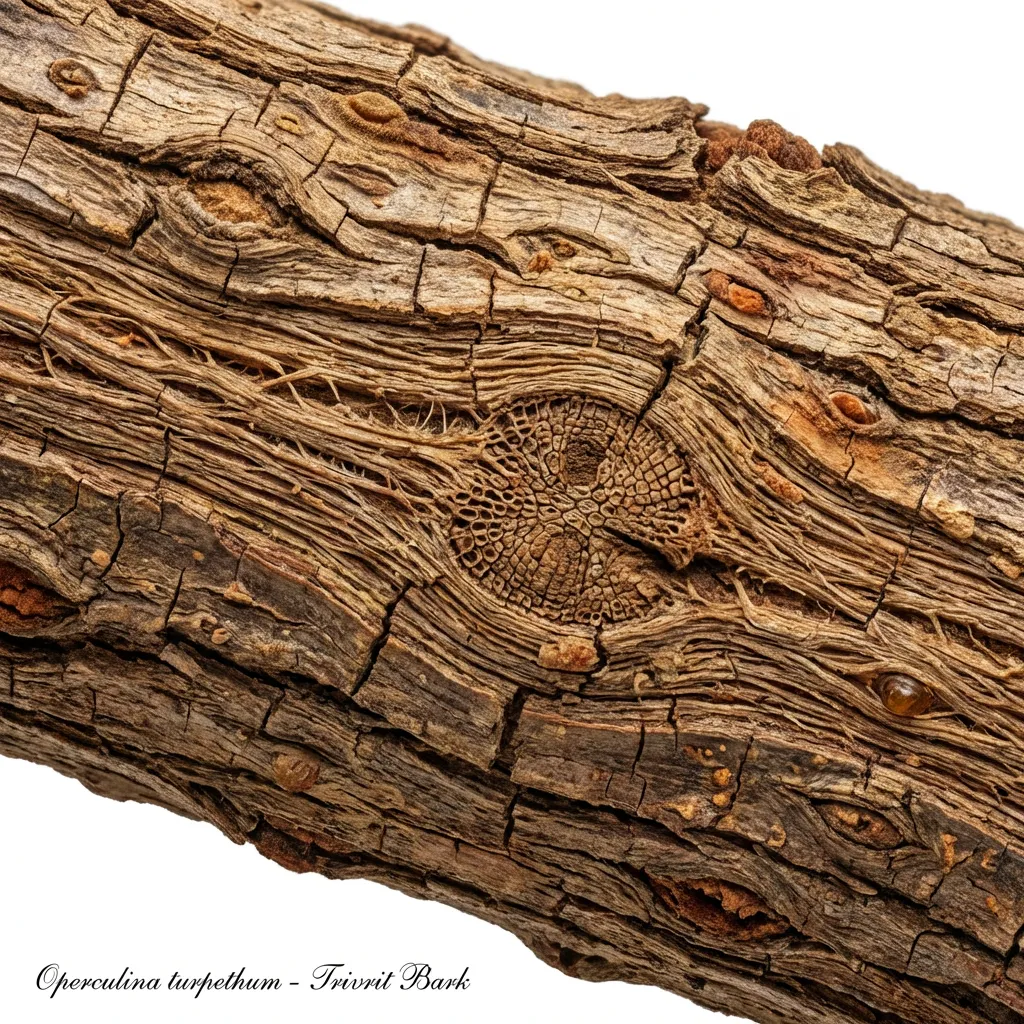
Trivrit, scientifically known as Operculina turpethum, is a remarkable perennial herbaceous twining vine belonging to the Convolvulaceae family, often referred to as the morning glory family. This vigorous climber can ascend to heights of up to 4 meters, characterized by its distinctive triangular stem, which is thought to be the origin of its Sanskrit name 'Trivrit' (meaning three-veined or three-angled). Its leaves are typically ovate to elliptic, ranging from 5 to 15 cm in length, featuring a smooth, glossy green surface and a pointed apex, aiding its climbing habit.
The plant produces striking funnel-shaped flowers, approximately 3-5 cm in diameter, borne in axillary clusters. These blooms exhibit a pale yellow or white hue, often with delicate purple veining, making them attractive to various pollinators. The thick, fleshy roots are the primary medicinal part, possessing a characteristic rough texture.
Operculina turpethum is native to the tropical regions of India but its distribution extends widely across tropical America, Pakistan, Sri Lanka, China, the Philippines, Bangladesh, Madagascar, Mauritania, and Africa. It thrives in well-drained, sandy soils found in scrublands, open woodlands, and even along roadsides, adapting well to warm climates with ample sunlight and moderate humidity. Taxonomically, it shares its family with other well-known species such as bindweeds (Convolvulus) and various morning glories (Ipomoea).
Trusted Scientific References
1. Authoritative external sources for Operculina turpethum
1.1 Wikipedia — Operculina turpethum
1.2 Kew POWO (Plants of the World Online)
1.3 PubMed — peer-reviewed research
1.4 NCBI Taxonomy Browser
1.5 GBIF — Global Biodiversity
1.6Trivrit should be interpreted through verified botanical identity, practical care, and responsible safety language. This recovery note adds the missing context needed for a complete profile: match light to the plant's habit, use well-drained soil, water according to season, and avoid unsupported medicinal or edible claims. For publishing, the plant can be presented as a source-backed medicinal plant with clear care guidance, common problem diagnosis, and conservative safety wording.
1.1.Trivrit — Distinguishing Points
- ✓Botanical Name — Operculina turpethum (Linn.) Silva Manso, also known by its older synonym Convolvulus turpethum.
- ✓Common Name — Trivrit, Indian Jalap, Turpeth Root, Nishoth, Pitohri.
- ✓Family — Convolvulaceae, recognized for its twining herbaceous vines.
- ✓Medicinal Part — Primarily the thick, fleshy, rough-textured roots.
- ✓Key Action — Functions as a powerful purgative, detoxifier, and anti-inflammatory agent.
- ✓Traditional Uses — Integral to Ayurvedic, Unani, and Siddha systems for digestive and dermatological issues.
- ✓Active Compounds — Contains turpethin (glycosidic resin), operculinosides (saponins), beta-sitosterol, and scopoletin.
- ✓Habitat — Thrives in tropical scrublands, open woodlands, and roadsides across several continents.
- ✓Growth Habit — A perennial, herbaceous, vigorous twining vine capable of reaching significant heights.
- ✓Distinctive Feature — Characterized by a triangular stem, a feature referenced in its Sanskrit name 'Trivrit'.
1.2.Trivrit — At-a-Glance Summary
- ✓Potent Ayurvedic purgative and detoxifier, central to traditional medicine.
- ✓The thick, fleshy roots of Operculina turpethum are the primary medicinal part.
- ✓Rich in glycosidic resins (turpethin), saponins (operculinosides), and triterpenoids.
- ✓Traditionally used for severe constipation, liver support, skin ailments, and inflammation.
- ✓Requires careful dosing and professional guidance due to its strong laxative action.
- ✓Native to tropical regions across the globe, often cultivated for its therapeutic properties.
2.Trivrit — Scientific Identity
3.Trivrit — Fact Sheet
4.Trivrit — Botanical Description
5.Trivrit — Origin & Spread
6.Trivrit — Traditional Uses
7.Trivrit — Chemical Profile
- ✓Glycosidic Resins — The root bark is rich in glycosidic resins, prominently featuring alpha- and beta-turpethein, which are the primary active compounds responsible for its potent purgative action.
- ✓Saponins — Contains a variety of saponins, including unique dammarane-type saponins known as operculinosides A-D, which have demonstrated significant hepatoprotective activities.
- ✓Triterpenoids — Key triterpenoids such as cycloartenol, lupeol, and betulin are present, contributing to its anti-inflammatory, antioxidant, and potential cytotoxic effects.
- ✓Sterols — Phytosterols like beta-sitosterol, stigma-5,22dien-3-O-β-D-glucopyranoside, and 22,23-dihydro-α-spinosterol-β-D-glucoside are found, offering diverse biological activities.
- ✓Flavonoids — A range of flavonoids are present, imparting antioxidant, anti-inflammatory, and protective cellular functions.
- ✓Coumarins — Scopoletin is a notable coumarin found in Trivrit, recognized for its anti-inflammatory and analgesic properties.
- ✓Phenolic Acids — Includes salicylic acid, which contributes to the plant's anti-inflammatory and pain-relieving characteristics.
- ✓Turpethinic Acids — A series of turpethinic acids (A, B, C, D, and E) are isolated from the roots, further enhancing its laxative and other pharmacological effects.
- ✓Carbohydrates — Simple sugars like glucose and fructose are present, providing basic nutritional components.
- ✓Essential Oils — Small amounts of essential oils contribute to the plant's characteristic aroma and may possess mild antimicrobial properties.
8.Trivrit — Evidence-Based Benefits
- ✓Potent Purgative & Laxative — Trivrit is renowned for its strong purgative action, effectively relieving chronic constipation by stimulating bowel movements, primarily due to its glycosidic resins.
- ✓Digestive Aid — Beyond purgation, it helps alleviate flatulence, addresses anorexia, and supports overall digestive health, making it a key ingredient in Ayurvedic formulations like Avipattikar Churna.
- ✓Detoxification & Liver Support — Possessing hepatoprotective properties, Operculina turpethum aids in detoxifying the body and supports liver function, beneficial in conditions like jaundice.
- ✓Anti-inflammatory & Analgesic — Its rich phytochemical profile, including coumarins and triterpenoids, contributes to significant anti-inflammatory and pain-relieving effects, useful in conditions such as arthritis and gout.
- ✓Antimicrobial Properties — Extracts from the plant, particularly the stem, have demonstrated antibacterial activity, contributing to its traditional use in managing various infections.
- ✓Dermatological Applications — Traditionally employed for a range of skin disorders including vitiligo, herpes, and ulcers, promoting healing and reducing skin irritations.
- ✓Anthelmintic Activity — The plant is effective in expelling parasitic worms from the intestines, making it a valuable natural anthelmintic agent.
- ✓Diuretic & Anti-edematous — By promoting the excretion of excess fluids, Trivrit helps manage edema and ascites, supporting fluid balance within the body.
- ✓Metabolic Support — It has been traditionally used in managing obesity and shows potential antidiabetic properties, supporting metabolic health.
- ✓Respiratory Health — Beneficial in addressing respiratory conditions such as bronchitis, aiding in clearing airways and reducing inflammation.
- ✓Anti-tumor/Cytotoxic Potential — Traditional texts mention its use against tumors, and modern research indicates certain compounds possess cytotoxic properties.
- ✓Ocular Health — The fresh juice of Operculina turpethum leaves is traditionally applied to treat corneal opacity and conjunctivitis.
8.1.Trivrit — Indications & Uses
9.Trivrit — Safety & Side Effects
9.1.Trivrit — Caution Notes
- ✓Excessive Purgation — Due to its potent laxative action, uncontrolled or high doses can lead to severe diarrhea and significant dehydration.
- ✓Abdominal Discomfort — Users may experience abdominal cramping, bloating, and gas, particularly if the dosage is too high or the individual is sensitive.
- ✓Electrolyte Imbalance — Prolonged or excessive use can result in the depletion of vital electrolytes like potassium, leading to serious health complications.
- ✓Nausea and Vomiting — Some individuals may experience gastrointestinal upset, including feelings of nausea and episodes of vomiting.
- ✓Hypotension — In rare cases, severe fluid loss from excessive purgation can contribute to a drop in blood pressure.
- ✓Hypoglycemia — There is a potential for blood sugar levels to drop, especially if used by individuals on antidiabetic medications.
- ✓Allergic Reactions — Sensitive individuals may develop allergic responses, such as skin rashes or respiratory irritation.
9.2.Trivrit — Safety Overview
- ✓Pregnancy and Lactation — Trivrit is strictly contraindicated during pregnancy and lactation due to its potent purgative effects and the absence of established safety data.
- ✓Children and Elderly — Use in children and elderly individuals should be approached with extreme caution and only under the direct supervision of a qualified medical practitioner.
- ✓Gastrointestinal Conditions — Individuals suffering from inflammatory bowel disease, gastric ulcers, intestinal obstruction, or acute abdominal pain should avoid its use.
- ✓Dehydration Risk — Not recommended for individuals who are already dehydrated or prone to fluid and electrolyte imbalances.
- ✓Drug Interactions — May interact with certain medications, including diuretics, corticosteroids, and cardiac glycosides, potentially exacerbating electrolyte disturbances.
- ✓Dosage Adherence — Strict adherence to prescribed dosages by a qualified herbalist or physician is paramount to prevent severe adverse effects.
- ✓Professional Guidance — Always consult a healthcare professional or medical herbalist before incorporating Operculina turpethum into any health regimen.
10.Trivrit — Preparation Methods
- ✓Root Powder — The dried root is commonly ground into a fine powder, which can be ingested with warm water, honey, or ghee, particularly for its purgative effects.
- ✓Decoction — A decoction is prepared by boiling sliced or crushed roots in water, allowing for the extraction of active compounds, then strained and consumed.
- ✓Infusion — For milder applications, dried leaves or finely chopped roots can be steeped in hot water to create a medicinal infusion.
- ✓Ayurvedic Formulations — Trivrit is a vital ingredient in complex polyherbal Ayurvedic preparations, such as Avipattikar Churna, targeting a range of gastrointestinal disorders.
- ✓Topical Paste — Powdered root mixed with water, milk, or specific herbal juices can be applied externally as a paste for various skin conditions.
- ✓Fresh Leaf Juice — The fresh juice extracted from the leaves is traditionally employed for topical application, particularly for ocular health issues like conjunctivitis.
- ✓Herbal Ghee (Ghrita) — Roots are sometimes processed with ghee (clarified butter) to create a medicated ghee, which is believed to enhance bioavailability and temper the harshness of the purgative action.
- ✓Medicinal Oils — Infusions of Trivrit roots in carrier oils are prepared for external massage, traditionally used to alleviate rheumatic pains and inflammation.
11.Trivrit — Cultivation & Care
- ✓Propagation — Trivrit is primarily propagated through seeds or stem cuttings, with stem cuttings being a faster method for establishing new plants.
- ✓Soil Requirements — It thrives best in well-drained, sandy loam soils that are rich in organic matter, ensuring good aeration and nutrient availability.
- ✓Climate & Temperature — A warm, humid tropical climate is ideal for its growth, as the plant is sensitive to frost and cold temperatures.
- ✓Sunlight Exposure — Requires full sunlight exposure for optimal growth, flowering, and development of medicinal compounds in its roots.
- ✓Watering — Moderate and consistent watering is necessary to keep the soil moist but not waterlogged, especially during dry periods.
- ✓Support Structure — As a vigorous twining vine, Operculina turpethum benefits greatly from the provision of trellises, stakes, or other support structures to climb.
- ✓Fertilization — Application of organic fertilizers or well-rotted compost during the growing season can enhance plant vigor and root development.
- ✓Pest Management — While generally robust, routine inspection for common vine pests and diseases is recommended, with organic pest control methods preferred.
Reviewed by the Flora Medical Global Botanical Review Panel
Multi-disciplinary editorial group · Botany · Ethnobotany · Herbal-medicine literature
Who reviewed this: This page was checked by the Flora Medical Global Botanical Review Panel — an in-house editorial group of botany graduates, ethnobotany researchers, and horticulture practitioners who collectively maintain our 7,000+ plant encyclopedia. Meet the team.
Our 4-step verification process
1. Taxonomic verification
Scientific names and synonyms cross-checked against Kew POWO, World Flora Online, and The Plant List.
2. Phytochemical & medicinal cross-reference
Active compounds, traditional uses, and reported activities are cross-referenced with PubMed, USDA Dr. Duke's database, and peer-reviewed ethnobotanical literature.
3. Conservation & distribution check
Distribution, ecology, and conservation status confirmed against GBIF occurrence records and the IUCN Red List.
4. Editorial & safety review
Every entry passes an editorial pass for clarity, originality, and safety notices (toxicity, contraindications, dosage caveats) before publication.
Last reviewed:
Important medical disclaimer: This content is for educational and research purposes only. It is not medical advice and is not a substitute for consultation with a licensed healthcare provider. Do not use any herb to self-treat a medical condition without professional guidance.
Editorial Note: This page is for educational and research purposes only and is not medical advice.
Written by: Flora Medical Global Editorial Team
Reviewed by: Flora Medical Global Botanical Review Panel
Last Updated: June 16, 2026





Trivrit — Comments & Community Reviews
Rate this plant