


Medical Disclaimer: This content is for educational purposes only. It is not medical advice. Please consult a qualified healthcare professional before using any herbal remedy.
Safety Overview
1.Allamanda — Plant Snapshot
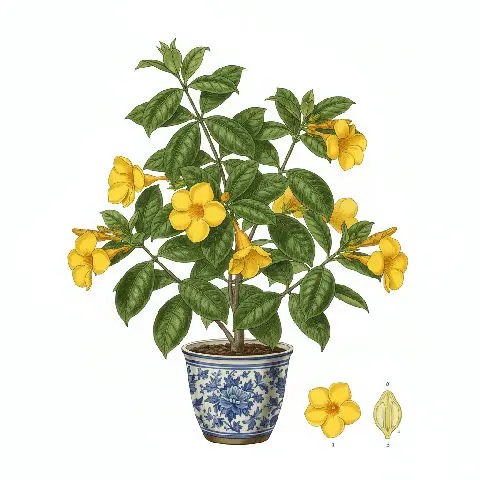
Allamanda cathartica, popularly known as Golden Trumpet, Common Allamanda, or Yellow Bell, is an impressive evergreen woody climber or shrub native to the lush rainforests of Brazil. Esteemed globally for its striking, large, golden-yellow, trumpet-shaped flowers, this member of the Apocynaceae family is a widespread ornamental in tropical and subtropical regions. Botanically, it is characterized by its glossy, dark green leaves, typically arranged in whorls of three or four along its robust stems.
The most captivating feature is undoubtedly its showy, funnel-shaped flowers, which measure approximately 7-12 cm in diameter and bloom profusely from spring through autumn, sometimes extending year-round in ideal climates. After flowering, the plant produces distinctive spiny capsules containing compressed, winged seeds. Allamanda cathartica thrives in environments offering abundant sunlight, warm temperatures, high humidity, and well-drained, fertile soil.
Its vigorous growth habit allows it to reach several meters in height when provided with adequate support, or to form a dense, vibrant shrub if regularly pruned. Historically, its brilliant blooms have symbolized vitality and beauty across various cultures, lending a regal presence to gardens. The species has successfully naturalized across numerous tropical and subtropical areas worldwide, including parts of North, Central, and South America, the Caribbean, Hawaii, India, Southeast Asia, China, and Australia, highlighting its adaptability as an ornamental, despite its inherent toxicity.
Trusted Scientific References
1. Authoritative external sources for Allamanda cathartica
1.1 Wikipedia — Allamanda cathartica
1.2 Kew POWO (Plants of the World Online)
1.3 PubMed — peer-reviewed research
1.4 NCBI Taxonomy Browser
1.5 GBIF — Global Biodiversity
1.6Allamanda should be interpreted through verified botanical identity, practical care, and responsible safety language. This recovery note adds the missing context needed for a complete profile: match light to the plant's habit, use well-drained soil, water according to season, and avoid unsupported medicinal or edible claims. For publishing, the plant can be presented as a source-backed garden plant with clear care guidance, common problem diagnosis, and conservative safety wording.
1.1.Allamanda — Standout Qualities
- ✓Scientific Name — Allamanda cathartica.
- ✓Family — Apocynaceae (Dogbane family).
- ✓Common Names — Golden Trumpet, Common Allamanda, Yellow Bell.
- ✓Native Region — Brazil, South America.
- ✓Key Morphology — Large, bright golden-yellow, trumpet-shaped flowers; glossy, dark green leaves arranged in whorls.
- ✓Medicinal Use — Primarily traditional external applications; internal use is highly toxic and not advised.
- ✓Key Constituents — Iridoid lactones (e.g., allamandin, allamandicin), flavonoids, and triterpenes.
- ✓Pharmacological Actions — Traditional purgative and emetic; studied for antimicrobial, antioxidant, and anti-inflammatory effects.
- ✓Toxicity — All plant parts are highly toxic if ingested, containing cardiac glycosides.
- ✓Ornamental Value — Widely cultivated worldwide for its showy, prolific blooms in tropical and subtropical climates.
1.2.Allamanda — Snapshot Summary
- ✓Golden Trumpet (Allamanda cathartica) is a beautiful ornamental climber from Brazil.
- ✓Traditionally used as a purgative and emetic, and externally for skin conditions.
- ✓Rich in iridoid lactones (e.g., allamandin), flavonoids, and triterpenes.
- ✓Exhibits potential antibacterial, antifungal, and antioxidant properties in research.
- ✓ALL parts are highly toxic if ingested; internal use is not recommended due to severe health risks.
- ✓Requires full sun, well-drained soil, and regular pruning for optimal cultivation.
2.Allamanda — Systematic Position
3.Allamanda — Reference Facts
4.Allamanda — Structural Profile
5.Allamanda — Where It Grows
6.Allamanda — Cultural & Traditional Roles
7.Allamanda — Secondary Metabolites
- ✓Iridoid Lactones — These bitter compounds, such as allamandin, allamandicin, and plumericin, are primarily responsible for the plant's potent purgative, emetic, and cardiotoxic properties, acting on the gastrointestinal and cardiovascular systems.
- ✓Flavonoids — A diverse group of polyphenolic compounds including quercetin and kaempferol derivatives, contributing significantly to the plant's observed antioxidant and anti-inflammatory activities.
- ✓Triterpenes — Compounds like ursolic acid and oleanolic acid are present, known for their anti-inflammatory, antimicrobial, and potential anticancer effects, typically found in the leaves.
- ✓Steroids — Various steroidal compounds are found within the plant, which can influence hormonal pathways and contribute to some of the plant's biological activities, though specific roles are still under investigation.
- ✓Alkaloids — Nitrogen-containing organic compounds, often with potent pharmacological effects, though specific alkaloids in Allamanda cathartica and their precise actions require further elucidation.
- ✓Phenolic Compounds — Beyond flavonoids, other simple phenolics contribute to the plant's broad antioxidant capacity and protection against oxidative stress, found across different plant parts.
- ✓Fatty Acids & Lipids — Essential components of cell membranes, these include various saturated and unsaturated fatty acids, playing roles in plant physiology and potentially in medicinal applications.
- ✓Volatile Compounds — A range of aromatic compounds that contribute to the plant's characteristic scent and may possess antimicrobial or insecticidal properties, particularly in the flowers and leaves.
- ✓Carbohydrates — Sugars and starches forming the structural and energy components of the plant, potentially contributing to overall extract effects and traditional preparations.
8.Allamanda — Research Insights
- ✓Traditional Purgative Action — Historically, preparations from the leaves and bark have been employed in Amazonian traditional medicine to induce strong bowel movements, aiding in detoxification processes, though with extreme caution.
- ✓Traditional Emetic Properties — Indigenous practices have utilized Allamanda cathartica extracts to induce vomiting, a method traditionally used for expelling ingested toxins or as part of ritualistic cleansing.
- ✓Potential Antifungal Activity — Research indicates that phytochemicals within Allamanda cathartica extracts may exhibit inhibitory effects against various fungal pathogens, suggesting a potential for external antifungal applications.
- ✓Demonstrated Antibacterial Efficacy — Studies have explored the plant's capacity to inhibit the growth of certain bacteria, pointing towards its traditional use in managing topical infections of the skin.
- ✓Antioxidant Capacity — The presence of flavonoids and other phenolic compounds contributes to its antioxidant properties, which can help neutralize free radicals and mitigate oxidative stress in cellular models.
- ✓Anti-inflammatory Potential — Preliminary studies suggest that certain constituents may modulate inflammatory pathways, offering a basis for its traditional external use in addressing inflammatory conditions.
- ✓Wound Healing Support (Topical) — Traditionally applied externally for certain skin conditions, its antibacterial and anti-inflammatory properties may contribute to supporting the healing of superficial wounds.
- ✓Traditional Laxative Use — In some folk medicine systems, Allamanda cathartica was sparingly used as a laxative to relieve constipation, though this application is overshadowed by its potent purgative effects and significant toxicity.
- ✓Analgesic Effects (In vitro/Traditional Topical) — Some reports allude to traditional topical application for pain relief, a property that aligns with its observed anti-inflammatory potential in research.
- ✓Insecticidal Properties — Extracts have shown activity against certain insect pests, indicating a potential for natural pest control applications, not for human medicinal use.
8.1.Allamanda — Conditions Traditionally Used For
9.Allamanda — Risk Profile
9.1.Allamanda — Warnings
- ✓Severe Gastrointestinal Distress — Ingestion can cause intense nausea, persistent vomiting, severe abdominal pain, and profuse diarrhea due to its potent purgative and emetic compounds.
- ✓Cardiotoxicity — Contains cardiac glycosides (iridoid lactones) that can disrupt normal heart rhythm and function, potentially leading to serious and life-threatening cardiovascular complications.
- ✓Skin Irritation — Direct contact with the milky sap can cause contact dermatitis, characterized by redness, itching, swelling, and blistering in sensitive individuals.
- ✓Dizziness and Weakness — Systemic absorption of the plant's toxins can lead to generalized weakness, lethargy, dizziness, and a feeling of malaise.
- ✓Central Nervous System Effects — In severe cases of poisoning, neurological symptoms such as confusion, tremors, convulsions, and even paralysis may occur.
- ✓Dehydration and Electrolyte Imbalance — Profuse vomiting and diarrhea resulting from ingestion can lead to severe dehydration and critical disturbances in the body's electrolyte balance.
9.2.Allamanda — Clinical Safety Notes
- ✓Extreme Caution Required — All parts of Allamanda cathartica are considered highly toxic if ingested, posing significant health risks.
- ✓Not for Internal Consumption — Due to the presence of potent cardiac glycosides and other toxic compounds, this plant is generally not safe for internal medicinal use in humans.
- ✓Avoid Skin Contact with Sap — The milky latex sap can cause significant skin irritation, allergic reactions, and dermatitis; always wear protective gloves when handling the plant.
- ✓Keep Away from Children and Pets — Ensure the plant is inaccessible to children and domestic animals who might accidentally ingest it, leading to severe poisoning.
- ✓Contraindicated in Pregnancy and Lactation — Absolutely contraindicated for use by pregnant or breastfeeding individuals due to the high risk of toxicity to both mother and developing child.
- ✓Potential Drug Interactions — Severe interactions may occur with cardiac medications, diuretics, or other drugs affecting electrolyte balance, due to its cardiac glycoside content.
- ✓Consult a Healthcare Professional — Any traditional use or consideration of this plant for medicinal purposes must be discussed with a qualified medical herbalist or physician, strictly for external applications or in controlled research settings.
10.Allamanda — Preparation & Dosage
- ✓Traditional Purgative Decoction — Historically, a decoction made from dried leaves or bark was prepared by boiling plant material in water, then strained and consumed in very small, carefully measured doses for its purgative effects, always with extreme caution due to its toxicity.
- ✓Emetic Infusion — In some indigenous practices, a dilute infusion of the leaves was traditionally prepared to induce vomiting, used under strict traditional supervision for detoxification purposes.
- ✓Topical Poultice for Skin Conditions — Crushed fresh leaves were traditionally applied directly as a poultice to the skin to address certain dermatological issues, such as eczema or fungal infections, leveraging its antimicrobial properties.
- ✓Liniment for Joint Pain (External) — Extracts, often oil-based, were traditionally prepared for external application as a liniment to massage onto painful joints or muscles, drawing on its reputed anti-inflammatory action.
- ✓Insecticidal Spray (Non-Human Contact) — Infusions of leaves can be used as a natural insecticidal spray for garden plants, but direct human or animal contact with the spray should be avoided due to its toxic nature.
- ✓Experimental Extracts for Research — For scientific study, various solvent extractions (e.g., ethanolic, methanolic, aqueous) are performed on leaves, bark, or flowers to isolate specific phytochemicals for in vitro and in vivo pharmacological testing.
11.Allamanda — Growing Guide
- ✓Climate — Thrives in tropical and subtropical regions with warm, humid conditions, intolerant to frost, requiring temperatures above 15°C.
- ✓Sunlight — Requires full sun exposure, ideally at least 6 hours of direct sunlight daily, for optimal growth and abundant flowering.
- ✓Soil — Prefers well-drained, fertile soil with a slightly acidic to neutral pH (6.0-7.0); amend heavy clay soils with organic matter for better drainage.
- ✓Watering — Needs consistent moisture, especially during dry periods; water deeply when the top inch of soil feels dry, but avoid waterlogging to prevent root rot.
- ✓Fertilization — Benefits from regular feeding during the active growing season (spring to autumn) with a balanced liquid fertilizer or a slow-release granular feed.
- ✓Pruning — Requires regular pruning to maintain its desired shape, control vigorous growth, and encourage prolific blooming; prune after a flush of flowers or in late winter/early spring.
- ✓Propagation — Primarily propagated by semi-hardwood stem cuttings taken in spring or early summer, which root readily in warm, humid conditions; can also be grown from seeds.
- ✓Support — As a vigorous climber, it necessitates a sturdy trellis, arbor, or other support structure to allow its vines to ascend and display its beautiful flowers.
Reviewed by the Flora Medical Global Botanical Review Panel
Multi-disciplinary editorial group · Botany · Ethnobotany · Herbal-medicine literature
Who reviewed this: This page was checked by the Flora Medical Global Botanical Review Panel — an in-house editorial group of botany graduates, ethnobotany researchers, and horticulture practitioners who collectively maintain our 7,000+ plant encyclopedia. Meet the team.
Our 4-step verification process
1. Taxonomic verification
Scientific names and synonyms cross-checked against Kew POWO, World Flora Online, and The Plant List.
2. Phytochemical & medicinal cross-reference
Active compounds, traditional uses, and reported activities are cross-referenced with PubMed, USDA Dr. Duke's database, and peer-reviewed ethnobotanical literature.
3. Conservation & distribution check
Distribution, ecology, and conservation status confirmed against GBIF occurrence records and the IUCN Red List.
4. Editorial & safety review
Every entry passes an editorial pass for clarity, originality, and safety notices (toxicity, contraindications, dosage caveats) before publication.
Last reviewed:
Important medical disclaimer: This content is for educational and research purposes only. It is not medical advice and is not a substitute for consultation with a licensed healthcare provider. Do not use any herb to self-treat a medical condition without professional guidance.
Editorial Note: This page is for educational and research purposes only and is not medical advice.
Written by: Flora Medical Global Editorial Team
Reviewed by: Flora Medical Global Botanical Review Panel
Last Updated: June 15, 2026





Allamanda — Comments & Community Reviews
Rate this plant