


Medical Disclaimer: This content is for educational purposes only. It is not medical advice. Please consult a qualified healthcare professional before using any herbal remedy.
Safety Overview
1.Alocasia Portodora — Plant Snapshot
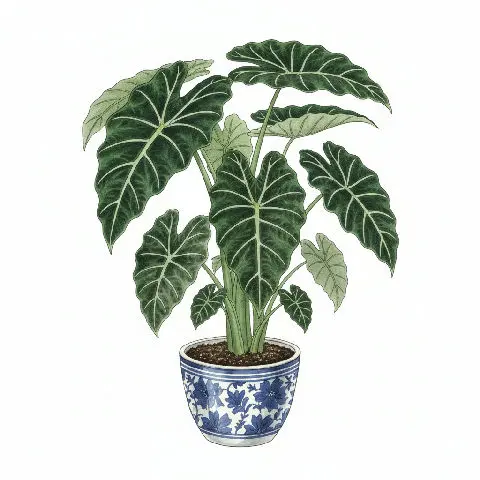
Alocasia 'Portodora' is a magnificent horticultural hybrid within the Araceae family, resulting from a deliberate cross between Alocasia odora and Alocasia portei. This striking cultivar, developed in the late 20th century, is prized for its dramatic architectural presence rather than any naturally occurring wild distribution. It exhibits robust growth, often reaching impressive heights even when cultivated indoors, making it a prominent feature in tropical plant collections.
The plant is characterized by its massive, deeply lobed, and distinctively corrugated leaves, which can extend up to 60-90 cm (2-3 feet) in length. These 'elephant ear' shaped leaves are held aloft on sturdy petioles, which frequently display an attractive purple tinge or speckled pattern, adding to the plant's visual appeal. The adaxial (upper) surface of the leaves is typically a rich, vibrant green with pronounced venation, while the abaxial (lower) surface is often a lighter green, sometimes with a purplish cast.
Alocasia 'Portodora' thrives in environments that replicate its tropical lineage, requiring consistently high humidity, warm temperatures, and bright, indirect light to flourish. Unlike many wild Alocasia species that have ethnobotanical uses, particularly for their starchy corms after extensive detoxification, 'Portodora' itself has no documented history of traditional medicinal or culinary applications, being a relatively recent ornamental creation.
Trusted Scientific References
1. Authoritative external sources for Alocasia portodora
1.1 Wikipedia — Alocasia portodora
1.2 Kew POWO (Plants of the World Online)
1.3 PubMed — peer-reviewed research
1.4 NCBI Taxonomy Browser
1.5 GBIF — Global Biodiversity
1.6Alocasia Portodora should be interpreted through verified botanical identity, practical care, and responsible safety language. This recovery note adds the missing context needed for a complete profile: match light to the plant's habit, use well-drained soil, water according to season, and avoid unsupported medicinal or edible claims. For publishing, the plant can be presented as a source-backed indoor plant with clear care guidance, common problem diagnosis, and conservative safety wording.
1.1.Alocasia Portodora — Key Features
- ✓Striking Architectural Foliage — Characterized by large, deeply lobed, and heavily veined leaves with a corrugated texture.
- ✓Hybrid Origin — A cultivated cross, not a naturally occurring species, developed for ornamental appeal.
- ✓'Elephant Ear' Appearance — Distinctive leaf shape typical of the Alocasia genus, adding a tropical aesthetic.
- ✓Robust Growth Habit — Can achieve substantial size and height, making it a prominent feature in plant displays.
- ✓Purple — Tinged Petioles — Sturdy leaf stalks often exhibit attractive purplish coloration or speckles.
- ✓High Humidity Requirement — Thrives in consistently moist air, typical of its tropical ancestry.
- ✓Toxic if Ingested — Contains calcium oxalate crystals in all tissues, causing severe irritation.
- ✓Ornamental Value — Exclusively grown for its decorative qualities in indoor and outdoor settings.
- ✓Tropical Ambiance Creator — Ideal for adding an exotic, lush feel to any environment.
- ✓Relatively Easy Care — Considered manageable for experienced aroid enthusiasts once its specific environmental needs are met.
1.2.Alocasia Portodora — Snapshot Summary
- ✓Alocasia 'Portodora' is a striking ornamental hybrid, a cross between Alocasia odora and Alocasia portei.
- ✓All parts of the plant contain toxic calcium oxalate crystals, causing irritation and poisoning if ingested.
- ✓This specific hybrid has no documented traditional or modern medicinal uses; it is purely decorative.
- ✓Thrives in tropical conditions — high humidity, warm temperatures, and bright, indirect light.
- ✓Valued for its large, deeply lobed 'elephant ear' leaves and architectural presence.
- ✓Requires careful handling due to its toxicity; keep away from children and pets.
2.Alocasia Portodora — Systematic Position
3.Alocasia Portodora — Quick Facts
4.Alocasia Portodora — Structural Profile
5.Alocasia Portodora — Where It Grows
6.Alocasia Portodora — Ethnobotanical Uses
7.Alocasia Portodora — Active Compounds
- ✓Calcium Oxalate — Abundant in all parts of Alocasia 'Portodora', forming needle-like raphides that cause severe irritation and toxicity upon contact or ingestion.
- ✓Flavonoids — Polyphenolic compounds found in many Alocasia species, often associated with antioxidant and anti-inflammatory activities, though specific profiles for 'Portodora' are not widely studied.
- ✓Saponins — Glycosides potentially present in some Alocasia varieties, which may contribute to expectorant or hemolytic properties in high concentrations, but not confirmed for 'Portodora'.
- ✓Alkaloids — Nitrogen-containing organic compounds that, while less dominant than oxalates, may be present in trace amounts in certain Alocasia species, influencing physiological processes.
- ✓Glycosides — Various types of sugar-bound compounds, including potential cyanogenic glycosides in some aroids, which can release hydrogen cyanide upon hydrolysis, though not specifically identified in 'Portodora'.
- ✓Phenolic Acids — Simple phenolic compounds contributing to antioxidant capacity and often involved in plant defense mechanisms, likely present in 'Portodora' as in other plants.
- ✓Steroids/Triterpenoids — Lipophilic compounds found in many plants, which could potentially possess anti-inflammatory or adaptogenic qualities in some Alocasia species, but unconfirmed for this hybrid.
- ✓Carbohydrates (Starches) — Primarily found in the corms of many Alocasia species, serving as an energy reserve, but only safely consumable after extensive detoxification processes, not applicable to 'Portodora' for consumption.
8.Alocasia Portodora — What Research Suggests
- ✓No Documented Medicinal Benefits for Alocasia 'Portodora' — This specific hybrid cultivar is primarily ornamental and has no established traditional or modern medicinal uses.
- ✓Potential Anti-inflammatory Research (Genus Alocasia) — Some studies on other Alocasia species indicate the presence of compounds with anti-inflammatory properties, suggesting a broader genus-level potential, but not specific to 'Portodora'.
- ✓Antioxidant Properties (Genus Alocasia) — Extracts from various Alocasia species have demonstrated antioxidant activity in laboratory settings, which could protect against cellular damage, though not directly linked to 'Portodora'.
- ✓Traditional Dermatological Use (Other Alocasia Species) — Historically, poultices from specific Alocasia species were used topically for skin conditions, but this requires extreme caution due to high oxalate content and is not applicable to 'Portodora'.
- ✓Antitussive Action (Other Alocasia Species) — In certain traditional medicine systems, highly processed corms of some Alocasia species were employed to alleviate coughs, a practice not associated with 'Portodora'.
- ✓Antipyretic Effects (Other Alocasia Species) — Folk medicine sometimes utilized prepared parts of particular Alocasia species to reduce fever, necessitating careful preparation to neutralize toxins, not relevant for 'Portodora'.
- ✓Carbohydrate Source (Other Alocasia Species) — The corms of numerous Alocasia species serve as a vital starchy food source in tropical regions, but only after rigorous processing to remove toxic calcium oxalate crystals, a use not for 'Portodora'.
- ✓Immunomodulatory Interest (Genus Alocasia) — Preliminary in vitro studies on related Alocasia species have suggested potential effects on the immune system, but human relevance for any Alocasia, especially 'Portodora', is yet to be determined.
8.1.Alocasia Portodora — Therapeutic Indications
9.Alocasia Portodora — Risk Profile
9.1.Alocasia Portodora — Reported Side Effects
- ✓Oral Irritation — Ingestion of any part causes immediate and intense burning, swelling, and pain in the mouth, throat, and digestive tract due to calcium oxalate.
- ✓Skin Irritation — Contact with the plant sap can lead to dermatitis, characterized by itching, redness, and swelling in sensitive individuals.
- ✓Gastrointestinal Distress — Nausea, vomiting, diarrhea, and severe abdominal pain are common symptoms following ingestion.
- ✓Airway Obstruction — In severe cases of ingestion, swelling of the tongue and throat can occur, potentially leading to difficulty breathing and requiring urgent medical intervention.
- ✓Ocular Irritation — Accidental contact with eyes can cause severe pain, redness, tearing, and temporary vision impairment.
- ✓Pet Toxicity — Highly toxic to pets; ingestion can cause similar symptoms of oral irritation, vomiting, and difficulty swallowing.
9.2.Alocasia Portodora — Safety Overview
- ✓Highly Toxic Plant — All parts of Alocasia 'Portodora' are considered toxic if ingested, primarily due to insoluble calcium oxalate crystals.
- ✓Keep Away from Children and Pets — It is crucial to position this plant out of reach of curious children and animals to prevent accidental ingestion.
- ✓Wear Protective Gloves — Always wear gloves when handling the plant, especially during repotting, pruning, or cleaning, to avoid skin irritation from the sap.
- ✓Avoid Eye Contact — Exercise extreme caution to prevent plant sap from coming into contact with eyes; rinse thoroughly with water and seek medical attention if exposed.
- ✓No Medicinal or Culinary Use — This plant is strictly for ornamental purposes and has no known safe applications in herbal medicine or food preparation.
- ✓Immediate Medical Attention — In case of ingestion or severe contact reactions, promptly contact a poison control center or seek emergency medical care.
- ✓Proper Disposal — Dispose of plant trimmings and waste carefully to prevent accidental exposure to humans or animals.
10.Alocasia Portodora — How to Use
- ✓Ornamental Display — Alocasia 'Portodora' is cultivated exclusively for its striking foliage and architectural form, serving as a decorative houseplant or tropical garden specimen.
- ✓No Internal Use — Absolutely no part of Alocasia 'Portodora' should be ingested due to its high concentration of toxic calcium oxalate crystals.
- ✓No Topical Application — Direct skin contact with the sap can cause irritation, and therefore it should not be used in topical preparations.
- ✓Horticultural Specimen — Its primary 'use' is its aesthetic contribution to indoor spaces, conservatories, or shaded outdoor tropical landscapes.
- ✓Avoid Traditional Preparations — Unlike some wild Alocasia species, 'Portodora' has no history of safe traditional medicinal or culinary preparation methods.
- ✓Handle with Care — When repotting or pruning, wear gloves to prevent skin irritation from the sap.
- ✓Educational Display — Can be used in botanical gardens or educational settings to showcase plant diversity and hybrid vigor.
11.Alocasia Portodora — Growth Requirements
- ✓Light — Prefers bright, indirect light; direct sunlight can scorch the large, delicate leaves of Alocasia 'Portodora'.
- ✓Watering — Keep the soil consistently moist but never waterlogged; allow the top inch of soil to dry out slightly between waterings.
- ✓Humidity — Requires high humidity, ideally between 60-80%; regular misting, a pebble tray, or a humidifier is recommended.
- ✓Temperature — Thrives in warm temperatures, optimally between 18-29°C (65-85°F); avoid exposure to cold drafts or temperatures below 15°C (60°F).
- ✓Soil — Use a well-draining, airy, and rich potting mix, typically incorporating components like perlite, orchid bark, coco coir, or peat moss.
- ✓Fertilization — Feed monthly during the active growing season (spring and summer) with a balanced liquid fertilizer diluted to half strength.
- ✓Propagation — Primarily propagated by dividing rhizomes or separating cormlets during repotting, ensuring each division has roots and a growth point.
- ✓Pests — Monitor regularly for common houseplant pests such as spider mites, mealybugs, and aphids, especially under dry conditions.
Reviewed by the Flora Medical Global Botanical Review Panel
Multi-disciplinary editorial group · Botany · Ethnobotany · Herbal-medicine literature
Who reviewed this: This page was checked by the Flora Medical Global Botanical Review Panel — an in-house editorial group of botany graduates, ethnobotany researchers, and horticulture practitioners who collectively maintain our 7,000+ plant encyclopedia. Meet the team.
Our 4-step verification process
1. Taxonomic verification
Scientific names and synonyms cross-checked against Kew POWO, World Flora Online, and The Plant List.
2. Phytochemical & medicinal cross-reference
Active compounds, traditional uses, and reported activities are cross-referenced with PubMed, USDA Dr. Duke's database, and peer-reviewed ethnobotanical literature.
3. Conservation & distribution check
Distribution, ecology, and conservation status confirmed against GBIF occurrence records and the IUCN Red List.
4. Editorial & safety review
Every entry passes an editorial pass for clarity, originality, and safety notices (toxicity, contraindications, dosage caveats) before publication.
Last reviewed:
Important medical disclaimer: This content is for educational and research purposes only. It is not medical advice and is not a substitute for consultation with a licensed healthcare provider. Do not use any herb to self-treat a medical condition without professional guidance.
Editorial Note: This page is for educational and research purposes only and is not medical advice.
Written by: Flora Medical Global Editorial Team
Reviewed by: Flora Medical Global Botanical Review Panel
Last Updated: June 15, 2026





Alocasia Portodora — Comments & Community Reviews
Rate this plant