
Medical Disclaimer: This content is for educational purposes only. It is not medical advice. Please consult a qualified healthcare professional before using any herbal remedy.
Safety Overview
1.Alocasia Stingray — At a Glance
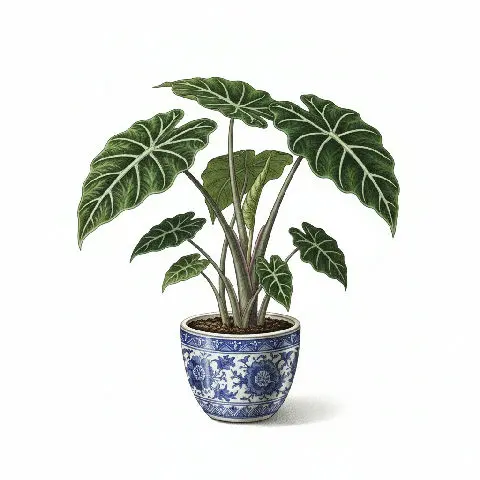
The Alocasia macrorrhiza 'Stingray', commonly known as Alocasia Stingray, stands as a distinctive and highly prized cultivar within the Araceae family. This unique plant is a horticultural derivative of the broader Alocasia macrorrhiza species, which naturally inhabits the lush tropical and subtropical rainforests of Southeast Asia and eastern Australia. Its 'Stingray' epithet is a direct homage to the remarkable and unmistakable shape of its foliage.
Unlike the expansive, elephant ear-like leaves typical of its parent species, the Alocasia Stingray showcases elongated, deeply sagittate leaves that dramatically narrow to a pointed, almost caudal apex, strikingly resembling the marine creature. These deep green, somewhat glossy leaves are further accentuated by prominent, often darker veins, enhancing its unique aesthetic. The plant develops robust, upright petioles, which can exhibit subtle purplish or reddish tones, contributing to its overall ornamental appeal.
While the 'Stingray' cultivar itself is a modern development, the wild Alocasia species, including A. macrorrhiza, have a rich history in traditional medicine systems such as Ayurveda, Traditional Chinese Medicine (TCM), and Unani, where their bioactives have been historically utilized. In contemporary settings, the Alocasia Stingray is exclusively cherished for its striking visual characteristics, serving as a captivating focal point in indoor plant collections and tropical landscape designs, reflecting its primary cultural significance as a decorative specimen.
Trusted Scientific References
1. Authoritative external sources for Alocasia macrorrhiza Stingray
1.1 Wikipedia — Alocasia macrorrhiza Stingray
1.2 Kew POWO (Plants of the World Online)
1.3 PubMed — peer-reviewed research
1.4 NCBI Taxonomy Browser
1.5 GBIF — Global Biodiversity
1.6Alocasia Stingray should be interpreted through verified botanical identity, practical care, and responsible safety language. This recovery note adds the missing context needed for a complete profile: match light to the plant's habit, use well-drained soil, water according to season, and avoid unsupported medicinal or edible claims. For publishing, the plant can be presented as a source-backed indoor plant with clear care guidance, common problem diagnosis, and conservative safety wording.
1.1.Alocasia Stingray — Highlights
- ✓Unique Leaf Morphology — Distinctive elongated, sagittate leaves tapering to a pointed tail-like apex, resembling a stingray.
- ✓Ornamental Value — Highly sought after as an exotic houseplant and tropical garden specimen for its striking aesthetics.
- ✓Tropical Origin — Derived from a species native to the rainforests of Southeast Asia and eastern Australia.
- ✓Deep Green Foliage — Glossy, deep green leaves often with contrasting darker, prominent veins.
- ✓Upright Growth Habit — Develops sturdy, upright petioles that can reach significant heights, supporting the large leaves.
- ✓Traditional Medicinal History — Its parent species, Alocasia macrorrhiza, has a long history of use in traditional Asian medicine systems.
- ✓Calcium Oxalate Content — Contains irritating calcium oxalate crystals in all tissues, making it toxic if ingested raw.
- ✓High Humidity Requirement — Thrives in environments with consistently high humidity, typical of its native rainforest habitat.
- ✓Corm — forming Perennial — Grows from underground corms, which can also be used for propagation.
- ✓Indirect Light Preference — Best suited for bright, indirect light conditions, avoiding harsh direct sun that can burn leaves.
1.2.Alocasia Stingray — Concise Overview
- ✓Alocasia Stingray is a unique ornamental cultivar of Alocasia macrorrhiza.
- ✓Features distinctive, stingray-shaped leaves, prized for its aesthetic appeal.
- ✓Parent species, Alocasia macrorrhiza, has traditional medicinal uses (anti-inflammatory, detoxifying).
- ✓All parts contain toxic calcium oxalate crystals, requiring extreme caution and proper processing for any traditional use.
- ✓Thrives in warm, humid conditions with bright, indirect light as an indoor plant.
- ✓Primarily cultivated for its striking appearance in modern horticulture, not for medicinal self-treatment.
2.Alocasia Stingray — Scientific Identity
3.Alocasia Stingray — Vital Statistics
4.Alocasia Stingray — Physical Description
5.Alocasia Stingray — Native Range & Habitat
6.Alocasia Stingray — Folk Medicine Applications
7.Alocasia Stingray — Key Phytochemicals
- ✓Calcium Oxalate — Abundant in all plant parts, forming needle-like raphides and druses, responsible for the plant's immediate irritant and toxic effects upon ingestion or contact.
- ✓Flavonoids — Compounds such as quercetin and kaempferol are present, known for their antioxidant, anti-inflammatory, and potentially anti-allergic properties.
- ✓Saponins — Triterpenoid saponins have been identified, contributing to traditional anti-inflammatory actions and exhibiting hemolytic properties.
- ✓Alkaloids — Various nitrogen-containing compounds are present, which can have diverse pharmacological activities, including analgesic or anti-inflammatory effects.
- ✓Phenolic Acids — Derivatives like caffeic acid and ferulic acid contribute to the plant's antioxidant capacity and may possess anti-inflammatory actions.
- ✓Polysaccharides — Found particularly in the tubers, these complex carbohydrates provide nutritional value (after processing) and can have immunomodulatory effects.
- ✓Steroids/Phytosterols — Compounds like beta-sitosterol are present, which are recognized for their anti-inflammatory and cholesterol-lowering potential.
- ✓Lectins — Certain proteins with carbohydrate-binding specificities may be present, potentially influencing immune responses or cellular interactions.
- ✓Glycosides — Various compounds linked to sugar molecules, which can contribute to a range of therapeutic actions once metabolized in the body.
- ✓Tannins — Astringent compounds that can provide antioxidant benefits and may contribute to wound healing and anti-inflammatory effects.
- ✓Anthraquinones — Compounds that can have laxative, antimicrobial, and anti-inflammatory properties, though less prominent in Alocasia.
- ✓Fatty Acids — Essential fatty acids and other lipids are present in varying concentrations, supporting cellular health and metabolic functions.
8.Alocasia Stingray — Scientific Evidence
- ✓Anti-inflammatory — Traditional uses of Alocasia macrorrhiza suggest efficacy in reducing swelling and pain, attributed to compounds like flavonoids and saponins.
- ✓Detoxifying Agent — Historically employed in traditional systems like Ayurveda for its perceived ability to cleanse the body and neutralize toxins.
- ✓Wound Healing — Poultices prepared from processed plant parts of the parent species have been traditionally applied to promote the healing of minor cuts and abrasions.
- ✓Skin Irritation Relief — Used topically in some traditional practices to soothe various skin irritations, insect bites, and rashes, due to its potential anti-inflammatory action.
- ✓Antipyretic Properties — Traditional medicine records indicate its use in managing fevers, suggesting a potential role in temperature regulation.
- ✓Analgesic Effects — Extracts from Alocasia macrorrhiza have been traditionally applied or consumed (after proper processing) for pain relief, particularly for rheumatism and joint discomfort.
- ✓Antimicrobial Potential — Preliminary research on the parent species indicates the presence of compounds with potential antimicrobial activity against certain pathogens.
- ✓Digestive Aid — In some traditional systems, carefully processed tubers were used to support digestive health, though this requires extreme caution due to toxicity.
- ✓Anti-venom (Traditional) — Historically applied as a folk remedy for snake bites, believed to help draw out venom, though modern medical intervention is always critical.
- ✓Antioxidant Activity — Phytochemical analysis suggests the presence of antioxidant compounds like flavonoids that can combat oxidative stress in the body.
- ✓Diuretic Action — Traditional applications sometimes include its use to promote urination, potentially aiding in fluid balance and toxin elimination.
- ✓Boils and Abscesses Treatment — Traditionally, processed leaves or rhizomes were used as poultices to treat boils and abscesses, assisting in drawing out impurities.
8.1.Alocasia Stingray — Reported Uses
9.Alocasia Stingray — Safety & Side Effects
9.1.Alocasia Stingray — Reported Side Effects
- ✓Oral Irritation — Immediate intense burning sensation and swelling of the mouth, tongue, and throat upon contact with raw plant material.
- ✓Digestive Upset — Ingestion can lead to severe nausea, vomiting, abdominal pain, and diarrhea due to calcium oxalate.
- ✓Skin Dermatitis — Direct contact with the sap or raw plant surfaces can cause skin irritation, redness, itching, and swelling.
- ✓Respiratory Distress — Severe swelling of the throat can potentially lead to difficulty breathing or airway obstruction in sensitive individuals.
- ✓Kidney Damage — Large quantities of raw plant material, if ingested, may cause kidney damage due though calcium oxalate accumulation.
- ✓Eye Irritation — Contact with eyes can cause severe pain, redness, and temporary vision impairment.
- ✓Toxicity to Pets — Highly toxic to cats, dogs, and other animals, causing similar oral and gastrointestinal symptoms upon ingestion.
9.2.Alocasia Stingray — Risk Assessment
- ✓Never Consume Raw — All parts of Alocasia Stingray are toxic when raw due to calcium oxalate crystals; never ingest without extensive processing.
- ✓Proper Processing Essential — If considering traditional medicinal use of the parent species' tubers, thorough and specific cooking methods are critical to neutralize toxins.
- ✓Keep Out of Reach — Position plants away from children and pets to prevent accidental ingestion or contact, which can cause severe irritation.
- ✓Avoid Skin Contact — Wear gloves when handling raw plant material, especially if harvesting or pruning, to prevent skin irritation from the sap.
- ✓Consult Professionals — Always seek advice from a medical professional or qualified herbalist before any internal use of Alocasia species.
- ✓Pregnant/Nursing Caution — Pregnant and nursing individuals should strictly avoid all forms of Alocasia consumption or topical application.
- ✓Kidney Conditions — Individuals with kidney disease or a history of kidney stones should avoid contact or ingestion due to oxalate content.
- ✓Allergic Reactions — Be aware of potential allergic reactions in sensitive individuals, even from processed material.
10.Alocasia Stingray — Preparations & Uses
- ✓Topical Poultice — Traditionally, processed and detoxified leaves or rhizomes of Alocasia macrorrhiza were crushed and applied as poultices for skin irritations, insect bites, and minor wounds.
- ✓Internal Decoction (Caution) — In ancient medicinal systems, highly processed and thoroughly cooked tubers or rhizomes were prepared as decoctions for internal ailments, always with extreme caution due to inherent toxicity.
- ✓Food Source (Processed Tubers) — The starchy tubers of the parent species, after extensive processing (boiling, fermentation, drying) to neutralize calcium oxalate, served as a famine food in some indigenous cultures.
- ✓Traditional Detoxification Preparations — Certain traditional remedies involved specific processing methods to utilize the plant's perceived detoxifying properties, usually involving cooking or prolonged soaking.
- ✓Ornamental Display — The primary and safest modern usage of Alocasia Stingray is as an indoor ornamental plant, cherished for its unique aesthetic appeal.
- ✓External Anti-inflammatory Pack — Crushed and cooked plant material was traditionally used as a warm compress to reduce localized swelling and inflammation.
- ✓Ritualistic Use — In some cultures, Alocasia species hold symbolic significance and are used in traditional rituals, though not for direct medicinal consumption.
- ✓Pest Control (Traditional) — Certain plant parts were historically processed and used in indigenous practices to deter pests from crops, due to their irritant properties.
11.Alocasia Stingray — Garden Cultivation
- ✓Light — Provide bright, indirect light; direct sunlight will scorch the distinctive leaves of Alocasia Stingray.
- ✓Soil — Use a rich, well-draining, slightly acidic potting mix, ideally composed of perlite, potting soil, and coco peat.
- ✓Watering — Maintain consistent moisture, allowing the top inch of soil to dry slightly between waterings, but avoid waterlogging.
- ✓Temperature — Keep temperatures consistently above 15°C (59°F), as this tropical plant thrives in warm environments.
- ✓Humidity — Ensure high humidity levels; consider a humidifier or pebble tray in dry indoor conditions to prevent leaf crisping.
- ✓Fertilizer — Feed twice monthly during spring and summer with a balanced liquid houseplant fertilizer; cease fertilization in fall and winter.
- ✓Propagation — Easily propagated by dividing offshoots or by carefully growing corms found around the root system.
- ✓Repotting — Repot every 1-2 years in spring or summer, choosing a pot only 2-4 inches larger to prevent overwatering.
Reviewed by the Flora Medical Global Botanical Review Panel
Multi-disciplinary editorial group · Botany · Ethnobotany · Herbal-medicine literature
Who reviewed this: This page was checked by the Flora Medical Global Botanical Review Panel — an in-house editorial group of botany graduates, ethnobotany researchers, and horticulture practitioners who collectively maintain our 7,000+ plant encyclopedia. Meet the team.
Our 4-step verification process
1. Taxonomic verification
Scientific names and synonyms cross-checked against Kew POWO, World Flora Online, and The Plant List.
2. Phytochemical & medicinal cross-reference
Active compounds, traditional uses, and reported activities are cross-referenced with PubMed, USDA Dr. Duke's database, and peer-reviewed ethnobotanical literature.
3. Conservation & distribution check
Distribution, ecology, and conservation status confirmed against GBIF occurrence records and the IUCN Red List.
4. Editorial & safety review
Every entry passes an editorial pass for clarity, originality, and safety notices (toxicity, contraindications, dosage caveats) before publication.
Last reviewed:
Important medical disclaimer: This content is for educational and research purposes only. It is not medical advice and is not a substitute for consultation with a licensed healthcare provider. Do not use any herb to self-treat a medical condition without professional guidance.
Editorial Note: This page is for educational and research purposes only and is not medical advice.
Written by: Flora Medical Global Editorial Team
Reviewed by: Flora Medical Global Botanical Review Panel
Last Updated: June 15, 2026





Alocasia Stingray — Comments & Community Reviews
Rate this plant