


Medical Disclaimer: This content is for educational purposes only. It is not medical advice. Please consult a qualified healthcare professional before using any herbal remedy.
Safety Overview
1.Alocasia Wentii — At a Glance
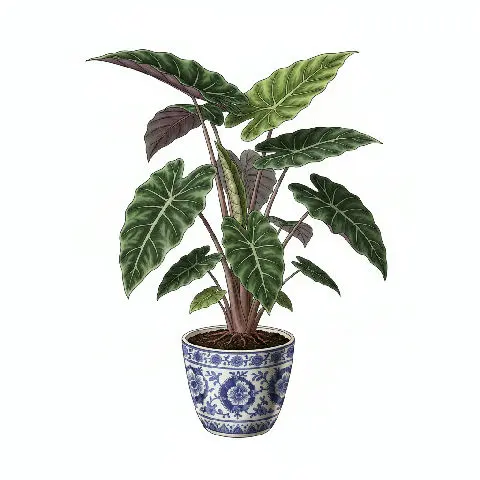
Alocasia wentii, commonly known as the 'New Guinea Shield' or 'Hardy Alocasia', is a striking hybrid cultivar belonging to the Araceae family, a lineage celebrated for its diverse and often dramatic foliage. While its precise native origin is complex due to its hybrid nature, Alocasia species generally thrive in the tropical and subtropical regions of Asia, eastern Australia, and the South Pacific islands. Alocasia wentii is believed to be a cross, potentially involving Alocasia odora and other species, though its exact parentage continues to be a subject of botanical discussion. This plant is highly prized for its distinctive bicolored leaves, which feature a deep, lustrous green on the adaxial (upper) surface and a rich, metallic purplish-bronze on the abaxial (lower) surface.
These broad, arrowhead-shaped leaves can grow substantially, often reaching 30-40 cm in length, supported by robust petioles that emerge directly from a subterranean corm. Unlike some Alocasia species known for their challenging care, A. wentii is valued for its relative ease of cultivation and its enhanced resilience to slightly cooler temperatures, earning it the 'hardy' descriptor. From a pharmacological standpoint, it is crucial to note that all parts of Alocasia wentii contain insoluble calcium oxalate crystals, rendering them highly toxic if ingested.
This inherent toxicity means that Alocasia wentii is not traditionally used in established medicinal systems like Ayurveda, TCM, Unani, or Siddha for internal applications. While other Alocasia species, such as Alocasia macrorrhizos (Giant Taro), have seen limited external traditional use for conditions like swellings, this is always with extreme caution and does not apply to Alocasia wentii for internal consumption.
Trusted Scientific References
1. Authoritative external sources for Alocasia wentii
1.1 Wikipedia — Alocasia wentii
1.2 Kew POWO (Plants of the World Online)
1.3 PubMed — peer-reviewed research
1.4 NCBI Taxonomy Browser
1.5 GBIF — Global Biodiversity
1.1.Alocasia Wentii — Notable Characteristics
- ✓Botanical Name — Alocasia wentii.
- ✓Common Names — New Guinea Shield, Hardy Elephant Ear.
- ✓Family — Araceae.
- ✓Distinctive Foliage — Bicolored leaves: deep green upper, metallic purplish-bronze lower.
- ✓High Toxicity — Contains calcium oxalate crystals, rendering all parts toxic if ingested.
- ✓Ornamental Value — Highly prized as an indoor houseplant and for tropical garden landscaping.
- ✓Growth Habit — Can reach up to 5 feet tall indoors, larger outdoors, growing from a subterranean corm.
- ✓Care Level — Considered relatively easier to care for than many other Alocasia species.
- ✓Humidity Lover — Thrives in environments with high ambient humidity.
- ✓Propagation Method — Primarily propagated by division of rhizomes or separation of corm offsets.
1.2.Alocasia Wentii — At-a-Glance Summary
- ✓Alocasia wentii is a stunning tropical hybrid, known for its distinctive bicolored, arrowhead-shaped foliage.
- ✓All parts of the plant are highly toxic due to the presence of insoluble calcium oxalate crystals.
- ✓Primarily cultivated as an ornamental houseplant or for tropical garden aesthetics, not for medicinal purposes.
- ✓Requires bright, indirect light, consistently moist soil, and high humidity for optimal growth.
- ✓It is not traditionally or currently used in herbal medicine internally due to its potent toxicity.
- ✓Handling should always be done with caution, including wearing gloves, to prevent skin irritation.
2.Alocasia Wentii — Scientific Identity
3.Alocasia Wentii — Key Data
4.Alocasia Wentii — Botanical Features
5.Alocasia Wentii — Ecological Habitat
6.Alocasia Wentii — Folk Medicine Applications
7.Alocasia Wentii — Phytochemistry
- ✓Calcium Oxalate — Present as insoluble raphides in idioblasts throughout all plant parts, causing severe mechanical irritation and toxicity upon ingestion or contact.
- ✓Flavonoids — Potentially present in leaves, typically exhibiting antioxidant and anti-inflammatory properties in other plant species, though not therapeutically applicable for Alocasia wentii.
- ✓Saponins — Hypothetically found in some Alocasia species, these glycosides can have detergent-like properties and varying biological activities, but specific presence and action in A. wentii are unconfirmed.
- ✓Phenolic Acids — Common plant secondary metabolites, potentially present, contributing to plant defense and offering antioxidant capacity, though not for direct medicinal use in A. wentii.
- ✓Alkaloids — Some members of the Araceae family contain alkaloids; their specific presence and concentration in Alocasia wentii remain largely uncharacterized, but could contribute to plant defense.
- ✓Glycosides — Various glycosidic compounds might be present, playing roles in plant metabolism and defense, but their medicinal relevance for A. wentii is negated by its toxicity.
- ✓Proteins and Enzymes — Essential for plant life processes, these include enzymes involved in metabolic pathways and structural proteins, some of which may contribute to the plant's defense mechanisms.
- ✓Carbohydrates — Starch and other sugars are present in the corms and other tissues, serving as energy reserves for the plant.
8.Alocasia Wentii — Scientific Evidence
- ✓Ornamental Value — The aesthetic appeal of Alocasia wentii, with its vibrant foliage, can contribute to psychological well-being and enhance the ambiance of indoor spaces.
- ✓Ethnobotanical Study — While Alocasia wentii itself is toxic, its study provides insight into the historical and cultural external uses of related Alocasia species in traditional medicine systems.
- ✓Phytochemical Research Potential — The Araceae family is known for diverse secondary metabolites; researching these in Alocasia wentii could theoretically yield compounds with future industrial or pharmaceutical applications, after detoxification or synthesis.
- ✓Plant Defense Mechanisms — The presence of calcium oxalate crystals in Alocasia wentii offers a valuable model for understanding plant self-defense strategies and associated biochemical pathways.
- ✓Air Quality Contribution (General) — As with many houseplants, Alocasia wentii may contribute modestly to improving indoor air quality through photosynthesis and minor pollutant absorption, though this is not a primary medicinal benefit.
- ✓Educational Resource — Alocasia wentii serves as an excellent botanical specimen for studying tropical plant morphology, hybrid characteristics, and specialized plant care.
- ✓Biomineralization Research — The unique formation and structure of calcium oxalate crystals in Alocasia wentii are subjects of scientific interest for understanding biomineralization processes in plants.
8.1.Alocasia Wentii — Indications & Uses
9.Alocasia Wentii — Safety Considerations
9.1.Alocasia Wentii — Possible Adverse Reactions
- ✓Oral Irritation — Ingestion causes immediate and severe burning sensation, intense pain, and swelling of the mouth, tongue, throat, and lips due to calcium oxalate.
- ✓Digestive Distress — Symptoms such as nausea, vomiting, abdominal pain, and diarrhea can occur following ingestion.
- ✓Skin Irritation — Direct contact with the sap or broken plant parts can lead to contact dermatitis, itching, redness, and a burning sensation on the skin.
- ✓Respiratory Issues — Severe swelling of the throat and airways from ingestion can lead to difficulty breathing and dysphagia (difficulty swallowing).
- ✓Eye Irritation — Contact with plant sap can cause significant eye pain, redness, irritation, and temporary vision disturbances.
- ✓Toxicity to Pets — Highly toxic to cats, dogs, and other animals, causing similar symptoms of oral irritation, vomiting, and digestive upset if ingested.
9.2.Alocasia Wentii — Safety Overview
- ✓High Toxicity — All parts of Alocasia wentii are highly toxic if ingested, containing insoluble calcium oxalate crystals that cause severe irritation.
- ✓No Internal Use — Absolutely contraindicated for any form of internal consumption, medicinal application, or culinary use.
- ✓External Contact — Avoid direct skin contact with the sap; always wear protective gloves when handling the plant to prevent irritation.
- ✓Keep Away from Children and Pets — Ensure Alocasia wentii plants are placed out of reach of curious children and pets to prevent accidental ingestion.
- ✓Emergency Protocol — In case of ingestion or severe contact, seek immediate medical attention or contact a poison control center.
- ✓Eye Protection — Exercise extreme caution to prevent plant sap from coming into contact with eyes, which can cause pain and irritation.
- ✓Washing Hands — Thoroughly wash hands with soap and water after handling the plant, even if wearing gloves, to remove any residual irritants.
10.Alocasia Wentii — Usage Guide
- ✓Ornamental Display — Primarily cultivated as an indoor houseplant or a tropical garden specimen for its striking foliage and aesthetic appeal.
- ✓Handling Precautions — Always wear gloves when handling Alocasia wentii, especially when pruning or propagating, to prevent skin irritation from calcium oxalate crystals.
- ✓Propagation Techniques — Used for expanding collections through division of its subterranean rhizomes or by carefully separating and planting corm offsets.
- ✓Educational Specimen — Utilized in botanical studies to illustrate unique leaf morphology, hybrid characteristics, and the presence of irritant compounds in plants.
- ✓Environmental Enhancement — Placed in living spaces to contribute to visual appeal and potentially minor ambient air quality improvement, though not for direct health benefits.
- ✓No Internal Consumption — Absolutely contraindicated for any internal medicinal, culinary, or herbal tea preparation due to its high toxicity.
- ✓External Application (Related Species Only) — While other Alocasia species have historical external uses for poultices on swellings, Alocasia wentii should not be used in this manner due to its potent irritants and unknown safety profile for such applications.
11.Alocasia Wentii — How to Grow
- ✓Light — Thrives in bright, indirect light; direct sun can cause leaf scorch, while too much shade leads to weak growth and duller foliage.
- ✓Soil — Prefers a rich, well-draining, and airy potting mix, typically composed of perlite, coco coir, and fertile potting soil.
- ✓Water — Requires consistent moisture, ensuring the top inch or two of soil dries out before rewatering; avoid both drought and waterlogging to prevent root rot.
- ✓Temperature — Best grown in daytime temperatures between 68°F and 77°F (20-25°C), tolerant of lows down to 45°F (7°C) but may go dormant.
- ✓Humidity — Demands high humidity levels, ideally between 60% and 70%, which can be maintained with humidifiers or pebble trays.
- ✓Fertilization — Benefits from regular feeding with a balanced liquid houseplant fertilizer every two to three weeks during its active growing season.
- ✓Pruning — Minimal pruning required, primarily to remove any unhealthy, yellowing, or dead leaves to redirect energy to new, healthy growth.
- ✓Propagation — Easily propagated by division of rhizomes or by carefully separating and repotting corm offsets from mature plants, typically in spring.
Reviewed by the Flora Medical Global Botanical Review Panel
Multi-disciplinary editorial group · Botany · Ethnobotany · Herbal-medicine literature
Who reviewed this: This page was checked by the Flora Medical Global Botanical Review Panel — an in-house editorial group of botany graduates, ethnobotany researchers, and horticulture practitioners who collectively maintain our 7,000+ plant encyclopedia. Meet the team.
Our 4-step verification process
1. Taxonomic verification
Scientific names and synonyms cross-checked against Kew POWO, World Flora Online, and The Plant List.
2. Phytochemical & medicinal cross-reference
Active compounds, traditional uses, and reported activities are cross-referenced with PubMed, USDA Dr. Duke's database, and peer-reviewed ethnobotanical literature.
3. Conservation & distribution check
Distribution, ecology, and conservation status confirmed against GBIF occurrence records and the IUCN Red List.
4. Editorial & safety review
Every entry passes an editorial pass for clarity, originality, and safety notices (toxicity, contraindications, dosage caveats) before publication.
Last reviewed:
Important medical disclaimer: This content is for educational and research purposes only. It is not medical advice and is not a substitute for consultation with a licensed healthcare provider. Do not use any herb to self-treat a medical condition without professional guidance.
Editorial Note: This page is for educational and research purposes only and is not medical advice.
Written by: Flora Medical Global Editorial Team
Reviewed by: Flora Medical Global Botanical Review Panel
Last Updated: June 15, 2026





Alocasia Wentii — Comments & Community Reviews
Rate this plant