


Medical Disclaimer: This content is for educational purposes only. It is not medical advice. Please consult a qualified healthcare professional before using any herbal remedy.
Safety Overview
1.Alstroemeria Indian Summer — At a Glance
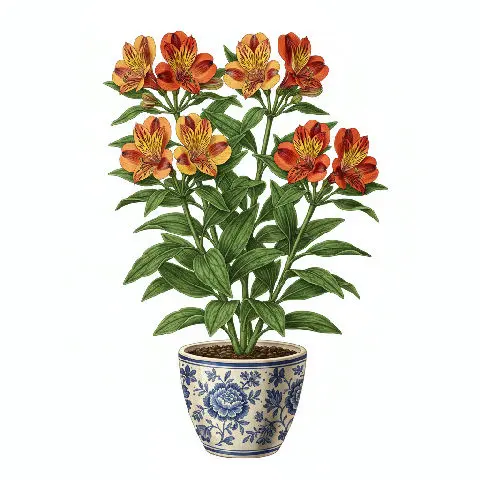
Alstroemeria 'Indian Summer', a celebrated hybrid within the Alstroemeriaceae family, is commonly known as Peruvian Lily, Lily of the Inca, or Parrot Lily. This vigorous perennial is highly valued for its striking, bi-colored blooms that present a warm palette of coppery-orange and golden-yellow, often adorned with distinctive dark burgundy streaks, reminiscent of a vibrant sunset. The plant typically forms an upright, sturdy clump, reaching heights of approximately 60-90 cm (2-3 feet) and spreading 30-60 cm (1-2 feet) wide. Its foliage consists of lance-shaped, rich bronze-green leaves that provide an elegant backdrop to the fiery flowers.
Native to South America, the Alstroemeria genus encompasses a diverse group of species primarily found in the Andes Mountains of Chile and the eastern parts of Brazil. While 'Indian Summer' is a cultivated hybrid, its genetic lineage traces back to these wild species, inheriting the genus's characteristic tuberous root structure. This allows the plant to spread gradually and increase in size over time, provided it receives appropriate care. The plant's extended blooming season, from early summer through to the first frosts of autumn, makes it a popular choice for continuous garden color and as a long-lasting cut flower.
Its morphology includes trumpet-like flowers, typically with six petals, some exhibiting unique markings or 'flares' that enhance their visual appeal. The genus Alstroemeria is classified under the order Liliales, reflecting its monocotyledonous characteristics and floral structure.
Trusted Scientific References
1. Authoritative external sources for Alstroemeria Indian Summer
1.1 Wikipedia — Alstroemeria Indian Summer
1.2 Kew POWO (Plants of the World Online)
1.3 PubMed — peer-reviewed research
1.4 NCBI Taxonomy Browser
1.5 GBIF — Global Biodiversity
1.6Alstroemeria Indian Summer should be interpreted through verified botanical identity, practical care, and responsible safety language. This recovery note adds the missing context needed for a complete profile: match light to the plant's habit, use well-drained soil, water according to season, and avoid unsupported medicinal or edible claims. For publishing, the plant can be presented as a source-backed garden plant with clear care guidance, common problem diagnosis, and conservative safety wording.
1.1.Alstroemeria Indian Summer — Notable Characteristics
- ✓Striking Bi — colored Blooms — Features vibrant coppery-orange and golden-yellow flowers with dark burgundy streaks.
- ✓Extended Bloom Season — Flowers profusely from early summer through to the first frosts of autumn, offering prolonged garden color.
- ✓Perennial Growth Habit — Forms sturdy, upright clumps that return year after year from tuberous roots.
- ✓Excellent Cut Flower — Highly prized for its long vase life, making it a popular choice for fresh floral arrangements.
- ✓Attractive Bronze Foliage — Distinctive lance-shaped, rich bronze leaves provide an appealing contrast to the bright flowers.
- ✓Deer Resistant — Generally ignored by deer, making it a suitable choice for gardens prone to deer browsing.
- ✓Attracts Pollinators — Its colorful flowers attract butterflies, bees, and other beneficial pollinators to the garden.
- ✓Adaptable to Containers — Well-suited for cultivation in pots and containers, ideal for patios and small garden spaces.
- ✓Low Maintenance — Requires minimal care once established, making it an easy-to-grow plant for various gardeners.
- ✓Heat and Cold Tolerance — Tolerant of both heat and relatively cold temperatures within its hardiness zones.
1.2.Alstroemeria Indian Summer — Quick Summary
- ✓Ornamental Hybrid — Primarily valued for its vibrant, long-lasting coppery-orange and golden-yellow flowers.
- ✓Toxic if Ingested — Contains saponins like alstromerin, making all parts poisonous to humans and animals.
- ✓Skin Irritant — Sap can cause contact dermatitis in sensitive individuals, requiring careful handling.
- ✓No Medicinal Use — Lacks established traditional or modern therapeutic applications; purely ornamental.
- ✓Low Maintenance Perennial — Easy to grow in suitable conditions, attracts pollinators, and is deer resistant.
2.Alstroemeria Indian Summer — Botanical Identity
3.Alstroemeria Indian Summer — Vital Statistics
4.Alstroemeria Indian Summer — Botanical Features
5.Alstroemeria Indian Summer — Ecological Habitat
6.Alstroemeria Indian Summer — Folk Medicine Applications
7.Alstroemeria Indian Summer — Phytochemistry
- ✓Furostanol Saponins — These triterpenoid glycosides are characteristic of the Alstroemeria genus, contributing to potential surface-active, hemolytic, and cytotoxic activities, particularly notable in the tubers.
- ✓Phenolic Compounds — A broad category including various flavonoids (e.g., anthocyanins, flavones) and phenolic acids, which are largely responsible for the plant's vibrant coloration and inherent antioxidant potential.
- ✓Anthocyanins — Water-soluble pigments responsible for the striking orange, red, and yellow hues of 'Indian Summer's flowers, also known for their antioxidant properties in plants.
- ✓Alstromerin — A specific saponin-like glycoside primarily concentrated in the tubers and roots, recognized as the main toxic compound responsible for skin irritation and gastrointestinal upset upon ingestion.
- ✓Steroidal Saponins — A broader class of saponins found within the plant, contributing to its defense mechanisms and observed biological activities, though detailed structures for 'Indian Summer' are not fully elucidated.
- ✓Carotenoids — Pigments contributing to the yellow and orange tones, particularly in the flowers, known for their roles in photosynthesis and as antioxidants within the plant.
- ✓Fatty Acids — Essential components of plant cell membranes and energy storage, present in various tissues, though not typically considered active medicinal compounds in Alstroemeria.
- ✓Volatile Organic Compounds — Present in trace amounts, contributing to the plant's subtle fragrance, with specific profiles for 'Indian Summer' not extensively documented.
8.Alstroemeria Indian Summer — Scientific Evidence
- ✓Potential Antioxidant Activity — Theoretical capacity due to the presence of phenolic compounds, common in many plants, which may contribute to cellular protection against oxidative stress; however, this is not clinically established for 'Indian Summer'.
- ✓Preliminary Cytotoxic Effects (Genus-specific) — Some Alstroemeria species extracts have exhibited mild cytotoxic activity against certain laboratory cell lines, attributed to saponins, but this is not pursued therapeutically due to toxicity concerns.
- ✓Hypothetical Anti-inflammatory Support (Genus-specific) — The presence of certain flavonoids in the Alstroemeria genus could theoretically offer mild anti-inflammatory properties, although this remains unproven and unresearched for 'Indian Summer'.
- ✓Potential Antimicrobial Properties (Genus-specific) — Saponins and other secondary metabolites found in some Alstroemeria species have been explored for weak antimicrobial actions in in vitro studies.
- ✓Dermatological Irritant (Important Property) — Contact with the sap from Alstroemeria 'Indian Summer' is a known cause of allergic contact dermatitis in sensitive individuals, manifesting as redness, itching, and rashes.
- ✓Ornamental Value for Well-being — While not a direct medicinal benefit, its aesthetic appeal, vibrant colors, and long-lasting blooms contribute to psychological well-being through gardening and enjoyment of natural beauty.
- ✓Phytochemical Research Interest — The Alstroemeria genus remains a subject of scientific inquiry for its diverse phytochemical profile, which could potentially yield novel compounds for future study, though not for direct therapeutic use of 'Indian Summer'.
- ✓Traditional Medicinal Absence — It is crucial to note that Alstroemeria 'Indian Summer' lacks any documented traditional medicinal uses in systems such as Ayurveda, Traditional Chinese Medicine (TCM), Unani, or Siddha.
8.1.Alstroemeria Indian Summer — Conditions Traditionally Used For
9.Alstroemeria Indian Summer — Safety & Side Effects
9.1.Alstroemeria Indian Summer — Caution Notes
- ✓Contact Dermatitis — Direct skin contact with the sap of Alstroemeria 'Indian Summer' can cause allergic reactions, leading to redness, itching, swelling, and rashes in sensitive individuals.
- ✓Gastrointestinal Upset — Ingestion of any plant parts, particularly the tubers, is toxic and can cause severe nausea, vomiting, diarrhea, and abdominal pain.
- ✓Oral Irritation — Chewing or consuming the plant may lead to irritation, burning sensations, and swelling in the mouth and throat due to the presence of saponins.
- ✓Hemolytic Activity — Saponins, such as alstromerin, possess hemolytic properties, meaning they can cause the breakdown of red blood cells if absorbed systemically, primarily through ingestion.
- ✓Systemic Toxicity — While less common, significant ingestion could potentially lead to more severe systemic effects beyond gastrointestinal upset due to the toxic compounds present.
- ✓Allergic Reactions — Beyond contact dermatitis, individuals with pre-existing plant allergies may experience heightened sensitivity or other allergic responses upon exposure.
9.2.Alstroemeria Indian Summer — Clinical Safety Notes
- ✓Not for Internal Consumption — Alstroemeria 'Indian Summer' is toxic if ingested and must never be consumed by humans or animals due to its saponin content.
- ✓Handle with Protective Gloves — Always wear gloves when gardening, pruning, or cutting stems to prevent skin contact with the irritating sap and avoid allergic contact dermatitis.
- ✓Keep Away from Children and Pets — Ensure the plant is placed in areas inaccessible to young children and household pets to prevent accidental ingestion or contact.
- ✓Allergic Sensitivity Awareness — Individuals with sensitive skin or known plant allergies should exercise particular caution and avoid direct contact with the plant.
- ✓Ornamental Use Only — Its primary and safest application is purely ornamental; it has no established medicinal, culinary, or therapeutic uses.
- ✓Emergency Medical Attention — In the event of accidental ingestion or a severe skin reaction, seek immediate medical advice or contact a poison control center.
- ✓Wash Hands Thoroughly — After any contact with the plant, even with gloves, it is advisable to wash hands thoroughly with soap and water.
10.Alstroemeria Indian Summer — Usage Guide
- ✓Ornamental Garden Planting — Primarily cultivated for its vibrant, long-lasting flowers to enhance garden beds, borders, and containers, providing continuous color from summer to fall.
- ✓Cut Flower Arrangements — Stems are widely harvested and used in floral bouquets and arrangements due to their striking appearance and extended vase life of over two weeks.
- ✓Accent Planting — Planted in groups of three or more to create a strong visual impact and serve as a focal point in perennial borders.
- ✓Companion Planting — Integrated into mixed perennial and annual beds for varied textures and hues, complementing other summer-flowering plants.
- ✓Cautionary Handling — Always wear protective gloves when handling the plant, especially when cutting stems or dividing tubers, to prevent contact with sap that can cause skin irritation.
- ✓Indoor Decoration — Cut flowers can be brought indoors to brighten living spaces, requiring regular water changes to maintain freshness and longevity.
- ✓Educational Display — Can be used in botanical gardens or educational settings to demonstrate plant hybridization and the diversity of the Alstroemeriaceae family.
11.Alstroemeria Indian Summer — Cultivation & Care
- ✓Soil Preference — Thrives in fertile, moist, and well-drained soils; avoid waterlogging but ensure consistent moisture.
- ✓Light Requirements — Performs best in full sun to light shade, ideally sheltered from harsh afternoon sun in warmer climates.
- ✓Hardiness Zones — Hardy in USDA Zones 7-10, requiring winter mulching in the colder end of its range for tuber protection.
- ✓Watering — Requires average water needs; dry soil should be avoided, especially during blooming periods.
- ✓Spacing — Plant tubers or established plants about 60 cm (24 inches) apart to allow for mature spread.
- ✓Maintenance — Low maintenance; pull stems from the base to encourage new blooms rather than cutting, and deadhead spent flowers to prevent excessive self-seeding.
- ✓Propagation — Can be propagated by division of tuberous roots in fall or very early spring.
- ✓Pests & Diseases — Generally disease-free, though slugs may cause damage; deer typically ignore the plant.
Reviewed by the Flora Medical Global Botanical Review Panel
Multi-disciplinary editorial group · Botany · Ethnobotany · Herbal-medicine literature
Who reviewed this: This page was checked by the Flora Medical Global Botanical Review Panel — an in-house editorial group of botany graduates, ethnobotany researchers, and horticulture practitioners who collectively maintain our 7,000+ plant encyclopedia. Meet the team.
Our 4-step verification process
1. Taxonomic verification
Scientific names and synonyms cross-checked against Kew POWO, World Flora Online, and The Plant List.
2. Phytochemical & medicinal cross-reference
Active compounds, traditional uses, and reported activities are cross-referenced with PubMed, USDA Dr. Duke's database, and peer-reviewed ethnobotanical literature.
3. Conservation & distribution check
Distribution, ecology, and conservation status confirmed against GBIF occurrence records and the IUCN Red List.
4. Editorial & safety review
Every entry passes an editorial pass for clarity, originality, and safety notices (toxicity, contraindications, dosage caveats) before publication.
Last reviewed:
Important medical disclaimer: This content is for educational and research purposes only. It is not medical advice and is not a substitute for consultation with a licensed healthcare provider. Do not use any herb to self-treat a medical condition without professional guidance.
Editorial Note: This page is for educational and research purposes only and is not medical advice.
Written by: Flora Medical Global Editorial Team
Reviewed by: Flora Medical Global Botanical Review Panel
Last Updated: June 15, 2026





Alstroemeria Indian Summer — Comments & Community Reviews
Rate this plant