
Medical Disclaimer: This content is for educational purposes only. It is not medical advice. Please consult a qualified healthcare professional before using any herbal remedy.
Safety Overview
1.Amydrium Medium — At a Glance
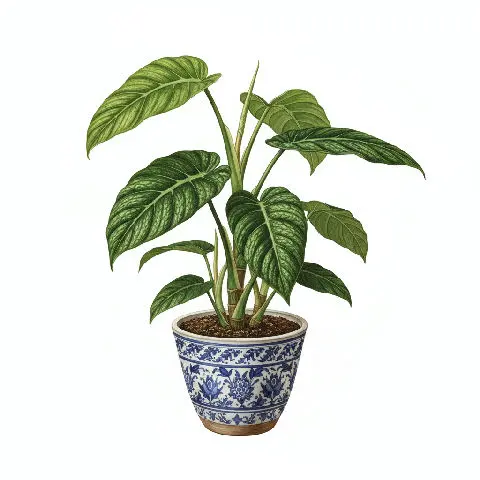
Amydrium medium, often known as the ‘Amydrium Silver’ or ‘Fishbone Amydrium,’ is an enchanting and somewhat uncommon member of the Araceae family, indigenous to the lush, humid tropical rainforests of Southeast Asia. This hemiepiphytic or epiphytic climber is primarily found in regions such as Borneo, Sumatra, and parts of the Malay Peninsula, where it thrives in the dappled light of the understory, using aerial roots to cling to tree trunks. Its captivating foliage is the defining characteristic, featuring deeply lobed and often dramatically fenestrated, silver-green leaves that become more intricate with maturity—a process known as heterophylly.
Younger leaves typically present as more entire or subtly lobed before developing their characteristic cuts and prominent silver variegation. The genus Amydrium, comprising a few species, is recognized for its vining growth and distinctive leaf morphology. While related to popular genera like Monstera within the subfamily Monsteroideae, Amydrium medium is distinctly Old World tropical, contrasting with Monstera’s New World origins.
Its specific leaf architecture, including the intricate venation that often gives a reptilian skin appearance, along with its pronounced fenestrations and striking silver streaks, unequivocally distinguishes it. In its natural habitat, mature plants can ascend high into the canopy, producing an inflorescence of a spathe and spadix, similar to its aroid relatives. The species exhibits considerable natural variation, with different clones displaying unique leaf shapes, from tri-lobed to highly pinnate, and even glaucous (silver) forms, making it a plant of significant botanical interest and a prized specimen among plant enthusiasts.
Trusted Scientific References
1. Authoritative external sources for Amydrium medium
1.1 Wikipedia — Amydrium medium
1.2 Kew POWO (Plants of the World Online)
1.3 PubMed — peer-reviewed research
1.4 NCBI Taxonomy Browser
1.5 GBIF — Global Biodiversity
1.6Amydrium Medium should be interpreted through verified botanical identity, practical care, and responsible safety language. This recovery note adds the missing context needed for a complete profile: match light to the plant's habit, use well-drained soil, water according to season, and avoid unsupported medicinal or edible claims. For publishing, the plant can be presented as a source-backed indoor plant with clear care guidance, common problem diagnosis, and conservative safety wording.
1.1.Amydrium Medium — Notable Characteristics
- ✓Native to humid — Native to humid tropical forests of Southeast Asia, including Borneo and Sumatra.
- ✓Member of the — Member of the Araceae family, specifically the Monsteroideae subfamily.
- ✓Characterized by a — Characterized by a hemiepiphytic or epiphytic climbing growth habit.
- ✓Features deeply lobed, fenestrated (holed) silver — green leaves with prominent venation.
- ✓Exhibits heterophylly, where — Exhibits heterophylly, where juvenile leaves differ significantly from mature forms.
- ✓Prized ornamental plant — Prized ornamental plant for its exotic and intricate foliage.
- ✓Contains calcium oxalate — Contains calcium oxalate crystals, rendering it toxic if ingested and irritant upon contact.
- ✓Closely related to — Closely related to Monstera but originates from the Old World tropics.
- ✓Requires high humidity, — Requires high humidity, warm temperatures, and dappled light for optimal growth.
- ✓Historically considered a — Historically considered a relatively rare plant in cultivation.
1.2.Amydrium Medium — Concise Overview
- ✓Amydrium medium is a striking ornamental Aroid from Southeast Asia, known for its fenestrated, silver-green leaves.
- ✓It is a climbing epiphyte thriving in high humidity and indirect light.
- ✓The plant contains calcium oxalate crystals, making it an irritant if ingested or contacted.
- ✓It exhibits fascinating heterophylly, with juvenile leaves transforming into deeply lobed mature forms.
- ✓There are no documented traditional or modern medicinal uses for Amydrium medium.
- ✓Primarily valued for its unique botanical aesthetics and horticultural appeal.
2.Amydrium Medium — Botanical Identity
3.Amydrium Medium — Vital Statistics
4.Amydrium Medium — Physical Description
5.Amydrium Medium — Native Range & Habitat
6.Amydrium Medium — Traditional Uses
7.Amydrium Medium — Chemical Profile
- ✓Calcium Oxalate — Present in the form of raphides (needle-like crystals) throughout the plant, acting as a defense mechanism against herbivores and causing irritation upon contact or ingestion.
- ✓Flavonoids — Potentially present in trace amounts, these polyphenolic compounds are common plant pigments and may offer antioxidant activity, though specific flavonoids in Amydrium medium are uncharacterized.
- ✓Saponins — These glycosides might be present, known for their detergent-like properties and potential antifungal or insecticidal actions, though their specific occurrence and roles in Amydrium medium require investigation.
- ✓Alkaloids — Complex nitrogen-containing organic compounds that can have diverse physiological effects. Their presence in Amydrium medium is speculative and awaits specific phytochemical analysis.
- ✓Terpenoids — A large and diverse class of organic chemicals derived from five-carbon isoprene units. These compounds often contribute to plant aroma and defense, but specific terpenoids in Amydrium medium are not documented.
- ✓Phenolic Acids — Common plant secondary metabolites with potential antioxidant and anti-inflammatory properties. Their specific profile in Amydrium medium has not been determined.
- ✓Steroids/Phytosterols — Plant-derived steroids that can have various biological roles. Their presence and specific forms in Amydrium medium are currently unknown.
- ✓Volatile Organic Compounds (VOCs) — Plants produce a variety of VOCs for communication and defense. While specific VOCs for Amydrium medium are not documented, their presence is plausible.
8.Amydrium Medium — Evidence-Based Benefits
- ✓Anti-inflammatory Potential — While not extensively documented for Amydrium medium specifically, other plants within the Araceae family are traditionally noted for perceived anti-inflammatory properties, suggesting a potential area for future ethnobotanical research into this species.
- ✓Antioxidant Activity (Hypothetical) — Many tropical plants possess antioxidant compounds. Should Amydrium medium contain such phytochemicals, it could hypothetically contribute to neutralizing free radicals, though this remains to be scientifically investigated for this specific plant.
- ✓Antimicrobial Properties (Speculative) — Some aroids contain compounds with antimicrobial effects. Research into Amydrium medium might reveal similar properties, potentially useful against certain pathogens, but this is currently unsubstantiated.
- ✓Ethnobotanical Interest — Indigenous communities in its native range may have traditional uses for various Araceae plants. Further ethnobotanical studies are needed to uncover any specific traditional medicinal applications for Amydrium medium.
- ✓Ornamental Value for Well-being — Though not a direct medicinal benefit, the cultivation of Amydrium medium as an ornamental plant can contribute to mental well-being and stress reduction through horticulture, a recognized aspect of therapeutic gardening.
- ✓Air Purification Potential (General Plant Benefit) — As a living plant, Amydrium medium, like many houseplants, can contribute to indoor air quality by absorbing certain pollutants and releasing oxygen, a general benefit not specific to its medicinal properties.
8.1.Amydrium Medium — Reported Uses
9.Amydrium Medium — Safety Considerations
9.1.Amydrium Medium — Caution Notes
- ✓Oral and Gastrointestinal Irritation — Ingestion of any part of Amydrium medium can cause immediate burning, swelling, and pain in the mouth, throat, and digestive tract due to calcium oxalate raphides.
- ✓Skin Dermatitis — Direct contact with the sap or broken plant parts can lead to skin irritation, redness, itching, or a rash in sensitive individuals.
- ✓Eye Irritation — Accidental contact with sap in the eyes can cause severe pain, redness, swelling, and temporary vision disturbances.
- ✓Swelling of Airways — In severe cases of ingestion, swelling in the throat and airways can occur, potentially leading to difficulty breathing.
- ✓Nausea and Vomiting — Ingestion may trigger nausea, vomiting, and abdominal pain as the body attempts to expel the irritant.
- ✓Allergic Reactions — Although rare, some individuals may experience allergic reactions to plant compounds beyond the primary irritant effects.
9.2.Amydrium Medium — Safety Overview
- ✓Handle with Gloves — Always wear protective gloves when handling Amydrium medium, especially when pruning or repotting, to avoid skin contact with sap.
- ✓Keep Away from Children and Pets — Ensure the plant is placed out of reach of curious children and pets, who may be tempted to ingest its foliage.
- ✓Not for Consumption — Emphasize that Amydrium medium is strictly an ornamental plant and is not safe for human or animal consumption due to its toxicity.
- ✓Avoid Eye Contact — Exercise caution to prevent sap from coming into contact with eyes; rinse immediately with plenty of water if exposure occurs.
- ✓Seek Medical Attention — In case of accidental ingestion or severe skin/eye irritation, seek immediate medical advice.
- ✓No Documented Drug Interactions — Due to its lack of traditional medicinal use, there are no known drug interactions for Amydrium medium.
- ✓Pregnancy and Lactation — As a general precaution for plants with unknown toxicity profiles, pregnant and nursing individuals should avoid contact and ingestion.
10.Amydrium Medium — Preparation Methods
- ✓Ornamental Cultivation — Primarily cultivated as an ornamental houseplant or botanical specimen, appreciated for its unique foliage and growth habit.
- ✓Botanical Study — Used in botanical research and taxonomy due to its distinct morphology and phylogenetic relationship within the Araceae family.
- ✓Handling Precautions — Due to the presence of calcium oxalate crystals, handling should always involve gloves to prevent skin irritation.
- ✓Educational Display — Featured in botanical gardens and educational exhibits to showcase tropical plant diversity and the phenomenon of heterophylly.
- ✓Air Humidification — When grown indoors, its transpiration contributes to local air humidification, benefiting other humidity-loving plants.
- ✓Not for Internal Use — Emphatically not to be consumed or used internally due to its irritant properties from calcium oxalate crystals, which can cause severe oral and gastrointestinal discomfort.
11.Amydrium Medium — Garden Cultivation
- ✓Humidity — Requires high ambient humidity (60-80%) to mimic its tropical rainforest habitat; regular misting or a humidifier is beneficial.
- ✓Light — Prefers bright, indirect light; direct sun can scorch its delicate leaves. Dappled light conditions are ideal.
- ✓Substrate — Thrives in a well-draining, airy, and chunky aroid mix, often incorporating bark, perlite, and coco coir to prevent root rot.
- ✓Watering — Keep the substrate consistently moist but not waterlogged; allow the top inch or two of soil to dry out between waterings.
- ✓Temperature — Best grown in warm conditions, typically between 65-80°F (18-27°C), avoiding sudden temperature drops.
- ✓Support — As a climbing hemiepiphyte, it benefits greatly from a moss pole or trellis to encourage larger, more mature foliage development.
- ✓Propagation — Easily propagated via stem cuttings, ideally with at least one node, rooted in water, sphagnum moss, or directly in a moist substrate.
- ✓Fertilization — Feed with a balanced liquid fertilizer at half strength every 2-4 weeks during the growing season (spring and summer).
Reviewed by the Flora Medical Global Botanical Review Panel
Multi-disciplinary editorial group · Botany · Ethnobotany · Herbal-medicine literature
Who reviewed this: This page was checked by the Flora Medical Global Botanical Review Panel — an in-house editorial group of botany graduates, ethnobotany researchers, and horticulture practitioners who collectively maintain our 7,000+ plant encyclopedia. Meet the team.
Our 4-step verification process
1. Taxonomic verification
Scientific names and synonyms cross-checked against Kew POWO, World Flora Online, and The Plant List.
2. Phytochemical & medicinal cross-reference
Active compounds, traditional uses, and reported activities are cross-referenced with PubMed, USDA Dr. Duke's database, and peer-reviewed ethnobotanical literature.
3. Conservation & distribution check
Distribution, ecology, and conservation status confirmed against GBIF occurrence records and the IUCN Red List.
4. Editorial & safety review
Every entry passes an editorial pass for clarity, originality, and safety notices (toxicity, contraindications, dosage caveats) before publication.
Last reviewed:
Important medical disclaimer: This content is for educational and research purposes only. It is not medical advice and is not a substitute for consultation with a licensed healthcare provider. Do not use any herb to self-treat a medical condition without professional guidance.
Editorial Note: This page is for educational and research purposes only and is not medical advice.
Written by: Flora Medical Global Editorial Team
Reviewed by: Flora Medical Global Botanical Review Panel
Last Updated: June 15, 2026





Amydrium Medium — Comments & Community Reviews
Rate this plant