


Medical Disclaimer: This content is for educational purposes only. It is not medical advice. Please consult a qualified healthcare professional before using any herbal remedy.
Safety Overview
1.Anchusa Azurea — Plant Snapshot
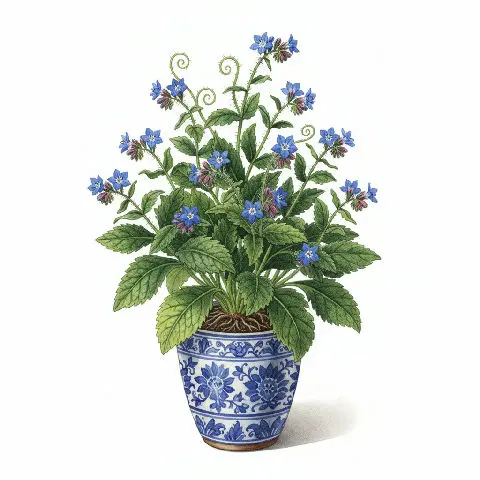
Anchusa azurea, commonly known as Italian Bugloss or Alkanet, is a striking herbaceous perennial belonging to the Boraginaceae family, renowned for its brilliant azure-blue flowers. Native to the Mediterranean basin, including Southern Europe, Northern Africa, and extending into the Caucasus, its historical presence dates back centuries, where it was admired for both its ornamental beauty and purported medicinal qualities. The plant thrives in disturbed areas, open woodlands, along roadsides, and on stony hillsides, indicating its adaptability and resilience across various soil types, including heavy clay. Botanically, Anchusa azurea is characterized by its robust, hairy stems, which can ascend to heights exceeding 1.5 meters under optimal conditions.
Its leaves are lanceolate to ovate-lanceolate, coarse-textured, and covered in bristly hairs, contributing to its somewhat rough feel. The most distinguishing feature, however, are its intensely blue, five-petaled, trumpet-shaped flowers, often with a white or pale 'eye' at the center, clustered in cymose inflorescences. These vibrant blossoms attract a myriad of pollinators, particularly bees and butterflies, playing a vital role in local ecosystems. Culturally, Anchusa azurea has been historically noted for its use as a dye plant, particularly the roots, which yield a red pigment.
This pigment was traditionally used in cosmetics, food coloring, and for dying fabrics, especially in archaic European societies. While not as prominently featured in classical Ayurvedic, TCM, or Unani texts as some other botanicals, its relatives within the Boraginaceae family, such as Borage (Borago officinalis) and Comfrey (Symphytum officinale), share some traditional medicinal associations, particularly concerning mucilage content and emollient properties. Modern pharmacological interest in Anchusa azurea is growing, primarily focusing on its rich phytochemical profile, which includes pyrrolizidine alkaloids (PAs), notably echimidine, requiring careful consideration for safety.
Trusted Scientific References
1. Authoritative external sources for Anchusa azurea
1.1 Wikipedia — Anchusa azurea
1.2 Kew POWO (Plants of the World Online)
1.3 PubMed — peer-reviewed research
1.4 NCBI Taxonomy Browser
1.5 GBIF — Global Biodiversity
1.1.Anchusa Azurea — Standout Qualities
- ✓Brilliant Azure — Blue Flowers
- ✓Robust, Hairy Stems — Robust, Hairy Stems and Leaves
- ✓Native to the — Native to the Mediterranean Basin
- ✓Historical Source of — Historical Source of Red Dye from Roots
- ✓Contains Pyrrolizidine Alkaloids — Contains Pyrrolizidine Alkaloids (PAs)
- ✓Traditional Antitussive and — Traditional Antitussive and Diuretic Properties
- ✓Attracts Key Pollinators, — Attracts Key Pollinators, Especially Bees
- ✓Demonstrates Drought and — Demonstrates Drought and Heavy Clay Soil Tolerance
- ✓Typically a Short — Lived Perennial
- ✓Significant Ornamental Garden — Significant Ornamental Garden Value
1.2.Anchusa Azurea — In Brief
- ✓Vibrant blue-flowered perennial native to the Mediterranean region.
- ✓Historically valued as a source of red dye from its roots for various applications.
- ✓Traditional medicinal uses include antitussive, depurative, diaphoretic, and diuretic actions.
- ✓Contains hepatotoxic pyrrolizidine alkaloids (PAs) like echimidine, making internal use highly unsafe.
- ✓Edible flowers and young shoots, but internal consumption is generally not recommended due to safety concerns.
- ✓Primarily appreciated for its ornamental beauty and cautious external applications in modern herbalism.
2.Anchusa Azurea — Scientific Profile
3.Anchusa Azurea — Quick Facts
4.Anchusa Azurea — Morphological Account
5.Anchusa Azurea — Geographic Distribution
6.Anchusa Azurea — Ethnobotanical Uses
7.Anchusa Azurea — Bioactive Constituents
- ✓Pyrrolizidine Alkaloids (PAs) — Key compounds include echimidine and cynoglossine; these are known for potential hepatotoxicity and neurotoxicity, requiring extreme caution for internal use.
- ✓Mucilage — Composed of polysaccharides, contributing to the plant's demulcent and emollient properties, particularly soothing for mucous membranes.
- ✓Flavonoids — Such as luteolin and quercetin derivatives; exhibit antioxidant, anti-inflammatory, and potentially antimicrobial activities.
- ✓Phenolic Acids — Including rosmarinic acid and caffeic acid derivatives; contribute significantly to the plant's antioxidant and free-radical scavenging capabilities.
- ✓Tannins — Astringent compounds that can help to tighten tissues and may offer antiseptic properties.
- ✓Anthocyanins — Water-soluble pigments responsible for the vibrant blue color of the flowers; potent antioxidants.
- ✓Saponins — Detergent-like compounds that may possess anti-inflammatory and immune-modulating effects, though their role in Anchusa azurea is less studied.
- ✓Naphthoquinone Derivatives — Primarily alkanet, a red pigment found in the roots, historically used as a natural dye.
- ✓Volatile Compounds — Minor constituents contributing to the plant's aroma, with potential antimicrobial or insect-repellent properties.
- ✓Minerals — Contains various essential macro and micronutrients vital for plant growth and potentially present in small amounts in herbal preparations.
8.Anchusa Azurea — Modern Studies
- ✓Antitussive Action — Traditionally used to alleviate coughs and soothe respiratory passages, helping to reduce irritation and frequency.
- ✓Depurative Properties — Believed to purify the blood and eliminate toxins from the body, contributing to overall systemic cleansing.
- ✓Diaphoretic Effect — Promotes perspiration, aiding the body in releasing heat and toxins through the skin, useful in feverish conditions.
- ✓Diuretic Activity — Encourages increased urine flow, supporting kidney function and assisting in the removal of excess fluids and waste products.
- ✓Anti-inflammatory Support — When applied topically as a poultice, it helps to reduce local inflammation and swelling in affected areas of the skin.
- ✓Emollient Qualities — Due to its mucilage content, it offers soothing and softening effects, particularly beneficial for irritated skin surfaces.
- ✓Traditional Wound Healing — Historically applied as a poultice to minor wounds and skin inflammations to aid in the healing process.
- ✓Respiratory System Relief — Its antitussive nature provides comfort for various respiratory discomforts, including dry and irritating coughs.
- ✓Urinary Tract Health — The diuretic action supports the health of the urinary system by facilitating the flushing out of potential irritants.
- ✓Skin Soothing — Topical applications can help calm irritated or inflamed skin, providing relief from discomfort and redness.
- ✓General Detoxification — Through its combined depurative, diaphoretic, and diuretic actions, it supports the body's natural detoxification pathways.
8.1.Anchusa Azurea — Conditions Traditionally Used For
9.Anchusa Azurea — Risk Profile
9.1.Anchusa Azurea — Reported Side Effects
- ✓Hepatotoxicity — The primary concern is liver damage from pyrrolizidine alkaloids (PAs) like echimidine, especially with internal or chronic use.
- ✓Paralyzing Effects — The alkaloid cynoglossine can potentially induce a paralyzing effect if consumed internally.
- ✓Gastrointestinal Distress — Nausea, vomiting, diarrhea, or abdominal discomfort may occur, particularly with ingestion of raw plant material or high doses.
- ✓Allergic Reactions — Skin irritation, redness, or contact dermatitis can result from topical exposure; systemic allergic responses are also possible in sensitive individuals.
- ✓Genotoxicity and Carcinogenicity — Certain PAs are known to be genotoxic and potentially carcinogenic with prolonged exposure, raising long-term health risks.
- ✓Kidney Damage — Chronic exposure to PAs can also have adverse effects on kidney function.
- ✓Drug Interactions — May interact with liver-metabolized medications or those affecting blood coagulation due to its alkaloid content.
9.2.Anchusa Azurea — Toxicity Assessment
- ✓Strictly Avoid Internal Use — Due to the presence of hepatotoxic pyrrolizidine alkaloids (PAs), internal consumption is strongly discouraged and potentially dangerous.
- ✓Pregnancy and Lactation — Absolutely contraindicated for pregnant and breastfeeding women due to the risk of PA transfer to the fetus or infant.
- ✓Liver Conditions — Individuals with pre-existing liver disease, damage, or compromised liver function must avoid Anchusa azurea entirely.
- ✓Children's Safety — Not suitable for use in children, who are more susceptible to the adverse effects of PAs.
- ✓Topical Application Caution — Use topically with care, for limited durations, and avoid application to broken or abraded skin.
- ✓Professional Consultation — Always consult a qualified healthcare professional or medical herbalist before any use, especially for medicinal purposes.
- ✓Identification Accuracy — Ensure accurate identification of the plant to avoid confusion with other species that may have different or more severe toxic profiles.
10.Anchusa Azurea — Application Forms
- ✓Herbal Infusion (External Use Only) — Dried aerial parts steeped in hot water to create a wash for minor skin irritations or as a soothing compress.
- ✓Poultice Application — Dried and powdered herb mixed with a small amount of water to form a paste, applied topically to areas of inflammation or swelling.
- ✓Root Dye Extraction — Roots can be decocted to extract the red naphthoquinone pigment for natural dyeing of fabrics or cosmetic preparations.
- ✓Culinary Garnish (Flowers) — Fresh, raw flowers can be used decoratively in salads or as an edible garnish for various dishes, offering a mild flavor.
- ✓Cooked Vegetable (Young Shoots/Leaves) — Tender young leaves and flowering shoots can be lightly cooked and consumed as a vegetable, similar to spinach, though caution is advised due to PA content.
- ✓Topical Oil Infusion (External Use Only) — Roots or aerial parts can be infused in a carrier oil for use in balms or salves aimed at skin soothing, ensuring no internal consumption.
11.Anchusa Azurea — Propagation & Care
- ✓Soil Preference — Succeeds in most soils, but prefers fertile, well-drained soil; tolerates heavy clay and requires deep soil.
- ✓Light Requirements — Thrives in full sun, needing ample light for optimal growth and flowering.
- ✓Water Needs — Prefers moist soil but established plants demonstrate good drought tolerance.
- ✓Hardiness — Hardy to UK zone 3, tolerating temperatures down to approximately -15°C (USDA hardiness zones 3-7).
- ✓Propagation from Seed — Sow seeds in spring in sandy soil; an overnight temperature drop can aid germination, typically occurring in 1-4 weeks at 21°C.
- ✓Vegetative Propagation — Can be propagated by division in early spring or more commonly by root cuttings taken in autumn or early winter.
- ✓Growth Habit — Grows up to 1.5 meters (5 feet) tall with a spread of 0.6 meters (2 feet), forming robust clumps.
- ✓Pollinator Attraction — Flowers are a valuable food source for bees and other pollinators, enhancing garden biodiversity.
Reviewed by the Flora Medical Global Botanical Review Panel
Multi-disciplinary editorial group · Botany · Ethnobotany · Herbal-medicine literature
Who reviewed this: This page was checked by the Flora Medical Global Botanical Review Panel — an in-house editorial group of botany graduates, ethnobotany researchers, and horticulture practitioners who collectively maintain our 7,000+ plant encyclopedia. Meet the team.
Our 4-step verification process
1. Taxonomic verification
Scientific names and synonyms cross-checked against Kew POWO, World Flora Online, and The Plant List.
2. Phytochemical & medicinal cross-reference
Active compounds, traditional uses, and reported activities are cross-referenced with PubMed, USDA Dr. Duke's database, and peer-reviewed ethnobotanical literature.
3. Conservation & distribution check
Distribution, ecology, and conservation status confirmed against GBIF occurrence records and the IUCN Red List.
4. Editorial & safety review
Every entry passes an editorial pass for clarity, originality, and safety notices (toxicity, contraindications, dosage caveats) before publication.
Last reviewed:
Important medical disclaimer: This content is for educational and research purposes only. It is not medical advice and is not a substitute for consultation with a licensed healthcare provider. Do not use any herb to self-treat a medical condition without professional guidance.
Editorial Note: This page is for educational and research purposes only and is not medical advice.
Written by: Flora Medical Global Editorial Team
Reviewed by: Flora Medical Global Botanical Review Panel
Last Updated: June 15, 2026





Anchusa Azurea — Comments & Community Reviews
Rate this plant