


Medical Disclaimer: This content is for educational purposes only. It is not medical advice. Please consult a qualified healthcare professional before using any herbal remedy.
Safety Overview
1.Anemone Blanda — Botanical Snapshot
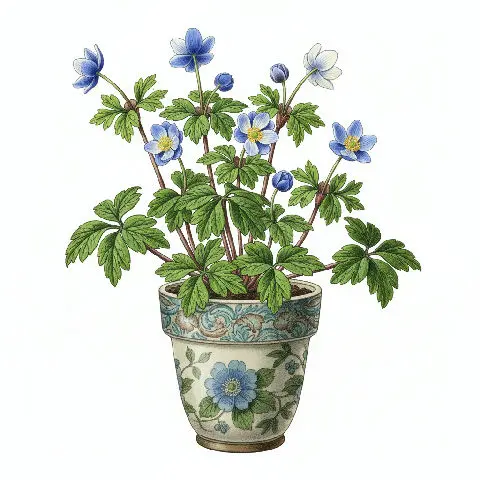
Anemone blanda, widely recognized as the Balkan Anemone or Grecian Windflower, is a charming and resilient perennial herbaceous plant belonging to the Ranunculaceae family. Native to the diverse landscapes of southeastern Europe, including Greece, Turkey, and Bulgaria, extending into parts of Central Asia, this diminutive yet impactful plant is celebrated for its remarkably early spring bloom, often unfurling its vibrant petals even before crocuses emerge from the thawing ground. Its botanical epithet, 'blanda', is derived from Latin, meaning 'mild' or 'charming', a fitting descriptor for its delicate appearance. Historically, Anemone blanda has been extensively cultivated in gardens as an ornamental for centuries, treasured for its ability to naturalize effortlessly and form lush carpets of star-shaped flowers in shades of intense blue, purple, pink, or white.
While this specific species is not as extensively documented in ancient medical systems like Ayurveda or Traditional Chinese Medicine as some other prominent botanicals, related species within the broader Anemone genus have been historically recognized for their potent medicinal properties. This interest primarily stems from their unique phytochemistry, particularly the presence of ranunculin, a glycoside that hydrolyzes into the highly reactive protoanemonin, and subsequently anemonin. Modern pharmacological interest in various Anemone species often centers on their potential for anti-inflammatory, analgesic, and antimicrobial effects, driven by these very compounds. The plant typically achieves a modest height of 10-15 cm, forming a low, spreading habit that makes it an ideal choice for groundcover, rock gardens, or planting beneath deciduous trees where it can bask in early spring sun before tree canopy forms.
Its finely dissected, fern-like foliage emerges alongside the flowers in early spring, creating a verdant backdrop for the multitude of blossoms. After its captivating flowering period, which can last for several weeks, the foliage naturally senesces and dies back by early summer, allowing other plants to seamlessly take over the space, showcasing its excellent companion planting potential. Anemone blanda is a cormous plant, meaning it grows from small, irregular, tuberous roots called corms. These specialized corms serve as nutrient storage organs, enabling the plant to survive dormant periods with remarkable hardiness and contributing significantly to its ease of naturalization and perenn ...[CURRENT TEXT EXISTS: 2738 chars]
1.1.Anemone Blanda — Notable Characteristics
- ✓Early Spring Bloom — One of the first plants to flower, bringing vibrant color to gardens in late winter to early spring.
- ✓Ornamental Value — Highly valued for its attractive daisy-like flowers in shades of blue, purple, pink, and white.
- ✓Naturalizing Habit — Easily spreads to form dense carpets, creating a stunning display in woodland or rock gardens.
- ✓Cormous Perennial — Grows from small, tuberous corms, allowing for nutrient storage and survival during dormant periods.
- ✓Finely Dissected Foliage — Features delicate, fern-like leaves that emerge with the flowers.
- ✓Deciduous Foliage — Leaves die back by early summer, making space for other summer-flowering plants.
- ✓Low Maintenance — Once established, requires minimal care, thriving in suitable conditions.
- ✓Adaptable Growth — Tolerates partial shade to full sun if moisture levels are maintained.
- ✓Member of Ranunculaceae — Belongs to the buttercup family, known for certain toxic compounds.
- ✓Contains Toxic Compounds — Notably ranunculin and protoanemonin, making it poisonous if ingested.
1.2.Anemone Blanda — In Brief
- ✓Charming early spring bloomer, native to southeastern Europe.
- ✓Contains toxic ranunculin, converting to highly irritating protoanemonin upon damage.
- ✓Primarily cultivated as an ornamental plant for its vibrant flowers.
- ✓Related Anemone species have historical uses for anti-inflammatory and analgesic effects, with extreme caution due to toxicity.
- ✓Not for internal consumption; direct contact can cause skin irritation.
- ✓Requires partial shade and moist, well-drained soil for optimal growth.
2.Anemone Blanda — Scientific Identity
3.Anemone Blanda — Vital Statistics
4.Anemone Blanda — Botanical Description
5.Anemone Blanda — Native Range & Habitat
6.Anemone Blanda — Folk Medicine Applications
7.Anemone Blanda — Phytochemistry
- ✓Ranunculin — A monoterpene glycoside present in the fresh plant, which is enzymatically hydrolyzed upon plant injury or drying to form the highly reactive protoanemonin, serving as a primary defense mechanism.
- ✓Protoanemonin — An unstable, pungent, and highly irritating alkenone lactone formed from ranunculin; it is responsible for the fresh plant's toxicity and potential antimicrobial and anti-inflammatory activities.
- ✓Anemonin — A stable, dimeric form of protoanemonin that results from its spontaneous dimerization upon drying or storage; it is less irritating but still possesses some of the therapeutic potential and toxicity.
- ✓Flavonoids — A diverse group of polyphenolic compounds, including quercetin and kaempferol derivatives, which are often present in plants and contribute to antioxidant and anti-inflammatory properties.
- ✓Saponins — Glycosides that produce a frothing in water, potentially contributing to expectorant or hemolytic activities, though their specific roles in Anemone blanda's medicinal profile are less defined.
- ✓Tannins — Astringent polyphenols that can bind to proteins, often found in plant tissues, contributing to potential antimicrobial or anti-diarrheal effects in other medicinal plants.
- ✓Organic Acids — Various organic acids are present in plant tissues, playing roles in primary metabolism and potentially influencing the overall chemical profile and stability of other compounds.
- ✓Volatile Compounds — Trace amounts of volatile organic compounds may contribute to the plant's scent or defense mechanisms, although not primary active constituents for Anemone blanda's known effects.
8.Anemone Blanda — Scientific Evidence
- ✓Anti-inflammatory Potential — Compounds like protoanemonin and anemonin, found in Anemone species, may modulate inflammatory pathways, offering a basis for historical use in related plants for conditions like arthritis or joint pain, though direct human studies on Anemone blanda are limited.
- ✓Analgesic Effects (Topical) — The irritant nature of protoanemonin, when applied externally in highly diluted forms, has been traditionally associated with counter-irritant effects that could alleviate localized pain in related Anemone species.
- ✓Antimicrobial Activity — Protoanemonin exhibits broad-spectrum antimicrobial properties against various bacteria and fungi in in vitro studies, suggesting potential as a natural antiseptic, albeit with high toxicity.
- ✓Traditional Rheumatic Relief (Related Species) — Historically, diluted preparations of other Anemone species were used externally in European folk medicine for rheumatic conditions and gout due to their rubefacient action.
- ✓Nerve Pain Management (Historical) — In some traditional practices, related Anemone plants were cautiously employed as external applications for neuralgic pain, leveraging their counter-irritant properties.
- ✓Skin Irritation Management (Extreme Caution) — Highly diluted and carefully prepared extracts of related Anemone species were historically used for certain skin eruptions, acting as a vesicant or counter-irritant, demanding expert supervision.
- ✓Diuretic Properties (Historical) — Some Anemone species have been anecdotally used in traditional remedies for their purported diuretic effects, though this carries significant risk due to toxicity.
- ✓Antispasmodic Action (Theoretical) — While not directly studied for Anemone blanda, compounds found in some Ranunculaceae members have shown antispasmodic properties in laboratory settings, warranting further investigation.
- ✓Immunomodulatory Effects (Research Interest) — Emerging research on various Ranunculaceae species suggests potential immunomodulatory activities of their compounds, opening avenues for future study on Anemone blanda.
8.1.Anemone Blanda — Health Applications
9.Anemone Blanda — Cautions & Contraindications
9.1.Anemone Blanda — Warnings
- ✓Skin Irritation — Direct contact with fresh sap can cause severe contact dermatitis, redness, itching, and blistering due to protoanemonin.
- ✓Gastrointestinal Distress — Ingestion of any part of the plant can lead to severe oral irritation, nausea, vomiting, diarrhea, and abdominal pain.
- ✓Mucous Membrane Irritation — Contact with eyes or other mucous membranes can cause burning sensations and inflammation.
- ✓Allergic Reactions — Individuals sensitive to plants in the Ranunculaceae family may experience allergic responses upon contact.
- ✓Organ Toxicity — Large doses, especially if ingested, could potentially lead to more systemic toxicity affecting kidneys or the nervous system, though this is rare with ornamental exposure.
- ✓Respiratory Irritation — Inhaling dust from dried plant material could potentially cause respiratory discomfort in sensitive individuals.
- ✓Livestock Poisoning — Ingestion by grazing animals can cause poisoning, leading to illness or death.
9.2.Anemone Blanda — Toxicity Assessment
- ✓Internal Consumption Prohibited — Anemone blanda is toxic if ingested and should never be consumed internally by humans or pets due to its potent irritant compounds.
- ✓Skin Contact Precautions — Always handle fresh plant material with gloves to prevent contact dermatitis, redness, and blistering.
- ✓Keep Away from Children and Pets — Ensure the plant is not accessible to curious children or pets who might ingest it, leading to severe poisoning.
- ✓Pregnant and Breastfeeding Women — Avoid any contact or potential exposure during pregnancy or lactation due to lack of safety data and known toxicity.
- ✓Allergic Individuals — Persons with known allergies to plants in the Ranunculaceae family should exercise extreme caution or avoid contact entirely.
- ✓Medical Consultation — In case of accidental ingestion or severe skin reaction, seek immediate medical attention or contact a poison control center.
- ✓No Self-Medication — Due to its toxicity, Anemone blanda is not suitable for self-medication; any traditional uses of related species should be approached with extreme caution and professional guidance.
10.Anemone Blanda — Usage Guide
- ✓Ornamental Cultivation — Primarily used as an ornamental plant for groundcover, rock gardens, or naturalized plantings in woodland settings.
- ✓Research Extraction (Laboratory) — For scientific investigation, extracts of Anemone blanda are prepared using specific solvents (e.g., ethanol) to isolate and quantify compounds like ranunculin or protoanemonin.
- ✓Topical Application (Historical, Related Species, Extreme Caution) — Historically, highly diluted poultices or compresses of related Anemone species were applied externally for rheumatic pain or skin conditions, always under strict supervision due to severe irritancy.
- ✓Homeopathic Preparations — In homeopathy, highly diluted preparations (e.g., Pulsatilla from Anemone pulsatilla) are used for various ailments, following specific homeopathic principles and not involving crude plant material.
- ✓Botanical Specimen — Collected and preserved as botanical specimens for herbarium collections and taxonomic studies, appreciating its morphological characteristics.
- ✓Educational Display — Utilized in botanical gardens and educational settings to showcase early spring flora and highlight the Ranunculaceae family's unique chemistry and ecological role.
- ✓Dye Production (Limited) — Some historical accounts mention the use of certain Anemone species for producing green dyes, though this is not a common modern application.
11.Anemone Blanda — Cultivation & Care
- ✓Site Selection — Choose a location with partial shade, ideally under deciduous trees or shrubs, to provide adequate sunlight in spring and shade in summer.
- ✓Soil Preparation — Ensure well-drained, humus-rich soil with a slightly acidic to neutral pH (6.0-7.0); amend heavy clay soils with organic matter.
- ✓Planting Corms — Plant the irregular corms in autumn, typically 5-8 cm deep and 10-15 cm apart, with the flatter side down or pointed side up.
- ✓Watering Regimen — Provide consistent moisture during the active growth period in fall and spring; allow the soil to dry out during summer dormancy.
- ✓Fertilization — A light application of balanced granular fertilizer or compost in early spring can support vigorous growth and flowering.
- ✓Propagation — Anemone blanda readily naturalizes from seed and can also be divided by separating clumps of corms during its dormant period in late summer.
- ✓Pest and Disease Management — Generally robust, but watch for slugs and snails on new foliage; root rot can occur in overly wet soils.
- ✓Dormancy Care — Allow foliage to die back naturally; avoid disturbing the corms during their summer dormancy.
Reviewed by the Flora Medical Global Botanical Review Panel
Multi-disciplinary editorial group · Botany · Ethnobotany · Herbal-medicine literature
Who reviewed this: This page was checked by the Flora Medical Global Botanical Review Panel — an in-house editorial group of botany graduates, ethnobotany researchers, and horticulture practitioners who collectively maintain our 7,000+ plant encyclopedia. Meet the team.
Our 4-step verification process
1. Taxonomic verification
Scientific names and synonyms cross-checked against Kew POWO, World Flora Online, and The Plant List.
2. Phytochemical & medicinal cross-reference
Active compounds, traditional uses, and reported activities are cross-referenced with PubMed, USDA Dr. Duke's database, and peer-reviewed ethnobotanical literature.
3. Conservation & distribution check
Distribution, ecology, and conservation status confirmed against GBIF occurrence records and the IUCN Red List.
4. Editorial & safety review
Every entry passes an editorial pass for clarity, originality, and safety notices (toxicity, contraindications, dosage caveats) before publication.
Last reviewed:
Important medical disclaimer: This content is for educational and research purposes only. It is not medical advice and is not a substitute for consultation with a licensed healthcare provider. Do not use any herb to self-treat a medical condition without professional guidance.
Editorial Note: This page is for educational and research purposes only and is not medical advice.
Written by: Flora Medical Global Editorial Team
Reviewed by: Flora Medical Global Botanical Review Panel
Last Updated: June 15, 2026





Anemone Blanda — Comments & Community Reviews
Rate this plant