


Medical Disclaimer: This content is for educational purposes only. It is not medical advice. Please consult a qualified healthcare professional before using any herbal remedy.
Safety Overview
1.Anemone Japonica — Essential Profile
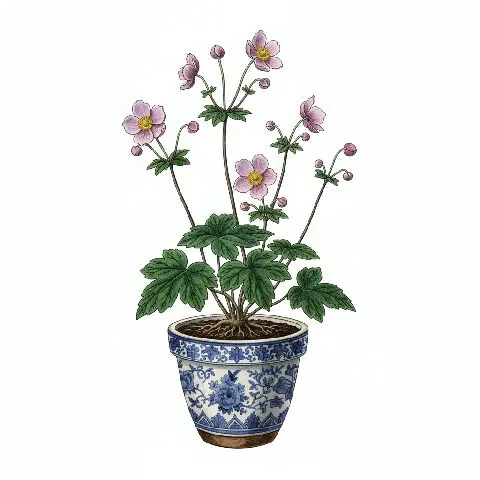
Anemone hupehensis, widely recognized as Japanese Anemone or Chinese Anemone, is a robust herbaceous perennial thriving within the Ranunculaceae family. Its true botanical origins trace back to the Hupeh province of central China, a fact often overshadowed by its common name, 'Japanese Anemone,' which stems from its subsequent introduction and popularization in Japan and the Western world during the 19th century. This elegant plant forms lush clumps of dark green, often trifoliate or palmately lobed basal foliage, from which graceful, slender stems emerge, culminating in an exquisite display of cup-shaped flowers. These blossoms, typically appearing in shades of white, pink, or purple, are a horticultural marvel, providing vibrant color and structural interest in late summer and autumn when many other garden species begin to wane.
Beyond its significant ornamental appeal, Anemone hupehensis holds a rich historical legacy in traditional Chinese herbal medicine, where its rhizomes, or underground stems, have been revered for their therapeutic properties. Early ethnobotanical records highlight its traditional application as an anti-inflammatory and analgesic agent. Modern scientific inquiry into the plant's phytochemical profile has identified key compounds, including triterpenoid saponins and various flavonoids, which are believed to underpin its historical medicinal uses. Research continues to explore its potential anti-cancer, anti-inflammatory, and antimicrobial activities, providing a scientific basis for some of its long-standing traditional applications.
Culturally, the Japanese Anemone is often associated with sincerity and protection in the language of flowers, its late blooming symbolizing enduring beauty and resilience. In garden settings, its adaptability to partial shade and established drought tolerance make it an invaluable asset for woodland gardens, perennial borders, and naturalized landscapes, where it can form extensive, beautiful colonies.
Trusted Scientific References
1. Authoritative external sources for Anemone hupehensis
1.1 Wikipedia — Anemone hupehensis
1.2 Kew POWO (Plants of the World Online)
1.3 PubMed — peer-reviewed research
1.4 NCBI Taxonomy Browser
1.5 GBIF — Global Biodiversity
1.1.Anemone Japonica — Distinguishing Points
- ✓Native to Central China — Its true origin, despite the common name 'Japanese Anemone'.
- ✓Ranunculaceae Family — Member of the buttercup family, known for potent medicinal species.
- ✓Late Summer/Autumn Blooms — Provides essential color when other garden plants fade.
- ✓Resilient Perennial Herb — Forms robust clumps and is relatively easy to grow.
- ✓Rich in Triterpenoid Saponins — Key compounds responsible for many medicinal actions.
- ✓Traditional Chinese Medicine (TCM) — Long history of use for various ailments.
- ✓Anti — inflammatory and Analgesic — Primary traditional and researched benefits.
- ✓Ornamental Value — Highly prized for its elegant flowers and foliage in gardens.
- ✓Drought Tolerant — Once established, can withstand periods of dry weather.
- ✓Potential Toxicity — Contains protoanemonin in fresh form, requiring careful handling.
1.2.Anemone Japonica — Concise Overview
- ✓Anemone hupehensis, or Japanese Anemone, is a beautiful perennial with deep roots in traditional Chinese medicine.
- ✓Known for anti-inflammatory, analgesic, and potential anti-cancer properties, primarily from triterpenoid saponins.
- ✓Traditionally used for a range of ailments from arthritis to parasitic infections and skin conditions.
- ✓Requires careful preparation and professional guidance for medicinal use due to potential toxicity from protoanemonin.
- ✓Valued ornamentally for its late-season blooms and resilience in partial shade gardens.
2.Anemone Japonica — Scientific Identity
3.Anemone Japonica — Fact Sheet
4.Anemone Japonica — Physical Description
5.Anemone Japonica — Native Range & Habitat
6.Anemone Japonica — Folk Medicine Applications
7.Anemone Japonica — Phytochemistry
- ✓Triterpenoid Saponins — These are primary bioactive compounds, including hederagenin saponins, known for their anti-inflammatory, immunomodulatory, and significant anti-cancer activities. They contribute to the plant's defensive mechanisms.
- ✓Flavonoids — A diverse group of polyphenolic compounds such as quercetin and kaempferol derivatives, offering antioxidant, anti-inflammatory, and protective cardiovascular effects.
- ✓Protoanemonin and Anemonin — Found in fresh plants, protoanemonin is a lactone responsible for the plant's irritating properties. Upon drying, it dimerizes to anemonin, which retains some antimicrobial activity but is less toxic.
- ✓Polysaccharides — Complex carbohydrates that contribute to the plant's immunomodulatory potential, potentially enhancing immune responses and overall health.
- ✓Phenolic Acids — Compounds like caffeic acid and ferulic acid, which are known for their antioxidant and anti-inflammatory properties, supporting cellular health.
- ✓Alkaloids — While less prominent than saponins, various alkaloids might be present in trace amounts, potentially contributing to diverse pharmacological effects.
- ✓Volatile Oils — Present in small quantities, these compounds contribute to the plant's aroma and may possess mild antiseptic or calming properties.
- ✓Phytosterols — Plant sterols such as beta-sitosterol are present, known for their cholesterol-lowering and anti-inflammatory effects.
8.Anemone Japonica — Evidence-Based Benefits
- ✓Anti-inflammatory Action — Research indicates that Anemone hupehensis contains compounds, particularly triterpenoid saponins, that exhibit significant anti-inflammatory effects, traditionally used for conditions like arthritis and rheumatism.
- ✓Analgesic Properties — Historically, the plant has been employed to alleviate pain, with some studies suggesting its extracts possess pain-relieving capabilities, useful for traumatic injuries and general discomfort.
- ✓Antimicrobial Activity — Extracts of Anemone hupehensis have demonstrated inhibitory effects against various microorganisms, supporting its traditional use in treating skin infections and other microbial ailments.
- ✓Immunomodulatory Effects — Certain constituents, such as polysaccharides, may help modulate the immune system, potentially enhancing the body's defensive responses.
- ✓Potential Anticancer Activity — Triterpenoid saponins found in the plant have shown promising in vitro anti-cancer activities against several cell lines, warranting further investigation.
- ✓Heat-Clearing and Detoxification — In Traditional Chinese Medicine (TCM), Anemone hupehensis is valued for its ability to clear heat and detoxify the body, addressing conditions associated with internal heat.
- ✓Wind-Dispersing and Damp-Eliminating — Traditional uses include dispelling 'wind' and 'dampness' from the body, making it applicable for rheumatic conditions and arthralgia.
- ✓Treatment for Ulcers and Sores — The plant has been traditionally applied topically or internally to aid in the healing of ulcers and external sores due to its purported soothing and antiseptic qualities.
- ✓Anti-parasitic Effects — Historical records suggest its use as a pesticide and in treating parasitic diseases, such as ascarids, aligning with observed antimicrobial properties.
- ✓Digestive Support — Traditionally used for conditions like enteritis and dysentery, indicating potential benefits for gastrointestinal health and alleviating digestive discomfort.
- ✓Pharyngolaryngitis Relief — In folk medicine, it has been applied to soothe sore throats and alleviate symptoms of pharyngolaryngitis.
- ✓Liver Support — Some traditional systems mention its use in cases of hepatitis, suggesting a role in supporting liver function.
8.1.Anemone Japonica — Indications & Uses
9.Anemone Japonica — Safety & Side Effects
9.1.Anemone Japonica — Side Effects & Warnings
- ✓Skin Irritation — Direct contact with fresh plant material can cause dermatitis, blistering, or irritation due to protoanemonin.
- ✓Gastrointestinal Upset — Internal consumption, especially of fresh or improperly prepared plant parts, can lead to nausea, vomiting, diarrhea, and abdominal pain.
- ✓Oral Irritation — Chewing fresh plant parts can cause burning sensations in the mouth and throat.
- ✓Allergic Reactions — Sensitive individuals may experience allergic responses, including skin rashes or respiratory symptoms.
- ✓Systemic Toxicity — Large doses or prolonged internal use without proper preparation can lead to more severe systemic toxicity, affecting the nervous system.
- ✓Liver and Kidney Stress — Overuse or improper preparation may potentially place undue stress on liver and kidney function.
- ✓Drug Interactions — May interact with medications, particularly those affecting inflammation, blood clotting, or the immune system.
9.2.Anemone Japonica — Clinical Safety Notes
- ✓Professional Guidance — Internal use of Anemone hupehensis must always be supervised by a qualified medical herbalist or healthcare practitioner due to its potent compounds.
- ✓Avoid During Pregnancy and Lactation — Contraindicated for pregnant or breastfeeding women due to lack of safety data and potential abortifacient effects.
- ✓External Use Caution — Use fresh plant material externally with extreme caution; dried forms are generally safer for topical applications.
- ✓Not for Children — Avoid use in infants and young children due to their increased sensitivity and the plant's potential toxicity.
- ✓Pre-existing Conditions — Individuals with liver, kidney, or gastrointestinal disorders should avoid use without medical consultation.
- ✓Dosage Adherence — Strictly adhere to recommended dosages and preparation methods to minimize the risk of adverse effects.
- ✓Allergy Alert — Individuals with known allergies to plants in the Ranunculaceae family should exercise caution.
10.Anemone Japonica — Preparation Methods
- ✓Decoction — Dried rhizomes can be simmered in water to create a decoction, traditionally used internally for anti-inflammatory purposes or digestive issues.
- ✓Tincture — Alcohol-based extracts of the rhizomes can be prepared, allowing for concentrated dosing and longer shelf life, often used for systemic effects.
- ✓Poultice — Fresh or dried and powdered plant material, particularly rhizomes, can be applied externally as a poultice for skin infections, ulcers, or traumatic injuries.
- ✓Infusion — Dried leaves and flowers can be steeped in hot water to make an infusion, sometimes used for milder conditions or as a general tonic.
- ✓Topical Liniment — Extracts or infusions can be incorporated into liniments for external application to sore joints or muscles, leveraging its analgesic properties.
- ✓Powdered Form — Dried rhizomes can be finely powdered and used in capsules or mixed with other herbs for internal consumption, or mixed into ointments for external use.
- ✓Herbal Bath — Infusions of the plant material can be added to bathwater for conditions like rheumatism or generalized body aches.
- ✓Consult a Professional — Due to potential toxicity, all internal use should be under the strict guidance of a qualified medical herbalist or healthcare professional.
11.Anemone Japonica — Cultivation & Care
- ✓Site Selection — Prefers partial shade to full shade, especially in warmer climates, protecting it from intense afternoon sun.
- ✓Soil Requirements — Thrives in well-drained, humus-rich soil; tolerates a range of soil types but prefers slightly acidic to neutral pH.
- ✓Watering — Requires consistent moisture, especially during dry spells and in its establishment phase, but is drought-tolerant once mature.
- ✓Propagation — Easily propagated by division of rhizomes in early spring or fall, or from seed, though seed germination can be erratic.
- ✓Planting Depth — Plant rhizomes just below the soil surface, ensuring the crown is at ground level.
- ✓Fertilization — Benefits from a layer of compost or balanced slow-release fertilizer in spring, especially in poorer soils.
- ✓Pruning — Deadhead spent flowers to encourage more blooms and prevent unwanted self-seeding; cut back foliage after frost for neatness.
- ✓Pest and Disease Management — Generally pest-resistant, but watch for slugs and snails on young foliage; rarely affected by serious diseases.
Reviewed by the Flora Medical Global Botanical Review Panel
Multi-disciplinary editorial group · Botany · Ethnobotany · Herbal-medicine literature
Who reviewed this: This page was checked by the Flora Medical Global Botanical Review Panel — an in-house editorial group of botany graduates, ethnobotany researchers, and horticulture practitioners who collectively maintain our 7,000+ plant encyclopedia. Meet the team.
Our 4-step verification process
1. Taxonomic verification
Scientific names and synonyms cross-checked against Kew POWO, World Flora Online, and The Plant List.
2. Phytochemical & medicinal cross-reference
Active compounds, traditional uses, and reported activities are cross-referenced with PubMed, USDA Dr. Duke's database, and peer-reviewed ethnobotanical literature.
3. Conservation & distribution check
Distribution, ecology, and conservation status confirmed against GBIF occurrence records and the IUCN Red List.
4. Editorial & safety review
Every entry passes an editorial pass for clarity, originality, and safety notices (toxicity, contraindications, dosage caveats) before publication.
Last reviewed:
Important medical disclaimer: This content is for educational and research purposes only. It is not medical advice and is not a substitute for consultation with a licensed healthcare provider. Do not use any herb to self-treat a medical condition without professional guidance.
Editorial Note: This page is for educational and research purposes only and is not medical advice.
Written by: Flora Medical Global Editorial Team
Reviewed by: Flora Medical Global Botanical Review Panel
Last Updated: June 15, 2026





Anemone Japonica — Comments & Community Reviews
Rate this plant