
Medical Disclaimer: This content is for educational purposes only. It is not medical advice. Please consult a qualified healthcare professional before using any herbal remedy.
Safety Overview
1.Anthriscus Sylvestris — Plant Snapshot
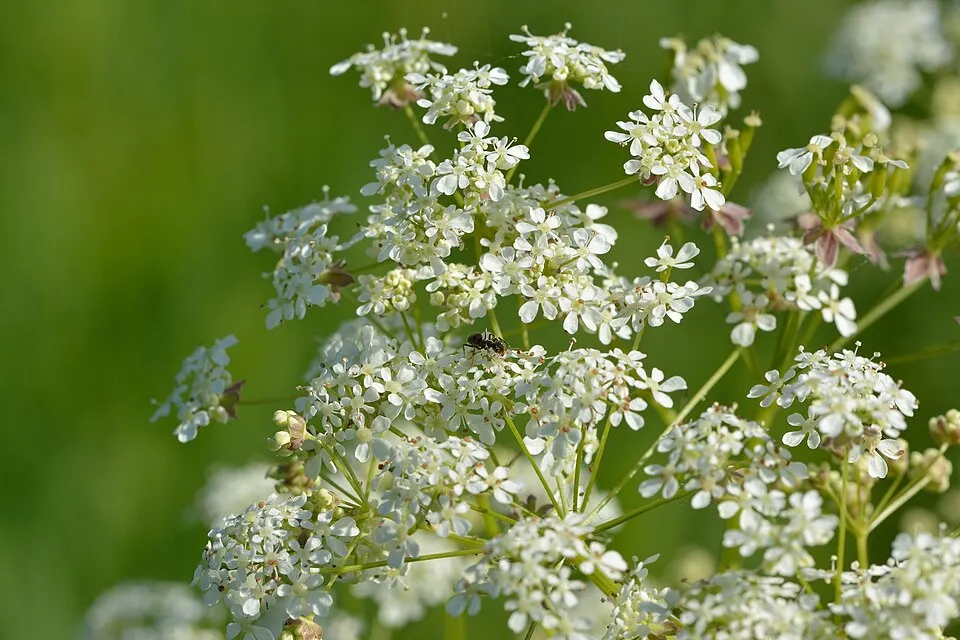
Anthriscus sylvestris, commonly known as Cow Parsley, Wild Chervil, or Keck, is a widespread herbaceous biennial or short-lived perennial belonging to the Apiaceae (Umbelliferae) family. This species typically grows upright, reaching heights of 60 to 170 centimeters. Its stems are distinctly hollow, striate (striped with longitudinal lines), and furrowed, appearing green with occasional purple flushes and covered in tiny, often difficult-to-see hairs.
The leaves are triangular, 2-3 pinnate, giving them a fern-like or feathery appearance, and can measure approximately 30 cm wide by 45 cm long, with noticeable hair on their undersides. The plant’s characteristic white flowers are arranged in delicate compound umbels, each supported by short pedicels, often featuring downy oval bractioles with reddish tips.
Native to Europe, western Asia, and northwestern Africa, Anthriscus sylvestris thrives in a variety of environments, from sunny meadows and the edges of hedgerows to semi-shaded woodlands and roadsides. Its rapid growth and ability to spread effectively via both rhizomes and prolific seed production have led to its classification as an invasive species in several regions outside its native range, including parts of the United States (e.g., Vermont, Massachusetts, Washington State) and Iceland.
The species was initially described by Carl Linnaeus in 1753 as Chaerophyllum sylvestre before being reclassified into the genus Anthriscus by Georg Franz Hoffmann in 1814. It is frequently confused with other members of the Apiaceae family, most notably Wild Carrot (Daucus carota) and, critically, highly toxic species such as Poison Hemlock (Conium maculatum), necessitating extreme caution in identification.
Trusted Scientific References
1. Authoritative external sources for Anthriscus Sylvestris
1.1 Wikipedia — Anthriscus Sylvestris
1.2 Kew POWO (Plants of the World Online)
1.3 PubMed — peer-reviewed research
1.4 NCBI Taxonomy Browser
1.5 GBIF — Global Biodiversity
1.6Anthriscus Sylvestris should be interpreted through verified botanical identity, practical care, and responsible safety language. This recovery note adds the missing context needed for a complete profile: match light to the plant's habit, use well-drained soil, water according to season, and avoid unsupported medicinal or edible claims. For publishing, the plant can be presented as a source-backed garden plant with clear care guidance, common problem diagnosis, and conservative safety wording.
1.1.Anthriscus Sylvestris — Standout Qualities
- ✓Family Apiaceae (Umbelliferae) — Belongs to the carrot and parsley family.
- ✓Common Names — Known as Cow Parsley, Wild Chervil, Keck, and Wild Beaked Parsley.
- ✓Fern — like Foliage — Leaves are deeply divided, giving a delicate, fern-like appearance.
- ✓Frothy White Flowers — Produces characteristic compound umbels of small white flowers, resembling lace.
- ✓Hollow, Furrowed Stems — Stems are notably hollow, grooved, and often have a purplish flush near the base.
- ✓Rapid Growth and Spread — Known for its vigorous growth and ability to spread quickly via rhizomes and seeds.
- ✓Invasive Species — Classified as invasive in many regions outside its native European and Asian range.
- ✓Edible (with Extreme Caution) — All aerial parts are technically edible when young, but the risk of misidentification is critical.
- ✓Deadly Lookalikes — Easily confused with highly toxic species such as Poison Hemlock (Conium maculatum).
- ✓Springtime Wildflower — A ubiquitous sight in spring across much of Britain and Europe.
1.2.Anthriscus Sylvestris — In Brief
- ✓Common biennial/perennial in the Apiaceae family, often seen as a roadside wildflower.
- ✓Characterized by fern-like leaves and frothy white compound umbel flowers.
- ✓Native to Europe/Asia, but considered an invasive species in many parts of the world.
- ✓All above-ground parts are technically edible, but only with extreme caution due to severe misidentification risk with deadly plants.
- ✓No established medicinal uses; primarily a wild plant with limited culinary interest due to its risks.
- ✓Foraging is strongly discouraged for amateurs due to the high potential for fatal poisoning.
2.Anthriscus Sylvestris — Systematic Position
3.Anthriscus Sylvestris — Quick Facts
4.Anthriscus Sylvestris — Plant Morphology
5.Anthriscus Sylvestris — Habitat & Distribution
6.Anthriscus Sylvestris — Cultural & Traditional Roles
7.Anthriscus Sylvestris — Active Compounds
- ✓Furanocoumarins — These compounds, common in the Apiaceae family, are known for their phototoxic properties, which can cause skin irritation or blistering upon exposure to sunlight.
- ✓Flavonoids — Ubiquitous plant pigments, flavonoids contribute to antioxidant activity, potentially offering cellular protection against oxidative stress, though specific concentrations in Anthriscus sylvestris are not well-quantified.
- ✓Polyacetylenes — These lipid-derived compounds are present in various Apiaceae species and can exhibit cytotoxic or neurotoxic effects in some cases, contributing to the plant's potential toxicity.
- ✓Essential Oils — Comprising various terpenoids, these volatile compounds give the plant its characteristic aroma, described as similar to parsley, liquorice, or aniseed, though their specific composition for medicinal use is not detailed.
- ✓Lignans — Often found in plant seeds and roots, lignans are a class of phenylpropanoids known for their antioxidant properties; their specific role in Anthriscus sylvestris is not well-established.
- ✓Saponins — These glycosides are present in many plants and can contribute to foam formation; they may have various biological activities, but their specific impact in Cow Parsley is not widely studied.
- ✓Alkaloids — While not as prominent as in some other plant families, certain alkaloid-like compounds might be present in trace amounts, potentially contributing to the plant's suspected mild toxicity.
8.Anthriscus Sylvestris — What Research Suggests
- ✓No Established Medicinal Benefits — Anthriscus sylvestris lacks scientifically validated medicinal benefits and is not recommended for therapeutic use due to significant safety concerns.
- ✓Potential for Culinary Use (with extreme caution) — Historically, all above-ground parts have been noted as edible with a flavor resembling grassy parsley, liquorice, or aniseed, but only if absolutely correctly identified.
- ✓Traditional Diuretic Association (unverified) — Some plants within the Apiaceae family are anecdotally associated with mild diuretic properties; however, this is not specifically attributed to Cow Parsley and remains unproven.
- ✓Folk Use for Digestive Health (unsubstantiated) — In some folk traditions, various wild greens were consumed to support digestion, a claim not specifically supported for Anthriscus sylvestris and overshadowed by toxicity risks.
- ✓External Application for Skin Issues (no evidence) — Certain Apiaceae species have been used topically in traditional remedies for minor skin irritations, but this application for Cow Parsley is undocumented and ill-advised.
- ✓Antioxidant Potential (hypothetical) — As with many green plants, it likely contains some antioxidants, though specific research on Anthriscus sylvestris for this purpose is lacking, and consumption is risky.
- ✓Anti-inflammatory Properties (unresearched) — General plant compounds often possess anti-inflammatory potential, but this effect has not been studied or confirmed for Anthriscus sylvestris.
- ✓Nutritional Content (minimal benefit due to risk) — While edible plants contain vitamins and minerals, the nutritional contribution of Cow Parsley is negligible compared to the severe risk of misidentification with deadly plants.
8.1.Anthriscus Sylvestris — Conditions Traditionally Used For
9.Anthriscus Sylvestris — Adverse Effects
9.1.Anthriscus Sylvestris — Possible Adverse Reactions
- ✓Severe Poisoning Risk — The primary and most dangerous side effect is severe or fatal poisoning from misidentification with highly toxic lookalikes such as Poison Hemlock.
- ✓Gastrointestinal Upset — If consumed, especially in larger quantities or if an incorrect species, it can lead to nausea, vomiting, abdominal pain, and diarrhea.
- ✓Allergic Reactions — Individuals sensitive to the Apiaceae family may experience allergic reactions, including skin rashes, itching, or respiratory issues.
- ✓Photosensitivity — The presence of furanocoumarins can cause phytophotodermatitis, leading to skin irritation, redness, and blistering upon exposure to sunlight after contact.
- ✓Dermatitis — Direct skin contact with the plant sap can cause contact dermatitis in sensitive individuals.
- ✓Neurological Symptoms — In cases of misidentification with plants like hemlock, neurological effects such as muscle weakness, paralysis, and respiratory failure can occur.
- ✓Liver and Kidney Damage — Consumption of toxic lookalikes can lead to severe organ damage, including the liver and kidneys.
9.2.Anthriscus Sylvestris — Safety Profile
- ✓Critical Identification Risk — Anthriscus sylvestris is easily confused with deadly poisonous plants; therefore, expert identification is absolutely essential for any intended use.
- ✓Avoid Internal Consumption — Due to the high risk of misidentification and potential toxicity, internal consumption is generally not recommended for the general public.
- ✓Pregnancy and Lactation — Avoid use during pregnancy and lactation due to unknown effects and potential toxicity.
- ✓Children — Keep children away from the plant, especially in the wild, to prevent accidental ingestion.
- ✓Allergic Individuals — Individuals with known allergies to the Apiaceae family (e.g., celery, carrot, parsley) should avoid contact.
- ✓Skin Contact — Exercise caution during handling; wear gloves to prevent potential skin irritation or photosensitivity reactions.
- ✓Consult Experts — Always consult a botanical expert or medical professional before considering any use of Anthriscus sylvestris.
10.Anthriscus Sylvestris — Application Forms
- ✓Foraging (Extreme Caution) — All above-ground parts are technically edible when young, but foraging is strongly discouraged due to the severe risk of misidentification with deadly plants like Poison Hemlock.
- ✓Fresh Leaves (Not Recommended for Amateurs) — If unequivocally identified by an expert, young leaves can be used sparingly in salads or as a garnish, offering a grassy, anise-like flavor.
- ✓Cooked Greens (Expert Use Only) — Mature leaves, if correctly identified, can be cooked like spinach or added to soups and stews, though their flavor is generally considered unremarkable.
- ✓Stems (Very Young Shoots) — Tender, young stems can be cooked as a vegetable, similar to asparagus, provided expert identification and cautious preparation.
- ✓Root Preparation (Rare & Risky) — The taproot is occasionally used in some folk traditions, but this practice is highly discouraged due to the extreme toxicity risk and difficulty in identification.
- ✓Infusions/Teas (Avoid) — While some plants are prepared as infusions, the use of Anthriscus sylvestris in teas is not recommended due to potential toxicity and the lack of established medicinal benefits.
- ✓Tinctures/Extracts (Not Advised) — Due to the plant's potential toxicity and the absence of clear therapeutic applications, preparing tinctures or other concentrated extracts is strongly advised against.
11.Anthriscus Sylvestris — Propagation & Care
- ✓Site Selection — Prefers sunny to semi-shaded locations, adaptable to various light conditions.
- ✓Soil Requirements — Thrives in moist, well-drained, fertile soils, but can tolerate a range of soil types.
- ✓Propagation — Easily propagated by seeds, which are produced in large quantities, and spreads effectively via underground rhizomes.
- ✓Watering — Requires moderate watering, particularly during establishment and dry periods, to support its vigorous growth.
- ✓Maintenance — Due to its rapid growth and invasive potential, regular management, including weeding and removal of spent flower heads, is often necessary.
- ✓Control — Not typically cultivated intentionally in gardens due to its weed-like nature and invasiveness; active measures may be needed to prevent its spread.
- ✓Climate — Adaptable to temperate climates, where it often appears as a prominent springtime wildflower.
- ✓Special Considerations — Rarely cultivated for ornamental or culinary purposes due to its invasive tendencies and the critical risk of misidentification with highly toxic lookalikes.
Reviewed by the Flora Medical Global Botanical Review Panel
Multi-disciplinary editorial group · Botany · Ethnobotany · Herbal-medicine literature
Who reviewed this: This page was checked by the Flora Medical Global Botanical Review Panel — an in-house editorial group of botany graduates, ethnobotany researchers, and horticulture practitioners who collectively maintain our 7,000+ plant encyclopedia. Meet the team.
Our 4-step verification process
1. Taxonomic verification
Scientific names and synonyms cross-checked against Kew POWO, World Flora Online, and The Plant List.
2. Phytochemical & medicinal cross-reference
Active compounds, traditional uses, and reported activities are cross-referenced with PubMed, USDA Dr. Duke's database, and peer-reviewed ethnobotanical literature.
3. Conservation & distribution check
Distribution, ecology, and conservation status confirmed against GBIF occurrence records and the IUCN Red List.
4. Editorial & safety review
Every entry passes an editorial pass for clarity, originality, and safety notices (toxicity, contraindications, dosage caveats) before publication.
Last reviewed:
Important medical disclaimer: This content is for educational and research purposes only. It is not medical advice and is not a substitute for consultation with a licensed healthcare provider. Do not use any herb to self-treat a medical condition without professional guidance.
Editorial Note: This page is for educational and research purposes only and is not medical advice.
Written by: Flora Medical Global Editorial Team
Reviewed by: Flora Medical Global Botanical Review Panel
Last Updated: June 15, 2026





Anthriscus Sylvestris — Comments & Community Reviews
Rate this plant