
Medical Disclaimer: This content is for educational purposes only. It is not medical advice. Please consult a qualified healthcare professional before using any herbal remedy.
Safety Overview
1.Anthurium Luxurians — Plant Snapshot
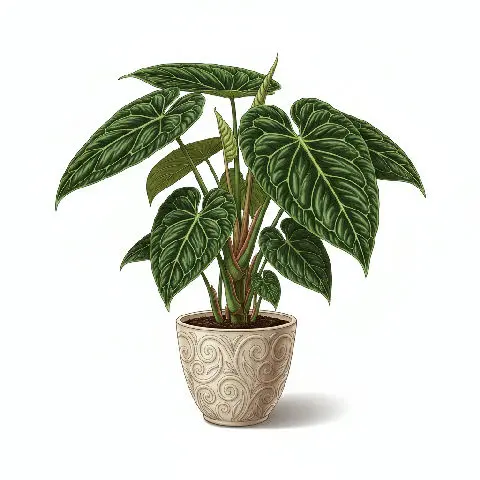
Anthurium luxurians, often celebrated as the 'Jewel Anthurium,' is an exquisite terrestrial aroid indigenous to the dense, humid tropical rainforests of Colombia. This species is highly prized among botanical connoisseurs for its extraordinarily textured foliage. Each leaf presents a deeply bullate, or puckered, surface, giving it a distinctive quilted or hammered appearance. Emerging in vibrant, almost iridescent green, the leaves mature into a deep, glossy, almost black-green hue, frequently displaying subtle silver or bronze undertones that shift with light conditions and age.
This unique texture is a hallmark feature, distinguishing it from many other Anthurium species. Its growth habit is naturally robust and compact, enhancing its appeal as an indoor specimen. While many Anthuriums are cultivated for their colorful inflorescences (spathes), Anthurium luxurians is sought almost exclusively for its unparalleled architectural foliage. Taxonomically, it belongs to the Araceae family, a vast group of monocotyledonous flowering plants, and is part of the Anthurium genus, the largest within the aroids with over 1,000 species.
In its natural habitat, Anthurium luxurians thrives under the canopy, experiencing consistently warm temperatures, high humidity, and dappled, indirect light. It typically grows terrestrially on the forest floor or occasionally as a low-level epiphyte or lithophyte, anchoring itself to tree trunks or rocks.
Trusted Scientific References
1. Authoritative external sources for Anthurium luxurians
1.1 Wikipedia — Anthurium luxurians
1.2 Kew POWO (Plants of the World Online)
1.3 PubMed — peer-reviewed research
1.4 NCBI Taxonomy Browser
1.5 GBIF — Global Biodiversity
1.6Anthurium Luxurians should be interpreted through verified botanical identity, practical care, and responsible safety language. This recovery note adds the missing context needed for a complete profile: match light to the plant's habit, use well-drained soil, water according to season, and avoid unsupported medicinal or edible claims. For publishing, the plant can be presented as a source-backed indoor plant with clear care guidance, common problem diagnosis, and conservative safety wording.
1.1.Anthurium Luxurians — Standout Qualities
- ✓Deeply bullate (quilted) — Deeply bullate (quilted) leaf texture.
- ✓Glossy, dark green to black — green leaves with iridescent undertones.
- ✓Terrestrial or low — level epiphyte/lithophyte growth habit.
- ✓Endemic to Colombian — Endemic to Colombian rainforests.
- ✓Primarily ornamental, no — Primarily ornamental, no known safe medicinal applications.
- ✓Member of the — Member of the large Araceae family.
- ✓Requires high humidity — Requires high humidity and stable warm temperatures.
- ✓Contains calcium oxalate, — Contains calcium oxalate, making it toxic if ingested.
- ✓Compact and robust — Compact and robust growth form.
- ✓Unique architectural element — Unique architectural element for plant collections.
1.2.Anthurium Luxurians — At-a-Glance Summary
- ✓'Jewel Anthurium' with unique, deeply textured foliage.
- ✓Native to the humid tropical forests of Colombia.
- ✓Prized for ornamental value, not traditional medicinal use.
- ✓Contains irritant calcium oxalate crystals in all parts.
- ✓Requires high humidity, indirect light, and consistent warmth.
- ✓Offers ambient benefits like air purification and stress reduction.
2.Anthurium Luxurians — Scientific Profile
3.Anthurium Luxurians — Reference Facts
4.Anthurium Luxurians — Morphological Account
5.Anthurium Luxurians — Geographic Distribution
6.Anthurium Luxurians — Ethnobotanical Uses
7.Anthurium Luxurians — Secondary Metabolites
- ✓Calcium Oxalate Crystals — Predominantly present as insoluble raphides and druse crystals throughout all plant tissues, responsible for severe irritation upon contact or ingestion.
- ✓Flavonoids — Including compounds like quercetin and kaempferol derivatives, potentially contributing to mild antioxidant properties, though not for internal consumption due to toxicity.
- ✓Saponins — Trace amounts of triterpenoid saponins may be present, which in other plants can exhibit surfactant properties, but their concentration and safety in Anthurium luxurians are not established for medicinal use.
- ✓Tannins — Low levels of polyphenolic compounds providing mild astringent properties, typically found in plant leaves and stems, contributing to defense mechanisms.
- ✓Anthocyanins — Pigments that may contribute to subtle undertones in leaf coloration, offering minor antioxidant activity in other plant species.
- ✓Alkaloids — Extremely low or negligible quantities, generally not considered a primary active constituent of medicinal significance in this species.
- ✓Glycosides — Various non-specific glycosidic compounds typically involved in plant metabolism and defense, not identified as medicinally active in A. luxurians.
- ✓Volatile Organic Compounds (VOCs) — Emitted in trace amounts, contributing to the plant's interaction with its environment, but not in concentrations for therapeutic benefit.
8.Anthurium Luxurians — Modern Studies
- ✓Air Purification — As a foliage plant, Anthurium luxurians contributes to indoor air quality by potentially absorbing common airborne toxins, creating a healthier living environment.
- ✓Stress Reduction (Ambient) — The presence of lush green plants like Anthurium luxurians in living spaces is associated with reduced psychological stress and improved mood, promoting a sense of tranquility.
- ✓Aesthetic Enhancement — Its unique and striking foliage provides significant ornamental value, transforming spaces into visually appealing and natural sanctuaries.
- ✓Connection to Nature — Cultivating Anthurium luxurians fosters a deeper connection with the natural world, which can enhance overall well-being and mindfulness.
- ✓Symbolic Gifting — Culturally, the plant's robust growth and lush appearance symbolize love, hospitality, and resilience, making it a meaningful gift for personal growth and strengthening bonds.
- ✓Humidifying Properties — Through transpiration, the plant releases moisture into the air, potentially contributing to slightly increased ambient humidity, which can be beneficial in dry indoor environments.
- ✓Cognitive Stimulation (Artistic Muse) — Its distinctive form and deep hues can inspire creativity and serve as a living muse for artists and writers, encouraging appreciation for unique natural beauty.
- ✓Environmental Enrichment — Integrating Anthurium luxurians into indoor spaces enriches the immediate environment, fostering a sense of vitality and promoting a positive atmosphere.
8.1.Anthurium Luxurians — Therapeutic Indications
9.Anthurium Luxurians — Risk Profile
9.1.Anthurium Luxurians — Side Effects & Warnings
- ✓Oral Irritation — Ingestion causes immediate and severe burning, swelling, and pain in the mouth, throat, and tongue due to calcium oxalate crystals.
- ✓Gastrointestinal Distress — If ingested, symptoms may include nausea, vomiting, abdominal cramps, and diarrhea.
- ✓Skin Irritation — Direct contact with the sap can cause dermatitis, redness, itching, and rash in sensitive individuals.
- ✓Eye Irritation — Contact with sap can lead to severe eye pain, redness, and swelling.
- ✓Allergic Reactions — Though rare, some individuals may experience allergic responses to plant components beyond direct irritation.
- ✓Respiratory Distress — Inhalation of fine particles or sap can potentially cause irritation to the respiratory tract, leading to coughing or difficulty breathing.
9.2.Anthurium Luxurians — Toxicity Assessment
- ✓Highly Toxic upon Ingestion — Contains insoluble calcium oxalate crystals; never consume any part of the plant.
- ✓Keep Out of Reach — Ensure Anthurium luxurians is inaccessible to children and pets to prevent accidental ingestion.
- ✓Handle with Gloves — Always wear gloves when handling, pruning, or repotting to avoid skin contact with irritant sap.
- ✓Eye Protection — Exercise caution to prevent sap from contacting eyes; rinse immediately and thoroughly if exposure occurs.
- ✓Wash Hands Thoroughly — After handling the plant, wash hands with soap and water even if gloves were worn.
- ✓No Medicinal Internal Use — Despite general plant benefits, Anthurium luxurians has no established safe internal medicinal uses and should never be prepared for consumption.
- ✓Consult Poison Control — In case of accidental ingestion or severe exposure, seek immediate medical attention or contact poison control.
10.Anthurium Luxurians — Preparation & Dosage
- ✓Ornamental Houseplant — Cultivated exclusively for its stunning foliage to enhance indoor aesthetics and promote a calming environment.
- ✓Air Quality Improvement — Strategically place in living areas to contribute to general indoor air purification and environmental enrichment.
- ✓Decorative Element — Utilize its unique texture and color as a focal point in interior design, adding a touch of tropical elegance.
- ✓Gifting for Symbolism — Present as a thoughtful gift to symbolize love, hospitality, resilience, and personal growth.
- ✓Terrarium or Conservatory Specimen — Ideal for high-humidity, controlled environments like terrariums or greenhouses where its specific needs can be met.
- ✓Botanical Study — Used by plant enthusiasts and botanists for its unique morphological characteristics and horticultural interest.
- ✓Photo and Art Inspiration — Its distinctive leaves serve as an artistic muse, inspiring creative works and botanical photography.
- ✓Mindful Plant Care — Engaging in its specific care routine can be a meditative practice, fostering patience and connection with nature.
11.Anthurium Luxurians — Growth Requirements
- ✓Light — Provide bright, indirect light; avoid direct sunlight which can scorch leaves.
- ✓Humidity — Requires high humidity (70-85%); use a humidifier or pebble tray.
- ✓Watering — Water thoroughly when the top inch of soil feels dry; avoid overwatering to prevent root rot.
- ✓Soil — Use a well-draining, airy potting mix rich in organic matter (e.g., orchid bark, perlite, coco coir).
- ✓Temperature — Maintain warm temperatures between 18-29°C (65-85°F); protect from cold drafts.
- ✓Fertilization — Feed monthly during the growing season with a balanced liquid fertilizer diluted to half strength.
- ✓Potting — Repot every 1-2 years into a slightly larger pot, ensuring good drainage.
- ✓Propagation — Primarily propagated by division of mature plants or stem cuttings, though rooting can be slow.
Reviewed by the Flora Medical Global Botanical Review Panel
Multi-disciplinary editorial group · Botany · Ethnobotany · Herbal-medicine literature
Who reviewed this: This page was checked by the Flora Medical Global Botanical Review Panel — an in-house editorial group of botany graduates, ethnobotany researchers, and horticulture practitioners who collectively maintain our 7,000+ plant encyclopedia. Meet the team.
Our 4-step verification process
1. Taxonomic verification
Scientific names and synonyms cross-checked against Kew POWO, World Flora Online, and The Plant List.
2. Phytochemical & medicinal cross-reference
Active compounds, traditional uses, and reported activities are cross-referenced with PubMed, USDA Dr. Duke's database, and peer-reviewed ethnobotanical literature.
3. Conservation & distribution check
Distribution, ecology, and conservation status confirmed against GBIF occurrence records and the IUCN Red List.
4. Editorial & safety review
Every entry passes an editorial pass for clarity, originality, and safety notices (toxicity, contraindications, dosage caveats) before publication.
Last reviewed:
Important medical disclaimer: This content is for educational and research purposes only. It is not medical advice and is not a substitute for consultation with a licensed healthcare provider. Do not use any herb to self-treat a medical condition without professional guidance.
Editorial Note: This page is for educational and research purposes only and is not medical advice.
Written by: Flora Medical Global Editorial Team
Reviewed by: Flora Medical Global Botanical Review Panel
Last Updated: June 15, 2026





Anthurium Luxurians — Comments & Community Reviews
Rate this plant