
Medical Disclaimer: This content is for educational purposes only. It is not medical advice. Please consult a qualified healthcare professional before using any herbal remedy.
Safety Overview
1.Arctostaphylos uva-ursi — Botanical Snapshot
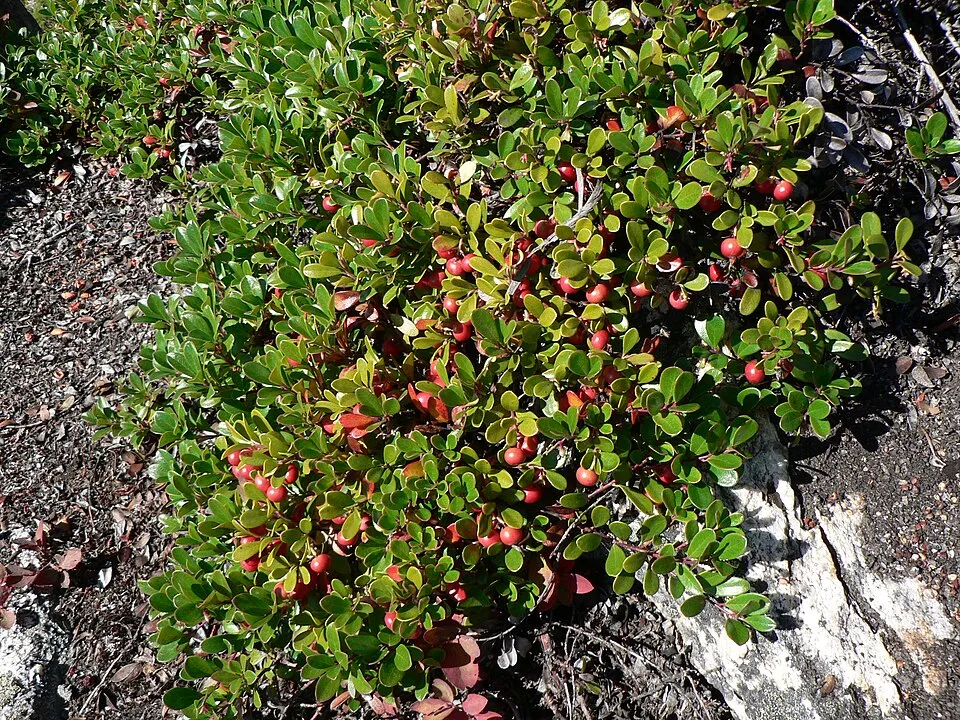
Arctostaphylos uva-ursi, commonly known as bearberry or uva ursi, is a resilient, low-growing evergreen shrub thriving in the harsh conditions of the northern hemisphere. Belonging to the Ericaceae family, this plant typically forms dense mats, spreading horizontally via creeping rhizomes, and reaching a modest height of 10 to 30 cm. Its distinctive leaves are leathery, glossy, and obovate to spatulate, measuring 1 to 4 cm in length, with a dark green upper surface and a paler underside, often displaying finely serrated edges.
In late spring to early summer, bearberry produces delicate clusters of small, urn-shaped flowers that range in color from pristine white to soft pink, measuring approximately 5 to 10 mm. These blossoms mature into bright red, fleshy drupes, 6 to 10 mm in diameter, which ripen in late summer and persist through winter, providing a food source for wildlife, especially bears, hence its common name.
The plant demonstrates a circumpolar distribution, flourishing across North America, Europe, and Asia in dry, rocky, and acidic soils. It commonly inhabits open woodlands, heathlands, sandy dunes, and gravelly terrains, showcasing its adaptability to nutrient-poor environments.
Taxonomically, Arctostaphylos is derived from Greek words 'arktos' (bear) and 'staphylos' (bunch of grapes), referring to the berries being a favorite food for bears. Historically, indigenous peoples and European herbalists have long recognized and utilized bearberry for its potent medicinal properties, particularly its leaves for addressing urinary tract ailments and other bladder-related conditions, establishing its enduring legacy in both traditional and contemporary herbal medicine.
Trusted Scientific References
1. Authoritative external sources for Arctostaphylos uva-ursi (L.) Spreng.
1.1 Wikipedia — Arctostaphylos uva-ursi (L.) Spreng.
1.2 Kew POWO (Plants of the World Online)
1.3 PubMed — peer-reviewed research
1.4 NCBI Taxonomy Browser
1.5 GBIF — Global Biodiversity
1.6Arctostaphylos uva-ursi should be interpreted through verified botanical identity, practical care, and responsible safety language. This recovery note adds the missing context needed for a complete profile: match light to the plant's habit, use well-drained soil, water according to season, and avoid unsupported medicinal or edible claims. For publishing, the plant can be presented as a source-backed medicinal plant with clear care guidance, common problem diagnosis, and conservative safety wording.
1.1.Arctostaphylos uva-ursi — Distinguishing Points
- ✓Low — growing evergreen shrub with a sprawling habit.
- ✓Leathery, glossy leaves — Leathery, glossy leaves that are dark green above and pale green beneath.
- ✓Produces clusters of small, urn — shaped pink to white flowers.
- ✓Bears bright red, — Bears bright red, edible (though bland) berries that persist through winter.
- ✓Native to circumpolar — Native to circumpolar regions across North America, Europe, and Asia.
- ✓Thrives in dry, — Thrives in dry, rocky, and acidic soils, indicating drought tolerance.
- ✓Key medicinal compound — Key medicinal compound is arbutin, a hydroquinone glycoside.
- ✓Renowned for its — Renowned for its traditional use as a urinary antiseptic for UTIs.
- ✓Also recognized for its skin — lightening properties in cosmetic applications.
- ✓Requires alkaline urine — Requires alkaline urine for optimal therapeutic effect in the urinary tract.
1.2.Arctostaphylos uva-ursi — Quick Summary
- ✓Arctostaphylos uva-ursi is an evergreen shrub known as bearberry or uva ursi.
- ✓Primarily used for urinary tract infections (UTIs) and bladder health.
- ✓Its main active compound, arbutin, converts to antiseptic hydroquinone in alkaline urine.
- ✓Also used in cosmetics for skin depigmentation due to tyrosinase inhibition.
- ✓Recommended for short-term use due to potential toxicity with prolonged high doses.
- ✓Found globally in northern regions, thriving in dry, acidic soils.
2.Arctostaphylos uva-ursi — Nomenclature & Classification
3.Arctostaphylos uva-ursi — Vital Statistics
4.Arctostaphylos uva-ursi — Botanical Features
5.Arctostaphylos uva-ursi — Origin & Spread
6.Arctostaphylos uva-ursi — Heritage Uses
7.Arctostaphylos uva-ursi — Phytochemistry
- ✓Hydroquinone Glycosides — Arbutin is the primary active compound, a hydroquinone glycoside that is metabolized into hydroquinone in alkaline urine, providing potent urinary antiseptic action. Methylarbutin is also present, acting as a similar precursor.
- ✓Phenolic Acids — Gallic acid and ellagic acid are present, contributing to the plant's antioxidant and astringent properties, and supporting overall cellular health.
- ✓Triterpenoids — Compounds such as amyrin, betulinic acid, lupeol, oleanolic acid, taraxenol, ursolic acid, and uvaol are found, known for their anti-inflammatory and hepatoprotective effects.
- ✓Tannins — High concentrations of hydrolyzable tannins (e.g., gallotannins) impart significant astringent properties, contributing to its traditional use for toning tissues and reducing secretions.
- ✓Flavonoids — Various flavonoids are present, which often act as antioxidants and may contribute to anti-inflammatory and vasoprotective effects.
- ✓Iridoids — These bitter compounds are found in some Ericaceae species and may contribute to its overall medicinal profile, though less prominent than arbutin.
- ✓Ursone — A triterpenoid derivative, ursone is another constituent that may contribute to the plant's pharmacological activities.
- ✓Steroids — Sitosterol, a phytosterol, is present and known for its anti-inflammatory and cholesterol-lowering properties.
- ✓Ericolin — This glucoside is another minor constituent that contributes to the complex phytochemistry of bearberry.
8.Arctostaphylos uva-ursi — Evidence-Based Benefits
- ✓Urinary Tract Antiseptic — Bearberry leaves are renowned for their antiseptic action on the urinary tract, primarily due to the metabolite hydroquinone, which is released from arbutin in alkaline urine and directly combats bacterial growth.
- ✓Diuretic Properties — The plant promotes increased urine flow, assisting in flushing out pathogens from the urinary system and reducing fluid retention.
- ✓Astringent Action — High tannin content provides astringent effects, helping to tone and tighten mucous membranes within the urinary passages, which can reduce irritation and inflammation.
- ✓Anti-inflammatory Effects — Constituents like ursolic acid and other triterpenoids contribute to its anti-inflammatory properties, soothing irritated tissues in the bladder and urethra.
- ✓Skin Depigmentation — Arbutin, a key compound, inhibits tyrosinase, an enzyme crucial for melanin production, making bearberry extracts useful in cosmetic formulations for reducing hyperpigmentation and brightening skin tone.
- ✓Antimicrobial Activity — In addition to its specific urinary antiseptic action, bearberry extracts have demonstrated broader antimicrobial activity against various pathogens, including Candida albicans, Staphylococcus aureus, and Escherichia coli.
- ✓Vulvovaginitis Relief — Used topically in traditional women's health, bearberry can act as an antiseptic and astringent to alleviate vulvar and urethral irritation associated with vulvovaginitis.
- ✓Wound Healing Support — The astringent and antiseptic properties may indirectly support the healing of minor skin abrasions or irritations when applied externally.
- ✓Antioxidant Activity — Phenolic compounds like gallic and ellagic acids contribute to the plant's antioxidant capacity, protecting cells from oxidative stress.
- ✓Bladder Irritation Soother — Its combined anti-inflammatory and astringent actions help to calm and reduce discomfort associated with bladder irritation.
8.1.Arctostaphylos uva-ursi — Health Applications
9.Arctostaphylos uva-ursi — Cautions & Contraindications
9.1.Arctostaphylos uva-ursi — Possible Adverse Reactions
- ✓Gastric Upset — High tannin content can cause nausea, vomiting, or stomach irritation, especially on an empty stomach.
- ✓Urine Darkening — Urine may darken to a brownish-green color upon standing due to the excretion of hydroquinone metabolites.
- ✓Allergic Reactions — Rare instances of dyspnea, cyanosis, or skin rashes have been reported after consuming aqueous decoctions.
- ✓Visual Acuity Reduction — Prolonged use (e.g., 3 years) has been linked to reduced visual acuity and bull's-eye maculopathy in isolated cases, possibly due to impaired melanin synthesis.
- ✓Liver Damage — Although rare, very high doses or prolonged use may pose a theoretical risk to liver function due to hydroquinone toxicity.
- ✓Carcinogenicity Concern — Long-term, high-dose administration of hydroquinone in animal studies has raised questions regarding potential carcinogenicity, although direct human relevance for typical herbal use is debated.
9.2.Arctostaphylos uva-ursi — Clinical Safety Notes
- ✓Pregnancy and Breastfeeding — Contraindicated during pregnancy and breastfeeding due to potential uterine stimulation and unknown effects on infants.
- ✓Children — Not recommended for use in children under 12 years of age, as their systems are more sensitive to its active compounds.
- ✓Kidney Conditions — Individuals with severe kidney disease should avoid bearberry due to the metabolic burden of hydroquinone.
- ✓Long-term Use — Avoid prolonged or continuous use; typically recommended for no more than 5-7 days due to potential toxicity concerns related to hydroquinone.
- ✓Urine pH Management — If alkalinizing urine with sodium bicarbonate, be aware of risks like high sodium load and potential interactions with other medications.
- ✓Drug Interactions — May interact with medications that are affected by changes in urine pH or those that are renally excreted; consult a healthcare provider.
- ✓Dosage Adherence — Adhere strictly to recommended dosages to minimize the risk of adverse effects.
10.Arctostaphylos uva-ursi — Preparation Methods
- ✓Herbal Tea (Infusion) — Dried bearberry leaves are commonly prepared as an infusion by steeping 1-2 teaspoons in hot water for 10-15 minutes; typically consumed 2-3 times daily for urinary support.
- ✓Decoction — For a stronger preparation, leaves can be simmered in water for a longer period, though this might extract more tannins, potentially increasing gastric upset.
- ✓Tincture — A concentrated liquid extract made by soaking leaves in alcohol, offering a convenient and potent form for internal use; dosage as directed by a healthcare professional.
- ✓Standardized Extracts — Available in capsule or tablet form, these provide precise dosages of active compounds like arbutin, often preferred for consistent efficacy.
- ✓Topical Rinses — Infusions or diluted tinctures can be used as external rinses or in sitz baths to alleviate vulvar or urethral irritation, as traditionally practiced.
- ✓Urine Alkalinization — To enhance the efficacy of hydroquinone, it is often suggested to consume alkaline-forming foods or, cautiously, sodium bicarbonate, under professional guidance, to ensure urine pH is above 7.0.
- ✓Short-term Use — Due to potential side effects, bearberry preparations are generally recommended for short-term use, typically not exceeding one week.
11.Arctostaphylos uva-ursi — Cultivation & Care
- ✓Soil Preference — Bearberry thrives in very well-drained, acidic to neutral soils (pH 4.5-7.0), preferring sandy, gravelly, or rocky substrates.
- ✓Light Requirements — It performs best in full sun to partial shade, tolerating a range of light conditions but flowering and fruiting more profusely with ample sunlight.
- ✓Propagation — Can be propagated by seeds (requiring cold stratification for germination), semi-hardwood cuttings taken in late summer, or by layering its creeping stems.
- ✓Watering — Once established, Arctostaphylos uva-ursi is highly drought-tolerant and requires minimal watering, making it suitable for xeriscaping.
- ✓Climate — Hardy in USDA zones 2-8, it tolerates cold temperatures and adapts well to various northern climates.
- ✓Maintenance — This is a low-maintenance plant, generally pest and disease resistant, requiring little to no fertilization and only occasional pruning to maintain shape or remove dead growth.
- ✓Spacing — Allow adequate space for its sprawling habit, typically planting 60-90 cm apart for groundcover establishment.
Reviewed by the Flora Medical Global Botanical Review Panel
Multi-disciplinary editorial group · Botany · Ethnobotany · Herbal-medicine literature
Who reviewed this: This page was checked by the Flora Medical Global Botanical Review Panel — an in-house editorial group of botany graduates, ethnobotany researchers, and horticulture practitioners who collectively maintain our 7,000+ plant encyclopedia. Meet the team.
Our 4-step verification process
1. Taxonomic verification
Scientific names and synonyms cross-checked against Kew POWO, World Flora Online, and The Plant List.
2. Phytochemical & medicinal cross-reference
Active compounds, traditional uses, and reported activities are cross-referenced with PubMed, USDA Dr. Duke's database, and peer-reviewed ethnobotanical literature.
3. Conservation & distribution check
Distribution, ecology, and conservation status confirmed against GBIF occurrence records and the IUCN Red List.
4. Editorial & safety review
Every entry passes an editorial pass for clarity, originality, and safety notices (toxicity, contraindications, dosage caveats) before publication.
Last reviewed:
Important medical disclaimer: This content is for educational and research purposes only. It is not medical advice and is not a substitute for consultation with a licensed healthcare provider. Do not use any herb to self-treat a medical condition without professional guidance.
Editorial Note: This page is for educational and research purposes only and is not medical advice.
Written by: Flora Medical Global Editorial Team
Reviewed by: Flora Medical Global Botanical Review Panel
Last Updated: June 15, 2026





Arctostaphylos uva-ursi — Comments & Community Reviews
Rate this plant