


Medical Disclaimer: This content is for educational purposes only. It is not medical advice. Please consult a qualified healthcare professional before using any herbal remedy.
Safety Overview
1.Artemisia Stelleriana — At a Glance
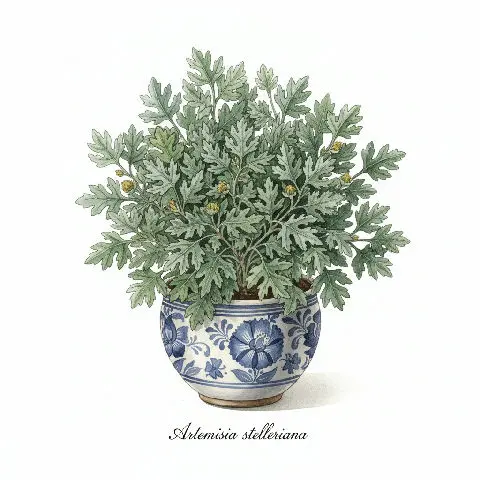
Artemisia stelleriana, commonly known as Beach Wormwood, Dusty Miller, or Old Woman, is a resilient perennial herb belonging to the expansive Asteraceae family. This distinctive plant is named in honor of the German botanist Georg Steller, who conducted significant botanical explorations.
Native to the harsh coastal environments of East Asia, including Japan, Korea, and northeastern China, as well as parts of North America such as Alaska and the Aleutian Islands, it has also naturalized along the Atlantic coast of North America. It thrives in exposed conditions like sandy beaches, dunes, and rocky coastal areas, playing a vital ecological role in soil stabilization and erosion prevention.
Its most striking feature is its dense, silvery-white, deeply lobed foliage, which provides a dramatic textural and color contrast in garden settings. The leaves are covered with fine, dense, velvety hairs, giving them a luminous appearance and serving as a crucial adaptation to minimize water loss in its often-windy and dry coastal habitats.
While primarily celebrated for its ornamental appeal, traditional medicine systems, particularly in its East Asian native regions, have historically explored its properties, albeit less extensively documented than other Artemisia species. Modern scientific inquiry is increasingly focused on its rich array of chemical constituents, including sesquiterpenoids, flavonoids, and essential oils, which hint at potential pharmacological applications.
Trusted Scientific References
1. Authoritative external sources for Artemisia stelleriana
1.1 Wikipedia — Artemisia stelleriana
1.2 Kew POWO (Plants of the World Online)
1.3 PubMed — peer-reviewed research
1.4 NCBI Taxonomy Browser
1.5 GBIF — Global Biodiversity
1.6Artemisia Stelleriana should be interpreted through verified botanical identity, practical care, and responsible safety language. This recovery note adds the missing context needed for a complete profile: match light to the plant's habit, use well-drained soil, water according to season, and avoid unsupported medicinal or edible claims. For publishing, the plant can be presented as a source-backed garden plant with clear care guidance, common problem diagnosis, and conservative safety wording.
1.1.Artemisia Stelleriana — Highlights
- ✓Common Names — Beach Wormwood, Dusty Miller, Old Woman, Hoary Mugwort, Dusty Miller Sagewort.
- ✓Scientific Name — Artemisia stelleriana.
- ✓Family — Asteraceae (Sunflower family).
- ✓Native Distribution — Coastal East Asia (Japan, Korea, China, Russian Far East) and North America (Alaska, Aleutian Islands).
- ✓Distinctive Foliage — Silvery-white, deeply lobed, fuzzy, evergreen leaves providing strong visual contrast.
- ✓Growth Habit — Creeping herbaceous perennial, forming an attractive groundcover.
- ✓Medicinal Potential — Investigated for anti-inflammatory, antioxidant, and antimicrobial activities.
- ✓Environmental Adaptations — Highly tolerant of salt spray, drought, and poor, sandy soils.
- ✓Ecological Role — Acts as a natural soil stabilizer in dune and coastal ecosystems.
- ✓Ornamental Value — Popular for xeriscaping, coastal gardens, rock gardens, and as an edging plant.
1.2.Artemisia Stelleriana — Concise Overview
- ✓Artemisia stelleriana, or Beach Wormwood, is a striking perennial herb of the Asteraceae family.
- ✓Known for its silvery, deeply lobed foliage and resilience in coastal environments.
- ✓Contains beneficial sesquiterpenoids, flavonoids, and essential oils.
- ✓Emerging research highlights its anti-inflammatory, antioxidant, and antimicrobial potential.
- ✓Primarily valued ornamentally, with traditional uses in East Asian folk medicine.
- ✓Requires full sun and well-drained, sandy soils, demonstrating high salt and drought tolerance.
2.Artemisia Stelleriana — Scientific Identity
3.Artemisia Stelleriana — Fact Sheet
4.Artemisia Stelleriana — Physical Description
5.Artemisia Stelleriana — Origin & Spread
6.Artemisia Stelleriana — Traditional Uses
7.Artemisia Stelleriana — Key Phytochemicals
- ✓Sesquiterpenoids — Key compounds like artemisinins (though specific to A. annua, the class is relevant) and other lactones contribute to anti-inflammatory and potential cytotoxic activities.
- ✓Flavonoids — Includes compounds such as quercetin and luteolin derivatives, which are potent antioxidants and contribute to anti-inflammatory effects.
- ✓Essential Oils — Composed of various monoterpenes (e.g., camphor, α-pinene) and sesquiterpenes, responsible for the plant's aroma and exhibiting antimicrobial properties.
- ✓Coumarins — May be present, offering potential anticoagulant, anti-inflammatory, and antimicrobial effects.
- ✓Phenolic Acids — Such as caffeic acid and chlorogenic acid, contributing significantly to the plant's overall antioxidant capacity.
- ✓Polyacetylenes — A class of compounds with potential antimicrobial and cytotoxic activities, found in various Asteraceae members.
- ✓Triterpenoids — Known for their anti-inflammatory, adaptogenic, and hepatoprotective properties, often present in plant extracts.
- ✓Sterols — Plant sterols are structural components that can also have cholesterol-lowering effects.
- ✓Polysaccharides — Complex carbohydrates that can possess immune-modulating properties.
8.Artemisia Stelleriana — Scientific Evidence
- ✓Anti-inflammatory Activity — Contains sesquiterpenoids and flavonoids that may modulate inflammatory pathways, potentially reducing swelling and discomfort.
- ✓Antioxidant Properties — Rich in phenolic compounds and flavonoids, it helps scavenge free radicals, protecting cells from oxidative damage.
- ✓Antimicrobial Potential — Essential oils and other extracts have shown inhibitory effects against certain bacteria and fungi in preclinical studies.
- ✓Digestive Support — Similar to other Artemisia species, its bitter compounds may stimulate digestive secretions, aiding in appetite and digestion.
- ✓Antiparasitic Effects — While not as potent as Artemisia annua, some Artemisia species exhibit properties that can be explored against internal parasites.
- ✓Skin Health — Traditionally, some Artemisia preparations are used topically to soothe minor skin irritations and promote healing due to anti-inflammatory and antiseptic qualities.
- ✓Immune Modulating — Certain constituents may interact with the immune system, contributing to overall immune balance.
- ✓Pain Relief — Its anti-inflammatory actions can indirectly contribute to alleviating mild to moderate pain, particularly related to inflammation.
- ✓Wound Healing — The combination of antimicrobial and anti-inflammatory effects suggests potential for supporting the healing of minor cuts and abrasions.
8.1.Artemisia Stelleriana — Health Applications
9.Artemisia Stelleriana — Safety Considerations
9.1.Artemisia Stelleriana — Reported Side Effects
- ✓Allergic Reactions — Individuals sensitive to the Asteraceae family (e.g., ragweed, chrysanthemums) may experience allergic contact dermatitis or respiratory symptoms.
- ✓Gastrointestinal Upset — High doses or prolonged internal use may lead to symptoms such as nausea, vomiting, abdominal cramps, or diarrhea.
- ✓Neurological Effects — While typically less severe than with Artemisia absinthium, very high concentrations or prolonged use could theoretically lead to neurological symptoms due to thujone-like compounds.
- ✓Uterine Stimulation — Some Artemisia species possess emmenagogue properties, potentially stimulating uterine contractions, posing a risk during pregnancy.
- ✓Skin Irritation — Direct contact with the plant's sap or essential oils can cause skin sensitization or irritation in susceptible individuals.
- ✓Photosensitivity — Some users may experience increased sensitivity to sunlight after internal consumption, though this is rare.
9.2.Artemisia Stelleriana — Safety Profile
- ✓Pregnancy and Lactation — Avoid use during pregnancy due to potential abortifacient or uterine stimulant effects; insufficient data exists regarding safety during lactation.
- ✓Allergies — Exercise caution if you have known allergies to plants in the Asteraceae family, as cross-reactivity may occur.
- ✓Dosage Adherence — Strictly follow recommended dosages; excessive intake can increase the risk and severity of adverse effects.
- ✓Drug Interactions — May potentially interact with anticoagulants, anti-seizure medications, or drugs metabolized by the liver; consult a healthcare professional before use.
- ✓Children and Infants — Not recommended for use in children or infants due to a lack of comprehensive safety data and potential for adverse reactions.
- ✓Long-term Use — Prolonged internal use is generally discouraged without professional medical supervision to prevent potential accumulation of active compounds and associated toxicity.
10.Artemisia Stelleriana — Preparations & Uses
- ✓Herbal Tea/Infusion — Dried leaves can be steeped in hot water to prepare a mild herbal tea, traditionally used for digestive complaints or as a general tonic.
- ✓Tincture Preparation — Aerial parts can be macerated in alcohol to create a concentrated liquid extract for internal use, administered in small, measured doses.
- ✓Topical Poultice/Compress — Freshly crushed leaves or a strong infusion can be applied directly to the skin as a poultice or compress for minor irritations or wounds.
- ✓Aromatic Use — Dried foliage can be used in potpourri or as a smudge stick for its distinctive, slightly aromatic scent, often used in traditional cleansing rituals.
- ✓Essential Oil (External) — If an essential oil is extracted, it can be diluted in a carrier oil for topical application to soothe muscle aches or skin issues.
- ✓Culinary (Limited) — Due to its bitter taste, it is used very sparingly, if at all, in culinary applications, primarily as a flavoring agent in certain regional cuisines.
- ✓Decoction — While less common for the leaves, if roots or tougher stems are used, they can be simmered in water to create a more potent extract for specific applications.
11.Artemisia Stelleriana — Cultivation & Care
- ✓Light Requirements — Thrives in full sun, requiring at least 6 hours of direct sunlight daily for optimal growth and foliage color.
- ✓Soil Preference — Prefers well-drained, sandy, or shallow rocky soils; tolerates a wide range of pH from acidic to alkaline.
- ✓Water Needs — Extremely drought-tolerant once established, making it ideal for xeriscaping; susceptible to root rot in overly wet conditions.
- ✓Climate Hardiness — Hardy in USDA Plant Hardiness Zones 3a through 9b, demonstrating excellent cold and heat tolerance.
- ✓Propagation — Easily propagated through division of its creeping rhizomes, stem cuttings, or by sowing seeds.
- ✓Maintenance — Low maintenance; benefits from occasional pruning to maintain a compact shape and remove spent flower stalks.
- ✓Growth Habit — Suitable as a groundcover or edging plant due to its spreading, mat-forming growth habit, requiring 12 inches to 3 feet of space.
Reviewed by the Flora Medical Global Botanical Review Panel
Multi-disciplinary editorial group · Botany · Ethnobotany · Herbal-medicine literature
Who reviewed this: This page was checked by the Flora Medical Global Botanical Review Panel — an in-house editorial group of botany graduates, ethnobotany researchers, and horticulture practitioners who collectively maintain our 7,000+ plant encyclopedia. Meet the team.
Our 4-step verification process
1. Taxonomic verification
Scientific names and synonyms cross-checked against Kew POWO, World Flora Online, and The Plant List.
2. Phytochemical & medicinal cross-reference
Active compounds, traditional uses, and reported activities are cross-referenced with PubMed, USDA Dr. Duke's database, and peer-reviewed ethnobotanical literature.
3. Conservation & distribution check
Distribution, ecology, and conservation status confirmed against GBIF occurrence records and the IUCN Red List.
4. Editorial & safety review
Every entry passes an editorial pass for clarity, originality, and safety notices (toxicity, contraindications, dosage caveats) before publication.
Last reviewed:
Important medical disclaimer: This content is for educational and research purposes only. It is not medical advice and is not a substitute for consultation with a licensed healthcare provider. Do not use any herb to self-treat a medical condition without professional guidance.
Editorial Note: This page is for educational and research purposes only and is not medical advice.
Written by: Flora Medical Global Editorial Team
Reviewed by: Flora Medical Global Botanical Review Panel
Last Updated: June 15, 2026





Artemisia Stelleriana — Comments & Community Reviews
Rate this plant