


Medical Disclaimer: This content is for educational purposes only. It is not medical advice. Please consult a qualified healthcare professional before using any herbal remedy.
Safety Overview
1.Asclepias Syriaca — Overview
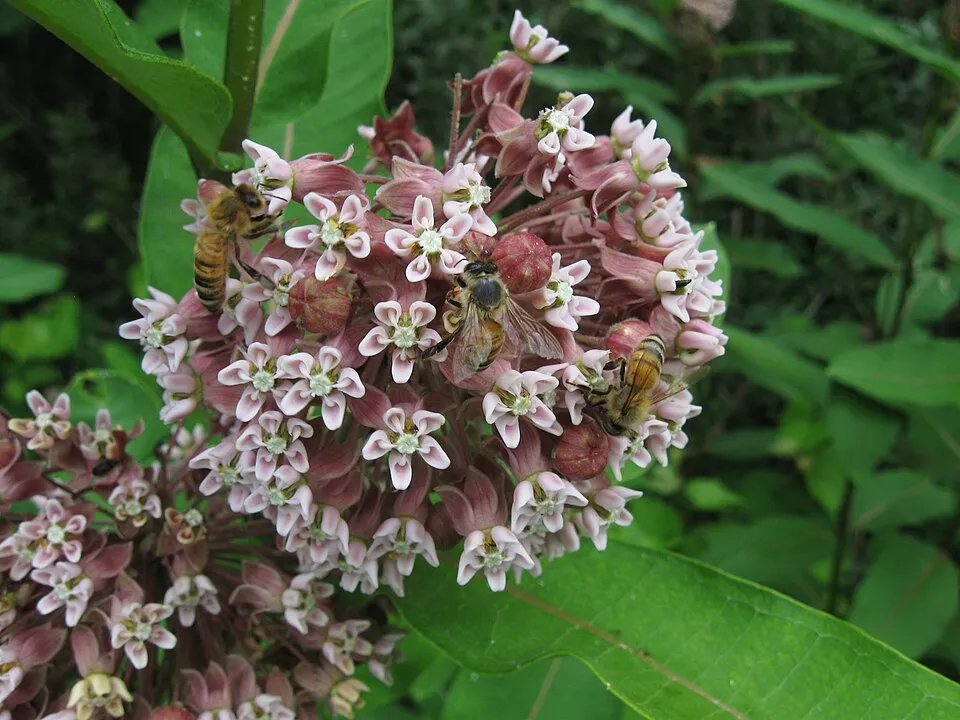
Asclepias syriaca, commonly known as Common Milkweed, is a robust herbaceous perennial belonging to the Asclepiadaceae family, now recognized as a subfamily within Apocynaceae. This distinctive plant typically reaches heights of 1 to 1.5 meters, forming dense colonies through its extensive rhizomatous root system. Its stout, upright stems are adorned with large, thick, paddle-shaped leaves, measuring 15-20 cm long and 5-9 cm wide. The leaves are oppositely arranged, featuring a light to dark green upper surface and a paler, sometimes almost white, underside with a prominent midrib.
When any part of the plant is broken, it exudes a characteristic white, milky latex sap. Flowering occurs from late spring to early summer, producing dense, nearly spherical clusters (umbels) of small, exquisitely scented flowers. These flowers range in color from greenish-pink to rosy pink or purplish-pink, attracting a wide array of pollinators. Following successful pollination, inflated, warty pods, about 10 cm long, develop, turning brown as they mature.
Each pod splits open to release 50-100 seeds, each equipped with a silky white coma, or 'parachute,' facilitating wind dispersal. Native to most of the eastern United States and southern Canada, Common Milkweed thrives in diverse habitats including fence rows, roadsides, open fields, prairies, and cultivated gardens, preferring full sun and well-drained soils.
Trusted Scientific References
1. Authoritative external sources for Asclepias Syriaca
1.1 Wikipedia — Asclepias Syriaca
1.2 Kew POWO (Plants of the World Online)
1.3 PubMed — peer-reviewed research
1.4 NCBI Taxonomy Browser
1.5 GBIF — Global Biodiversity
1.6Asclepias Syriaca should be interpreted through verified botanical identity, practical care, and responsible safety language. This recovery note adds the missing context needed for a complete profile: match light to the plant's habit, use well-drained soil, water according to season, and avoid unsupported medicinal or edible claims. For publishing, the plant can be presented as a source-backed garden plant with clear care guidance, common problem diagnosis, and conservative safety wording.
1.1.Asclepias Syriaca — Standout Qualities
- ✓Native North American — Native North American perennial wildflower.
- ✓Essential host plant — Essential host plant for Monarch butterfly caterpillars.
- ✓Exudes characteristic white, — Exudes characteristic white, milky latex sap.
- ✓Contains toxic cardiac — Contains toxic cardiac glycosides (cardenolides).
- ✓Produces sweetly scented pink — to-purple flowers in umbels.
- ✓Features large, thick, paddle — shaped leaves.
- ✓Spreads vigorously through — Spreads vigorously through underground rhizomes, forming colonies.
- ✓Seeds are dispersed — Seeds are dispersed by wind, aided by a silky white coma.
- ✓Possesses historical traditional — Possesses historical traditional medicinal uses, primarily external applications.
- ✓Thrives in full sun and well — drained soil conditions.
1.2.Asclepias Syriaca — At-a-Glance Summary
- ✓Common Milkweed (Asclepias syriaca) is a native North American perennial known for its distinctive milky sap.
- ✓It is an essential host plant for Monarch butterfly caterpillars, crucial for their lifecycle and conservation.
- ✓The plant contains cardiac glycosides, rendering it toxic if ingested and requiring extreme caution in handling.
- ✓Historically used externally for warts and internally for lung ailments, modern internal use is highly discouraged due to toxicity.
- ✓Valued primarily for its ecological role in supporting pollinators and its ornamental appeal in native plant gardens.
2.Asclepias Syriaca — Taxonomic Classification
3.Asclepias Syriaca — Botanical Stats
4.Asclepias Syriaca — Plant Morphology
5.Asclepias Syriaca — Habitat & Distribution
6.Asclepias Syriaca — Historical Applications
7.Asclepias Syriaca — Secondary Metabolites
- ✓Cardiac Glycosides (Cardenolides) — These potent compounds, including asclepiadin, are primarily responsible for the plant's toxicity and serve as a defense mechanism, affecting heart muscle contractility in high doses.
- ✓Flavonoids — Such as quercetin and kaempferol derivatives, these compounds are well-known for their significant antioxidant, anti-inflammatory, and potential vasodilatory properties.
- ✓Triterpenes — Compounds like lupeol and β-amyrin are often found, contributing to various biological activities including anti-inflammatory, analgesic, and potential hepatoprotective effects.
- ✓Phenolic Acids — Including caffeic acid and ferulic acid, these possess strong antioxidant and anti-inflammatory activities, playing a crucial role in protecting cells from oxidative damage.
- ✓Saponins — These naturally occurring compounds can exhibit expectorant and anti-inflammatory properties, often contributing to traditional uses for respiratory issues.
- ✓Resins — Complex mixtures present in the plant that can contain various active compounds, potentially contributing to antiseptic or wound-healing properties when applied externally.
- ✓Alkaloids — While not extensively detailed for Asclepias syriaca, some Asclepias species contain minor alkaloids that can exert diverse pharmacological actions.
- ✓Latex Constituents — The milky sap itself is a complex emulsion containing a mixture of cardiac glycosides, proteases (e.g., asclepain), and other compounds, historically utilized for its specific effects.
8.Asclepias Syriaca — Research Insights
- ✓Respiratory Support — Traditionally employed for lung ailments like pleurisy and coughs, the plant's compounds may have historically been used for expectorant or anti-inflammatory effects on the respiratory system, though internal use is cautioned.
- ✓Dermatological Applications — Historically, the milky latex sap of Common Milkweed was applied topically for wart removal, suggesting potential keratolytic properties that help dissolve skin growths.
- ✓Digestive Aid — In some traditional medicine systems, it was believed to assist digestive processes, potentially through mild laxative or carminative actions, though internal consumption is now highly discouraged due to toxicity.
- ✓Anti-inflammatory Potential — The presence of flavonoids and phenolic acids suggests a capacity to modulate inflammatory pathways, offering a theoretical basis for its traditional use in various inflammatory conditions.
- ✓Antioxidant Activity — Phytochemicals such as phenolic acids contribute to cellular protection by neutralizing free radicals, thereby supporting overall cellular health and reducing oxidative stress.
- ✓Diuretic Properties — Traditional use as a diuretic implies compounds that promote increased urine output, aiding in fluid balance and detoxification within historical contexts.
- ✓Emetic Action — Historically, certain preparations were used as an emetic to induce vomiting, a practice employed for expelling ingested substances, though this is not a recommended modern use.
- ✓General Wellness Enhancement — Its rich phytochemical profile, particularly its antioxidants, is thought to contribute to general vitality and systemic balance, as recognized in some traditional healing practices.
8.1.Asclepias Syriaca — Indications & Uses
9.Asclepias Syriaca — Adverse Effects
9.1.Asclepias Syriaca — Caution Notes
- ✓Gastrointestinal Upset — Ingestion can lead to severe nausea, vomiting, diarrhea, and abdominal pain due to the irritant nature of its compounds.
- ✓Cardiac Toxicity — High doses of cardiac glycosides can induce serious cardiovascular effects, including irregular heart rhythms, bradycardia, and potential heart failure.
- ✓Skin Irritation — Direct contact with the milky latex sap can cause contact dermatitis, skin rashes, redness, and significant irritation.
- ✓Ocular Damage — Exposure of the latex to the eyes can result in severe pain, burning, conjunctivitis, and potentially temporary vision impairment.
- ✓Central Nervous System Effects — In cases of severe poisoning, symptoms such as lethargy, weakness, muscle tremors, and incoordination may manifest.
- ✓Allergic Reactions — Sensitive individuals may experience allergic responses, including skin reactions or respiratory symptoms, upon exposure to the plant.
- ✓Liver and Kidney Stress — Chronic or high-dose internal exposure may potentially lead to adverse effects on liver and kidney function.
9.2.Asclepias Syriaca — Safety Overview
- ✓Highly Toxic Internally — Due to the presence of potent cardiac glycosides, internal consumption of Common Milkweed is generally NOT recommended and can be dangerous.
- ✓External Use with Extreme Caution — Topical application of the latex should be performed with utmost care, strictly avoiding contact with eyes, mucous membranes, and broken skin, and always patch testing first.
- ✓Pregnant and Nursing Women — Avoid use during pregnancy and lactation due to the potential for toxicity to the fetus or infant and a lack of established safety data.
- ✓Children and Pets — Keep all parts of the plant out of reach of children and pets to prevent accidental ingestion and severe poisoning.
- ✓Cardiac Conditions — Individuals with pre-existing heart conditions or those on cardiac medications should strictly avoid any form of use due to potential interactions and cardiac toxicity.
- ✓Drug Interactions — May interact adversely with cardiac medications (e.g., digoxin), diuretics, or other drugs affecting heart rhythm or electrolyte balance.
- ✓Expert Consultation — Always consult a qualified medical professional, toxicologist, or experienced herbalist before considering any medicinal use of Asclepias syriaca.
10.Asclepias Syriaca — Application Forms
- ✓Topical Application of Latex (Traditional) — Historically, the milky sap was carefully applied directly to warts for its purported keratolytic action, demanding extreme caution due to its irritant nature.
- ✓Herbal Infusions (Historical Internal Use) — Dried leaves or roots were traditionally prepared as infusions for respiratory ailments and as a diuretic, strictly under the guidance of experienced herbalists due to inherent toxicity.
- ✓Decoctions (Historical Internal Use) — Roots were sometimes decocted for internal use as an emetic or for lung conditions in very small, controlled doses within traditional practices, not recommended for self-medication today.
- ✓Poultices (External) — Crushed leaves or roots might have been applied externally as poultices for minor skin conditions, ensuring no application on broken skin due to the latex.
- ✓Tinctures (Traditional Herbalism) — In historical medicinal contexts, tinctures of various plant parts were prepared, though their internal use is highly specialized and generally avoided today due to toxicity and safety concerns.
- ✓Seed Floss for Craft — The silky coma attached to the seeds is utilized as a natural stuffing material or sustainable fiber in various textile and craft applications.
- ✓Cultivation for Pollinator Habitat — Planting Common Milkweed is a widely adopted method to provide essential food and habitat for Monarch butterfly caterpillars and other crucial pollinators.
11.Asclepias Syriaca — Growth Requirements
- ✓Soil Preference — Thrives best in well-drained soil with a pH ranging from 6.0 to 7.5, accommodating various soil types from sandy to clay.
- ✓Light Requirements — Prefers full sun exposure for optimal growth and flowering, though it can tolerate light shade, albeit with reduced vigor.
- ✓Watering — Requires regular watering, particularly during dry spells, but exhibits good drought tolerance once established due to its deep root system.
- ✓Planting Time — Best planted in the spring after the last frost date to allow ample time for establishment and growth before winter.
- ✓Fertilization — Benefits from a light application of a balanced organic fertilizer in spring to enhance growth, flowering, and overall plant health.
- ✓Propagation — Readily propagates from seeds and spreads aggressively via its deep rhizomes, quickly forming dense colonies.
- ✓Garden Placement — Due to its vigorous spreading nature, it should be planted in areas where its colonial growth habit can be accommodated or managed.
- ✓Pollinator Support — Cultivating Common Milkweed is crucial for supporting Monarch butterfly populations, as it is the sole host plant for their caterpillars.
Reviewed by the Flora Medical Global Botanical Review Panel
Multi-disciplinary editorial group · Botany · Ethnobotany · Herbal-medicine literature
Who reviewed this: This page was checked by the Flora Medical Global Botanical Review Panel — an in-house editorial group of botany graduates, ethnobotany researchers, and horticulture practitioners who collectively maintain our 7,000+ plant encyclopedia. Meet the team.
Our 4-step verification process
1. Taxonomic verification
Scientific names and synonyms cross-checked against Kew POWO, World Flora Online, and The Plant List.
2. Phytochemical & medicinal cross-reference
Active compounds, traditional uses, and reported activities are cross-referenced with PubMed, USDA Dr. Duke's database, and peer-reviewed ethnobotanical literature.
3. Conservation & distribution check
Distribution, ecology, and conservation status confirmed against GBIF occurrence records and the IUCN Red List.
4. Editorial & safety review
Every entry passes an editorial pass for clarity, originality, and safety notices (toxicity, contraindications, dosage caveats) before publication.
Last reviewed:
Important medical disclaimer: This content is for educational and research purposes only. It is not medical advice and is not a substitute for consultation with a licensed healthcare provider. Do not use any herb to self-treat a medical condition without professional guidance.
Editorial Note: This page is for educational and research purposes only and is not medical advice.
Written by: Flora Medical Global Editorial Team
Reviewed by: Flora Medical Global Botanical Review Panel
Last Updated: June 15, 2026





Asclepias Syriaca — Comments & Community Reviews
Rate this plant