


Medical Disclaimer: This content is for educational purposes only. It is not medical advice. Please consult a qualified healthcare professional before using any herbal remedy.
Safety Overview
1.Asparagus Plumosus — Essential Profile
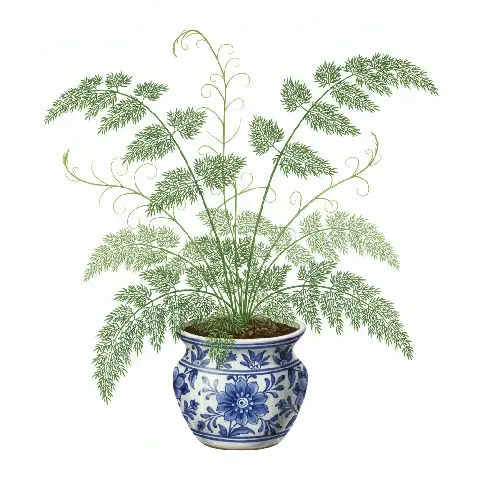
Asparagus setaceus 'Plumosus', often recognized by its common names Asparagus Fern, Plumosa Fern, or Lace Fern, is a distinctive evergreen perennial belonging to the Asparagaceae family. Despite its common name, it is not a true fern but a member of the lily-like group, characterized by its delicate, feathery appearance. Native to the subtropical and tropical regions of South Africa, particularly the Cape Province and KwaZulu-Natal, and extending into Central Ethiopia, this plant has been widely cultivated globally since the late 19th century.
Its highly prized 'foliage' consists of minute, scale-like true leaves and flattened, needle-like modified stems known as cladodes, which perform photosynthesis and give the plant its characteristic lace-like texture. Asparagus setaceus 'Plumosus' exhibits a vigorous, scrambling or climbing growth habit, often utilizing other vegetation for support, and can reach significant lengths in its natural environment. It produces inconspicuous small white flowers that develop into small, round berries, typically green when immature and ripening to a deep red or black.
While admired for its graceful aesthetics, particularly in floristry where its sprays add softness and texture to arrangements, corsages, and bouquets, its robust nature has also led to its classification as an invasive species in some non-native regions, including parts of Australia, New Zealand, Cuba, and Hawaii, where it can outcompete indigenous flora. The plant's stems also feature sharp spines, contributing to its robust yet delicate facade.
Trusted Scientific References
1. Authoritative external sources for Asparagus plumosus
1.1 Wikipedia — Asparagus plumosus
1.2 Kew POWO (Plants of the World Online)
1.3 PubMed — peer-reviewed research
1.4 NCBI Taxonomy Browser
1.5 GBIF — Global Biodiversity
1.6Asparagus Plumosus should be interpreted through verified botanical identity, practical care, and responsible safety language. This recovery note adds the missing context needed for a complete profile: match light to the plant's habit, use well-drained soil, water according to season, and avoid unsupported medicinal or edible claims. For publishing, the plant can be presented as a source-backed indoor plant with clear care guidance, common problem diagnosis, and conservative safety wording.
1.1.Asparagus Plumosus — Distinguishing Points
- ✓Delicate, feathery cladodes — Delicate, feathery cladodes
- ✓Evergreen perennial — Evergreen perennial
- ✓Scrambling or climbing — Scrambling or climbing growth habit
- ✓Small, inconspicuous white — Small, inconspicuous white flowers
- ✓Produces poisonous red — to-black berries
- ✓Stems adorned with — Stems adorned with sharp spines
- ✓Highly valued in — Highly valued in floristry for texture
- ✓Popular ornamental houseplant — Popular ornamental houseplant
- ✓Known invasive species — Known invasive species in some areas
- ✓Belongs to the — Belongs to the Asparagaceae family, not a true fern
1.2.Asparagus Plumosus — Quick Summary
- ✓Ornamental Asparagus Fern — A delicate-looking, evergreen perennial widely used for its aesthetic appeal in floristry and as a houseplant.
- ✓Not a True Fern — Despite its common name, it belongs to the Asparagaceae family, with feathery 'foliage' being modified stems (cladodes).
- ✓Toxic Berries and Spines — All parts, especially the red berries, are poisonous if ingested, and its stems bear sharp, irritating spines.
- ✓Invasive Potential — In many non-native regions, it is considered an aggressive invasive species, outcompeting local flora.
- ✓Low Medicinal Value — Primarily ornamental, with no significant traditional or modern medicinal uses attributed directly to this species.
- ✓Easy to Cultivate — Relatively easy to grow indoors with bright indirect light, high humidity, and consistent moisture.
2.Asparagus Plumosus — Scientific Identity
3.Asparagus Plumosus — Key Data
4.Asparagus Plumosus — Botanical Features
5.Asparagus Plumosus — Ecological Habitat
6.Asparagus Plumosus — Traditional Uses
7.Asparagus Plumosus — Key Phytochemicals
- ✓Steroidal Saponins — The Asparagus genus, including 'Plumosus', is known to contain various steroidal saponins, which are compounds of pharmacological interest for their potential anti-inflammatory and antioxidant activities, though specific bioactivity of 'Plumosus' saponins is not well-documented for medicinal use.
- ✓Flavonoids — These are a class of polyphenolic compounds widely distributed in plants, acting as natural antioxidants, and are likely present in 'Plumosus' as they are in other Asparagaceae members.
- ✓Polyphenolic Compounds — Beyond flavonoids, other polyphenols contribute to the plant's defense mechanisms and are generally found in plant tissues, offering antioxidant potential.
- ✓Vitamins — Like many green plants, 'Plumosus' may contain trace amounts of various vitamins, though it is not consumed for nutritional benefit.
- ✓Minerals — Essential minerals are present in all plant matter, contributing to cellular functions, but 'Plumosus' is not a dietary source.
- ✓Amino Acids — The building blocks of proteins, amino acids are fundamental to plant growth and metabolism, present in the plant's tissues.
- ✓Chlorophylls — The green pigment essential for photosynthesis, abundant in the cladodes of 'Plumosus'.
- ✓Carotenoids — These pigments, often associated with yellow, orange, or red colors, are also present in green tissues and berries, playing roles in photosynthesis and antioxidant defense.
- ✓Alkaloids — Some plants contain alkaloids, which are nitrogen-containing organic compounds; their presence and specific types in 'Plumosus' are less characterized but possible in trace amounts.
8.Asparagus Plumosus — Pharmacological Findings
- ✓Limited Medicinal Use — Asparagus setaceus 'Plumosus' itself is primarily an ornamental plant and is not recognized for prominent traditional or modern medicinal applications due to its known toxicity.
- ✓General Antioxidant Potential (Asparagus genus) — Other species within the Asparagus genus are known to contain antioxidants like flavonoids and polyphenols that may help neutralize free radicals, though this is not specifically attributed to 'Plumosus'.
- ✓Potential Anti-inflammatory Effects (Asparagus genus) — Some Asparagus species have shown compounds with anti-inflammatory properties, which may support overall well-being, but direct evidence for 'Plumosus' is lacking.
- ✓Diuretic Properties (Asparagus genus) — Certain Asparagus species are traditionally used for their mild diuretic action, potentially aiding in fluid balance, a benefit not confirmed for 'Plumosus'.
- ✓Immunomodulatory Support (Asparagus genus) — Research on related Asparagus species suggests components that could support immune system function, a characteristic not established for 'Plumosus'.
- ✓Digestive Health Support (Asparagus genus) — Fibers and compounds in edible Asparagus species can contribute to healthy digestion, a benefit not applicable to the toxic 'Plumosus'.
- ✓Neuroprotective Qualities (Asparagus genus) — Some Asparagus species contain compounds studied for their potential to protect nerve cells, an area not explored for 'Plumosus' due to its ornamental and toxic nature.
- ✓Adaptogenic Potential (Asparagus genus, e.g., A. racemosus) — While Asparagus racemosus (Shatavari) is renowned for its adaptogenic properties, Asparagus setaceus 'Plumosus' does not share this therapeutic profile and should not be used medicinally.
8.1.Asparagus Plumosus — Reported Uses
9.Asparagus Plumosus — Cautions & Contraindications
9.1.Asparagus Plumosus — Reported Side Effects
- ✓Berry Toxicity — Ingestion of the small, red-to-black berries is poisonous to humans and pets, potentially causing gastrointestinal upset such as vomiting, diarrhea, and abdominal pain.
- ✓Skin Irritation — Contact with the sap from the plant, particularly when stems are broken or cut, may cause skin irritation or contact dermatitis in sensitive individuals.
- ✓Physical Injury from Spines — The sharp spines present along the stems can cause scratches or minor punctures upon handling, necessitating care.
- ✓Allergic Reactions — While less common, some individuals may experience allergic reactions to airborne particles or direct contact with the plant.
- ✓Invasive Species Impact — In non-native environments, its rapid growth and seed dispersal can lead to it becoming an invasive weed, outcompeting native flora and disrupting ecosystems.
- ✓Respiratory Irritation — Prolonged exposure to very high concentrations of plant particles (e.g., during extensive pruning) could theoretically cause mild respiratory irritation in sensitive individuals, though this is rare.
9.2.Asparagus Plumosus — Safety Profile
- ✓Avoid Ingestion — All parts of Asparagus setaceus 'Plumosus', especially the berries, are considered toxic if ingested by humans or pets; keep out of reach of children and animals.
- ✓Handle with Gloves — Wear protective gloves when handling the plant, particularly during pruning or repotting, to prevent skin irritation from sap and scratches from spines.
- ✓No Medicinal Use — Do not use Asparagus setaceus 'Plumosus' for any internal medicinal purposes due to its documented toxicity and lack of therapeutic efficacy.
- ✓Consult Medical Professional — In case of accidental ingestion or severe skin irritation, seek immediate medical attention or contact a poison control center.
- ✓Environmental Management — In regions where it is considered invasive, manage its growth responsibly to prevent escape into natural areas and protect local biodiversity.
- ✓Wash Hands Thoroughly — After handling the plant, even with gloves, wash hands thoroughly with soap and water to remove any residual sap or irritants.
- ✓Proper Disposal — Dispose of pruned plant material carefully to prevent propagation in unwanted areas, especially its berries.
10.Asparagus Plumosus — Preparations & Uses
- ✓Asparagus setaceus 'Plumosus' is NOT recommended for internal medicinal use due to its known toxicity. Its primary applications are ornamental.
- ✓Floristry Greenery — Widely used in floral arrangements, bouquets, corsages, and wreaths for its delicate, feathery texture and vibrant green color, adding volume and softness.
- ✓Ornamental Houseplant — Cultivated indoors as an elegant houseplant, often grown in hanging baskets or on shelves where its cascading stems can be admired.
- ✓Groundcover in Warm Climates — In USDA hardiness zones 9-12, it can be grown outdoors as a trailing groundcover or climbing vine, providing lush, evergreen foliage.
- ✓Landscape Accent Plant — Utilized in subtropical and tropical gardens as an accent plant, allowed to scramble over rocks or climb trellises, showcasing its natural growth habit.
- ✓Terrarium or Fairy Garden Plant — Its fine texture and moderate size when young make it suitable for larger terrariums or miniature garden designs, creating a miniature forest effect.
- ✓Event Decor — Frequently employed in event decoration for its aesthetic appeal, often as a filler or textural element in centerpieces and large-scale floral displays.
- ✓Botanical Education — Serves as an excellent botanical specimen for illustrating cladodes and the distinction between true leaves and modified stems.
11.Asparagus Plumosus — Cultivation & Care
- ✓Light Requirements — Prefers bright, indirect light; direct sunlight can scorch its delicate cladodes, leading to yellowing and browning.
- ✓Soil and Drainage — Thrives in slightly acidic, organically rich, well-drained soil; for houseplants, a peaty potting mix is ideal to prevent root rot.
- ✓Watering Schedule — Requires regular watering from spring through autumn, keeping the soil consistently moist but not waterlogged; reduce watering significantly in winter.
- ✓Humidity Needs — High humidity is crucial for healthy growth; misting daily, using a humidifier, or placing the pot on a pebble tray filled with water can help.
- ✓Temperature Range — Best grown in temperatures between 55 to 70 degrees Fahrenheit (13-21°C); intolerant of cold drafts or temperatures below 50°F (10°C).
- ✓Pruning and Shaping — To maintain shape and encourage bushier growth, pinch back stem tips; for extensive pruning, cut stems all the way back to the rootstock rather than shortening them.
- ✓Repotting — Possesses large, tuberous roots that can quickly become pot-bound, necessitating regular repotting into a slightly larger container when roots emerge from drainage holes.
- ✓Propagation — Easily propagated by division of its tuberous roots or by sowing seeds obtained from its berries, although seed propagation is less common for home growers.
Reviewed by the Flora Medical Global Botanical Review Panel
Multi-disciplinary editorial group · Botany · Ethnobotany · Herbal-medicine literature
Who reviewed this: This page was checked by the Flora Medical Global Botanical Review Panel — an in-house editorial group of botany graduates, ethnobotany researchers, and horticulture practitioners who collectively maintain our 7,000+ plant encyclopedia. Meet the team.
Our 4-step verification process
1. Taxonomic verification
Scientific names and synonyms cross-checked against Kew POWO, World Flora Online, and The Plant List.
2. Phytochemical & medicinal cross-reference
Active compounds, traditional uses, and reported activities are cross-referenced with PubMed, USDA Dr. Duke's database, and peer-reviewed ethnobotanical literature.
3. Conservation & distribution check
Distribution, ecology, and conservation status confirmed against GBIF occurrence records and the IUCN Red List.
4. Editorial & safety review
Every entry passes an editorial pass for clarity, originality, and safety notices (toxicity, contraindications, dosage caveats) before publication.
Last reviewed:
Important medical disclaimer: This content is for educational and research purposes only. It is not medical advice and is not a substitute for consultation with a licensed healthcare provider. Do not use any herb to self-treat a medical condition without professional guidance.
Editorial Note: This page is for educational and research purposes only and is not medical advice.
Written by: Flora Medical Global Editorial Team
Reviewed by: Flora Medical Global Botanical Review Panel
Last Updated: June 15, 2026





Asparagus Plumosus — Comments & Community Reviews
Rate this plant