
Medical Disclaimer: This content is for educational purposes only. It is not medical advice. Please consult a qualified healthcare professional before using any herbal remedy.
Safety Overview
1.Ativisha — Overview
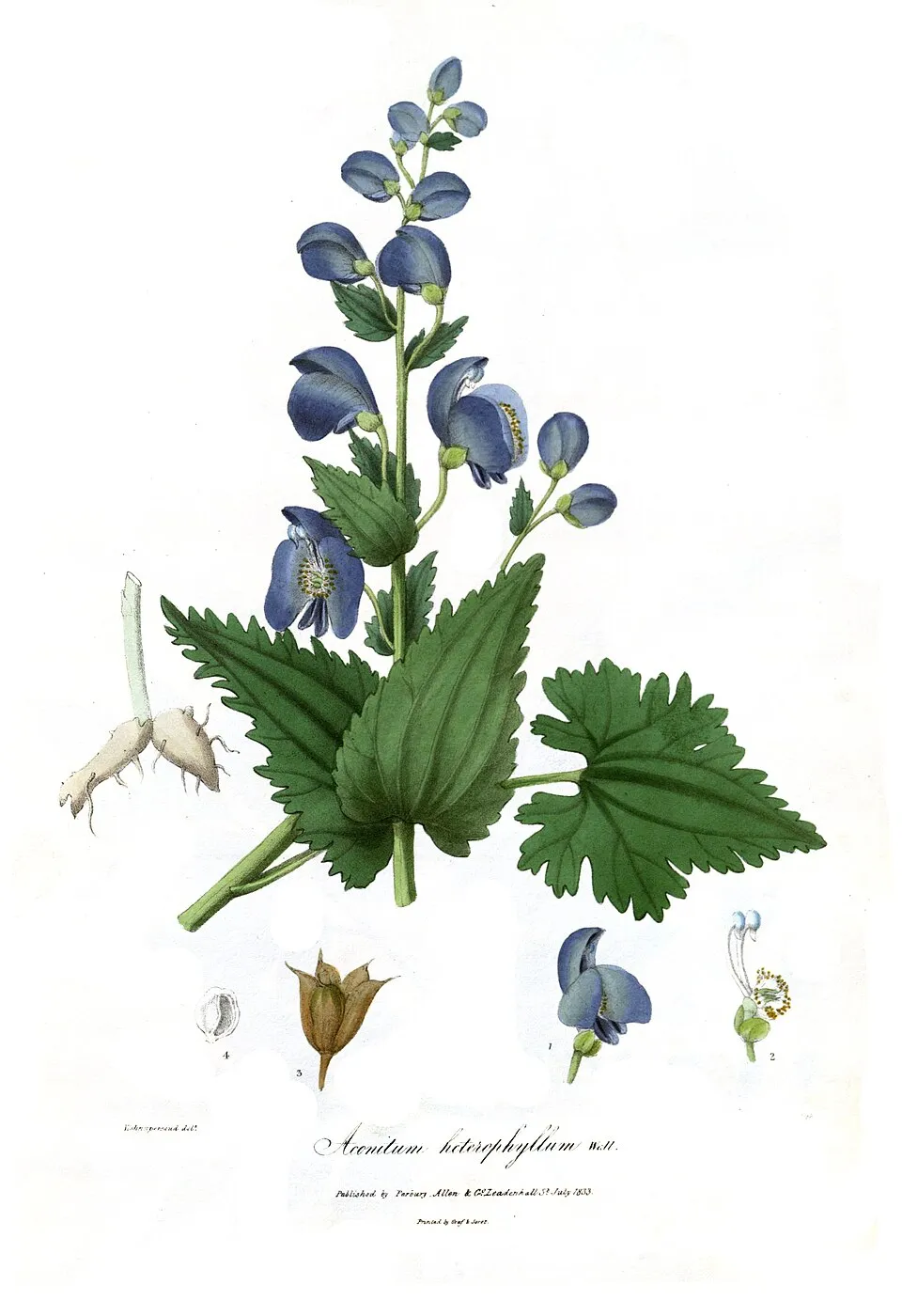
Ativisha, scientifically recognized as Aconitum heterophyllum, is a distinguished perennial herb belonging to the Ranunculaceae family. It is indigenous to the subalpine and alpine ecosystems of the Himalayan range, thriving primarily across India, Nepal, and Bhutan at altitudes generally between 2,500 and 4,500 meters. A. heterophyllum is notably characterized by its non-poisonous tuberous roots, setting it apart from many of its highly toxic Aconitum relatives and making it a uniquely safe and valuable component in traditional medicinal systems like Ayurveda and Unani.
The Sanskrit name 'Ativisha' paradoxically translates to 'super-poison' or 'extraordinary poison,' a nomenclature that historically signifies its profound medicinal efficacy rather than actual toxicity, especially when contrasted with other Aconite species. Botanically, the plant typically grows to a height of 15-20 cm, featuring simple or sometimes branched stems that are green. Its leaves are heteromorphous and dark green; the upper leaves are amplexicaul, clasping the stem, while the lower ones possess long petioles, arranged alternately in a spiral pattern. The distinct purplish-blue to greenish-white flowers are arranged in lax racemes, blooming from August to September.
The tuberous roots, which are the primary medicinal part, are whitish-grey, often appearing in pairs (one young, one mature), and measure 2.0-7.5 cm in length and 0.4-1.6 cm in thickness, tapering towards the end. These roots are distinguished by their bitter taste and cooling potency (Virya) in Ayurvedic pharmacology. Its conservation status is a critical concern, as rampant overharvesting for medicinal purposes and habitat destruction have led to its classification as endangered in various regions, necessitating urgent conservation and sustainable cultivation initiatives. Historically, its medicinal applications are extensively documented in ancient Ayurvedic texts such as the Charaka Samhita and Sushruta Samhita, where it is highly praised for its therapeutic versatility.
Trusted Scientific References
1. Authoritative external sources for Aconitum heterophyllum
1.1 Wikipedia — Aconitum heterophyllum
1.2 Kew POWO (Plants of the World Online)
1.3 PubMed — peer-reviewed research
1.4 NCBI Taxonomy Browser
1.5 GBIF — Global Biodiversity
1.1.Ativisha — Standout Qualities
- ✓Non — toxic Aconitum Species — Uniquely safe compared to its highly poisonous relatives.
- ✓Himalayan Origin — Native to the high-altitude regions of India, Nepal, and Bhutan.
- ✓Potent Ayurvedic Febrifuge — Widely used in traditional medicine for reducing fevers.
- ✓Effective Antidiarrheal Agent — Known for its ability to treat various forms of diarrhea.
- ✓Rich in Diterpenoid Alkaloids — Active compounds like atisine drive its therapeutic actions.
- ✓Cooling Potency (Virya) — Imparts a cooling effect according to Ayurvedic pharmacology.
- ✓Endangered Status — Faces significant threat due to overharvesting and habitat loss.
- ✓Documented in Ancient Texts — Applications extensively recorded in Charaka Samhita and Sushruta Samhita.
- ✓Versatile Medicinal Applications — Utilized for digestive, respiratory, and anti-inflammatory conditions.
- ✓Distinctive Morphology — Features purplish-blue flowers and paired, whitish-grey tuberous roots.
1.2.Ativisha — Snapshot Summary
- ✓Himalayan perennial herb with non-poisonous tuberous roots.
- ✓Highly valued in Ayurveda for its antipyretic and antidiarrheal properties.
- ✓Rich in unique diterpenoid alkaloids like atisine, contributing to its efficacy.
- ✓Exhibits anti-inflammatory, digestive, hepatoprotective, and antioxidant benefits.
- ✓Classified as endangered, emphasizing the critical need for conservation and sustainable practices.
2.Ativisha — Taxonomic Classification
3.Ativisha — Quick Facts
4.Ativisha — Plant Morphology
5.Ativisha — Where It Grows
6.Ativisha — Cultural & Traditional Roles
7.Ativisha — Bioactive Constituents
- ✓Alkaloids — Ativisha is notably rich in diterpenoid alkaloids such as atisine, heterophyllisine, heterophylline, heterophyllidine, hetisine, hetisinone, and ajaconine, which are primarily responsible for its antipyretic, anti-inflammatory, and analgesic effects.
- ✓Diterpenes — Beyond specific alkaloids, the plant contains a broader spectrum of diterpenes that contribute to its diverse pharmacological activities, including immune modulation.
- ✓Carbohydrates — Sugars and starches are present, providing metabolic energy and structural support within the plant tissues.
- ✓Proteins and Amino Acids — Essential proteins and amino acids are found, playing roles in the plant's growth, repair, and enzymatic functions, and offering nutritional value.
- ✓Saponins — These glycosides contribute to the plant's medicinal profile with potential anti-inflammatory, adaptogenic, and immune-modulating properties.
- ✓Glycosides — Various other glycosides are present, often responsible for specific therapeutic actions and influencing the plant's overall bioactivity.
- ✓Flavonoids — Compounds like kaempferol are found, imparting potent antioxidant, anti-inflammatory, and cardioprotective benefits.
- ✓Quinones — These compounds may contribute to antimicrobial and additional antioxidant activities within the plant.
- ✓Terpenoids — A diverse group of terpenoids is present, often associated with anti-inflammatory, antimicrobial, and adaptogenic properties, enhancing the plant's therapeutic scope.
8.Ativisha — Research Insights
- ✓Antipyretic/Febrifuge — Ativisha is highly regarded in Ayurveda for its potent ability to reduce fever, attributed to its bitter taste and cooling potency (Virya).
- ✓Antidiarrheal — The plant exhibits significant antidiarrheal properties, effectively managing various forms of diarrhea and dysentery through its astringent action.
- ✓Digestive Aid/Carminative — It helps improve digestion, reduces flatulence, and alleviates abdominal discomfort by promoting healthy gastrointestinal function.
- ✓Expectorant — Ativisha assists in clearing respiratory passages, making it beneficial for coughs and colds by facilitating the expulsion of mucus.
- ✓Hepatoprotective — Research suggests its capacity to protect the liver from damage, supporting overall liver health and function.
- ✓Anti-inflammatory — It possesses anti-inflammatory effects, helping to reduce swelling and pain associated with various inflammatory conditions.
- ✓Analgesic — Ativisha is traditionally used to alleviate pain, offering natural relief for different types of bodily aches.
- ✓Antioxidant — The plant contains compounds that act as antioxidants, protecting body cells from oxidative stress and free radical damage.
- ✓Diuretic — It promotes urination, which can be beneficial in managing certain urinary infections and supporting kidney function.
- ✓Anti-periodic — Traditionally, it has been employed to treat conditions characterized by recurring symptoms, such as intermittent fevers.
- ✓Reproductive Health Support — In some traditional systems, Ativisha is used for addressing certain reproductive disorders.
8.1.Ativisha — Therapeutic Indications
9.Ativisha — Precautions & Warnings
9.1.Ativisha — Caution Notes
- ✓Gastrointestinal Upset — High doses or sensitive individuals may experience mild symptoms like nausea, vomiting, or stomach discomfort.
- ✓Allergic Reactions — Rare instances of allergic responses such as skin rashes, itching, or hives have been reported in hypersensitive individuals.
- ✓Hypotension Risk — There is a theoretical risk of mild blood pressure lowering, especially if taken with antihypertensive medications.
- ✓Sedative Effects — Some individuals might experience mild drowsiness or sedation, particularly when combined with other central nervous system depressants.
- ✓Drug Interactions — Potential interactions with certain medications, including blood thinners, cardiac drugs, or sedatives, warrant caution and medical consultation.
- ✓Overdose Concerns — Although less toxic than other Aconitum species, excessive consumption of Ativisha should be avoided to prevent adverse effects.
- ✓Pregnancy and Lactation — Due to insufficient safety data, its use is generally contraindicated during pregnancy and breastfeeding.
9.2.Ativisha — Risk Assessment
- ✓Generally Safe — Ativisha is considered one of the safer Aconitum species, notably non-toxic unlike its highly poisonous relatives.
- ✓Professional Consultation — Always consult a qualified medical herbalist or Ayurvedic physician before use, especially for chronic conditions or during pregnancy.
- ✓Dosage Adherence — Strict adherence to recommended dosages is critical to ensure safety and efficacy, as individual responses can vary.
- ✓Pediatric Use — Often used in children for fever and diarrhea in traditional medicine, but under strict professional supervision and appropriate dosages.
- ✓Pre-existing Conditions — Individuals with pre-existing heart conditions, liver, or kidney impairments should exercise caution and seek medical advice.
- ✓Quality Sourcing — Ensure the botanical identity of the plant material is verified to avoid adulteration with toxic Aconitum species.
- ✓Monitoring for Reactions — Discontinue use and seek medical attention if any unusual or adverse reactions occur.
10.Ativisha — Preparation & Dosage
- ✓Decoction — The dried roots are commonly prepared as a decoction, boiling them in water, for internal administration to treat fever, diarrhea, and digestive issues.
- ✓Powder (Churna) — Finely powdered dried roots (Ativisha Churna) can be taken with honey or warm water, often prescribed for children's ailments and digestive complaints.
- ✓External Paste — A paste made from the root powder mixed with water or other emollients may be applied topically for localized inflammation or pain relief.
- ✓Ayurvedic Formulations — Ativisha is a key ingredient in numerous polyherbal Ayurvedic formulations, where its actions are synergized with other herbs.
- ✓Dosage — Precise dosage varies significantly based on the individual's age, specific condition, body constitution (Prakriti), and the form of preparation; professional guidance is essential.
- ✓Traditional Processing — While Ativisha is considered non-toxic, traditional Ayurvedic texts outline specific processing (Shodhana) for certain Aconitum species to enhance efficacy and safety.
- ✓Preparation Types — Utilized in various Ayurvedic forms including Kwatha (decoction), Vati (pills), and Arishta (fermented preparations).
11.Ativisha — Growth Requirements
- ✓Habitat Mimicry — Cultivation should aim to replicate its natural high-altitude, cool climate conditions with moderate humidity.
- ✓Soil Requirements — Prefers rich, well-drained loamy soil abundant in organic matter, with a slightly acidic to neutral pH.
- ✓Propagation — Primarily propagated through seeds, which require cold stratification, or by dividing its tuberous roots.
- ✓Sowing Time — Seeds are best sown in late autumn or early spring in prepared nursery beds or directly in the field.
- ✓Watering — Requires consistent moisture, especially during the growing season, but good drainage is crucial to prevent waterlogging and root rot.
- ✓Sunlight Exposure — Thrives in partial shade to full sun in cooler regions; protection from intense midday sun is advisable.
- ✓Harvesting — Tuberous roots are typically harvested after 2-3 years of growth, usually in late autumn or early winter after the aerial parts have senesced.
- ✓Conservation Farming — Sustainable cultivation practices, including nursery propagation and controlled harvesting, are vital given its endangered status.
Reviewed by the Flora Medical Global Botanical Review Panel
Multi-disciplinary editorial group · Botany · Ethnobotany · Herbal-medicine literature
Who reviewed this: This page was checked by the Flora Medical Global Botanical Review Panel — an in-house editorial group of botany graduates, ethnobotany researchers, and horticulture practitioners who collectively maintain our 7,000+ plant encyclopedia. Meet the team.
Our 4-step verification process
1. Taxonomic verification
Scientific names and synonyms cross-checked against Kew POWO, World Flora Online, and The Plant List.
2. Phytochemical & medicinal cross-reference
Active compounds, traditional uses, and reported activities are cross-referenced with PubMed, USDA Dr. Duke's database, and peer-reviewed ethnobotanical literature.
3. Conservation & distribution check
Distribution, ecology, and conservation status confirmed against GBIF occurrence records and the IUCN Red List.
4. Editorial & safety review
Every entry passes an editorial pass for clarity, originality, and safety notices (toxicity, contraindications, dosage caveats) before publication.
Last reviewed:
Important medical disclaimer: This content is for educational and research purposes only. It is not medical advice and is not a substitute for consultation with a licensed healthcare provider. Do not use any herb to self-treat a medical condition without professional guidance.
Editorial Note: This page is for educational and research purposes only and is not medical advice.
Written by: Flora Medical Global Editorial Team
Reviewed by: Flora Medical Global Botanical Review Panel
Last Updated: June 15, 2026





Ativisha — Comments & Community Reviews
Rate this plant