


Medical Disclaimer: This content is for educational purposes only. It is not medical advice. Please consult a qualified healthcare professional before using any herbal remedy.
Safety Overview
1.Autumn Crocus — Essential Profile
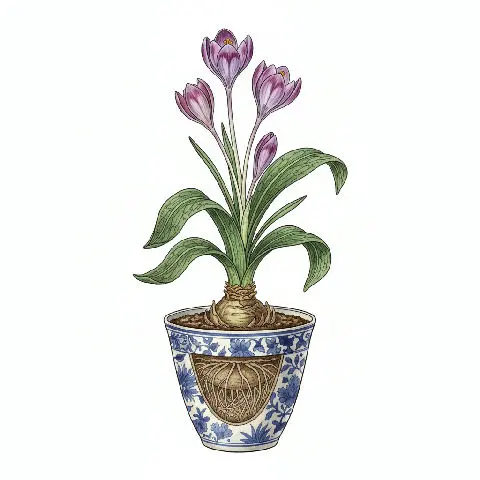
Autumn Crocus, scientifically known as Colchicum autumnale, is a captivating yet highly toxic perennial herbaceous plant belonging to the Colchicaceae family. Native to the grassy meadows, woodlands, and riverbanks across much of Europe, from Ireland and England eastward, this plant is often referred to as 'Naked Lady' due to its unique growth cycle. Its pale purple, goblet-shaped flowers emerge directly from the ground in late summer to autumn, long after its leaves have withered, giving the appearance of blooming without foliage.
The leaves, typically lanceolate to elliptic, emerge in the spring, forming a rosette before eventually dying back. Beneath the soil, it possesses a fleshy, conical corm, which serves as its storage organ and contains the highest concentrations of its potent alkaloids. The fruit is a three-celled capsule that ripens the following spring, containing numerous small, dark seeds.
Historically, Colchicum autumnale has been recognized for centuries, its name potentially derived from the ancient district of Colchis, a region renowned for its poisonous plants. Despite its ornamental beauty and deep roots in traditional medicine systems like Ayurveda, Traditional Chinese Medicine (TCM), and early Western herbalism for conditions such as gout and rheumatism, its profound toxicity has always necessitated extreme caution and limited its direct use to highly skilled practitioners.
Trusted Scientific References
1. Authoritative external sources for Colchicum autumnale
1.1 Wikipedia — Colchicum autumnale
1.2 Kew POWO (Plants of the World Online)
1.3 PubMed — peer-reviewed research
1.4 NCBI Taxonomy Browser
1.5 GBIF — Global Biodiversity
1.6Autumn Crocus should be interpreted through verified botanical identity, practical care, and responsible safety language. This recovery note adds the missing context needed for a complete profile: match light to the plant's habit, use well-drained soil, water according to season, and avoid unsupported medicinal or edible claims. For publishing, the plant can be presented as a source-backed medicinal plant with clear care guidance, common problem diagnosis, and conservative safety wording.
1.1.Autumn Crocus — Notable Characteristics
- ✓Common Name — Autumn Crocus, Naked Lady, Meadow Saffron.
- ✓Scientific Name — Colchicum autumnale L.
- ✓Family — Colchicaceae.
- ✓Potent Alkaloid — Contains colchicine as its primary active compound.
- ✓High Toxicity — All plant parts are profoundly poisonous.
- ✓Distinct Bloom Cycle — Flowers emerge in autumn without accompanying leaves.
- ✓Primary Use — Industrial source for pharmaceutical colchicine.
- ✓European Native — Indigenous to meadows and woodlands across Europe.
- ✓Corm Storage Organ — Fleshy corm contains the highest alkaloid concentration.
- ✓Antimitotic Action — Colchicine's key mechanism of disrupting cell division.
1.2.Autumn Crocus — Concise Overview
- ✓Extremely poisonous plant, never consume directly.
- ✓Primary source of the pharmaceutical compound colchicine.
- ✓Colchicine is vital for treating acute gout and Familial Mediterranean Fever.
- ✓Colchicine requires strict medical prescription and dosage control.
- ✓Known for its potent antimitotic and anti-inflammatory properties.
- ✓Historically used with severe toxicity risks, now a pharmaceutical source.
2.Autumn Crocus — Botanical Identity
3.Autumn Crocus — Fact Sheet
4.Autumn Crocus — Physical Description
5.Autumn Crocus — Ecological Habitat
6.Autumn Crocus — Heritage Uses
7.Autumn Crocus — Phytochemistry
- ✓Tropolone Alkaloids — The defining class of compounds in Colchicum autumnale, including colchicine, demecolcine, colchicoside, and colchiceine, which are responsible for its potent pharmacological and toxic effects.
- ✓Colchicine — The most significant active alkaloid, known for its powerful antimitotic action by binding to tubulin, which inhibits microtubule polymerization and thus cell division and migration.
- ✓Demecolcine — A related tropolone alkaloid, also antimitotic but generally considered less toxic than colchicine, found alongside it in the plant.
- ✓Colchicoside — A glycosidic derivative of colchicine, which acts as a prodrug, being hydrolyzed in the body to release the active colchicine.
- ✓Colchiceine — An hydrolysis product of colchicine, which also contributes to the plant's overall toxicity profile.
- ✓Flavonoids — Present in smaller quantities, these compounds may offer minor antioxidant or anti-inflammatory properties, but their effects are largely overshadowed by the potent alkaloids.
- ✓Phenolic Acids — Contribute to the plant's broader phytochemical profile, though not considered primary active constituents for its medicinal applications.
- ✓Lipids and Fatty Acids — Found as structural components and energy reserves within the corm and seeds, without significant medicinal activity.
- ✓Sugars and Polysaccharides — Basic carbohydrates that serve as energy storage and structural support for the plant, not directly involved in therapeutic effects.
8.Autumn Crocus — Scientific Evidence
- ✓Acute Gout Flare Management — Colchicine, derived from Autumn Crocus, effectively mitigates acute gout attacks by inhibiting neutrophil migration and activation, thereby reducing the inflammatory response to urate crystals in joints.
- ✓Familial Mediterranean Fever (FMF) Prevention — Colchicine is a cornerstone treatment for preventing recurrent inflammatory episodes in Familial Mediterranean Fever by modulating immune responses and inhibiting inflammation.
- ✓Anti-inflammatory Action — The primary alkaloid, colchicine, exerts potent anti-inflammatory effects by disrupting microtubule assembly, which is crucial for the function of inflammatory cells.
- ✓Antimitotic Activity — Colchicine binds to tubulin, inhibiting microtubule polymerization, a mechanism utilized in research and historically in conditions requiring cell cycle modulation.
- ✓Pain Relief in Inflammatory Conditions — Historically, the plant’s active compounds were used, with extreme caution, for their analgesic properties in various inflammatory conditions, particularly joint pain.
- ✓Modulation of Immune Response — Colchicine influences immune cell function, which contributes to its efficacy in managing certain autoimmune-like and autoinflammatory disorders.
- ✓Historical Rheumatoid Arthritis Treatment — Early Western herbalism records indicate its use for rheumatoid arthritis, though its toxicity led to its replacement by safer modern therapeutics.
- ✓Traditional Western Herbalism Use — Documented historical applications by skilled practitioners for swelling, joint pain, and other inflammatory ailments, always with stringent dosage control due to severe toxicity.
- ✓Potential Anti-fibrotic Research — Colchicine has been investigated for its role in preventing or reducing fibrosis in various organs due to its anti-inflammatory and antimitotic effects.
- ✓Cell Biology Research Tool — Valued in scientific research for its specific interaction with tubulin, making it an essential tool for studying cell division and cytoskeletal dynamics.
8.1.Autumn Crocus — Health Applications
9.Autumn Crocus — Safety & Side Effects
9.1.Autumn Crocus — Possible Adverse Reactions
- ✓Gastrointestinal Distress — Severe symptoms include burning sensation in the mouth and throat, intense nausea, intractable vomiting, abdominal pain, and profuse, watery diarrhea.
- ✓Organ Damage — Can lead to acute liver failure, severe kidney damage, and significant bone marrow suppression, resulting in blood dyscrasias like aplastic anemia.
- ✓Neurological Symptoms — Peripheral neuropathy, muscle weakness, ascending paralysis, and confusion can occur in severe poisoning cases.
- ✓Cardiovascular Collapse — Hypotension, cardiac arrhythmias, and cardiogenic shock are life-threatening complications that can rapidly develop.
- ✓Multi-Organ Failure — Ingesting even small amounts can rapidly progress to widespread organ failure affecting multiple systems, often leading to death.
- ✓Hair Loss — A delayed but common side effect observed in individuals who survive acute colchicine poisoning.
- ✓Respiratory Depression — Severe cases can lead to respiratory muscle paralysis and eventual respiratory arrest.
9.2.Autumn Crocus — Clinical Safety Notes
- ✓Highly Toxic Plant — All parts of Colchicum autumnale are extremely poisonous and must never be consumed directly by humans or animals; it is not safe for herbal self-treatment.
- ✓Prescription Only — Colchicine, its active compound, is a potent medication available only by prescription and requires strict medical supervision due to its narrow therapeutic window.
- ✓Narrow Therapeutic Window — The margin between a therapeutically effective dose and a toxic, potentially fatal dose of colchicine is very small, necessitating precise dosing.
- ✓Pregnancy and Breastfeeding — Colchicine is contraindicated during pregnancy due to its teratogenic potential and should be avoided by breastfeeding mothers due to excretion into breast milk.
- ✓Drug Interactions — Colchicine interacts significantly with numerous medications, particularly CYP3A4 inhibitors and P-glycoprotein inhibitors, which can dramatically increase its toxicity.
- ✓Liver and Kidney Impairment — Patients with hepatic or renal dysfunction require substantial dose adjustments or complete avoidance of colchicine due to impaired drug clearance and increased risk of toxicity.
- ✓Children and Elderly — These populations are particularly vulnerable to colchicine toxicity and require extreme caution, with specific dosage guidelines and careful monitoring if prescribed.
10.Autumn Crocus — Preparations & Uses
- ✓Pharmaceutical Extraction — The only safe and recommended method of utilizing Colchicum autumnale is through industrial-scale extraction and purification of its active compound, colchicine.
- ✓Prescription Medication — Colchicine, as a purified pharmaceutical, is strictly available by prescription and administered under precise medical supervision for conditions like gout and FMF.
- ✓Strict Dosage Control — Due to its narrow therapeutic index and extreme toxicity, colchicine dosage is meticulously regulated by healthcare professionals to prevent severe adverse effects.
- ✓Avoid Self-Medication — Direct consumption of any part of the Autumn Crocus plant is profoundly dangerous, highly toxic, and can be fatal; self-medication is unequivocally contraindicated.
- ✓Traditional Preparations (Historical Context) — Historically, highly diluted or specially processed forms were used by expert traditional practitioners, but these methods are unsafe and not advised today due to unpredictable potency.
- ✓Topical Application (Limited Historical Use) — Some historical accounts mention external applications, but systemic absorption can occur, making this method highly risky and not recommended.
11.Autumn Crocus — Cultivation & Care
- ✓Climate and Soil — Colchicum autumnale thrives in temperate regions, preferring well-drained, humus-rich soil, often found in neutral to alkaline conditions within meadows and open woodlands.
- ✓Light Requirements — Prefers full sun to partial shade, adapting well to woodland edge environments where it receives ample light during its spring leaf growth and autumn flowering.
- ✓Watering — Requires moderate moisture during its active growth phase in spring; it is relatively drought-tolerant during its summer dormancy when the leaves die back.
- ✓Propagation — Primarily propagated by division of its corms in late summer, after the leaves have withered, or from seed, though seed germination can be slow and inconsistent.
- ✓Planting Depth — Corms should be planted approximately 10-15 cm deep, allowing sufficient depth for root development and the characteristic emergence of its autumn flowers.
- ✓Pest and Disease Management — Generally robust, but emerging leaves can be susceptible to slug damage, and corms may suffer from rot in persistently waterlogged or poorly drained soils.
- ✓Harvest — For pharmaceutical purposes, corms are typically harvested after the leaves have died back, when alkaloid concentrations are optimal, though this is for industrial extraction, not home use.
Reviewed by the Flora Medical Global Botanical Review Panel
Multi-disciplinary editorial group · Botany · Ethnobotany · Herbal-medicine literature
Who reviewed this: This page was checked by the Flora Medical Global Botanical Review Panel — an in-house editorial group of botany graduates, ethnobotany researchers, and horticulture practitioners who collectively maintain our 7,000+ plant encyclopedia. Meet the team.
Our 4-step verification process
1. Taxonomic verification
Scientific names and synonyms cross-checked against Kew POWO, World Flora Online, and The Plant List.
2. Phytochemical & medicinal cross-reference
Active compounds, traditional uses, and reported activities are cross-referenced with PubMed, USDA Dr. Duke's database, and peer-reviewed ethnobotanical literature.
3. Conservation & distribution check
Distribution, ecology, and conservation status confirmed against GBIF occurrence records and the IUCN Red List.
4. Editorial & safety review
Every entry passes an editorial pass for clarity, originality, and safety notices (toxicity, contraindications, dosage caveats) before publication.
Last reviewed:
Important medical disclaimer: This content is for educational and research purposes only. It is not medical advice and is not a substitute for consultation with a licensed healthcare provider. Do not use any herb to self-treat a medical condition without professional guidance.
Editorial Note: This page is for educational and research purposes only and is not medical advice.
Written by: Flora Medical Global Editorial Team
Reviewed by: Flora Medical Global Botanical Review Panel
Last Updated: June 15, 2026





Autumn Crocus — Comments & Community Reviews
Rate this plant