


Medical Disclaimer: This content is for educational purposes only. It is not medical advice. Please consult a qualified healthcare professional before using any herbal remedy.
Safety Overview
1.Autumn Sage — Overview
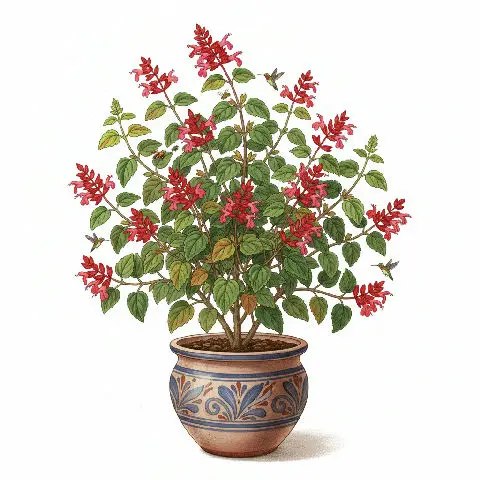
Salvia greggii, widely known as Autumn Sage, is a captivating and resilient perennial subshrub belonging to the Lamiaceae family, native to the arid and semi-arid regions spanning from West Texas across to Mexico. This species thrives in challenging environments, commonly found gracing rocky slopes, limestone outcrops, and canyons where other plants struggle. Its ecological history is deeply rooted in these landscapes, adapting to harsh conditions with remarkable tenacity. Botanically, Autumn Sage is characterized by its small, typically ovate to oblong leaves, which are evergreen to semi-evergreen and usually measure between 1 to 3 cm in length.
These leaves are borne on slender, woody stems and emit a distinct, pleasant aroma when crushed, a characteristic common to many Salvia species. The plant is celebrated for its vibrant, often two-lipped flowers that appear in a profusion of colors, including various shades of red, pink, purple, white, and coral. These blooms emerge prolifically from late spring through fall, and frequently continue sporadically through winter in milder climates, hence the descriptive 'Autumn' in its common name. The flowers are arranged in terminal racemes, serving as a significant attractant for local pollinators such as hummingbirds, butterflies, and bees, playing a crucial role in its ecological niche.
While not historically central to Old World traditional medicine systems like Ayurveda or TCM, indigenous communities in its native range likely utilized its aromatic properties for various local remedies and practical applications. Contemporary scientific inquiry is now actively exploring its rich phytochemical profile and potential health benefits.
Trusted Scientific References
1. Authoritative external sources for Salvia greggii
1.1 Wikipedia — Salvia greggii
1.2 Kew POWO (Plants of the World Online)
1.3 PubMed — peer-reviewed research
1.4 NCBI Taxonomy Browser
1.5 GBIF — Global Biodiversity
1.6Autumn Sage should be interpreted through verified botanical identity, practical care, and responsible safety language. This recovery note adds the missing context needed for a complete profile: match light to the plant's habit, use well-drained soil, water according to season, and avoid unsupported medicinal or edible claims. For publishing, the plant can be presented as a source-backed garden plant with clear care guidance, common problem diagnosis, and conservative safety wording.
1.1.Autumn Sage — Standout Qualities
- ✓Native to West — Native to West Texas and Mexico, thriving in arid and semi-arid landscapes.
- ✓Evergreen to semi — evergreen subshrub with woody stems and small, aromatic leaves.
- ✓Produces profuse, vibrant, two — lipped flowers in various colors from spring through fall.
- ✓Distinctive, pleasant aroma — Distinctive, pleasant aroma when the leaves are crushed.
- ✓Significant pollinator plant, — Significant pollinator plant, attracting hummingbirds, butterflies, and bees.
- ✓Exceptional drought tolerance — Exceptional drought tolerance and low water requirements, ideal for xeriscaping.
- ✓Rich in antioxidant — Rich in antioxidant compounds, particularly phenolic acids like caffeic acid and flavonoids.
- ✓Demonstrated inhibitory effects on α — glucosidase enzyme, suggesting anti-diabetic potential.
- ✓Low maintenance requirements, — Low maintenance requirements, making it a popular choice for sustainable gardening.
- ✓Belongs to the — Belongs to the Lamiaceae (mint) family, known for its aromatic and medicinal species.
1.2.Autumn Sage — Snapshot Summary
- ✓Resilient ornamental and medicinal perennial subshrub native to West Texas and Mexico.
- ✓Celebrated for its vibrant, long-lasting blooms and distinctively aromatic foliage.
- ✓Exhibits significant antioxidant activity and promising α-glucosidase inhibitory effects, relevant for metabolic health.
- ✓Rich in beneficial phytochemicals including phenolic acids, flavonoids, and diterpenoids.
- ✓Highly valued for its drought tolerance, low maintenance, and ability to attract beneficial pollinators.
- ✓Not a primary herb in Old World traditional systems, but gaining attention in modern research for its therapeutic potential.
2.Autumn Sage — Systematic Position
3.Autumn Sage — Quick Facts
4.Autumn Sage — Structural Profile
5.Autumn Sage — Where It Grows
6.Autumn Sage — Historical Applications
7.Autumn Sage — Active Compounds
- ✓Diterpenoids — Compounds like carnosol and rosmanol, often found in Salvia species, are known for their potent anti-inflammatory, antioxidant, and antimicrobial actions.
- ✓Flavonoids — Includes glycosidic forms of apigenin, luteolin, and scutellarein, which are powerful antioxidants and contribute to anti-inflammatory and neuroprotective effects.
- ✓Phenolic Acids — Contains caffeic acid and its derivatives, such as rosmarinic acid, highly valued for their significant antioxidant, anti-inflammatory, and α-glucosidase inhibitory activities.
- ✓Volatile Terpenes — Aromatic monoterpenes and sesquiterpenes contribute to the plant's characteristic scent and possess antimicrobial and insect-repellent properties.
- ✓Tannins — These astringent compounds contribute to the plant's protective mechanisms and may offer antioxidant and anti-inflammatory benefits.
- ✓Steroids — Plant steroids or phytosterols are present, which can have various biological activities, including anti-inflammatory effects.
- ✓Saponins — These natural detergents can form a lather and are associated with immune-modulating and cholesterol-lowering properties.
- ✓Glycosides — Various compounds linked to sugar molecules, enhancing solubility and affecting bioavailability and biological activity.
8.Autumn Sage — Research Insights
- ✓Antioxidant Activity — Autumn Sage decoctions have demonstrated notable antioxidant effects, including the capacity to scavenge free radicals like DPPH•, NO•, and O2•–, and to reduce Fe3+, protecting cells from oxidative damage.
- ✓Blood Sugar Regulation — Research indicates Salvia greggii has significant inhibitory activity against α-glucosidase, an enzyme involved in carbohydrate metabolism, suggesting potential in managing post-prandial blood glucose levels relevant for diabetes.
- ✓Metabolic Health Support — By inhibiting key carbohydrate metabolic enzymes, Autumn Sage may contribute to overall metabolic balance and assist in the management of conditions like type 2 diabetes and obesity.
- ✓Anti-inflammatory Potential — The presence of various diterpenoids and flavonoids in Salvia greggii suggests intrinsic anti-inflammatory properties, consistent with other medicinally valued Salvia species.
- ✓Antimicrobial Effects — Its aromatic compounds and essential oils, typical of the Lamiaceae family, are often associated with broad-spectrum antimicrobial activity, offering potential against various pathogens.
- ✓Digestive Aid — Through its influence on carbohydrate-digesting enzymes, Autumn Sage may indirectly support healthy digestion and nutrient absorption.
- ✓Cardiovascular Health — The rich antioxidant content can contribute to protecting the cardiovascular system from oxidative stress, a key factor in heart disease development.
- ✓Immune System Fortification — Antioxidants help bolster the body's natural defenses, supporting immune function against cellular damage.
- ✓Aromatic Therapy — The distinct aroma of Salvia greggii, released when leaves are crushed, offers potential for use in aromatherapy for its perceived calming or invigorating properties.
8.1.Autumn Sage — Reported Uses
9.Autumn Sage — Risk Profile
9.1.Autumn Sage — Possible Adverse Reactions
- ✓Allergic Reactions — Sensitive individuals may experience skin irritation, rashes, or respiratory symptoms upon contact or ingestion.
- ✓Gastrointestinal Upset — High doses or prolonged use may lead to mild nausea, stomach discomfort, or diarrhea in some individuals.
- ✓Skin Sensitivity — Direct contact with the plant's sap or essential oils can cause dermatitis or photosensitivity in susceptible people.
- ✓Dizziness/Headache — Rare instances of dizziness or headache have been reported with excessive internal consumption.
- ✓Interactions with Medications — Potential to interact with blood thinners, anti-diabetic medications, or sedatives; consult a doctor.
- ✓Uterine Stimulation — As with some Salvia species, very high doses might theoretically induce uterine contractions, though not specifically documented for Salvia greggii.
- ✓Liver Toxicity — Although rare, excessive, long-term use of certain Salvia species has been linked to liver concerns due to specific thujone content, which is typically low in S. greggii.
9.2.Autumn Sage — Safety Profile
- ✓Pregnancy and Breastfeeding — Avoid use during pregnancy and breastfeeding due to insufficient safety data and theoretical uterine stimulant effects from some Salvia species.
- ✓Children — Consultation with a qualified healthcare professional is advised before administering any Salvia greggii preparations to children.
- ✓Pre-existing Conditions — Individuals with hormone-sensitive conditions, seizure disorders, or those undergoing surgery should use with extreme caution and medical guidance.
- ✓Surgical Procedures — Discontinue use of Salvia greggii at least two weeks prior to any scheduled surgery due to potential interactions with anesthesia or blood clotting.
- ✓Allergic Individuals — People with known allergies to plants in the Lamiaceae family (e.g., mint, lavender) should avoid Autumn Sage to prevent allergic reactions.
- ✓Dosage Adherence — Always adhere strictly to recommended dosages and duration of use to minimize the risk of adverse effects and ensure safety.
- ✓Professional Consultation — It is paramount to consult a qualified healthcare provider or medical herbalist before incorporating Autumn Sage into any health regimen, especially if on medication.
10.Autumn Sage — Preparation & Dosage
- ✓Herbal Tea/Infusion — Dried leaves and flowers can be steeped in hot water to create an aromatic and potentially health-benefiting infusion.
- ✓Decoction — Woody stems or roots may be simmered to extract more robust compounds, producing a concentrated liquid for internal or external use.
- ✓Tincture — An alcoholic extract of the aerial parts can be prepared, offering a potent and shelf-stable form for internal medicinal administration.
- ✓Poultice — Freshly crushed leaves can be applied topically as a poultice for minor skin irritations or localized inflammation.
- ✓Essential Oil (External) — While not commonly extracted for commercial essential oil, the aromatic properties suggest potential for diluted topical application or diffusion for aromatherapy.
- ✓Culinary Use (Limited) — The aromatic leaves can be used sparingly to flavor dishes, adding a unique, earthy note, similar to common sage but with a distinct profile.
- ✓Smudging/Incense — Dried bundles of Autumn Sage may be used for aromatic purposes or in traditional ceremonial practices, akin to other sacred sages.
11.Autumn Sage — Growing Guide
- ✓Climate Preference — Thrives in warm, arid to semi-arid climates, tolerant of high temperatures.
- ✓Sunlight Requirements — Prefers full sun exposure, requiring at least 6 hours of direct sunlight daily for optimal growth and flowering.
- ✓Soil Composition — Requires well-drained soil; tolerates poor, rocky, or sandy soil types and is adaptable to various pH levels.
- ✓Watering Needs — Highly drought-tolerant once established; water sparingly, allowing the soil to dry out completely between waterings.
- ✓Pruning Techniques — Prune lightly after flowering or in late winter to maintain shape, encourage bushiness, and promote new blooms.
- ✓Propagation Methods — Can be successfully propagated from seeds, semi-hardwood stem cuttings taken in spring or summer, or by division.
- ✓Pest and Disease Resistance — Generally robust and resistant to most common garden pests and diseases, making it a low-maintenance choice.
- ✓Fertilization — Requires minimal fertilization; excessive nitrogen can lead to lush foliage at the expense of flower production.
Reviewed by the Flora Medical Global Botanical Review Panel
Multi-disciplinary editorial group · Botany · Ethnobotany · Herbal-medicine literature
Who reviewed this: This page was checked by the Flora Medical Global Botanical Review Panel — an in-house editorial group of botany graduates, ethnobotany researchers, and horticulture practitioners who collectively maintain our 7,000+ plant encyclopedia. Meet the team.
Our 4-step verification process
1. Taxonomic verification
Scientific names and synonyms cross-checked against Kew POWO, World Flora Online, and The Plant List.
2. Phytochemical & medicinal cross-reference
Active compounds, traditional uses, and reported activities are cross-referenced with PubMed, USDA Dr. Duke's database, and peer-reviewed ethnobotanical literature.
3. Conservation & distribution check
Distribution, ecology, and conservation status confirmed against GBIF occurrence records and the IUCN Red List.
4. Editorial & safety review
Every entry passes an editorial pass for clarity, originality, and safety notices (toxicity, contraindications, dosage caveats) before publication.
Last reviewed:
Important medical disclaimer: This content is for educational and research purposes only. It is not medical advice and is not a substitute for consultation with a licensed healthcare provider. Do not use any herb to self-treat a medical condition without professional guidance.
Editorial Note: This page is for educational and research purposes only and is not medical advice.
Written by: Flora Medical Global Editorial Team
Reviewed by: Flora Medical Global Botanical Review Panel
Last Updated: June 15, 2026





Autumn Sage — Comments & Community Reviews
Rate this plant