
Medical Disclaimer: This content is for educational purposes only. It is not medical advice. Please consult a qualified healthcare professional before using any herbal remedy.
Safety Overview
1.Bearberry — Essential Profile
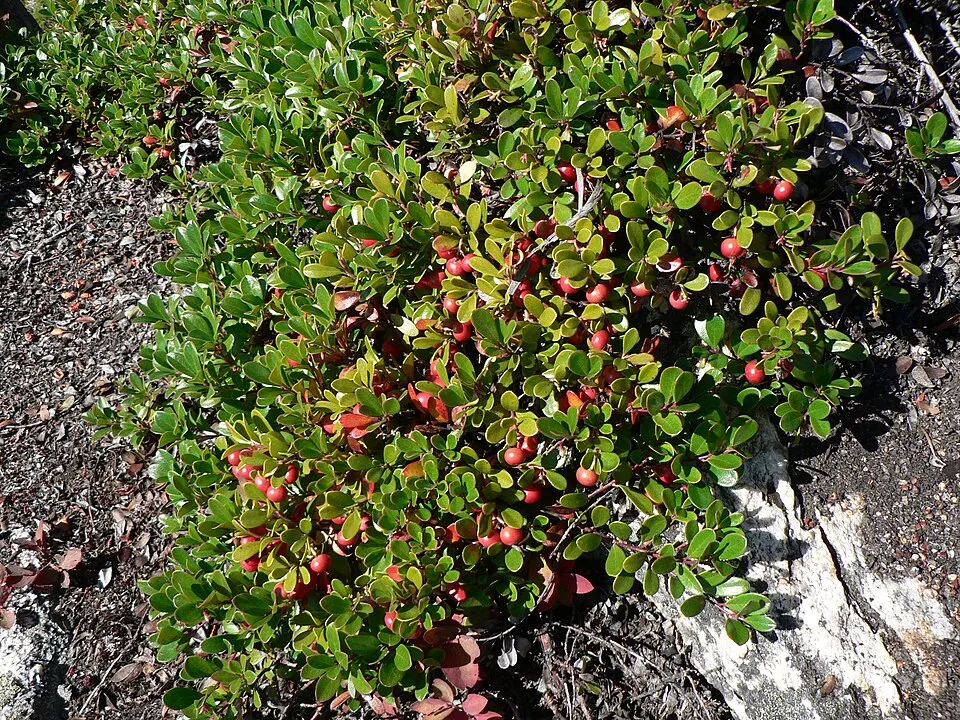
Arctostaphylos uva-ursi, commonly known as Bearberry, Uva-Ursi, or Kinnikinnick, is a hardy, prostrate evergreen shrub belonging to the Ericaceae family, which also includes blueberries and rhododendrons. Its Latin name, 'uva-ursi,' meaning 'bear's grape,' directly references its bright red berries, a preferred food for bears after their winter hibernation. This resilient plant exhibits a circumpolar distribution across the Northern Hemisphere, demonstrating remarkable adaptability by thriving in diverse, often challenging, environments.
It is found in open boreal forests, dry heathlands, subalpine meadows, and exposed rocky slopes at high altitudes. Its low-growing, sprawling habit forms dense mats, providing effective ground cover and soil stabilization in harsh conditions.
The leaves, which are the primary part used in herbal medicine, are small, spatulate to obovate, and possess a tough, leathery texture. They are typically glossy, vibrant green, often developing attractive reddish-bronze tones in colder months, offering year-round visual appeal. In spring, delicate, bell-shaped flowers emerge, usually pinkish-white, arranged in small, pendulous clusters, serving as an important nectar source for early pollinators.
These blossoms mature into small, spherical, bright red drupes in late summer and autumn, which persist through winter, providing a crucial food source for various wildlife. Taxonomically, Bearberry is a characteristic species within the genus Arctostaphylos, distinguished by its fruit type and persistent evergreen foliage. Historically, Bearberry holds deep cultural and medicinal significance across numerous indigenous traditions.
North American tribes, such as the Ojibwe, Cree, and Algonquin, highly valued it for its efficacy in treating kidney and bladder ailments, often incorporating its dried leaves into ceremonial smoking mixtures known as 'kinnikinnick.'
Trusted Scientific References
1. Authoritative external sources for Arctostaphylos uva-ursi
1.1 Wikipedia — Arctostaphylos uva-ursi
1.2 Kew POWO (Plants of the World Online)
1.3 PubMed — peer-reviewed research
1.4 NCBI Taxonomy Browser
1.5 GBIF — Global Biodiversity
1.1.Bearberry — Notable Characteristics
- ✓Primary Urinary Antiseptic — Highly effective against bacterial infections in the urinary tract.
- ✓Rich in Arbutin — The key hydroquinone glycoside responsible for its medicinal actions.
- ✓Astringent Properties — Significant tannin content helps tone and tighten tissues.
- ✓Evergreen Foliage — Maintains green leaves year-round, often turning reddish in cold.
- ✓Circumpolar Distribution — Found across the Northern Hemisphere in various cold climates.
- ✓Low — Growing Shrub — Forms dense, sprawling mats, excellent for ground cover.
- ✓Red Berries — Edible for wildlife, giving the plant its common name.
- ✓Traditional Ethnobotanical Uses — Valued by indigenous cultures for centuries.
- ✓Adaptable to Harsh Environments — Thrives in poor, rocky, or sandy soils.
- ✓Anti — inflammatory & Antioxidant — Contains flavonoids and triterpenes contributing to these effects.
1.2.Bearberry — Snapshot Summary
- ✓Potent urinary antiseptic, primarily due to arbutin.
- ✓Traditionally used for urinary tract infections (UTIs) and bladder issues.
- ✓Evergreen shrub of the Ericaceae family, native to northern regions.
- ✓Contains high levels of tannins, providing astringent properties.
- ✓Recommended for short-term use only, typically 5-7 days.
- ✓Requires alkaline urine for optimal therapeutic effect.
2.Bearberry — Nomenclature & Classification
3.Bearberry — Fact Sheet
4.Bearberry — Physical Description
5.Bearberry — Origin & Spread
6.Bearberry — Folk Medicine Applications
7.Bearberry — Chemical Profile
- ✓Arbutin — A glycoside that is the primary active compound, hydrolyzed to hydroquinone for its antiseptic effects.
- ✓Hydroquinone — A potent antimicrobial and skin-lightening agent released from arbutin.
- ✓Tannins — Astringent compounds that help to constrict tissues and reduce inflammation.
- ✓Ursolic Acid — A triterpenoid with anti-inflammatory and potential anti-cancer properties.
- ✓Flavonoids — Antioxidant compounds that protect cells from damage.
- ✓Phenolic Compounds — A broad group of antioxidants contributing to the plant's protective effects.
- ✓Iridois — Contribute to the plant's medicinal properties, though less studied than arbutin.
8.Bearberry — Pharmacological Findings
- ✓Urinary Tract Health — Bearberry is most renowned for its potent antiseptic properties, primarily attributed to its high concentration of arbutin. Arbutin is a glycoside that, upon ingestion, is hydrolyzed in the kidneys to hydroquinone, a powerful antimicrobial agent. This compound effectively combats a wide range of bacteria commonly found in the urinary tract, including E. coli and Staphylococcus saprophyticus, making it a valuable remedy for cystitis (bladder infections) and urethritis. It helps to cleanse the urinary passages and prevent the proliferation of pathogens, offering relief from burning sensations, frequent urination, and discomfort associated with these infections.
- ✓Kidney Stone Prevention — The diuretic properties of bearberry, coupled with its ability to reduce inflammation in the urinary tract, can contribute to the prevention of kidney stones. By promoting increased urine flow, it helps to flush out small stones and prevent the accumulation of mineral deposits that can lead to stone formation.
- ✓Anti-inflammatory Action — Beyond its antiseptic role, bearberry exhibits significant anti-inflammatory effects. Compounds like ursolic acid and tannins help to soothe irritated tissues within the urinary system, reducing swelling and pain. This makes it beneficial not only for infections but also for other inflammatory conditions affecting the kidneys and bladder.
- ✓Wound Healing — Traditionally, bearberry has been used topically to promote wound healing. The astringent properties of its tannins help to constrict tissues, reduce bleeding, and create an environment conducive to faster tissue regeneration.
- ✓Digestive Aid — While less common, bearberry has also been employed to address certain digestive complaints. Its astringent nature can help to tone the digestive tract and may be beneficial for conditions like diarrhea.
- ✓Antioxidant Properties — Bearberry contains various antioxidants, including flavonoids and phenolic compounds, which help to combat oxidative stress in the body. This can contribute to overall cellular health and may play a role in preventing chronic diseases.
- ✓Diuretic Effect — The plant acts as a mild diuretic, increasing urine output. This can be helpful in flushing out the urinary system and reducing fluid retention.
- ✓Astringent Qualities — The high tannin content gives bearberry strong astringent properties, which can help to tighten tissues and reduce secretions. This is particularly useful in urinary tract applications and for topical wound care.
- ✓Pain Relief — By reducing inflammation and combating infection, bearberry can indirectly alleviate pain associated with urinary tract issues.
- ✓Blood Sugar Regulation — Some research suggests that compounds in bearberry may have a role in modulating blood sugar levels, although more studies are needed in this area.
- ✓Liver Support — The antioxidant and anti-inflammatory actions may offer some protective benefits for the liver.
- ✓Skin Conditions — Topically, bearberry extracts have been explored for their potential to lighten skin and treat hyperpigmentation due to the hydroquinone content, though this is a more specialized application.
8.1.Bearberry — Indications & Uses
9.Bearberry — Cautions & Contraindications
9.1.Bearberry — Reported Side Effects
- ✓Bearberry should be used with caution and typically for short durations (no more than 2-4 weeks at a time) to avoid potential side effects.
- ✓Prolonged or excessive use can lead to nausea, vomiting, stomach upset, and in rare cases, liver damage due to the hydroquinone content. It is also important to note that bearberry can cause the urine to turn greenish-brown.
9.2.Bearberry — Safety Profile
- ✓Bearberry is generally considered safe for short-term use in adults when taken as directed.
- ✓However, it is not recommended for pregnant or breastfeeding women, children, or individuals with kidney or liver disease.
- ✓Due to its potential to interact with certain medications, it is advisable to consult a healthcare professional before use, especially if you are taking other prescription drugs.
10.Bearberry — Preparations & Uses
- ✓Herbal Tea/Decoction — Prepare by simmering 1-2 teaspoons of dried Bearberry leaves in a cup of water for 10-15 minutes. Strain and drink up to 3 times daily.
- ✓Tincture — Take 2-5 ml of a 1:5 ethanol tincture, 2-3 times per day. Tinctures offer a concentrated form and are easily absorbed.
- ✓Capsules/Tablets — Standardized extracts are available, typically dosed to provide a specific amount of arbutin (e.g., 400 mg of extract standardized to 10% arbutin, 2-3 times daily).
- ✓External Application (Poultice) — Traditionally, crushed fresh or rehydrated dried leaves can be applied as a poultice to wounds or inflamed areas.
- ✓Topical Preparations (Skin) — Extracts can be incorporated into creams or lotions for skin lightening purposes, targeting hyperpigmentation.
- ✓Alkalinization of Urine — For optimal efficacy against UTIs, ensure urine is alkaline. This can be supported by dietary choices (e.g., avoiding acidic foods) or with bicarbonate supplementation, under professional guidance.
- ✓Short-term Use Protocol — Due to potential side effects, Bearberry preparations are generally recommended for short-term use, typically no longer than 5-7 days.
11.Bearberry — How to Grow
- ✓Site Selection — Choose a location with full sun to partial shade, mimicking its natural habitat in open, well-drained areas.
- ✓Soil Requirements — Bearberry thrives in acidic to neutral soil (pH 4.5-7.0), preferring sandy or gravelly loam with excellent drainage. Amend heavy soils with sand or grit.
- ✓Propagation — Can be propagated from seeds, which require stratification, or more commonly from semi-hardwood cuttings taken in late summer or early autumn.
- ✓Planting — Space plants 1-3 feet apart, allowing for their sprawling growth habit. Ensure good air circulation to prevent fungal issues.
- ✓Watering — Once established, Bearberry is drought-tolerant. Water regularly during dry spells in the first year, then only during prolonged drought.
- ✓Fertilization — Generally requires minimal fertilization. An annual application of a balanced, slow-release fertilizer designed for acid-loving plants can be beneficial in poor soils.
- ✓Pruning — Prune only to remove dead or damaged branches, or to maintain shape. It generally requires little pruning due to its slow-growing, prostrate habit.
- ✓Winter Hardiness — Extremely cold-hardy, tolerating temperatures down to USDA Zone 2, making it suitable for northern climates.
Reviewed by the Flora Medical Global Botanical Review Panel
Multi-disciplinary editorial group · Botany · Ethnobotany · Herbal-medicine literature
Who reviewed this: This page was checked by the Flora Medical Global Botanical Review Panel — an in-house editorial group of botany graduates, ethnobotany researchers, and horticulture practitioners who collectively maintain our 7,000+ plant encyclopedia. Meet the team.
Our 4-step verification process
1. Taxonomic verification
Scientific names and synonyms cross-checked against Kew POWO, World Flora Online, and The Plant List.
2. Phytochemical & medicinal cross-reference
Active compounds, traditional uses, and reported activities are cross-referenced with PubMed, USDA Dr. Duke's database, and peer-reviewed ethnobotanical literature.
3. Conservation & distribution check
Distribution, ecology, and conservation status confirmed against GBIF occurrence records and the IUCN Red List.
4. Editorial & safety review
Every entry passes an editorial pass for clarity, originality, and safety notices (toxicity, contraindications, dosage caveats) before publication.
Last reviewed:
Important medical disclaimer: This content is for educational and research purposes only. It is not medical advice and is not a substitute for consultation with a licensed healthcare provider. Do not use any herb to self-treat a medical condition without professional guidance.
Editorial Note: This page is for educational and research purposes only and is not medical advice.
Written by: Flora Medical Global Editorial Team
Reviewed by: Flora Medical Global Botanical Review Panel
Last Updated: June 15, 2026





Bearberry — Comments & Community Reviews
Rate this plant