


Medical Disclaimer: This content is for educational purposes only. It is not medical advice. Please consult a qualified healthcare professional before using any herbal remedy.
Safety Overview
1.Begonia Angel Wing — Botanical Snapshot
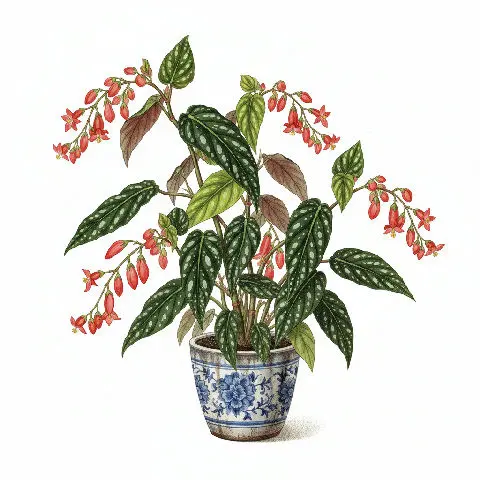
Begonia coccinea, universally recognized as Angel Wing Begonia, is a captivating perennial herb renowned for its striking ornamental attributes. Belonging to the diverse Begoniaceae family, this species was formally described by Hooker in 1845. Its morphology is characterized by thick, upright cane-like stems that can reach up to 3 meters in height in its native habitat, fostering a more compact, shrub-like growth in cultivation.
The plant's most distinctive feature is its asymmetrical, wing-shaped leaves, which are typically green or bronze, often variegated with metallic silver spots, and consistently display a contrasting reddish underside. These leaves can also be deeply etched, lobed, or have wavy to feathered margins, providing a rich textural appeal.
Native to the humid rainforests of Brazil, particularly the state of Rio de Janeiro, Begonia coccinea thrives as an understory plant, preferring warm, moist, and partially shaded conditions. Its natural distribution is confined to these tropical and subtropical regions of South America. The plant produces abundant clusters of pendulous flowers, ranging in color from vibrant red and pink to orange-red, salmon, and even white.
These blooms contribute significantly to its aesthetic value, often appearing year-round under ideal indoor conditions. Taxonomically, it holds significance as a parent species in the creation of numerous popular Angel Wing Begonia hybrids, contributing its robust growth habit and distinctive foliage to its progeny. While its primary role has historically been ornamental, its robust nature and unique appearance have secured its place as a globally cherished houseplant and garden accent.
Trusted Scientific References
1. Authoritative external sources for Begonia coccinea
1.1 Wikipedia — Begonia coccinea
1.2 Kew POWO (Plants of the World Online)
1.3 PubMed — peer-reviewed research
1.4 NCBI Taxonomy Browser
1.5 GBIF — Global Biodiversity
1.6Begonia Angel Wing should be interpreted through verified botanical identity, practical care, and responsible safety language. This recovery note adds the missing context needed for a complete profile: match light to the plant's habit, use well-drained soil, water according to season, and avoid unsupported medicinal or edible claims. For publishing, the plant can be presented as a source-backed indoor plant with clear care guidance, common problem diagnosis, and conservative safety wording.
1.1.Begonia Angel Wing — Distinguishing Points
- ✓Distinctive 'Angel Wing' — Distinctive 'Angel Wing' foliage with unique patterns.
- ✓Produces vibrant, pendulous — Produces vibrant, pendulous flower clusters in red, pink, orange, or white.
- ✓Cane — stemmed growth habit, can grow quite tall.
- ✓Rich in phytochemicals — Rich in phytochemicals like flavonoids, triterpenoids, and coumarins.
- ✓Thrives in warm, — Thrives in warm, humid environments with bright, indirect light.
- ✓Highly valued for — Highly valued for its ornamental beauty and continuous blooming.
- ✓Relatively easy to — Relatively easy to propagate from stem or leaf cuttings.
- ✓Prefers to be slightly pot — bound for optimal growth.
- ✓Exhibits a compact, shrub — like form in its native habitat.
- ✓Symbolizes grace, beauty, — Symbolizes grace, beauty, and often seen as a gift of appreciation.
1.2.Begonia Angel Wing — At-a-Glance Summary
- ✓Angel Wing Begonia (Begonia coccinea) is a popular ornamental plant.
- ✓Features distinctive wing-shaped leaves and vibrant, pendulous flowers.
- ✓Native to Brazilian rainforests, requires high humidity and indirect light.
- ✓Contains beneficial phytochemicals like flavonoids and triterpenoids, but also toxic oxalates.
- ✓Traditionally used for minor ailments, but modern medicinal use is limited and requires caution.
- ✓Toxic if ingested by humans or pets, primarily causing oral and gastrointestinal irritation.
2.Begonia Angel Wing — Botanical Identity
3.Begonia Angel Wing — Fact Sheet
4.Begonia Angel Wing — Botanical Description
5.Begonia Angel Wing — Native Range & Habitat
6.Begonia Angel Wing — Traditional Uses
7.Begonia Angel Wing — Phytochemistry
- ✓Flavonoids — Key compounds include quercetin, kaempferol, and their glycosides, known for potent antioxidant, anti-inflammatory, and potentially anticarcinogenic activities.
- ✓Triterpenoids — Such as ursolic acid and oleanolic acid, which contribute to anti-inflammatory, hepatoprotective, and antimicrobial properties commonly observed in plants.
- ✓Coumarins — Including scopoletin and umbelliferone, known for their anti-inflammatory, antimicrobial, and anticoagulant effects.
- ✓Phenolic Acids — Compounds like caffeic acid, gallic acid, and ferulic acid, which are strong antioxidants and contribute to the plant's defense mechanisms.
- ✓Organic Acids — Notably oxalic acid, present in significant concentrations in all parts of the plant, responsible for its characteristic sour taste and toxicity upon ingestion.
- ✓Saponins — Glycosides that can exhibit expectorant, anti-inflammatory, and sometimes hemolytic activities, found in varying amounts.
- ✓Anthocyanins — Pigments responsible for the red, pink, and orange hues in the flowers and the reddish undersides of the leaves, also possessing antioxidant benefits.
- ✓Polysaccharides — Complex carbohydrates that can contribute to immune modulation and general plant structural integrity.
- ✓Volatile Compounds — Minor amounts of various terpenes and esters that contribute to the plant's subtle aroma and may possess mild antimicrobial properties.
8.Begonia Angel Wing — Evidence-Based Benefits
- ✓Potential Anti-inflammatory Action — Research on related Begonia species suggests that compounds like flavonoids and triterpenoids may help reduce inflammation by modulating signaling pathways involved in inflammatory responses.
- ✓Antioxidant Properties — The presence of various phenolic compounds, including flavonoids, contributes to the plant's ability to scavenge free radicals, thereby protecting cells from oxidative damage.
- ✓Traditional Wound Healing Support — Indigenous communities in its native range have traditionally applied preparations of Begonia species topically to minor cuts and abras, potentially leveraging its antiseptic and anti-inflammatory attributes.
- ✓Minor Antimicrobial Effects — Some phytochemicals found in Begonia species, such as coumarins and certain phenolic acids, may exhibit mild inhibitory effects against certain bacteria and fungi.
- ✓Relief for Minor Skin Irritations — When used externally in highly diluted forms, its anti-inflammatory properties might offer soothing relief for superficial skin irritations, though caution is paramount.
- ✓Respiratory Discomfort (Traditional) — In some traditional practices, extracts from Begonia species were used to alleviate symptoms of respiratory discomfort, possibly due to expectorant or anti-inflammatory actions.
- ✓Digestive Aid (Traditional) — Anecdotal traditional uses suggest very dilute preparations might have been employed for minor digestive complaints, likely acting as a mild carminative or stomachic.
- ✓Potential for Pain Relief (Topical) — The anti-inflammatory compounds could theoretically provide localized pain relief when applied externally to minor aches, similar to other plant-derived topical analgesics.
- ✓Immune System Modulation — Flavonoids and polysaccharides present in botanicals often contribute to modulating immune responses, potentially supporting overall immune health.
8.1.Begonia Angel Wing — Therapeutic Indications
9.Begonia Angel Wing — Safety Considerations
9.1.Begonia Angel Wing — Side Effects & Warnings
- ✓Oxalate Toxicity — Ingestion of any part of the plant, especially the tuberous roots, can cause severe irritation of the mouth, throat, and gastrointestinal tract due to calcium oxalate crystals.
- ✓Oral Irritation — Symptoms of ingestion include intense burning, swelling, excessive salivation, difficulty swallowing, and vomiting.
- ✓Digestive Upset — Accidental ingestion can lead to nausea, stomach pain, diarrhea, and other gastrointestinal disturbances.
- ✓Skin Irritation — Direct contact with the plant sap may cause contact dermatitis or irritation in sensitive individuals.
- ✓Kidney Damage (Rare) — In very large quantities, oxalate ingestion can potentially lead to kidney damage or the formation of kidney stones due to calcium oxalate accumulation.
- ✓Pet Poisoning — Highly toxic to dogs and cats, causing oral irritation, vomiting, and difficulty swallowing if consumed.
- ✓Allergic Reactions — Although uncommon, some individuals may experience allergic reactions to pollen or plant compounds, manifesting as respiratory or skin symptoms.
9.2.Begonia Angel Wing — Safety Overview
- ✓Not for Internal Consumption — Due to the presence of calcium oxalate crystals, ingestion is strongly discouraged and potentially harmful.
- ✓Keep Away from Children and Pets — Ensure the plant is placed out of reach to prevent accidental ingestion by curious children or animals.
- ✓Handle with Gloves — Sensitive individuals should wear gloves when handling the plant to avoid potential skin irritation from sap.
- ✓Consult a Healthcare Professional — Always seek medical advice immediately if any part of the plant is ingested or if severe skin irritation occurs.
- ✓Avoid During Pregnancy and Lactation — Due to insufficient safety data and potential toxicity, pregnant or breastfeeding individuals should avoid any medicinal use.
- ✓Individuals with Kidney Issues — Those with a history of kidney stones or kidney disease should strictly avoid contact or ingestion due to oxalate content.
- ✓Patch Test for Topical Use — Before any hypothetical topical application, perform a small patch test on the skin to check for adverse reactions.
10.Begonia Angel Wing — Preparation Methods
- ✓Ornamental Display — Primarily cultivated as an aesthetic houseplant or garden accent, providing vibrant foliage and continuous blooms for visual appeal.
- ✓Aesthetic Enhancement — Used to beautify indoor spaces, patios, and shaded garden areas, contributing to a sense of well-being through its striking appearance.
- ✓Propagation by Cuttings — Stem or leaf cuttings are the primary method for propagation, allowing gardeners to easily multiply the plant and maintain vigor.
- ✓Folkloric Topical Application — In traditional contexts, leaves were sometimes crushed and applied as a poultice for minor skin irritations or small wounds, always with extreme caution due to oxalates.
- ✓Botanical Specimen — Valued in botanical collections and conservatories for its unique morphological features and as a representative of the Begoniaceae family.
- ✓Indoor Air Amelioration (General Plant Benefit) — Like many houseplants, it contributes to indoor air quality by absorbing certain airborne toxins and releasing oxygen, though not its primary medicinal use.
- ✓Hybridization Parent — Utilized by plant breeders for its desirable traits, such as unique leaf patterns and flower colors, to create new Begonia cultivars.
11.Begonia Angel Wing — How to Grow
- ✓Provide Bright, Indirect Light — Place in an east or west-facing window indoors; outdoors, ensure partial shade to prevent leaf scorch and enhance foliage color.
- ✓Maintain Consistent Warmth — Ideal daytime temperatures range from 70-75°F (21-24°C), with nighttime temperatures not dropping below 60°F (15°C).
- ✓Ensure High Humidity — thrives in environments with elevated humidity; use a pebble tray, humidifier, or mist regularly, especially indoors.
- ✓Water Judiciously — Allow the top inch of soil to dry out between waterings, then saturate thoroughly; avoid overwatering to prevent root rot.
- ✓Fertilize Sparingly — Apply a dilute balanced liquid fertilizer (e.g., 20-20-20) once a month during the growing season (April to October) to encourage flowering and prevent excessively leggy growth.
- ✓Prune for Bushiness — Pinch back young plants at 6 inches to encourage lateral branching; for older plants (one year+), drastic pruning down to 6 inches in winter and late spring maintains compactness.
- ✓Use Well-Draining Potting Mix — A blend of equal parts loam, peat, sand, and compost or a commercial potting mix formulated for good drainage is ideal; clay pots are preferred.
- ✓Repot When Slightly Potbound — Repot in spring or summer only when necessary, as Angel Wing Begonias prefer to be slightly potbound to prevent waterlogging.
Reviewed by the Flora Medical Global Botanical Review Panel
Multi-disciplinary editorial group · Botany · Ethnobotany · Herbal-medicine literature
Who reviewed this: This page was checked by the Flora Medical Global Botanical Review Panel — an in-house editorial group of botany graduates, ethnobotany researchers, and horticulture practitioners who collectively maintain our 7,000+ plant encyclopedia. Meet the team.
Our 4-step verification process
1. Taxonomic verification
Scientific names and synonyms cross-checked against Kew POWO, World Flora Online, and The Plant List.
2. Phytochemical & medicinal cross-reference
Active compounds, traditional uses, and reported activities are cross-referenced with PubMed, USDA Dr. Duke's database, and peer-reviewed ethnobotanical literature.
3. Conservation & distribution check
Distribution, ecology, and conservation status confirmed against GBIF occurrence records and the IUCN Red List.
4. Editorial & safety review
Every entry passes an editorial pass for clarity, originality, and safety notices (toxicity, contraindications, dosage caveats) before publication.
Last reviewed:
Important medical disclaimer: This content is for educational and research purposes only. It is not medical advice and is not a substitute for consultation with a licensed healthcare provider. Do not use any herb to self-treat a medical condition without professional guidance.
Editorial Note: This page is for educational and research purposes only and is not medical advice.
Written by: Flora Medical Global Editorial Team
Reviewed by: Flora Medical Global Botanical Review Panel
Last Updated: June 15, 2026





Begonia Angel Wing — Comments & Community Reviews
Rate this plant