


Medical Disclaimer: This content is for educational purposes only. It is not medical advice. Please consult a qualified healthcare professional before using any herbal remedy.
Safety Overview
1.Begonia Pavonina — Introduction & Highlights
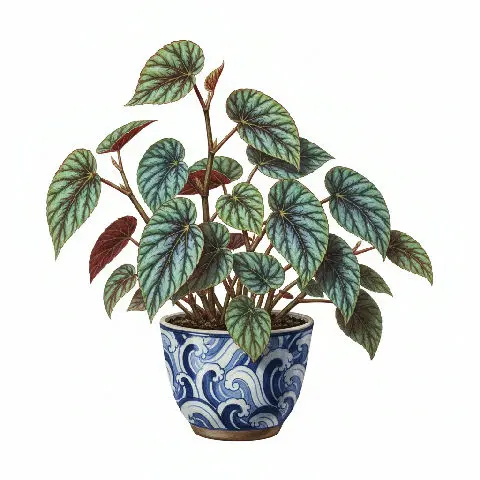
Begonia pavonina, widely recognized as the Peacock Begonia or Peacock Jewel Begonia, is a captivating species belonging to the diverse Begoniaceae family. This unique plant is indigenous to the humid, high-elevation tropical rainforests of Peninsular Malaysia, typically found at altitudes between 1400 and 1800 meters. Unlike many Begonia species celebrated for their vibrant floral displays, B.
pavonina is prized almost exclusively for its extraordinary foliage. The leaves exhibit a mesmerizing metallic blue-green sheen under low light conditions, a striking phenomenon attributed to specialized chloroplast-derived structures known as iridoplasts within its epidermal cells. These iridoplasts are arranged in a photonic crystal-like formation, an evolutionary adaptation that enhances photosynthetic efficiency in the deep shade of its understory habitat.
This mechanism allows the plant to more effectively absorb blue-green light and reflect green light, capturing a greater usable light spectrum where sunlight is scarce.
Its growth habit is rhizomatous, typically creeping along the substrate and branching as it matures, though some cultivated forms, often hybrids, may display a more upright, cane-like structure. The leaves can reach up to 6 inches in length, often featuring subtly jagged edges and hairy petioles, with a deep crimson-red coloration on their undersides.
The distinction between the true species and the more commonly cultivated 'blue form', which is suspected to be a Begonia grandis x pavonina hybrid, is important for cultivation, as the hybrid often exhibits 'hybrid vigor' and is easier to grow. This remarkable plant offers significant ornamental value and is a subject of ongoing botanical research into its unique light-harvesting adaptations.
Trusted Scientific References
1. Authoritative external sources for Begonia pavonina
1.1 Wikipedia — Begonia pavonina
1.2 Kew POWO (Plants of the World Online)
1.3 PubMed — peer-reviewed research
1.4 NCBI Taxonomy Browser
1.5 GBIF — Global Biodiversity
1.1.Begonia Pavonina — Standout Qualities
- ✓Iridescent Foliage — Displays a captivating metallic blue-green sheen, shifting with light angle.
- ✓Photonic Crystal Adaptation — Possesses specialized iridoplasts to optimize photosynthesis in low light.
- ✓Native to Malaysia — Indigenous to high-altitude, humid tropical rainforests of Peninsular Malaysia.
- ✓High Ornamental Value — Exceedingly popular among plant enthusiasts and collectors for its unique beauty.
- ✓Low Light Specialist — Thrives in deep shade, a testament to its highly efficient light-gathering mechanism.
- ✓Rhizomatous Growth Habit — Characterized by creeping rhizomes, forming a spreading, compact plant.
- ✓Bicolor Leaves — Upper surface is iridescent, while the underside typically showcases a deep crimson-red.
- ✓Unique Cellular Biology — A subject of intense scientific interest for its structural coloration and light manipulation.
- ✓Begoniaceae Family Member — Belongs to a diverse genus known for both ornamental appeal and some folk medicinal uses.
- ✓Potential Hybrid Forms — The 'blue form' often encountered in cultivation may be a robust hybrid, offering easier care.
1.2.Begonia Pavonina — Concise Overview
- ✓Peacock Begonia (Begonia pavonina) boasts iridescent blue-green leaves, a rare botanical marvel.
- ✓Native to Malaysia's humid, high-elevation tropical rainforests, adapted to deep shade.
- ✓Features specialized iridoplasts for enhanced light capture, a unique photosynthetic adaptation.
- ✓Primarily an ornamental houseplant, highly prized by collectors for its stunning aesthetic.
- ✓Contains oxalic acid, rendering all parts toxic if ingested; not suitable for medicinal use.
- ✓The widely available 'blue form' is often a more vigorous hybrid, potentially Begonia grandis x pavonina.
2.Begonia Pavonina — Systematic Position
3.Begonia Pavonina — Reference Facts
4.Begonia Pavonina — Morphological Account
5.Begonia Pavonina — Where It Grows
6.Begonia Pavonina — Cultural & Traditional Roles
7.Begonia Pavonina — Bioactive Constituents
- ✓Flavonoids — Compounds like quercetin and kaempferol derivatives are likely present, known for their potent antioxidant, anti-inflammatory, and potentially anti-cancer activities within the plant.
- ✓Triterpenoids — Ursolic acid and oleanolic acid are common in the Begonia genus, contributing to anti-inflammatory, hepatoprotective, and adaptogenic properties.
- ✓Phenolic Acids — Caffeic acid, ferulic acid, and other related compounds are expected, providing significant antioxidant capacity and free radical scavenging abilities.
- ✓Oxalic Acid — Present in all Begonia species, including B. pavonina, this organic acid contributes to the plant's toxicity if ingested, causing irritation and potential kidney issues.
- ✓Anthocyanins — Responsible for the deep crimson-red coloration on the undersides of the leaves, these pigments are powerful antioxidants and play a role in photoprotection.
- ✓Carotenoids — Beta-carotene and lutein are involved in light harvesting, particularly in low light conditions, and serve as crucial antioxidants within the plant's photosynthetic machinery.
- ✓Saponins — These glycosides may be present, potentially offering adaptogenic, immune-modulating, and hemolytic properties, common in various medicinal plants.
- ✓Polysaccharides — Complex carbohydrate polymers are likely found, contributing to plant structural integrity, energy storage, and potential immune-stimulatory effects.
- ✓Chlorophylls — The primary green pigments, chlorophyll a and b, are fundamental for photosynthesis, though their arrangement in iridoplasts is uniquely adapted for low-light capture.
8.Begonia Pavonina — Research Insights
- ✓Enhanced Photosynthetic Efficiency — Specialized iridoplasts in Begonia pavonina leaves significantly boost light absorption and utilization in low-light environments, improving cellular energy conversion.
- ✓Adaptogenic Potential — The plant's ability to thrive in challenging, low-light, high-humidity, high-elevation conditions suggests inherent resilience and unique biochemical adaptations.
- ✓Anti-inflammatory Properties (Extrapolated) — While not specifically documented for Begonia pavonina, other Begonia species are known to possess anti-inflammatory compounds, warranting further research into this specific species.
- ✓Analgesic Effects (Extrapolated) — Similar to anti-inflammatory properties, the Begonia genus often contains compounds with pain-relieving potential, suggesting a possible area of study for B. pavonina.
- ✓Antimicrobial Activity (Extrapolated) — Various Begonia species have demonstrated antimicrobial properties, indicating that B. pavonina might also contain compounds effective against certain pathogens.
- ✓Antioxidant Support (Potential) — The presence of phenolic compounds and anthocyanins, particularly on the leaf undersides, suggests a capacity for neutralizing free radicals and offering antioxidant benefits.
- ✓Photoprotective Qualities — The unique leaf structure and pigment arrangement likely offer cellular protection against photo-oxidative stress, even in its shaded habitat.
- ✓Cellular Bio-optimization — The sophisticated light-bending mechanism of its iridoplasts represents an advanced form of cellular bio-optimization for resource acquisition.
- ✓Potential for Botanical Research — Its distinctive biological adaptations make Begonia pavonina an invaluable subject for studies in plant physiology, biophysics, and evolutionary botany.
- ✓Ornamental and Aesthetic Value — The plant's striking iridescent beauty contributes to mental well-being and enriches indoor environments, offering indirect health benefits through psychological uplift.
8.1.Begonia Pavonina — Conditions Traditionally Used For
9.Begonia Pavonina — Precautions & Warnings
9.1.Begonia Pavonina — Warnings
- ✓Ingestion Toxicity — Begonia pavonina, like other Begonias, contains oxalic acid, which is toxic if ingested and can cause severe irritation to the mouth, throat, and digestive tract.
- ✓Gastrointestinal Upset — Symptoms of accidental ingestion may include nausea, vomiting, diarrhea, and intense abdominal pain.
- ✓Oral and Pharyngeal Irritation — Chewing or swallowing plant material can lead to a burning sensation, swelling, and discomfort in the mouth and throat.
- ✓Skin Irritation — Direct contact with the plant sap may cause mild dermatitis or skin irritation in individuals with sensitive skin.
- ✓Kidney Damage (Severe Cases) — Large quantities of ingested oxalic acid, particularly from rhizomes, can potentially lead to kidney stone formation or renal damage.
- ✓Allergic Reactions — Although rare, susceptible individuals might experience allergic responses such as skin rash, itching, or respiratory symptoms upon exposure.
9.2.Begonia Pavonina — Risk Assessment
- ✓Not for Internal Consumption — Begonia pavonina should never be ingested due to its inherent oxalic acid content, which is toxic.
- ✓Keep Away from Children and Pets — Ensure the plant is placed in an inaccessible location to prevent accidental ingestion by curious children or animals.
- ✓Handle with Caution — Individuals with sensitive skin should wear gloves when handling the plant to avoid potential contact dermatitis from plant sap.
- ✓Seek Medical Attention — In case of accidental ingestion, immediately contact poison control or a medical professional for guidance.
- ✓Avoid Eye Contact — Prevent plant sap from coming into contact with eyes, as it may cause irritation and discomfort.
- ✓Ornamental Use Only — This plant is strictly for ornamental purposes; there is no documented safe dosage or traditional medicinal application for human use.
- ✓No Established Therapeutic Efficacy — The plant's safety and efficacy as a medicinal herb have not been established through scientific or traditional use.
10.Begonia Pavonina — How to Use
- ✓Ornamental Display — Primarily cultivated as a highly sought-after ornamental houseplant, valued for its extraordinary iridescent foliage.
- ✓Terrarium Cultivation — Ideal for closed terrarium or vivarium setups due to its strict requirements for high humidity and stable, low-light conditions.
- ✓Botanical Research Specimen — Used in scientific studies to investigate unique plant adaptations, suchophotonics, and photosynthetic efficiency mechanisms.
- ✓Aesthetic Enhancement — Integrated into interior design and plant collections to provide visual interest and a sense of natural beauty.
- ✓Topical Application (Theoretical) — While not directly studied for B. pavonina, extracts from related Begonia species have been explored for potential topical anti-inflammatory balms; requires extensive research.
- ✓Infusion for Analysis (Laboratory Only) — Researchers may prepare aqueous infusions from leaves to isolate and characterize water-soluble phytochemicals for scientific purposes.
- ✓Tincture for Analysis (Laboratory Only) — Alcoholic tinctures can be made to extract non-polar compounds for detailed phytochemical screening and identification in a lab setting.
- ✓Educational Material — Serves as an excellent specimen for botanical education, showcasing unique plant morphology and evolutionary adaptations.
11.Begonia Pavonina — Propagation & Care
- ✓Light — Requires low, indirect light to maintain its characteristic iridescent blue sheen; direct sunlight can diminish coloration and cause leaf scorch.
- ✓Temperature — Thrives in cool nights (10-18°C) and moderate daytime temperatures (20-25°C), reflecting its high-elevation native habitat.
- ✓Humidity — Demands very high atmospheric humidity (70-90%), making it ideal for terrariums or humid indoor environments.
- ✓Soil — Prefers a rich, well-draining, slightly acidic potting mix, often composed of peat, perlite, and orchid bark to mimic rainforest substrate.
- ✓Watering — Keep the soil consistently moist but never waterlogged; allow the top inch of soil to dry slightly before rewatering to prevent root rot.
- ✓Propagation — Best propagated through rhizome division or stem cuttings, which root readily under high humidity and warmth.
- ✓Feeding — Fertilize sparingly during the active growing season (spring and summer) with a diluted, balanced liquid fertilizer (e.g., half-strength).
- ✓Potting — Utilize shallow, wide pots to accommodate its creeping rhizomatous growth habit, allowing for lateral expansion.
Reviewed by the Flora Medical Global Botanical Review Panel
Multi-disciplinary editorial group · Botany · Ethnobotany · Herbal-medicine literature
Who reviewed this: This page was checked by the Flora Medical Global Botanical Review Panel — an in-house editorial group of botany graduates, ethnobotany researchers, and horticulture practitioners who collectively maintain our 7,000+ plant encyclopedia. Meet the team.
Our 4-step verification process
1. Taxonomic verification
Scientific names and synonyms cross-checked against Kew POWO, World Flora Online, and The Plant List.
2. Phytochemical & medicinal cross-reference
Active compounds, traditional uses, and reported activities are cross-referenced with PubMed, USDA Dr. Duke's database, and peer-reviewed ethnobotanical literature.
3. Conservation & distribution check
Distribution, ecology, and conservation status confirmed against GBIF occurrence records and the IUCN Red List.
4. Editorial & safety review
Every entry passes an editorial pass for clarity, originality, and safety notices (toxicity, contraindications, dosage caveats) before publication.
Last reviewed:
Important medical disclaimer: This content is for educational and research purposes only. It is not medical advice and is not a substitute for consultation with a licensed healthcare provider. Do not use any herb to self-treat a medical condition without professional guidance.
Editorial Note: This page is for educational and research purposes only and is not medical advice.
Written by: Flora Medical Global Editorial Team
Reviewed by: Flora Medical Global Botanical Review Panel
Last Updated: June 15, 2026





Begonia Pavonina — Comments & Community Reviews
Rate this plant