


Medical Disclaimer: This content is for educational purposes only. It is not medical advice. Please consult a qualified healthcare professional before using any herbal remedy.
Safety Overview
1.Billbergia Nutans — Essential Profile
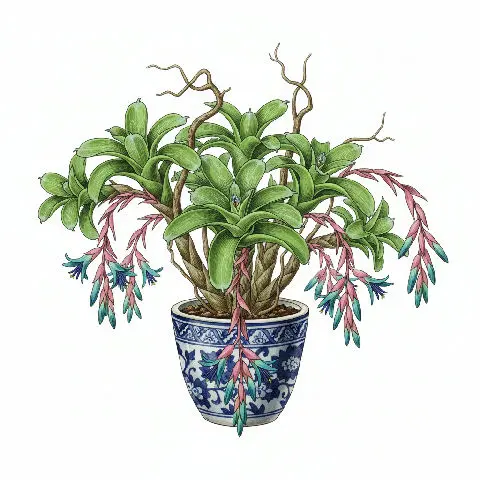
Billbergia nutans, commonly known as Queen's Tears or Friendship Plant, is an elegant epiphytic bromeliad celebrated for its distinctive morphology and adaptability as an indoor specimen. This native of Brazil, Paraguay, Uruguay, and Argentina typically forms a loose rosette of narrow, strap-like leaves, which are often bronze-green and feature small teeth along their margins, reaching lengths up to one foot (30 cm). The plant's most striking feature is its pendulous inflorescence, which emerges on arching stalks.
These racemes are adorned with vibrant rose-pink bracts, cradling delicate, bell-shaped flowers that display a captivating combination of chartreuse-green petals tipped with royal blue margins, often accented by bright yellow stamens. Flowering typically occurs in late winter to early spring, though it can extend into November and December in ideal conditions. As an epiphyte, Billbergia nutans naturally grows on other plants, absorbing moisture and nutrients from the air and rain, a trait reflected in its water-tight leaf rosette, which collects water.
This species readily produces 'pups' or offsets at its base, contributing to its common name 'Friendship Plant' due to its ease of sharing.
Trusted Scientific References
1. Authoritative external sources for Billbergia nutans
1.1 Wikipedia — Billbergia nutans
1.2 Kew POWO (Plants of the World Online)
1.3 PubMed — peer-reviewed research
1.4 NCBI Taxonomy Browser
1.5 GBIF — Global Biodiversity
1.6Billbergia Nutans should be interpreted through verified botanical identity, practical care, and responsible safety language. This recovery note adds the missing context needed for a complete profile: match light to the plant's habit, use well-drained soil, water according to season, and avoid unsupported medicinal or edible claims. For publishing, the plant can be presented as a source-backed indoor plant with clear care guidance, common problem diagnosis, and conservative safety wording.
1.1.Billbergia Nutans — Distinguishing Points
- ✓Elegant, arching flower — Elegant, arching flower stalks with pendulous inflorescences.
- ✓Striking rose — pink bracts surrounding bell-shaped green and blue flowers.
- ✓Epiphytic growth habit, typically forming a water — tight leaf rosette.
- ✓Native to regions — Native to regions of Brazil, Paraguay, Uruguay, and Argentina.
- ✓Easy to cultivate — Easy to cultivate indoors as a decorative houseplant.
- ✓Readily produces 'pups' — Readily produces 'pups' (offsets) for simple propagation.
- ✓Contains notable flavonoids — Contains notable flavonoids (e.g., kaempferol, quercetin) and phenolic acids.
- ✓Exhibits potential, though — Exhibits potential, though unproven, antioxidant and anti-inflammatory activities.
- ✓Attracts birds and — Attracts birds and butterflies in its natural habitat.
- ✓Tolerant of periodic — Tolerant of periodic droughts by storing water in its leaf cup.
1.2.Billbergia Nutans — Snapshot Summary
- ✓Queen's Tears is an ornamental epiphytic bromeliad, native to South America.
- ✓Known for its distinctive arching flowers with rose-pink bracts and green/blue petals.
- ✓Phytochemical analysis reveals flavonoids and phenolic acids, suggesting antioxidant potential.
- ✓Limited research exists; no established medicinal uses in traditional or modern systems.
- ✓Anecdotal reports suggest mild diuretic effects, but clinical evidence is lacking.
- ✓Caution is advised for any internal use due to insufficient safety data.
2.Billbergia Nutans — Nomenclature & Classification
3.Billbergia Nutans — Fact Sheet
4.Billbergia Nutans — Botanical Description
5.Billbergia Nutans — Origin & Spread
6.Billbergia Nutans — Traditional Uses
7.Billbergia Nutans — Phytochemistry
- ✓Flavonoids — Key compounds include kaempferol, quercetin, luteolin, and apigenin, which are well-known for their significant antioxidant and anti-inflammatory properties, contributing to cellular protection.
- ✓Phenolic Acids — Caffeic acid and ferulic acid are identified, acting as powerful antioxidants that neutralize harmful free radicals and support cellular health.
- ✓Flavonoid Glycosides — These are various conjugated forms of flavonoids, which may enhance bioavailability and contribute to the mild diuretic effects anecdotally reported for Billbergia nutans.
- ✓Anthocyanins — Pigments responsible for the plant's vibrant pink and blue flower colors, also possessing considerable antioxidant activity and potential benefits for microvascular health.
- ✓Organic Acids — Compounds such as malic acid and citric acid are present, playing roles in plant metabolism and potentially contributing to the plant's overall biochemical profile.
- ✓Terpenoids — While not extensively characterized for this species, general terpenoids are common in plants and can contribute to aroma, defense, and may exhibit various biological activities.
- ✓Trace Minerals — Essential elements absorbed from the growth medium, vital for the plant's physiological processes and potentially contributing to the nutritional profile of any extract.
- ✓Polysaccharides — Structural and storage carbohydrates that can sometimes possess immunomodulatory or prebiotic properties, though specific research on Billbergia nutans is limited.
8.Billbergia Nutans — Scientific Evidence
- ✓Antioxidant Activity — Phytochemical analysis reveals the presence of flavonoids such as kaempferol, quercetin, luteolin, and apigenin, alongside phenolic acids like caffeic and ferulic acid, all known for their potent free radical scavenging capabilities in vitro.
- ✓Anti-inflammatory Potential — Specific flavonoids and phenolic acids found in Billbergia nutans have demonstrated the ability to inhibit inflammatory pathways in laboratory studies, suggesting a potential role in modulating inflammatory responses.
- ✓Diuretic Effects (Anecdotal) — Some traditional accounts and preliminary observations suggest a mild diuretic action, which may be attributed to certain flavonoid glycosides that could promote increased urine production, though clinical efficacy is unconfirmed.
- ✓Antimicrobial Properties (Investigational) — Extracts containing various phenolic compounds may exhibit mild inhibitory effects against certain microorganisms, an area requiring further detailed microbiological investigation.
- ✓Cardioprotective Outlook (Theoretical) — The presence of potent antioxidants like flavonoids suggests a theoretical benefit in protecting cardiovascular health by mitigating oxidative stress and potentially supporting vascular integrity.
- ✓Hepatoprotective Hints (Exploratory) — Due to its antioxidant capacity, Billbergia nutans may offer preliminary protective effects against liver damage, an area that warrants specific toxicological and pharmacological studies.
- ✓Immunomodulatory Suggestions (Pre-clinical) — Certain plant compounds are known to subtly influence immune system responses, and the diverse phytochemicals in Queen's Tears could potentially play an immunomodulatory role, pending specific research.
- ✓Skin Health Support (Antioxidant) — The antioxidant compounds present could potentially protect skin cells from environmental damage and oxidative stress, making it of interest for cosmetic or dermatological research.
8.1.Billbergia Nutans — Therapeutic Indications
9.Billbergia Nutans — Safety & Side Effects
9.1.Billbergia Nutans — Caution Notes
- ✓Allergic Reactions — Direct skin contact may cause mild irritation or allergic dermatitis in sensitive individuals.
- ✓Gastrointestinal Upset — Ingesting Billbergia nutans, especially in large quantities, could potentially lead to nausea, vomiting, or diarrhea due to uncharacterized compounds.
- ✓Unknown Drug Interactions — Due to the lack of clinical studies, potential interactions with prescription medications or other herbal supplements are currently unknown.
- ✓Lack of Safety Data — There is insufficient scientific data to determine the safety of Billbergia nutans for internal human consumption.
- ✓Potential Toxicity — As with any unstudied plant, unknown toxic compounds may be present, warranting extreme caution against ingestion.
9.2.Billbergia Nutans — Risk Assessment
- ✓Insufficient Human Data — There is a critical lack of robust clinical trials to establish the safety and efficacy of Billbergia nutans for human medicinal use.
- ✓Pregnancy and Lactation — Avoid use during pregnancy and breastfeeding due to the absence of safety data and potential unknown effects on the fetus or infant.
- ✓Pediatric Use — Not recommended for internal use in children, as no safety information is available for this vulnerable population.
- ✓Pre-existing Conditions — Individuals with chronic health conditions, allergies, or those on medication should consult a healthcare professional before any form of use.
- ✓Topical Patch Test — For external applications, always perform a patch test on a small skin area to check for any adverse reactions or sensitivities.
- ✓Internal Consumption — Ingestion of Billbergia nutans is not advised due to the unknown phytochemical profile and lack of established safety guidelines.
10.Billbergia Nutans — Preparation Methods
- ✓Aqueous Infusion — For general botanical study, dried or fresh leaves can be steeped in hot water to create an infusion, though not for established therapeutic use.
- ✓Ethanolic Tincture — Plant material can be macerated in an alcohol-water solution to extract a broader spectrum of phytochemicals for research or potential formulation development.
- ✓Topical Poultice — Crushed fresh leaves might be applied externally as a poultice for localized soothing, based on anecdotal use, but without scientific validation for efficacy.
- ✓Glycerite Extraction — A glycerin-based extract can be prepared as an alcohol-free alternative, suitable for cosmetic applications or preliminary phytochemical analysis.
- ✓Phytochemical Isolation — Advanced laboratory techniques such as chromatography are employed to isolate and purify specific compounds like flavonoids for detailed pharmacological research.
- ✓Experimental Decoction — Tougher plant parts, if any, could be boiled in water for a longer duration to yield a more concentrated extract for in vitro studies or chemical analysis.
11.Billbergia Nutans — Garden Cultivation
- ✓Light Exposure — Provide medium to bright indirect light indoors; in a home landscape, Billbergia nutans thrives in full sun.
- ✓Watering Technique — Fill the central leaf cup (tank) with water weekly, preferably rainwater, and empty any standing water from the pot's saucer to prevent root rot.
- ✓Humidity Levels — Maintain high humidity by placing the pot on a saucer filled with gravel and a small amount of water, ensuring roots do not sit in the water.
- ✓Potting Medium — Use a well-draining, coarse bromeliad-specific potting mix or orchid bark to simulate its epiphytic growing conditions.
- ✓Fertilization Schedule — Feed monthly during the active growing season (spring and summer) with a half-strength liquid fertilizer applied to the leaf cup or potting medium.
- ✓Temperature and Hardiness — Best grown in USDA hardiness zones 10a to 11b, intolerant of frost; ideal indoor temperatures range from 60-80°F (15-27°C).
- ✓Pest Management — If mosquitoes or fungus gnats breed in the leaf cup, treat with Bacillus thuringiensis var. israelensis, a natural larvicide.
Reviewed by the Flora Medical Global Botanical Review Panel
Multi-disciplinary editorial group · Botany · Ethnobotany · Herbal-medicine literature
Who reviewed this: This page was checked by the Flora Medical Global Botanical Review Panel — an in-house editorial group of botany graduates, ethnobotany researchers, and horticulture practitioners who collectively maintain our 7,000+ plant encyclopedia. Meet the team.
Our 4-step verification process
1. Taxonomic verification
Scientific names and synonyms cross-checked against Kew POWO, World Flora Online, and The Plant List.
2. Phytochemical & medicinal cross-reference
Active compounds, traditional uses, and reported activities are cross-referenced with PubMed, USDA Dr. Duke's database, and peer-reviewed ethnobotanical literature.
3. Conservation & distribution check
Distribution, ecology, and conservation status confirmed against GBIF occurrence records and the IUCN Red List.
4. Editorial & safety review
Every entry passes an editorial pass for clarity, originality, and safety notices (toxicity, contraindications, dosage caveats) before publication.
Last reviewed:
Important medical disclaimer: This content is for educational and research purposes only. It is not medical advice and is not a substitute for consultation with a licensed healthcare provider. Do not use any herb to self-treat a medical condition without professional guidance.
Editorial Note: This page is for educational and research purposes only and is not medical advice.
Written by: Flora Medical Global Editorial Team
Reviewed by: Flora Medical Global Botanical Review Panel
Last Updated: June 15, 2026





Billbergia Nutans — Comments & Community Reviews
Rate this plant