
Medical Disclaimer: This content is for educational purposes only. It is not medical advice. Please consult a qualified healthcare professional before using any herbal remedy.
Safety Overview
1.Bleeding Heart — Overview
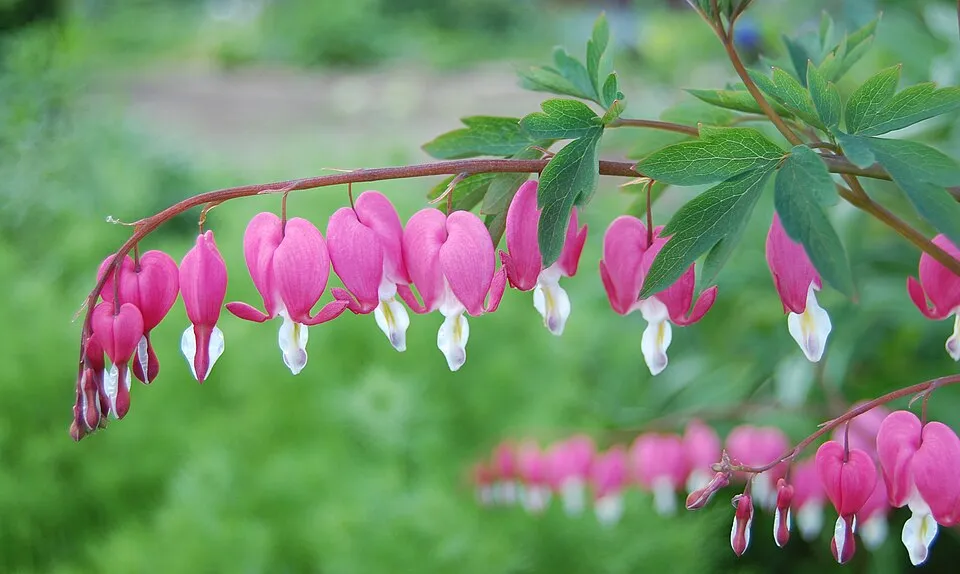
Lamprocapnos spectabilis, commonly known as Bleeding Heart, is a captivating perennial herb renowned for its strikingly heart-shaped, pendant flowers. Native to the cool, shaded woodlands of Siberia, northern China, Korea, and Japan, this resilient plant thrives in environments offering dappled light. Its taxonomy has seen shifts, originally classified under the genus Dicentra, hence its occasional reference as Dicentra spectabilis, but molecular studies have firmly placed it within Lamprocapnos.
Belonging to the Papaveraceae family, known for its diverse alkaloid content, the plant forms loose, bushy clumps, typically reaching up to 3 feet in height and 4 feet in width. New reddish foliage emerges in early spring, rapidly developing into powdery-green leaves, deeply divided into three leaflets, on fleshy, often pinkish stems. The distinct 1-2 inch flowers, appearing from late spring to early summer, feature two rose-pink (or white in cultivars like 'Alba') outer petals and two white inner petals, with a 'teardrop' at the base, creating its iconic form.
These delicate blooms hang in one-sided horizontal racemes from arching, leafless stems. After flowering, the plant produces elongate seed pods, and in hotter or drier conditions, it typically senesces and goes dormant by mid-summer, with foliage yellowing and withering. This captivating morphology has cemented its place in folklore and symbolism, often associated with deep affection, sorrow, or unrequited love, making it a powerful ornamental and cultural symbol.
Trusted Scientific References
1. Authoritative external sources for Lamprocapnos spectabilis
1.1 Wikipedia — Lamprocapnos spectabilis
1.2 Kew POWO (Plants of the World Online)
1.3 PubMed — peer-reviewed research
1.4 NCBI Taxonomy Browser
1.5 GBIF — Global Biodiversity
1.6Bleeding Heart should be interpreted through verified botanical identity, practical care, and responsible safety language. This recovery note adds the missing context needed for a complete profile: match light to the plant's habit, use well-drained soil, water according to season, and avoid unsupported medicinal or edible claims. For publishing, the plant can be presented as a source-backed garden plant with clear care guidance, common problem diagnosis, and conservative safety wording.
1.1.Bleeding Heart — Standout Qualities
- ✓Distinctive heart — shaped, pendant flowers.
- ✓Early spring blooming — Early spring blooming perennial.
- ✓Native to East — Native to East Asian temperate regions.
- ✓Thrives in shaded — Thrives in shaded garden environments.
- ✓High ornamental value — High ornamental value for landscaping.
- ✓Contains toxic isoquinoline — Contains toxic isoquinoline alkaloids.
- ✓Formerly classified as — Formerly classified as Dicentra spectabilis.
- ✓Requires well — drained, organic-rich soil.
- ✓Symbolizes deep affection — Symbolizes deep affection and sorrow.
- ✓Exhibits summer dormancy — Exhibits summer dormancy in hot, dry conditions.
1.2.Bleeding Heart — Concise Overview
- ✓Iconic ornamental with distinctive heart-shaped flowers.
- ✓Native to East Asian woodlands, hardy in USDA Zones 2-8.
- ✓All plant parts are toxic if ingested due to isoquinoline alkaloids.
- ✓Primarily cultivated for its aesthetic appeal in shade gardens.
- ✓Traditional medicinal uses are limited, historical, and require extreme caution.
- ✓Research focuses on isolated compounds for potential pharmacological actions.
2.Bleeding Heart — Taxonomic Classification
3.Bleeding Heart — Quick Facts
4.Bleeding Heart — Structural Profile
5.Bleeding Heart — Habitat & Distribution
6.Bleeding Heart — Historical Applications
7.Bleeding Heart — Active Compounds
- ✓Isoquinoline Alkaloids — Key compounds include protopine, allocryptopine, sanguinarine, dicentrine, corydalmine, and chelidonine, responsible for both pharmacological activity and significant toxicity.
- ✓Benzophenanthridine Alkaloids — Sanguinarine is a notable example within this subgroup, known for its antimicrobial, cytotoxic, and irritant properties.
- ✓Protopine Alkaloids — Protopine and allocryptopine are recognized for their potential antispasmodic and analgesic effects in controlled laboratory environments.
- ✓Flavonoids — Compounds such as quercetin glycosides are present, contributing to the plant's antioxidant capacity.
- ✓Phenolic Acids — Derivatives of caffeic acid are found, offering mild antioxidant and anti-inflammatory properties.
- ✓Saponins — These compounds may be present in trace amounts, potentially contributing to irritant effects upon direct contact or ingestion.
- ✓Glycosides — Various glycosidic compounds may contribute to the plant's overall chemical profile, though their specific activities are less defined.
- ✓Organic Acids — General organic acids are present, supporting basic plant metabolic functions.
8.Bleeding Heart — Modern Studies
- ✓Potential Analgesic Effects — Research on isolated isoquinoline alkaloids like protopine suggests potential pain-relieving properties by interacting with neuroreceptors, observed in controlled laboratory studies.
- ✓Antispasmodic Activity — Certain alkaloids, such as protopine and allocryptopine, have shown in vitro antispasmodic effects, potentially by influencing smooth muscle contractions.
- ✓Anti-inflammatory Potential — Some traditional uses hint at anti-inflammatory applications, and specific compounds may modulate inflammatory pathways, though this requires extensive validation and human studies.
- ✓Sedative Properties — Historically, plants in the Papaveraceae family are known for sedative qualities; Lamprocapnos spectabilis alkaloids might contribute to central nervous system effects, necessitating extreme caution due to toxicity.
- ✓Antimicrobial Investigations — Sanguinarine, an alkaloid found in the plant, has demonstrated antimicrobial activity against various pathogens in in vitro studies.
- ✓Potential Cytotoxic Effects — Some plant alkaloids exhibit cytotoxic properties against certain cell lines in laboratory settings, warranting further research into their therapeutic index, always with caution.
- ✓Traditional Topical Applications — In some East Asian folk traditions, highly diluted preparations were reportedly used topically for skin irritations or minor aches, always with extreme caution due to irritant alkaloids.
- ✓Antioxidant Capacity — While not a primary focus, some plant extracts contain phenolic compounds that could exhibit antioxidant properties, contributing to cellular protection in vitro.
8.1.Bleeding Heart — Reported Uses
9.Bleeding Heart — Precautions & Warnings
9.1.Bleeding Heart — Warnings
- ✓Skin Irritation — Direct contact with the sap can cause contact dermatitis, characterized by redness, itching, and blistering, especially in sensitive individuals.
- ✓Gastrointestinal Distress — Ingestion of any part of the plant can lead to severe nausea, vomiting, diarrhea, abdominal pain, and excessive salivation.
- ✓Central Nervous System Depression — Higher doses ingested may cause lethargy, dizziness, tremors, and in severe cases, convulsions or respiratory depression.
- ✓Cardiac Toxicity — Certain alkaloids present can adversely affect heart rhythm and function, potentially leading to serious cardiovascular complications.
- ✓Allergic Reactions — Sensitive individuals may experience allergic responses, including systemic rashes or respiratory symptoms, upon exposure.
- ✓Mucous Membrane Irritation — Contact with the eyes or mucous membranes can cause significant irritation, burning, and discomfort.
9.2.Bleeding Heart — Clinical Safety Notes
- ✓Highly Toxic — All parts of Lamprocapnos spectabilis are considered highly toxic if ingested by humans or animals due to the presence of potent isoquinoline alkaloids.
- ✓Not for Internal Consumption — This plant is strictly not recommended for any internal medicinal use or consumption due to its severe toxicity and potential for fatal outcomes.
- ✓Skin Contact Precaution — Wear protective gloves when handling the plant, particularly when pruning or harvesting, to prevent contact dermatitis and skin irritation.
- ✓Keep Away from Children and Pets — Ensure Bleeding Heart plants are inaccessible to young children and household pets to prevent accidental ingestion.
- ✓Seek Immediate Medical Attention — In case of accidental ingestion or severe skin reaction, contact a poison control center or emergency medical services immediately.
- ✓Expert Guidance for Traditional Use — Any historical or traditional medicinal application requires profound expert knowledge and extreme caution; self-medication is highly dangerous and strongly discouraged.
10.Bleeding Heart — How to Use
- ✓Ornamental Garden Plant — Primarily cultivated for its exquisite aesthetic appeal in shade gardens, borders, and woodland settings due to its early spring blooms and unique flower shape.
- ✓Cut Flower Arrangements — The arching stems with multiple pendant flowers are highly valued for fresh floral arrangements, offering a distinctive and elegant addition to bouquets.
- ✓Botanical Research — Plant extracts and isolated compounds are utilized in controlled laboratory research to investigate potential pharmacological activities under strict scientific conditions.
- ✓Traditional Topical Preparations (Historical) — Historically, in some East Asian folk medicine, highly diluted and carefully prepared poultices or washes were reportedly used externally for certain ailments, always with extreme caution due to inherent toxicity.
- ✓Educational Botanical Displays — Featured in botanical gardens and educational exhibits to showcase its unique morphology, cultural significance, and the critical importance of understanding plant toxicity.
- ✓Herbal Liniments (External, Caution) — In very specific historical or traditional contexts, extracts might have been prepared as liniments for external application on localized pain, requiring profound expert knowledge and significant dilution due to irritant alkaloids.
11.Bleeding Heart — Propagation & Care
- ✓Light Requirements — Thrives best in light to partial shade, preferring morning sun and protection from harsh afternoon sun; tolerates full sun only in cool, moist climates.
- ✓Soil Conditions — Requires well-drained soil rich in organic matter; tolerates both clay and sandy soils if consistently moist but not waterlogged to prevent root rot.
- ✓Hardiness Zones — Hardy in USDA Zones 2-8, demonstrating resilience to cold temperatures.
- ✓Watering Practice — Maintain consistent soil moisture, especially during dry spells and the active growing season; reduce watering as the plant enters summer dormancy.
- ✓Propagation — Propagated by division in late fall or very early spring, or from fresh seeds which require cold, moist stratification for germination.
- ✓Maintenance — Cut back hard after the initial flowering to potentially delay summer senescence or encourage a second, smaller flush of blooms; remove dead foliage as it declines.
- ✓Pests and Diseases — Generally pest-resistant, but watch for occasional aphids on inflorescences and slugs feeding on leaves.
- ✓Landscape Use — Ideal for woodland gardens, shaded borders, and cottage garden settings, often paired with later-emerging plants to fill gaps when it goes dormant.
Reviewed by the Flora Medical Global Botanical Review Panel
Multi-disciplinary editorial group · Botany · Ethnobotany · Herbal-medicine literature
Who reviewed this: This page was checked by the Flora Medical Global Botanical Review Panel — an in-house editorial group of botany graduates, ethnobotany researchers, and horticulture practitioners who collectively maintain our 7,000+ plant encyclopedia. Meet the team.
Our 4-step verification process
1. Taxonomic verification
Scientific names and synonyms cross-checked against Kew POWO, World Flora Online, and The Plant List.
2. Phytochemical & medicinal cross-reference
Active compounds, traditional uses, and reported activities are cross-referenced with PubMed, USDA Dr. Duke's database, and peer-reviewed ethnobotanical literature.
3. Conservation & distribution check
Distribution, ecology, and conservation status confirmed against GBIF occurrence records and the IUCN Red List.
4. Editorial & safety review
Every entry passes an editorial pass for clarity, originality, and safety notices (toxicity, contraindications, dosage caveats) before publication.
Last reviewed:
Important medical disclaimer: This content is for educational and research purposes only. It is not medical advice and is not a substitute for consultation with a licensed healthcare provider. Do not use any herb to self-treat a medical condition without professional guidance.
Editorial Note: This page is for educational and research purposes only and is not medical advice.
Written by: Flora Medical Global Editorial Team
Reviewed by: Flora Medical Global Botanical Review Panel
Last Updated: June 15, 2026





Bleeding Heart — Comments & Community Reviews
Rate this plant