


Medical Disclaimer: This content is for educational purposes only. It is not medical advice. Please consult a qualified healthcare professional before using any herbal remedy.
Safety Overview
1.Blessed Thistle — Botanical Snapshot
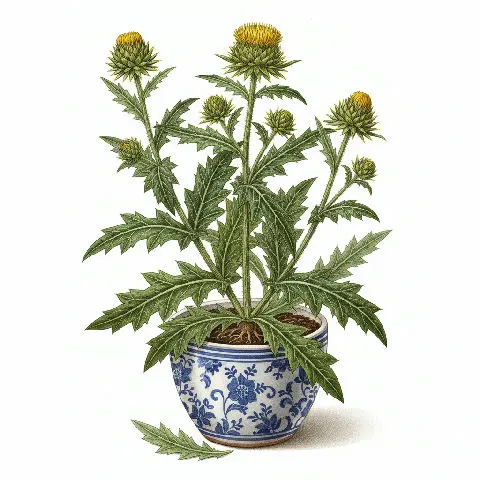
Blessed Thistle, scientifically designated Cnicus benedictus, is a prominent annual herbaceous plant within the extensive Asteraceae family, which notably includes a diverse range of species such as daisies, sunflowers, and other thistle varieties. This resilient plant is indigenous to the sun-drenched Mediterranean basin, specifically encompassing southern Europe and parts of North Africa.
Over time, it has successfully naturalized across various temperate regions globally, frequently flourishing in disturbed habitats like cultivated fields, roadsides, and waste areas.
Its botanical presentation is quite distinctive, characterized by a robust, upright stem that typically attains heights of 30 to 60 cm, often branching towards its apex. Both the stem and its lanceolate to oblong-lanceolate leaves are armed with a dense array of sharp, rigid prickles, a characteristic feature common to many thistles. The leaves exhibit deep lobing and serrated margins, presenting a unique silvery-green coloration attributed to the fine, downy hairs covering their surfaces.
The plant produces a solitary, terminal flower head, which generally emerges from late spring through mid-summer. These vibrant yellow, tubular florets are enveloped by an involucre of spiny bracts, contributing to its striking, albeit somewhat formidable, appearance. Cnicus benedictus anchors itself with a taproot system, facilitating effective nutrient absorption from various soil depths.
Taxonomically, Cnicus benedictus occupies a specific niche within the Cardueae tribe of the Asteraceae, differentiating it from other well-known thistles like Milk Thistle (Silybum marianum) or Common Thistle (Cirsium vulgare), despite shared common nomenclature. Its historical and cultural significance is profound; the epithet 'Blessed Thistle' is thought to stem from its widespread medicinal application during the Middle Ages, particularly by Benedictine monks who prized its purported purifying and tonic properties.
It was widely regarded as a panacea, often invoked for its 'blessed' healing capabilities across various ailments, extending beyond its direct medicinal applications to symbolize resilience in disturbed ecological settings.
Trusted Scientific References
1. Authoritative external sources for Cnicus benedictus
1.1 Wikipedia — Cnicus benedictus
1.2 Kew POWO (Plants of the World Online)
1.3 PubMed — peer-reviewed research
1.4 NCBI Taxonomy Browser
1.5 GBIF — Global Biodiversity
1.1.Blessed Thistle — Notable Characteristics
- ✓Botanical Identity — Cnicus benedictus, a distinctive annual herbaceous plant from the Asteraceae family.
- ✓Mediterranean Origin — Native to Southern Europe and North Africa, now naturalized globally in temperate zones.
- ✓Spiny Morphology — Characterized by prickly stems and deeply lobed, spiny leaves with a silvery-green hue.
- ✓Historical Significance — Valued since the Middle Ages, particularly by Benedictine monks, for its 'blessed' healing properties.
- ✓Digestive Bitter — Highly regarded for its potent bitter compounds that stimulate digestion and appetite.
- ✓Lactation Support — Widely used as a traditional galactagogue to enhance milk supply in nursing mothers.
- ✓Key Constituent Cnicin — Contains sesquiterpene lactone cnicin, responsible for much of its therapeutic action.
- ✓Anti — inflammatory Potential — Exhibits anti-inflammatory and antimicrobial activities due to its phytochemical profile.
- ✓Diverse Preparations — Commonly consumed as tea, tincture, or encapsulated supplement.
- ✓Important Precautions — Contraindicated in pregnancy and for individuals with Asteraceae allergies or certain GI issues.
1.2.Blessed Thistle — Snapshot Summary
- ✓Resilient annual herb native to the Mediterranean, known for its spiny leaves and yellow flowers.
- ✓Traditionally revered as a bitter tonic, digestive aid, and galactagogue.
- ✓Contains cnicin, lignans, and flavonoids, contributing to its medicinal properties.
- ✓Primarily used to stimulate appetite, support digestion, and encourage milk flow in nursing mothers.
- ✓Key contraindications include pregnancy, allergies to Asteraceae, and certain gastrointestinal conditions.
- ✓High doses can cause stomach upset and vomiting; always adhere to recommended dosages.
2.Blessed Thistle — Scientific Identity
3.Blessed Thistle — Fact Sheet
4.Blessed Thistle — Botanical Features
5.Blessed Thistle — Origin & Spread
6.Blessed Thistle — Heritage Uses
7.Blessed Thistle — Chemical Profile
- ✓Sesquiterpene Lactones — The primary active compound is cnicin, a bitter sesquiterpene lactone responsible for many of Blessed Thistle's digestive and anti-inflammatory actions.
- ✓Lignans — Compounds like arctigenin and arctiin are present, known for their antioxidant, antiviral, and potential anticancer properties.
- ✓Flavonoids — Includes apigenin, luteolin, and quercetin derivatives, contributing to the plant's antioxidant, anti-inflammatory, and protective cellular effects.
- ✓Tannins — These polyphenolic compounds provide astringent properties, contributing to Blessed Thistle's traditional use for diarrhea and wound healing.
- ✓Essential Oils — Composed of various monoterpenes and sesquiterpenes, these volatile compounds contribute to the plant's aroma and exhibit some antimicrobial activity.
- ✓Phytosterols — Beta-sitosterol and other plant sterols are present, which may have cholesterol-lowering and anti-inflammatory benefits.
- ✓Triterpenes — These compounds are known for their anti-inflammatory and hepatoprotective potential.
- ✓Polysaccharides — Complex carbohydrates that can contribute to the plant's immune-modulating properties.
- ✓Mucilage — A gelatinous substance providing soothing properties for mucous membranes, particularly in the digestive tract.
- ✓Mineral Salts — Contains various essential minerals, contributing to its overall nutritional profile and tonic effects.
8.Blessed Thistle — Evidence-Based Benefits
- ✓Digestive Aid — Blessed Thistle acts as a potent bitter tonic, stimulating the production of digestive enzymes and bile, which enhances overall digestion and nutrient absorption.
- ✓Appetite Stimulant — Its bitter compounds, particularly cnicin, can increase appetite, making it beneficial for individuals experiencing loss of hunger due to illness or convalescence.
- ✓Galactagogue Properties — Traditionally used to support lactation, Blessed Thistle is believed to promote milk flow in nursing mothers, though scientific evidence is primarily anecdotal.
- ✓Anti-inflammatory Action — Certain constituents, such as sesquiterpene lactones and flavonoids, may contribute to its anti-inflammatory effects, potentially easing discomfort.
- ✓Antimicrobial Activity — Research suggests that Cnicus benedictus possesses compounds with antibacterial and antifungal properties, offering potential benefits against various pathogens.
- ✓Wound Healing — Applied topically, Blessed Thistle has been historically used to aid in the healing of minor cuts and wounds, likely due to its astringent and antimicrobial qualities.
- ✓Diuretic Effect — The plant may exhibit mild diuretic properties, assisting the body in expelling excess fluids and supporting kidney function.
- ✓Fever Reducer — In traditional medicine, Blessed Thistle was employed to help break fevers, possibly by promoting sweating and detoxification.
- ✓Liver Support — While not as prominent as Milk Thistle, its bitter principles can indirectly support liver health by stimulating bile production and aiding detoxification processes.
- ✓Expectorant Qualities — It has been used to alleviate coughs and congestion by helping to loosen and expel mucus from the respiratory tract.
8.1.Blessed Thistle — Indications & Uses
9.Blessed Thistle — Cautions & Contraindications
9.1.Blessed Thistle — Possible Adverse Reactions
- ✓Stomach Upset and Vomiting — High doses, particularly exceeding 5 grams per cup of tea, can induce significant stomach upset, nausea, and vomiting.
- ✓Allergic Reactions — Individuals sensitive to the Asteraceae/Compositae family (e.g., ragweed, daisies, chrysanthemums) may experience allergic reactions, including skin rashes or respiratory symptoms.
- ✓Heartburn Exacerbation — Due to its ability to increase stomach acid, it might worsen symptoms in individuals prone to severe heartburn or acid reflux.
- ✓Diarrhea (Paradoxical) — While traditionally used for mild diarrhea, in some sensitive individuals or at very high doses, it could potentially irritate the digestive tract.
- ✓Skin Irritation — Direct skin contact with the fresh plant, especially the prickly parts, can cause irritation or contact dermatitis in susceptible individuals.
- ✓Bitter Taste Discomfort — The intense bitter taste can be off-putting for some, leading to gastric discomfort even at lower doses.
9.2.Blessed Thistle — Safety Overview
- ✓Pregnancy Contraindication — Blessed Thistle is considered likely unsafe during pregnancy and should be avoided due to potential uterine stimulant effects.
- ✓Breastfeeding Caution — There is insufficient reliable information regarding its safety during breastfeeding; therefore, it is best to avoid use to be on the safe side.
- ✓Allergy to Asteraceae — Individuals with known allergies to ragweed, chrysanthemums, marigolds, daisies, or other members of the Asteraceae family should avoid Blessed Thistle.
- ✓Gastrointestinal Conditions — Avoid use in individuals with inflammatory bowel conditions such as Crohn's disease, ulcerative colitis, or stomach ulcers, as it may cause irritation.
- ✓Drug Interactions — Blessed Thistle may interact with medications that decrease stomach acid (e.g., antacids, H2-blockers, proton pump inhibitors) by increasing acid production, thus reducing their effectiveness.
- ✓Dosage Sensitivity — Adhere strictly to recommended dosages, as high amounts can lead to significant gastrointestinal distress, including vomiting.
- ✓Consult Healthcare Provider — Always consult a healthcare professional before using Blessed Thistle, especially if pregnant, breastfeeding, on medication, or managing a health condition.
10.Blessed Thistle — Preparations & Uses
- ✓Herbal Tea (Infusion) — Steep 1-2 teaspoons of dried Blessed Thistle herb in a cup of hot water for 10-15 minutes; consume up to 3 times daily, particularly before meals as a bitter tonic.
- ✓Liquid Extract (Tincture) — Take 1-2 ml of a Blessed Thistle tincture, 2-3 times per day, diluted in water, following product-specific instructions.
- ✓Capsules/Tablets — For convenient dosing, Blessed Thistle can be taken in encapsulated or tablet form; always adhere to the manufacturer's recommended dosage.
- ✓Poultice — For topical applications, a poultice can be made by crushing fresh leaves or rehydrating dried herb with warm water, then applying it directly to minor wounds or skin irritations.
- ✓Decoction — For stronger preparations, particularly of the root, simmer the herb in water for a longer period (e.g., 20-30 minutes) to create a decoction.
- ✓Culinary Use — Young leaves can occasionally be added to salads or cooked, though their bitter taste is pronounced and their spiny nature requires careful preparation.
- ✓Syrups — Infused Blessed Thistle can be incorporated into herbal syrups, often combined with other herbs, for respiratory support or general tonic purposes.
- ✓External Wash — A strong infusion can be used as an external wash for minor skin issues or as a gargle for throat discomfort.
11.Blessed Thistle — Cultivation & Care
- ✓Soil Preparation — Blessed Thistle thrives in well-drained, average to poor soils, preferring a pH range of 6.0 to 7.0; amend heavy clay soils with organic matter for better drainage.
- ✓Sowing Seeds — Sow seeds directly into the garden in early spring after the last frost, or in late fall for germination the following spring, planting them about 1 cm deep.
- ✓Sunlight Requirements — Ensure the plant receives full sun exposure, at least 6-8 hours of direct sunlight daily, for optimal growth and flowering.
- ✓Watering — Water regularly during dry spells, especially when young, but avoid overwatering as it is somewhat drought-tolerant once established.
- ✓Spacing — Space plants approximately 30-45 cm apart to allow for proper air circulation and growth, as they can spread.
- ✓Pest and Disease Management — Blessed Thistle is generally robust and resistant to most pests and diseases, though occasional aphid infestations can occur; treat with organic insecticidal soap if necessary.
- ✓Harvesting — Harvest the aerial parts (leaves, stems, and flower heads) when the plant is in full bloom, typically from late spring to mid-summer, for medicinal use.
- ✓Seed Collection — Allow some flower heads to go to seed for self-seeding or collect seeds for future planting once they mature and dry on the plant.
Reviewed by the Flora Medical Global Botanical Review Panel
Multi-disciplinary editorial group · Botany · Ethnobotany · Herbal-medicine literature
Who reviewed this: This page was checked by the Flora Medical Global Botanical Review Panel — an in-house editorial group of botany graduates, ethnobotany researchers, and horticulture practitioners who collectively maintain our 7,000+ plant encyclopedia. Meet the team.
Our 4-step verification process
1. Taxonomic verification
Scientific names and synonyms cross-checked against Kew POWO, World Flora Online, and The Plant List.
2. Phytochemical & medicinal cross-reference
Active compounds, traditional uses, and reported activities are cross-referenced with PubMed, USDA Dr. Duke's database, and peer-reviewed ethnobotanical literature.
3. Conservation & distribution check
Distribution, ecology, and conservation status confirmed against GBIF occurrence records and the IUCN Red List.
4. Editorial & safety review
Every entry passes an editorial pass for clarity, originality, and safety notices (toxicity, contraindications, dosage caveats) before publication.
Last reviewed:
Important medical disclaimer: This content is for educational and research purposes only. It is not medical advice and is not a substitute for consultation with a licensed healthcare provider. Do not use any herb to self-treat a medical condition without professional guidance.
Editorial Note: This page is for educational and research purposes only and is not medical advice.
Written by: Flora Medical Global Editorial Team
Reviewed by: Flora Medical Global Botanical Review Panel
Last Updated: June 15, 2026





Blessed Thistle — Comments & Community Reviews
Rate this plant