


Medical Disclaimer: This content is for educational purposes only. It is not medical advice. Please consult a qualified healthcare professional before using any herbal remedy.
Safety Overview
1.Boldo — Essential Profile
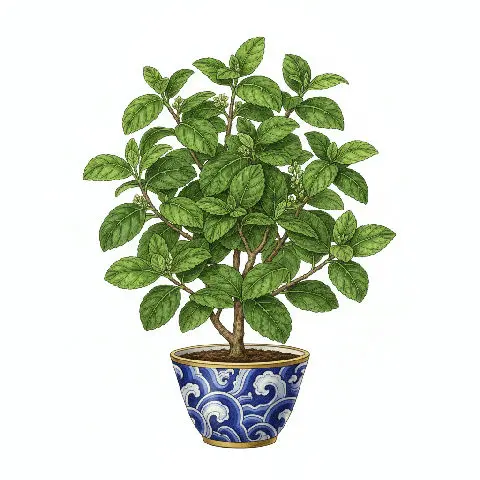
Boldo, scientifically known as Peumus boldus, is a distinctive evergreen shrub or small tree belonging to the Monimiaceae family. Native to the arid and semi-arid regions of central Chile, it is an integral component of the Chilean matorral ecosystem, often found thriving on dry, rocky slopes and in sunny, open woodlands.
This resilient plant can grow up to 6 meters tall, characterized by its sturdy, greyish-brown, furrowed bark and a deep, extensive root system that enables it to withstand drought conditions. Its taxonomic classification places it within the Laurales order, indicating an ancient lineage among flowering plants.
The most notable feature of Peumus boldus is its leaves. They are opposite, oval to elliptical in shape, measuring about 3-7 cm long, and possess a thick, leathery texture. The margins are entire or slightly serrated, and the surface is rough due to numerous microscopic glands.
When crushed, the leaves release a strong, camphoraceous, and somewhat spicy aroma, indicative of their rich volatile oil content. Boldo produces small, bell-shaped flowers that are typically greenish-white or pale yellow, appearing in axillary racemes. Peumus boldus is a dioecious species, meaning male and female flowers are borne on separate plants.
The fruit is a small, yellowish-green drupe, which is edible but not widely consumed.
Historically, Boldo holds profound cultural and medicinal significance, particularly among the Mapuche people of Chile and other indigenous communities in South America. For centuries, its leaves have been a cornerstone of traditional herbal medicine, utilized for a wide array of digestive, hepatic, and general wellness applications.
Its introduction to European medicine in the 19th century further cemented its reputation, leading to extensive pharmacological investigation that continues to validate many of its traditional uses.
Trusted Scientific References
1. Authoritative external sources for Peumus boldus
1.1 Wikipedia — Peumus boldus
1.2 Kew POWO (Plants of the World Online)
1.3 PubMed — peer-reviewed research
1.4 NCBI Taxonomy Browser
1.5 GBIF — Global Biodiversity
1.1.Boldo — Distinguishing Points
- ✓Native to Chile's — Native to Chile's arid regions.
- ✓Characterized by aromatic, — Characterized by aromatic, leathery leaves.
- ✓Deep historical use — Deep historical use by Mapuche people for medicinal purposes.
- ✓Primary active compound — Primary active compound is the alkaloid boldine.
- ✓Known for stimulating — Known for stimulating bile production and flow (choleretic).
- ✓Possesses diuretic and — Possesses diuretic and mild laxative properties.
- ✓Crucial to use products verified as ascaridole — free.
- ✓Supports liver and — Supports liver and gallbladder function.
- ✓Strong, camphoraceous scent — Strong, camphoraceous scent when leaves are crushed.
- ✓Part of the — Part of the ancient Laurales order of flowering plants.
1.2.Boldo — Snapshot Summary
- ✓Traditional Chilean herb known as Peumus boldus.
- ✓Valued for its choleretic, hepatoprotective, and diuretic properties.
- ✓Contains beneficial boldine but also potentially toxic ascaridole.
- ✓Essential to use only ascaridole-free products for safety.
- ✓Supports liver, gallbladder, and digestive health.
- ✓Contraindicated in pregnancy, liver disease, and prior to surgery.
2.Boldo — Botanical Identity
3.Boldo — Key Data
4.Boldo — Physical Description
5.Boldo — Native Range & Habitat
6.Boldo — Traditional Uses
7.Boldo — Key Phytochemicals
- ✓Aporphine Alkaloids — Boldine is the most prominent alkaloid, responsible for many of Boldo's choleretic, antioxidant, and hepatoprotective actions. Other related alkaloids include isoboldine and laurotetanine.
- ✓Volatile Oils — These contribute to Boldo's characteristic aroma and include monoterpenes such as ascaridole (a potentially hepatotoxic compound, which should be absent or in minimal amounts in medicinal preparations), cineole, and limonene.
- ✓Flavonoids — Compounds like quercetin and kaempferol derivatives are present, providing antioxidant and anti-inflammatory benefits.
- ✓Phenolic Acids — Caffeic acid and rosmarinic acid contribute to the plant's free-radical scavenging capacity and overall antioxidant profile.
- ✓Tannins — These astringent compounds may offer benefits for digestive health and have mild antiseptic properties.
- ✓Glycosides — Various glycosidic compounds are found, which might play a role in its diuretic and digestive effects.
- ✓Lignans — These phytochemicals possess potential antioxidant, anti-inflammatory, and even anticarcinogenic properties.
- ✓Saponins — Contribute to the plant's bitter taste and may have expectorant or diuretic actions, though their specific roles are less studied.
8.Boldo — Evidence-Based Benefits
- ✓Cholagogue/Choleretic Action — Boldo stimulates the production and flow of bile from the liver and gallbladder, aiding in fat digestion and nutrient absorption.
- ✓Hepatoprotective Effects — The alkaloid boldine, a primary active compound, exhibits antioxidant properties that help protect liver cells from oxidative damage and inflammation.
- ✓Digestive Aid — It helps alleviate symptoms of dyspepsia, indigestion, bloating, and gas by promoting healthy digestive enzyme secretion and bile flow.
- ✓Diuretic Properties — Boldo has been traditionally used to increase urine output, which can assist in flushing out toxins and may help in the management of kidney stones.
- ✓Antimicrobial Activity — Certain constituents within Boldo leaves demonstrate mild antimicrobial effects, potentially inhibiting bacterial growth, particularly in the urinary tract.
- ✓Anti-inflammatory Support — Boldine and other compounds may contribute to reducing inflammation, offering relief for conditions like mild joint discomfort.
- ✓Antioxidant Capacity — Rich in various antioxidant compounds, Boldo helps neutralize free radicals, protecting cells from damage and supporting overall cellular health.
- ✓Gastrointestinal Motility — It can help regulate bowel movements, providing a gentle laxative effect and easing mild constipation.
- ✓Detoxification Support — By enhancing liver and kidney function, Boldo supports the body's natural detoxification pathways, aiding in the elimination of waste products.
- ✓Antispasmodic Effects — The plant may help relax smooth muscles in the digestive tract, which can alleviate abdominal cramps and spasms.
8.1.Boldo — Conditions Traditionally Used For
9.Boldo — Cautions & Contraindications
9.1.Boldo — Caution Notes
- ✓Liver Toxicity — High doses or prolonged use of Boldo products containing ascaridole can lead to liver damage.
- ✓Allergic Reactions — Some individuals may experience skin irritation, rash, or, in rare cases, anaphylaxis.
- ✓Gastrointestinal Upset — Nausea, vomiting, diarrhea, or abdominal pain can occur, especially with excessive intake.
- ✓Increased Bleeding Risk — Boldo may slow blood clotting, increasing the likelihood of bruising or bleeding.
- ✓Hypotension — In susceptible individuals, Boldo might cause a drop in blood pressure.
- ✓Drug Interactions — Can reduce the efficacy of tacrolimus and increase levels of lithium, requiring careful monitoring.
- ✓Gallbladder Issues — May exacerbate conditions like bile duct obstruction or gallstones due to increased bile flow.
9.2.Boldo — Toxicity Assessment
- ✓Ascaridole Content — Only use Boldo products certified as 'ascaridole-free' to prevent liver damage.
- ✓Pregnancy & Breastfeeding — Boldo is contraindicated during pregnancy and lactation due to potential harm to the fetus and infants.
- ✓Liver Disease — Individuals with pre-existing liver conditions should avoid Boldo due to increased risk of hepatotoxicity.
- ✓Gallbladder Disorders — Not recommended for those with bile duct obstruction, gallstones, or severe gallbladder disease without medical supervision.
- ✓Prior to Surgery — Discontinue Boldo use at least two weeks before any scheduled surgical procedure due to its anticoagulant properties.
- ✓Medication Interactions — Exercise caution and consult a healthcare provider if taking blood thinners, lithium, or immunosuppressants like tacrolimus.
- ✓Children — Avoid use in children due to insufficient safety data and the potential for toxicity.
10.Boldo — Preparations & Uses
- ✓Herbal Infusion (Tea) — Steep 1 gram of dried, crushed Boldo leaves (ensure ascaridole-free) in 150 mL of boiling water for 5-10 minutes; strain and consume.
- ✓Tinctures — A concentrated liquid extract made by macerating Boldo leaves in alcohol, typically taken in drops mixed with water.
- ✓Capsules/Tablets — Standardized extracts or powdered leaves are available in capsule or tablet form for precise dosing.
- ✓Liquid Extracts — Non-alcoholic or hydro-alcoholic extracts are used for their concentrated benefits, often added to water or juice.
- ✓Decoction — For bark or tougher plant parts, a decoction involves simmering the material in water for a longer period, though less common for Boldo leaves.
- ✓Topical Application — Less common and generally not recommended due to potential for skin irritation; internal use is primary for medicinal benefits.
- ✓Ascaridole-Free Products — Always prioritize products explicitly labeled as 'ascaridole-free' to mitigate liver toxicity risks.
11.Boldo — Cultivation & Care
- ✓Climate Preference — Thrives in Mediterranean climates with dry summers and mild, wet winters.
- ✓Soil Requirements — Prefers well-drained, sandy or loamy soils, tolerating poor and rocky conditions.
- ✓Light Exposure — Requires full sun exposure for optimal growth and development of its medicinal compounds.
- ✓Watering — Highly drought-tolerant once established, needing minimal irrigation.
- ✓Propagation — Can be propagated from seeds, which may require scarification, or from semi-hardwood cuttings.
- ✓Growth Rate — A relatively slow-growing evergreen shrub or small tree.
- ✓Hardiness — Tolerant to mild frosts but sensitive to prolonged freezing temperatures.
- ✓Harvesting — Leaves are typically harvested when mature, usually during dry periods, and then carefully dried for medicinal use.
Reviewed by the Flora Medical Global Botanical Review Panel
Multi-disciplinary editorial group · Botany · Ethnobotany · Herbal-medicine literature
Who reviewed this: This page was checked by the Flora Medical Global Botanical Review Panel — an in-house editorial group of botany graduates, ethnobotany researchers, and horticulture practitioners who collectively maintain our 7,000+ plant encyclopedia. Meet the team.
Our 4-step verification process
1. Taxonomic verification
Scientific names and synonyms cross-checked against Kew POWO, World Flora Online, and The Plant List.
2. Phytochemical & medicinal cross-reference
Active compounds, traditional uses, and reported activities are cross-referenced with PubMed, USDA Dr. Duke's database, and peer-reviewed ethnobotanical literature.
3. Conservation & distribution check
Distribution, ecology, and conservation status confirmed against GBIF occurrence records and the IUCN Red List.
4. Editorial & safety review
Every entry passes an editorial pass for clarity, originality, and safety notices (toxicity, contraindications, dosage caveats) before publication.
Last reviewed:
Important medical disclaimer: This content is for educational and research purposes only. It is not medical advice and is not a substitute for consultation with a licensed healthcare provider. Do not use any herb to self-treat a medical condition without professional guidance.
Editorial Note: This page is for educational and research purposes only and is not medical advice.
Written by: Flora Medical Global Editorial Team
Reviewed by: Flora Medical Global Botanical Review Panel
Last Updated: June 15, 2026





Boldo — Comments & Community Reviews
Rate this plant