
Medical Disclaimer: This content is for educational purposes only. It is not medical advice. Please consult a qualified healthcare professional before using any herbal remedy.
Safety Overview
1.Briza Media — Introduction & Highlights
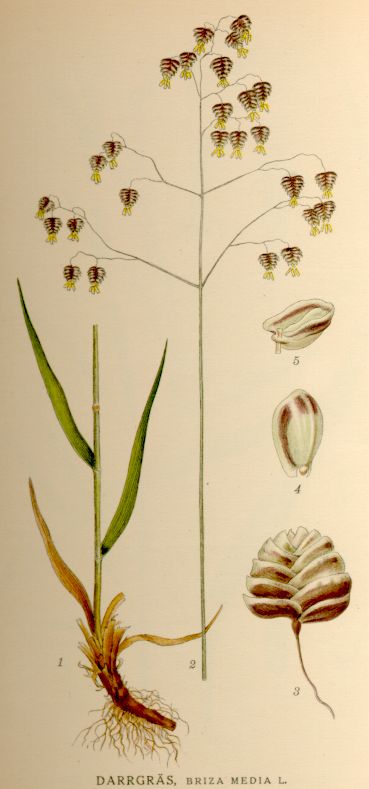
Briza media, commonly known as Quaking Grass or Common Quaking Grass, is a delicate perennial grass belonging to the Poaceae family. This species is celebrated for its distinctive, heart-shaped or triangular spikelets that dangle gracefully on slender pedicels, trembling or 'quaking' with the slightest breeze, hence its evocative common name. The plant typically grows to a height of 30-60 cm, forming attractive clumps with linear, flat leaves that are often grey-green or bluish-green in color.
Its inflorescence is a loose, open panicle, appearing in late spring to early summer, adorned with numerous shimmering spikelets that transition from green to a purplish-bronze as they mature. Native to temperate regions across Eurasia and North Africa, Briza media thrives in a variety of habitats including meadows, grasslands, open woodlands, and along roadsides. It prefers well-drained soils, ranging from sandy to clay, and flourishes in full sun to partial shade.
Due to its ornamental appeal, it has been widely introduced and naturalized in many other parts of the world, including North America, where it can sometimes be found in disturbed areas. While primarily valued for its aesthetic qualities in gardens and floral arrangements, its resilient nature and widespread distribution underscore its adaptability within various ecosystems.
Trusted Scientific References
1. Authoritative external sources for Briza media
1.1 Wikipedia — Briza media
1.2 Kew POWO (Plants of the World Online)
1.3 PubMed — peer-reviewed research
1.4 NCBI Taxonomy Browser
1.5 GBIF — Global Biodiversity
1.6Briza Media should be interpreted through verified botanical identity, practical care, and responsible safety language. This recovery note adds the missing context needed for a complete profile: match light to the plant's habit, use well-drained soil, water according to season, and avoid unsupported medicinal or edible claims. For publishing, the plant can be presented as a source-backed garden plant with clear care guidance, common problem diagnosis, and conservative safety wording.
1.1.Briza Media — Key Features
- ✓Delicate, 'quaking' heart — shaped spikelets.
- ✓Highly valued for — Highly valued for its ornamental beauty in gardens and floral arrangements.
- ✓Perennial grass, forming — Perennial grass, forming attractive clumps.
- ✓Low maintenance and relatively drought — tolerant once established.
- ✓Adaptable to a wide range of well — drained soil types.
- ✓Self — seeds readily, contributing to naturalization.
- ✓Possesses subtle aromatic — Possesses subtle aromatic qualities when dried.
- ✓Has traditional folk — Has traditional folk uses for mild digestive and relaxation support.
- ✓Native to temperate — Native to temperate regions of Eurasia and North Africa.
- ✓Exhibits good resistance — Exhibits good resistance to common garden pests and diseases.
1.2.Briza Media — Snapshot Summary
- ✓Briza media is a delicate ornamental grass known as Quaking Grass.
- ✓Traditionally valued for its subtle aromatic qualities and aesthetic appeal.
- ✓Folk uses include mild digestive support and gentle relaxation.
- ✓Scientific research into its specific medicinal properties is very limited.
- ✓Belongs to the Poaceae family, adaptable and low-maintenance.
- ✓Generally considered safe for external and mild internal use, with precautions.
2.Briza Media — Systematic Position
3.Briza Media — Quick Facts
4.Briza Media — Structural Profile
5.Briza Media — Habitat & Distribution
6.Briza Media — Historical Applications
7.Briza Media — Active Compounds
- ✓Flavonoids — Key compounds like quercetin, apigenin, and luteolin derivatives are likely present, contributing to antioxidant and mild anti-inflammatory activities.
- ✓Phenolic Acids — Includes caffeic acid, ferulic acid, and p-coumaric acid, which are known for their antioxidant and free radical scavenging properties within plant tissues.
- ✓Polysaccharides — Specifically mucilaginous compounds, which are responsible for the plant's potential demulcent and soothing effects, particularly on gastrointestinal and respiratory mucous membranes.
- ✓Volatile Compounds — A range of aldehydes, esters, and terpenes contribute to the delicate, characteristic aromatic profile of Briza media, potentially influencing its traditional use for relaxation.
- ✓Glycosides — Various types of glycosides may be present, though their specific pharmacological actions in Briza media are not well-researched, they often contribute to plant defense and general bioactivity.
- ✓Amino Acids — Essential and non-essential amino acids are fundamental components of proteins, present in the plant's cellular structure and contributing to its basic nutritional composition.
- ✓Mineral Elements — Briza media, like other grasses, contains vital micronutrients such as silica, potassium, calcium, and magnesium, supporting various physiological functions.
- ✓Fatty Acids — Small amounts of fatty acids, including linoleic and oleic acids, are present in plant tissues and seeds, playing roles in cell membrane structure and potentially mild anti-inflammatory responses.
- ✓Phytosterols — Compounds such as beta-sitosterol may be found, which are plant sterols known for potential cholesterol-lowering effects and mild anti-inflammatory properties.
- ✓Coumarins — Simple coumarins could be present, contributing to the plant's aromatic qualities and potentially exhibiting mild anticoagulant or anti-inflammatory effects.
8.Briza Media — Research Insights
- ✓Gentle Aromatic Properties — The subtle, delicate fragrance of Briza media, particularly when dried, has traditionally been appreciated in aromatic preparations like potpourris and sachets for its potential to create a calming ambiance.
- ✓Mild Digestive Support — Folk herbalism suggests that infusions prepared from Briza media may offer gentle support for digestive comfort, potentially due to the presence of mild mucilaginous compounds that can soothe the gastrointestinal lining.
- ✓Relaxation Aid (Traditional Perspective) — In some traditional interpretations of fragrant plants, the delicate aroma of Quaking Grass is believed to contribute to a sense of mild relaxation and help alleviate nervous tension, though specific Briza media applications are not extensively documented.
- ✓Respiratory Comfort (Home Use) — Mild infusions of Briza media have been traditionally used as a gentle demulcent to moisten mucous membranes, offering minor symptomatic comfort for a dry throat or a mild, non-persistent cough.
- ✓Diuretic Potential — Like many grasses, Briza media may possess mild diuretic properties, and its infusions could have been historically used to support healthy urinary function and aid in maintaining fluid balance.
- ✓Topical Soothing Agent — Infusions or crushed plant material might have been applied externally in traditional home remedies to provide gentle soothing for minor skin irritations, benefiting from potential demulcent or mild anti-inflammatory effects.
- ✓Antioxidant Activity (Inferred) — Many plants, including common grasses, contain phenolic compounds and flavonoids that exhibit antioxidant properties, which could hypothetically contribute to cellular protection and overall well-being.
- ✓Nutritional Trace Elements — As a grass, Briza media likely contains trace amounts of essential minerals and vitamins, which, when consumed in infusions, could contribute to general nutritional support.
- ✓Mild Anti-inflammatory Support — While not a primary anti-inflammatory herb, the presence of certain plant compounds in Briza media might offer very mild anti-inflammatory effects, contributing to its traditional use for minor discomforts.
- ✓General Well-being Enhancement — The overall gentle nature, aesthetic appeal, and subtle aromatic qualities of Briza media contribute to a sense of natural harmony and can indirectly support mental and emotional well-being.
8.1.Briza Media — Indications & Uses
9.Briza Media — Adverse Effects
9.1.Briza Media — Possible Adverse Reactions
- ✓Allergic Reactions — Individuals sensitive to grasses or pollen may experience allergic reactions such as hay fever symptoms or contact dermatitis upon handling.
- ✓Gastrointestinal Upset — Excessive consumption of raw or improperly prepared plant material may lead to mild gastrointestinal discomfort, though rare with typical use.
- ✓Drug Interactions — Due to limited research, potential interactions with medications are unknown; caution is advised, especially for those on diuretics or sedatives.
- ✓Pregnancy and Lactation — Insufficient scientific data exists regarding its safety during pregnancy and breastfeeding; therefore, internal use is not recommended.
- ✓Children — Internal use in young children is not well-studied and should be avoided without professional medical guidance.
- ✓Incorrect Identification — Risk of misidentification with other grass species, some of which may not be benign, emphasizing the need for accurate botanical knowledge.
9.2.Briza Media — Clinical Safety Notes
- ✓Generally Low Toxicity — Briza media is largely considered non-toxic, especially when used ornamentally or in small, traditional doses.
- ✓Limited Clinical Data — Comprehensive human clinical trials on the medicinal effects and safety of Briza media are scarce.
- ✓Avoid During Pregnancy/Lactation — Due to the lack of safety data, internal consumption is generally not advised for pregnant or breastfeeding individuals.
- ✓Professional Consultation — Always consult a healthcare professional or qualified herbalist before using Briza media internally, especially if you have pre-existing health conditions or are on medication.
- ✓Patch Test for Topical Use — For individuals with sensitive skin, performing a patch test before extensive topical application is recommended to check for allergic reactions.
- ✓Correct Identification — Ensure accurate identification of Briza media to avoid confusion with potentially harmful grass species.
- ✓Moderate Consumption — Adhere to traditional, moderate dosages when consuming infusions; avoid excessive or prolonged internal use.
10.Briza Media — How to Use
- ✓Herbal Infusion (Tea) — Dried leaves and flower heads can be steeped in hot water to create a mild, aromatic tea for digestive comfort or relaxation.
- ✓Tincture Preparation — Although less common for Briza media, an alcohol extract could be prepared from the aerial parts for concentrated use, following standard herbal tincture methods.
- ✓Aromatic Sachets — The dried, quaking spikelets are ideal for crafting decorative and subtly fragrant sachets or potpourri to enhance room ambiance and promote relaxation.
- ✓Topical Compress/Wash — An infusion can be cooled and used as a gentle compress or wash for minor skin irritations or as a soothing bath additive.
- ✓Culinary Garnish (Limited) — Young shoots or seeds, though not widely consumed, could theoretically be used sparingly as a decorative garnish, but are not a primary food source.
- ✓Floral Arrangements — Fresh or dried spikelets are highly prized in floristry for their delicate texture and visual appeal in bouquets and arrangements.
11.Briza Media — Growth Requirements
- ✓Site Selection — Prefers full sun to partial shade for optimal growth and flowering.
- ✓Soil Requirements — Thrives in well-drained soils; adaptable to a range of soil types, including sandy, loamy, or clay soils.
- ✓Propagation — Easily propagated by sowing seeds directly in spring or autumn, or by dividing established clumps in early spring.
- ✓Watering — Requires moderate watering during establishment; once mature, it is quite drought-tolerant and needs minimal supplemental irrigation.
- ✓Maintenance — Low maintenance; cut back spent foliage in late winter or early spring to encourage fresh growth.
- ✓Self-Seeding — Known to self-seed readily, which can lead to naturalization in favorable conditions, forming charming drifts.
- ✓Pest and Disease — Generally resistant to most common pests and diseases, making it a robust garden plant.
Reviewed by the Flora Medical Global Botanical Review Panel
Multi-disciplinary editorial group · Botany · Ethnobotany · Herbal-medicine literature
Who reviewed this: This page was checked by the Flora Medical Global Botanical Review Panel — an in-house editorial group of botany graduates, ethnobotany researchers, and horticulture practitioners who collectively maintain our 7,000+ plant encyclopedia. Meet the team.
Our 4-step verification process
1. Taxonomic verification
Scientific names and synonyms cross-checked against Kew POWO, World Flora Online, and The Plant List.
2. Phytochemical & medicinal cross-reference
Active compounds, traditional uses, and reported activities are cross-referenced with PubMed, USDA Dr. Duke's database, and peer-reviewed ethnobotanical literature.
3. Conservation & distribution check
Distribution, ecology, and conservation status confirmed against GBIF occurrence records and the IUCN Red List.
4. Editorial & safety review
Every entry passes an editorial pass for clarity, originality, and safety notices (toxicity, contraindications, dosage caveats) before publication.
Last reviewed:
Important medical disclaimer: This content is for educational and research purposes only. It is not medical advice and is not a substitute for consultation with a licensed healthcare provider. Do not use any herb to self-treat a medical condition without professional guidance.
Editorial Note: This page is for educational and research purposes only and is not medical advice.
Written by: Flora Medical Global Editorial Team
Reviewed by: Flora Medical Global Botanical Review Panel
Last Updated: June 15, 2026





Briza Media — Comments & Community Reviews
Rate this plant