


Medical Disclaimer: This content is for educational purposes only. It is not medical advice. Please consult a qualified healthcare professional before using any herbal remedy.
Safety Overview
1.Burgundy Rubber Plant — Botanical Snapshot
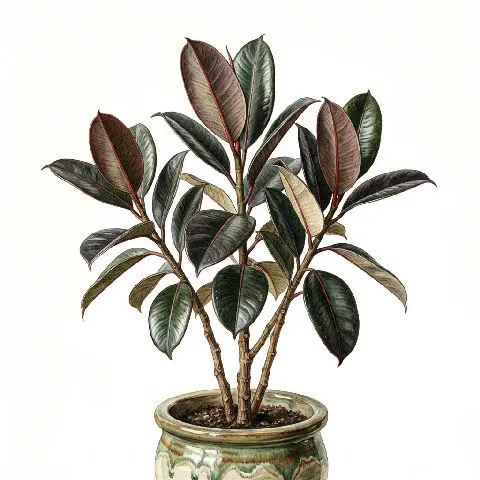
The Burgundy Rubber Plant, scientifically designated Ficus elastica 'Burgundy', is a highly prized cultivated variety of the ubiquitous Rubber Plant, Ficus elastica. This striking indoor specimen is celebrated for its distinctive, deeply colored, and lustrous foliage, which transitions from rich burgundy to an almost black hue, particularly pronounced on newly unfurling leaves and under optimal bright light exposure. Indigenous to the tropical and subtropical belts of South Asia, extending from the Himalayan foothills through Malaysia and Indonesia, the parent species Ficus elastica naturally flourishes in warm, humid climes. The 'Burgundy' cultivar was specifically developed and selected for its intensified leaf pigmentation, significantly enhancing its ornamental appeal.
Historically, the wild Ficus elastica species served as a vital source of natural rubber prior to the widespread cultivation of Hevea brasiliensis. Its characteristic white, milky latex is notably rich in rubber hydrocarbons. While the broader Ficus elastica species has a history of recognition within various traditional medicine systems for its diverse properties, Ficus elastica 'Burgundy' is predominantly valued for its aesthetic contribution as a decorative indoor plant. Its inherent hardiness and remarkable adaptability to a spectrum of indoor conditions have cemented its global popularity.
Within contemporary homes and professional environments, it functions effectively as an air purifier, enhancing indoor air quality by aiding in the filtration of common airborne volatile organic compounds. Phytochemical research, primarily focused on the general Ficus elastica species, has identified a range of compounds within its latex and leaves, including triterpenoids, flavonoids, and coumarins. However, specific pharmacological investigations dedicated solely to the 'Burgundy' cultivar are limited, as its primary differentiation from the parent species is phenotypic (coloration) rather than substantial biochemical divergence. The plant's profound, opulent coloration also lends it cultural resonance in modern interior design, often symbolizing elegance, resilience, and refined sophistication.
Trusted Scientific References
1. Authoritative external sources for Ficus elastica Burgundy
1.1 Wikipedia — Ficus elastica Burgundy
1.2 Kew POWO (Plants of the World Online)
1.3 PubMed — peer-reviewed research
1.4 NCBI Taxonomy Browser
1.5 GBIF — Global Biodiversity
1.1.Burgundy Rubber Plant — Highlights
- ✓Distinctive Deep Burgundy Foliage — Glossy, dark leaves with a rich, almost black hue.
- ✓Air Purifying Qualities — Contributes to cleaner indoor air by filtering common toxins.
- ✓Low — Maintenance Houseplant — Relatively easy to care for, suitable for beginners.
- ✓Milky, Irritant Latex — Contains a toxic sap that can cause skin and gastrointestinal irritation.
- ✓Robust & Adaptable — Tolerates a range of indoor conditions, making it popular globally.
- ✓Architectural Form — Large, sturdy leaves and upright growth create a strong visual presence.
- ✓Native to South Asia — Originates from tropical and subtropical regions.
- ✓Historical Rubber Source — The parent species was historically used for natural rubber production.
- ✓Ornamental Value — Highly prized for its aesthetic appeal in interior design.
- ✓Evergreen Perennial — Retains its leaves year-round, providing continuous greenery.
1.2.Burgundy Rubber Plant — Concise Overview
- ✓Ficus elastica 'Burgundy' is an ornamental cultivar of the Rubber Plant.
- ✓Features striking deep burgundy, glossy foliage.
- ✓Known for contributing to indoor air purification (species property).
- ✓Contains toxic milky latex that causes irritation upon contact or ingestion.
- ✓A relatively low-maintenance indoor plant, sensitive to sudden environmental changes.
- ✓Primarily valued for its aesthetic appeal, with traditional uses attributed to the general Ficus elastica species.
2.Burgundy Rubber Plant — Botanical Identity
3.Burgundy Rubber Plant — Vital Statistics
4.Burgundy Rubber Plant — Physical Description
5.Burgundy Rubber Plant — Origin & Spread
6.Burgundy Rubber Plant — Traditional Uses
7.Burgundy Rubber Plant — Phytochemistry
- ✓Triterpenoids — Key compounds include lupeol, beta-amyrin, and alpha-amyrin, known for their anti-inflammatory, antioxidant, and hepatoprotective actions.
- ✓Flavonoids — Such as quercetin, catechin, and rutin, these potent antioxidants contribute to the plant's free radical scavenging and anti-inflammatory capacities.
- ✓Coumarins — Ficusin and other coumarin derivatives are present, which can exhibit photosensitizing and sometimes antimicrobial activities.
- ✓Rubber Hydrocarbons — The prominent constituent of the milky latex, primarily cis-1,4-polyisoprene, responsible for the plant's historical industrial use and its irritant properties.
- ✓Phenolic Acids — Including gallic acid and caffeic acid, these compounds contribute to the plant's overall antioxidant and anti-inflammatory profile.
- ✓Alkaloids — While less prominent, certain alkaloidal compounds may be present, contributing to various pharmacological effects.
- ✓Sterols — Phytosterols like beta-sitosterol are found, known for their anti-inflammatory and cholesterol-lowering properties.
- ✓Tannins — Astringent compounds that contribute to antimicrobial effects and traditional wound healing applications.
- ✓Saponins — These glycosides can have hemolytic, anti-inflammatory, and cholesterol-lowering activities, though their presence and specific roles in Ficus elastica are less studied.
8.Burgundy Rubber Plant — Evidence-Based Benefits
- ✓Anti-inflammatory Support — Extracts from Ficus elastica species have demonstrated properties that may help reduce inflammation, potentially through modulating immune responses and inhibiting inflammatory pathways.
- ✓Antioxidant Protection — The leaves and latex of Ficus elastica contain compounds like flavonoids and phenolics that exhibit significant antioxidant activity, helping to neutralize free radicals and mitigate oxidative stress.
- ✓Wound Healing Properties — Traditionally, the latex of Ficus elastica has been applied topically to aid in wound healing, potentially due to its antimicrobial properties and ability to form a protective layer.
- ✓Antimicrobial Action — Studies suggest that Ficus elastica extracts possess antimicrobial effects against various bacteria and fungi, which could contribute to its traditional use in treating infections.
- ✓Antidiabetic Potential — Some research indicates that Ficus elastica extracts may help in managing blood glucose levels, a traditional use that warrants further scientific investigation.
- ✓Hepatoprotective Effects — Traditional medicine systems have utilized parts of Ficus elastica for liver support, with preliminary studies suggesting protective effects against liver damage.
- ✓Analgesic Activity — Certain compounds within the Ficus elastica species may offer pain-relieving effects, as observed in some traditional applications and preliminary pharmacological screenings.
- ✓Air Purification — As an indoor plant, Ficus elastica contributes to improved indoor air quality by absorbing common airborne toxins such as formaldehyde and benzene, as identified in environmental studies.
- ✓Digestive Aid (Traditional) — In some traditional practices, specific preparations from the Ficus elastica species were used to support digestive health, though this requires careful preparation due to toxicity.
- ✓Anti-pyretic Action (Traditional) — Historically, parts of the plant have been used to reduce fever, suggesting a traditional antipyretic property that needs modern validation.
8.1.Burgundy Rubber Plant — Reported Uses
9.Burgundy Rubber Plant — Safety Considerations
9.1.Burgundy Rubber Plant — Side Effects & Warnings
- ✓Skin Irritation — Direct contact with the milky latex sap can cause dermal irritation, redness, itching, or allergic reactions in sensitive individuals.
- ✓Oral Irritation — Ingestion or chewing of leaves/stems, particularly by pets, can lead to mouth and throat irritation, swelling, and discomfort.
- ✓Gastrointestinal Distress — If ingested by humans or pets, symptoms may include nausea, vomiting, abdominal pain, and diarrhea.
- ✓Allergic Reactions — Some individuals may experience more severe allergic responses to the latex, including dermatitis or respiratory issues.
- ✓Leaf Drop — Sudden changes in light, temperature, or watering can stress the plant, leading to significant leaf shedding.
- ✓Toxicity to Pets — The plant is considered toxic to cats, dogs, and other household pets, necessitating placement out of their reach.
- ✓Photosensitivity — Coumarins present in the plant may induce photosensitivity in some individuals upon skin contact, especially if exposed to sunlight.
9.2.Burgundy Rubber Plant — Risk Assessment
- ✓Latex Toxicity — The milky sap of Ficus elastica 'Burgundy' is considered toxic and a skin and mucosal irritant; avoid direct contact.
- ✓Keep Out of Reach — Always position the plant where it is inaccessible to children and household pets to prevent accidental ingestion or contact.
- ✓Protective Gear — Wear gloves and protective eyewear when pruning or handling the plant to prevent sap exposure.
- ✓Internal Consumption — Ficus elastica 'Burgundy' is strictly NOT for internal consumption due to its toxicity; traditional medicinal uses refer to specific preparations of the parent species and are not for self-treatment.
- ✓Wash Immediately — In case of skin contact with sap, wash the affected area thoroughly with soap and warm water.
- ✓Seek Medical Advice — If ingestion occurs or severe irritation develops, seek immediate medical or veterinary attention.
- ✓Allergic Sensitivity — Individuals with known latex allergies should exercise extreme caution or avoid handling this plant.
10.Burgundy Rubber Plant — Preparations & Uses
- ✓Ornamental Display — Primarily used as an indoor ornamental plant, place in well-lit areas to showcase its striking burgundy foliage and architectural form.
- ✓Air Purification — Position in living spaces or offices to leverage its air-purifying capabilities, contributing to healthier indoor environments.
- ✓Topical Application (Species-Specific) — In traditional medicine, the latex from the Ficus elastica species has been applied externally as a poultice for minor wounds or skin irritations, always with extreme caution due to its irritant nature.
- ✓Decoctions (Traditional, Species-Specific) — Leaves or bark of the Ficus elastica species may be prepared as decoctions in traditional systems for internal ailments, but this is NOT recommended for 'Burgundy' due to toxicity and lack of specific safety data.
- ✓Propagation — Cuttings can be taken from healthy stems for propagation; ensure proper handling of the latex during this process.
- ✓Leaf Shine — Gently wipe leaves with a damp cloth to remove dust and enhance their natural gloss, promoting better light absorption.
- ✓Environmental Enhancement — Utilize its presence to create a calming and natural aesthetic in interior designs, contributing to overall well-being through biophilic design principles.
11.Burgundy Rubber Plant — Cultivation & Care
- ✓Light — Provide bright, indirect light; the 'Burgundy' cultivar can tolerate some direct morning sun, which enhances its deep leaf coloration.
- ✓Watering — Allow the top 1-2 inches of soil to dry out completely between waterings; ensure adequate drainage to prevent root rot.
- ✓Humidity — Thrives in average indoor humidity but benefits from increased levels (50-60%) via a humidifier or pebble tray, especially in dry environments.
- ✓Temperature — Maintain consistent indoor temperatures between 60-80°F (15-27°C); avoid sudden cold drafts or extreme temperature fluctuations.
- ✓Feeding — Fertilize monthly during the active growing seasons of spring and summer with a balanced liquid houseplant fertilizer diluted to half strength.
- ✓Repotting — Repot only when root-bound, typically every 2-3 years, using a well-draining potting mix; avoid over-potting.
- ✓Pruning — Prune to maintain desired shape and size, especially leggy growth; wear gloves to avoid contact with the irritant latex sap.
- ✓Stability — Once placed, avoid frequent relocation, as Ficus elastica 'Burgundy' can be sensitive to environmental changes and may drop leaves.
Reviewed by the Flora Medical Global Botanical Review Panel
Multi-disciplinary editorial group · Botany · Ethnobotany · Herbal-medicine literature
Who reviewed this: This page was checked by the Flora Medical Global Botanical Review Panel — an in-house editorial group of botany graduates, ethnobotany researchers, and horticulture practitioners who collectively maintain our 7,000+ plant encyclopedia. Meet the team.
Our 4-step verification process
1. Taxonomic verification
Scientific names and synonyms cross-checked against Kew POWO, World Flora Online, and The Plant List.
2. Phytochemical & medicinal cross-reference
Active compounds, traditional uses, and reported activities are cross-referenced with PubMed, USDA Dr. Duke's database, and peer-reviewed ethnobotanical literature.
3. Conservation & distribution check
Distribution, ecology, and conservation status confirmed against GBIF occurrence records and the IUCN Red List.
4. Editorial & safety review
Every entry passes an editorial pass for clarity, originality, and safety notices (toxicity, contraindications, dosage caveats) before publication.
Last reviewed:
Important medical disclaimer: This content is for educational and research purposes only. It is not medical advice and is not a substitute for consultation with a licensed healthcare provider. Do not use any herb to self-treat a medical condition without professional guidance.
Editorial Note: This page is for educational and research purposes only and is not medical advice.
Written by: Flora Medical Global Editorial Team
Reviewed by: Flora Medical Global Botanical Review Panel
Last Updated: June 15, 2026





Burgundy Rubber Plant — Comments & Community Reviews
Rate this plant