


Medical Disclaimer: This content is for educational purposes only. It is not medical advice. Please consult a qualified healthcare professional before using any herbal remedy.
Safety Overview
1.Calathea Louisae — Overview
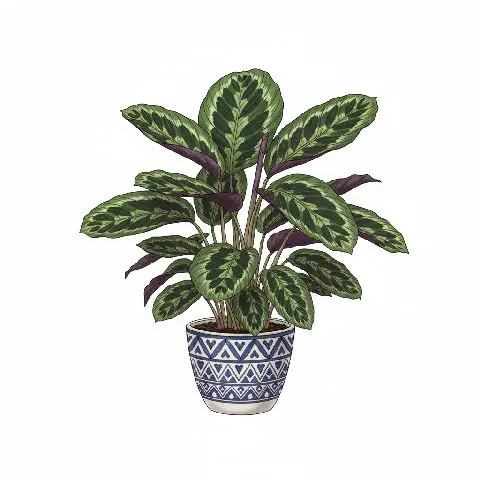
Goeppertia louisae, often still recognized by its former botanical classification Calathea louisae, is a striking tropical perennial native to the lush, humid understory of the Brazilian rainforests, particularly abundant in the southeastern regions. This captivating species, a proud member of the Marantaceae family—commonly known as the prayer plant family—thrives in environments characterized by consistent warmth, high humidity, and filtered, dappled sunlight. Its reclassification from Calathea to Goeppertia reflects advancements in phylogenetic understanding based on molecular studies, refining our botanical comprehension of this diverse genus.
The plant's primary allure lies in its magnificent foliage; its large, ovate to oblong leaves are a vibrant tapestry of dark green, often adorned with lighter green or silvery-green feathering that radiates from the midrib, complemented by a distinctly purplish-red underside. This dramatic contrast creates an exquisite visual spectacle, making it a highly prized ornamental houseplant.
A defining characteristic of the Marantaceae family, and elegantly displayed by Goeppertia louisae, is the phenomenon of nyctinasty. Throughout the day, its leaves spread open to maximize light capture for photosynthesis. As dusk approaches, specialized motor organs called pulvini, located at the base of each leaf stalk, respond to diminishing light intensity.
Through precise changes in turgor pressure within these pulvini, the leaves gracefully fold upwards, evoking the image of hands clasped in prayer. This fascinating circadian rhythm not only optimizes photosynthetic efficiency but may also serve as a defense mechanism against nocturnal herbivores or to minimize water loss. While its ornamental beauty is paramount, documented traditional medicinal applications for Goeppertia louisae are notably scarce in established ethnomedical systems like Ayurveda, TCM, or Unani, which typically focus on pharmacologically active root or leaf compounds.
Modern pharmacological research into this specific species remains limited, primarily due to its prevailing status as an ornamental.
Trusted Scientific References
1. Authoritative external sources for Goeppertia louisae
1.1 Wikipedia — Goeppertia louisae
1.2 Kew POWO (Plants of the World Online)
1.3 PubMed — peer-reviewed research
1.4 NCBI Taxonomy Browser
1.5 GBIF — Global Biodiversity
1.1.Calathea Louisae — Key Features
- ✓Botanical Reclassification — Formerly Calathea louisae, now scientifically known as Goeppertia louisae.
- ✓Family Marantaceae — A prominent member of the 'prayer plant' family.
- ✓Brazilian Origin — Native to the humid understories of southeastern Brazilian rainforests.
- ✓Nyctinastic Leaves — Displays daily rhythmic movement, folding leaves upwards at dusk.
- ✓Distinctive Foliage — Large, ovate leaves with intricate green patterns and a deep purplish-red underside.
- ✓Rhizomatous Perennial — Grows from underground rhizomes, allowing for easy propagation.
- ✓Shade/Partial Shade Tolerant — Prefers dappled light, making it suitable for indoor environments.
- ✓High Humidity Lover — Requires consistent atmospheric moisture to prevent leaf crisping.
- ✓Non — Toxic Plant — Safe for humans and common household pets.
- ✓Ornamental Value — Primarily cultivated for its exceptional aesthetic appeal and decorative qualities.
1.2.Calathea Louisae — At-a-Glance Summary
- ✓Striking Ornamental Foliage — Renowned for its vibrant, intricately patterned leaves with purple undersides.
- ✓Prayer Plant Movement — Exhibits nyctinasty, gracefully folding its leaves upwards at night.
- ✓Tropical Rainforest Native — Thrives in warm, humid conditions with indirect light.
- ✓Non-toxic and Pet-Friendly — Considered safe for households with children and pets upon contact or ingestion.
- ✓Limited Medicinal Research — Currently lacks specific documented traditional or modern medicinal uses.
- ✓Air Purifier (General) — Contributes to indoor air quality as a common houseplant.
2.Calathea Louisae — Scientific Profile
3.Calathea Louisae — Reference Facts
4.Calathea Louisae — Structural Profile
5.Calathea Louisae — Habitat & Distribution
6.Calathea Louisae — Ethnobotanical Uses
7.Calathea Louisae — Bioactive Constituents
- ✓Chlorophylls — Predominantly Chlorophyll a and b, vital pigments responsible for the plant's vibrant green coloration and the critical process of photosynthesis in the leaves.
- ✓Anthocyanins — Water-soluble flavonoid pigments responsible for the striking purplish-red coloration on the underside of the leaves, offering photoprotection and potentially antioxidant properties.
- ✓Carotenoids — Accessory pigments like beta-carotene and lutein, contributing to leaf coloration and acting as antioxidants, protecting chlorophyll from photo-oxidative damage.
- ✓Polysaccharides — Complex carbohydrates such as starch, primarily found in rhizomes for energy storage, and cellulose, which forms the structural components of cell walls throughout the plant.
- ✓Flavonoids (General) — A broad class of polyphenolic compounds likely present in the leaves, potentially contributing to antioxidant defense, UV protection, and plant signaling, though specific compounds for G. louisae are not well-studied.
- ✓Terpenoids — A diverse group of organic compounds that may include monoterpenes and triterpenes, potentially involved in plant defense mechanisms or as volatile aromatics, though specific roles in G. louisae are unconfirmed.
- ✓Organic Acids — Various organic acids, such as malic and citric acid, are present in plant tissues, playing roles in metabolic pathways and nutrient regulation.
- ✓Minerals and Vitamins — Essential micronutrients like potassium, magnesium, calcium, and trace vitamins are integral to the plant's growth, metabolic functions, and overall vitality.
8.Calathea Louisae — What Research Suggests
- ✓Indoor Air Quality Enhancement — While not a direct medicinal action, many houseplants, including Goeppertia louisae, contribute to improved indoor air quality by absorbing common volatile organic compounds and releasing oxygen.
- ✓Humidity Regulation — As a tropical plant, Goeppertia louisae naturally releases moisture into the surrounding air through transpiration, potentially aiding in maintaining comfortable indoor humidity levels.
- ✓Stress Reduction and Mental Well-being — The presence of lush, vibrant plants like Calathea louisae in living spaces has been linked to biophilic effects, promoting relaxation, reducing stress, and improving mood through aesthetic appeal.
- ✓Non-Toxic and Pet-Friendly — A significant benefit for households, Goeppertia louisae is known to be non-toxic to humans and common household pets, making it a safe choice for indoor environments.
- ✓Aesthetic Appeal and Visual Therapy — The intricate patterns and dynamic leaf movements of this prayer plant offer visual stimulation and a connection to nature, which can be therapeutically calming and engaging.
- ✓Low Allergenic Potential — Unlike some flowering plants, Goeppertia louisae rarely flowers indoors and is not known to produce significant pollen, making it a suitable choice for individuals with pollen sensitivities.
- ✓Educational Value — Observing the nyctinastic movement of Goeppertia louisae provides a tangible example of plant physiology and circadian rhythms, offering educational benefits for all ages.
- ✓Sustainable Decoration — Cultivating Goeppertia louisae offers an eco-friendly and renewable way to decorate indoor spaces, contributing to a greener home environment.
8.1.Calathea Louisae — Indications & Uses
9.Calathea Louisae — Risk Profile
9.1.Calathea Louisae — Caution Notes
- ✓No Known Toxicity — Calathea louisae (Goeppertia louisae) is widely recognized as non-toxic to humans and pets, making it safe for homes and offices.
- ✓Pest Attraction (if stressed) — A weakened or stressed plant may become more susceptible to common houseplant pests like spider mites or mealybugs, which can then spread to other plants.
- ✓Leaf Scorch — Direct sunlight exposure can lead to leaf burn and discoloration, diminishing the plant's ornamental value and overall health.
- ✓Root Rot — Overwatering or poor drainage can cause roots to rot, leading to plant decline, yellowing leaves, and eventual death.
- ✓Crispy Leaf Edges — Low humidity levels can result in brown, crispy leaf margins, indicating environmental stress for this tropical species.
- ✓Fungal Issues — Prolonged wet foliage or overly damp soil can encourage fungal diseases, though proper care minimizes this risk.
- ✓Sensitivity to Fluoride/Chlorine — Some Calatheas, including G. louisae, can exhibit leaf tip burn from fluoride or chlorine in tap water, necessitating filtered water.
9.2.Calathea Louisae — Risk Assessment
- ✓Non-toxic to Humans — Goeppertia louisae is officially listed as non-toxic, posing no direct health risks upon contact or accidental ingestion, making it safe for family environments.
- ✓Pet-Friendly — This plant is considered safe for common household pets, including cats and dogs, and is a popular choice for pet owners due to its lack of harmful compounds.
- ✓Minimal Allergenic Potential — It typically does not produce significant airborne pollen or strong fragrances, reducing the risk of allergic reactions for sensitive individuals.
- ✓No Known Drug Interactions — As it is not used medicinally, there are no documented interactions with pharmaceutical medications or other herbal remedies.
- ✓Safe for Indoor Environments — Its non-irritating nature and lack of toxic sap or compounds make it an ideal and worry-free addition to homes, schools, and workplaces.
- ✓Environmental Sensitivity — While safe for consumption, improper care (e.g., direct sun, low humidity) can cause the plant to decline, but does not render it hazardous to humans or animals.
10.Calathea Louisae — How to Use
- ✓Ornamental Display — Cultivated almost exclusively as an indoor houseplant, admired for its striking, patterned foliage and unique nyctinastic movement.
- ✓Rhizome Division — The primary method for propagating new Goeppertia louisae plants, where mature rhizomes are carefully divided into sections, each with viable roots and leaves.
- ✓Foliar Misting — Regularly misting the leaves with non-calcareous water helps to increase ambient humidity, crucial for the plant's health and to prevent leaf crisping.
- ✓Leaf Cleaning — Gently wiping the large leaves with a soft, damp cloth removes dust, allowing for more efficient photosynthesis and enhancing their aesthetic appeal.
- ✓Soil Amendment — Preparing a specialized potting mix with components like peat moss, perlite, and coco coir to ensure optimal drainage, aeration, and moisture retention for healthy root development.
- ✓Environmental Humidifier — Strategically placing multiple Goeppertia louisae plants, possibly with pebble trays, can collectively contribute to a slightly elevated humidity level in a room.
- ✓Biophilic Design Integration — Incorporating the plant into interior design schemes to leverage its natural beauty and the psychological benefits associated with biophilic elements.
- ✓Educational Observation — Using the plant as a living example to observe and teach about plant physiology, specifically the fascinating nyctinastic leaf movements.
11.Calathea Louisae — Growing Guide
- ✓Light — Provide bright, indirect light; direct sunlight can scorch the delicate leaves and fade their vibrant patterns.
- ✓Watering — Keep the soil consistently moist but not waterlogged; use non-calcareous, room-temperature water like rainwater or filtered water.
- ✓Humidity — Requires high humidity (60-80%); regularly mist foliage, use a pebble tray, or place near a humidifier.
- ✓Soil — Plant in a well-draining, humus-rich potting mix, ideally with added perlite or coco coir for aeration and moisture retention.
- ✓Temperature — Maintain warm temperatures between 18-24°C (65-75°F); avoid cold drafts or sudden temperature fluctuations.
- ✓Fertilization — Feed sparingly with a diluted liquid green plant fertilizer during the spring and summer growing seasons, typically every 2-4 weeks.
- ✓Repotting — Repot every 1-2 years in spring into a slightly larger pot, choosing a wide pot to accommodate its rhizomatous growth.
- ✓Propagation — Primarily propagated by rhizome division during repotting, ensuring each section has roots and at least one leaf.
Reviewed by the Flora Medical Global Botanical Review Panel
Multi-disciplinary editorial group · Botany · Ethnobotany · Herbal-medicine literature
Who reviewed this: This page was checked by the Flora Medical Global Botanical Review Panel — an in-house editorial group of botany graduates, ethnobotany researchers, and horticulture practitioners who collectively maintain our 7,000+ plant encyclopedia. Meet the team.
Our 4-step verification process
1. Taxonomic verification
Scientific names and synonyms cross-checked against Kew POWO, World Flora Online, and The Plant List.
2. Phytochemical & medicinal cross-reference
Active compounds, traditional uses, and reported activities are cross-referenced with PubMed, USDA Dr. Duke's database, and peer-reviewed ethnobotanical literature.
3. Conservation & distribution check
Distribution, ecology, and conservation status confirmed against GBIF occurrence records and the IUCN Red List.
4. Editorial & safety review
Every entry passes an editorial pass for clarity, originality, and safety notices (toxicity, contraindications, dosage caveats) before publication.
Last reviewed:
Important medical disclaimer: This content is for educational and research purposes only. It is not medical advice and is not a substitute for consultation with a licensed healthcare provider. Do not use any herb to self-treat a medical condition without professional guidance.
Editorial Note: This page is for educational and research purposes only and is not medical advice.
Written by: Flora Medical Global Editorial Team
Reviewed by: Flora Medical Global Botanical Review Panel
Last Updated: June 15, 2026





Calathea Louisae — Comments & Community Reviews
Rate this plant