
Medical Disclaimer: This content is for educational purposes only. It is not medical advice. Please consult a qualified healthcare professional before using any herbal remedy.
Safety Overview
1.Campsis Radicans — Botanical Snapshot
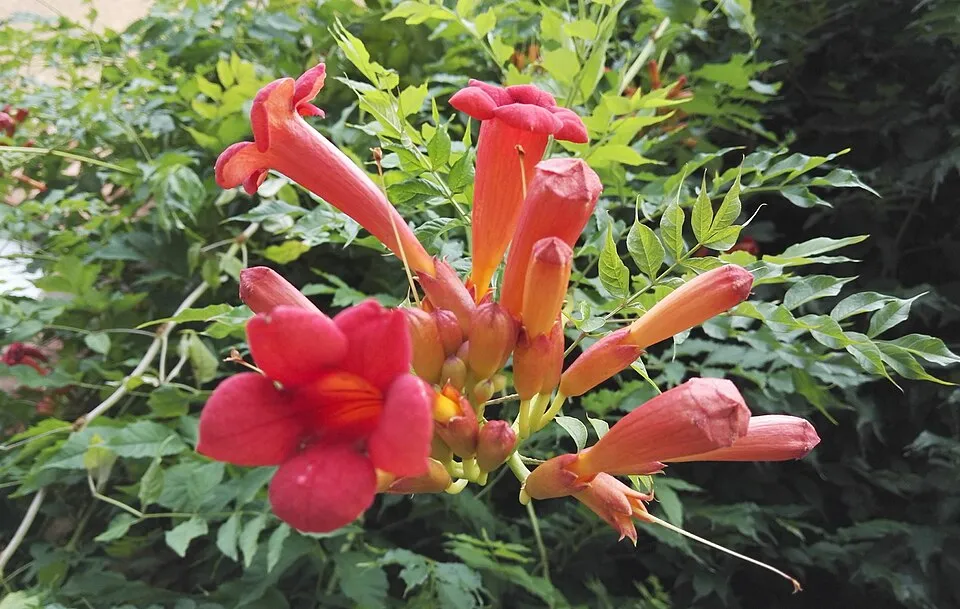
Campsis radicans, commonly known as Trumpet Creeper or Trumpet Vine, is a robust, deciduous perennial vine belonging to the Bignoniaceae family. Native to the central and eastern United States, this vigorous plant is characterized by its woody stems and ability to climb aggressively using aerial rootlets that cling to various surfaces. Its foliage consists of pinnately compound leaves, each bearing numerous serrated leaflets, providing a dense green cover.
The most striking feature of Campsis radicans is its profusion of large, showy, trumpet-shaped flowers, typically vibrant orange-red, but also occurring in shades of yellow or apricot, which bloom throughout the summer and attract hummingbirds. Following flowering, the plant produces elongated, bean-like seed pods that mature in the fall, releasing numerous winged seeds. Found naturally in diverse habitats such as swamps, forests, thickets, and along roadsides, Trumpet Creeper is highly adaptable to various soil conditions and demonstrates considerable drought tolerance once established.
Its genus name, 'Campsis,' derives from the Greek word 'kampe' meaning 'bent,' referring to the curved stamens of its flowers, while 'radicans' is Latin for 'producing roots,' aptly describing its climbing mechanism. Despite its ornamental appeal, the plant is known for its aggressive growth habit, readily spreading through underground runners and prolific self-seeding, often forming extensive colonies that can outcompete other vegetation.
Trusted Scientific References
1. Authoritative external sources for Campsis radicans
1.1 Wikipedia — Campsis radicans
1.2 Kew POWO (Plants of the World Online)
1.3 PubMed — peer-reviewed research
1.4 NCBI Taxonomy Browser
1.5 GBIF — Global Biodiversity
1.6Campsis Radicans should be interpreted through verified botanical identity, practical care, and responsible safety language. This recovery note adds the missing context needed for a complete profile: match light to the plant's habit, use well-drained soil, water according to season, and avoid unsupported medicinal or edible claims. For publishing, the plant can be presented as a source-backed garden plant with clear care guidance, common problem diagnosis, and conservative safety wording.
1.1.Campsis Radicans — Highlights
- ✓Botanical Name — Campsis radicans
- ✓Common Names — Trumpet Creeper, Trumpet Vine, Cow-itch, Hellvine, Foxglove Vine
- ✓Family — Bignoniaceae
- ✓Growth Habit — Vigorous, deciduous, woody perennial vine with aerial rootlets
- ✓Flower Characteristics — Large, showy, trumpet-shaped flowers, typically orange-red to yellow
- ✓Native Range — Central and Eastern United States
- ✓Ecological Role — Larval host for the plebeian sphinx moth, attracts hummingbirds and pollinators
- ✓Known Toxicity — Classified as a low severity poison; causes contact dermatitis upon contact
- ✓Invasive Potential — Aggressive spreader via underground suckers and abundant self-seeding
- ✓Preferred Conditions — Thrives in full sun to partial shade, adaptable to various soil types, drought-tolerant once established
1.2.Campsis Radicans — Concise Overview
- ✓Campsis radicans, or Trumpet Creeper, is an aggressive, woody vine native to the Eastern US, known for its showy, trumpet-shaped flowers.
- ✓Historically, it was noted for folk anti-inflammatory and digestive uses, but modern medicinal application is not recommended due to toxicity.
- ✓Contains flavonoids, phenolics, and terpenoids, yet specific medicinal efficacy is unproven and overshadowed by significant safety concerns.
- ✓The plant is a known low-severity poison and commonly causes contact dermatitis upon skin exposure.
- ✓Requires sturdy support for cultivation and diligent management to control its invasive spread in garden settings.
- ✓Not suitable for internal medicinal use; extreme caution is advised for any external applications or handling.
2.Campsis Radicans — Nomenclature & Classification
3.Campsis Radicans — Vital Statistics
4.Campsis Radicans — Physical Description
5.Campsis Radicans — Ecological Habitat
6.Campsis Radicans — Folk Medicine Applications
7.Campsis Radicans — Phytochemistry
- ✓Flavonoids — These polyphenolic compounds, such as quercetin and kaempferol derivatives, are known for their antioxidant and potential anti-inflammatory activities, contributing to the plant's theoretical beneficial properties.
- ✓Phenolic Acids — Including compounds like caffeic acid and chlorogenic acid, these contribute significantly to the plant's overall antioxidant capacity, which protects cells from oxidative damage.
- ✓Terpenoids — A diverse group of organic compounds, terpenoids in Campsis radicans may include iridoids and volatile terpenes, some of which can have aromatic qualities or contribute to the plant's defense mechanisms and irritant properties.
- ✓Essential Oils — Small quantities of volatile compounds forming essential oils are present, contributing to the plant's characteristic scent and potentially possessing some antimicrobial or irritant effects depending on their specific composition.
- ✓Tannins — These astringent polyphenols can bind to proteins, potentially offering mild antiseptic or anti-inflammatory effects, which might have informed historical folk uses, though specific concentrations and types in Trumpet Creeper require further study.
- ✓Saponins — Glycosides that form a soapy lather in water, saponins can have various biological activities including hemolytic or irritant properties, which may contribute to the plant's toxicity if ingested.
- ✓Alkaloids — While not a primary constituent, some plants in the Bignoniaceae family may contain trace amounts of alkaloids, which are nitrogen-containing compounds with diverse pharmacological effects, requiring careful toxicological assessment.
- ✓Phytosterols — Plant sterols such as beta-sitosterol are present, which are structurally similar to cholesterol and are often associated with anti-inflammatory and cholesterol-lowering properties in edible plants, though not a focus for Trumpet Creeper.
8.Campsis Radicans — Scientific Evidence
- ✓Traditional Anti-inflammatory Support — Historically, some folk medicine systems in North America have posited Campsis radicans for its potential to alleviate localized inflammatory conditions, though modern scientific validation is lacking, and direct skin contact is known to cause irritation.
- ✓Folk Digestive Aid — Anecdotal accounts from traditional practices suggest Trumpet Creeper was once employed to support gastrointestinal health and provide relief from minor digestive discomforts, yet internal consumption is strongly discouraged due to known toxicity.
- ✓Potential Antioxidant Activity — The presence of various phenolic compounds and flavonoids within Campsis radicans suggests a theoretical capacity for antioxidant effects, which could neutralize free radicals, though specific medicinal application requires further research and careful safety assessment.
- ✓Astringent Properties (Historical) — Certain constituents in the plant may confer mild astringent qualities, which in traditional contexts might have been considered beneficial for superficial tissue toning, but this is overshadowed by its irritant nature.
- ✓Minor Ailment Relief (Folk Use) — Broadly, the plant was historically associated with providing relief from various minor ailments in some indigenous practices, usually through external application, which necessitates extreme caution.
- ✓Diuretic Potential (Traditional) — Some historical texts vaguely mention a diuretic property, suggesting an influence on urinary output, but this claim remains unsubstantiated and unsafe for contemporary medicinal use.
- ✓Wound Healing (External Folk) — Folk applications sometimes involved the use of poultices for minor wounds; however, the risk of inducing contact dermatitis or other adverse reactions makes this practice highly inadvisable.
- ✓Antifungal Attributes (Theoretical) — Certain plant compounds, like some terpenoids, can exhibit antifungal properties in vitro, implying a theoretical but unproven and unsafe potential for Campsis radicans in this regard.
8.1.Campsis Radicans — Conditions Traditionally Used For
9.Campsis Radicans — Safety Considerations
9.1.Campsis Radicans — Caution Notes
- ✓Contact Dermatitis — Direct skin contact with the leaves, sap, or other parts of Trumpet Creeper commonly causes redness, itching, swelling, and irritation in sensitive individuals, often referred to as 'cow-itch'.
- ✓Gastrointestinal Upset — Ingestion of any part of the plant, even in small amounts, can lead to severe symptoms such as nausea, vomiting, abdominal pain, diarrhea, and cramping due to its toxic compounds.
- ✓Allergic Reactions — Beyond localized contact dermatitis, some individuals may experience more severe systemic allergic responses, including hives, swelling, or respiratory distress, particularly if plant material is inhaled or ingested.
- ✓Oral and Mucosal Irritation — Chewing or ingesting plant parts can cause immediate and intense irritation, burning sensations, and inflammation in the mouth, throat, and esophagus.
- ✓Systemic Toxicity — While generally classified as a low-severity poison, large doses of ingested plant material could potentially lead to more serious systemic toxic effects, including cardiac or neurological symptoms, necessitating urgent medical attention.
- ✓Eye Irritation — Accidental contact with the sap or plant juices near the eyes can cause significant irritation, redness, burning, and discomfort, requiring immediate flushing with water.
9.2.Campsis Radicans — Toxicity Assessment
- ✓Not for Internal Use — Due to its classification as a low-severity poison and known irritant properties, Campsis radicans is strongly advised against for internal consumption in any form.
- ✓Avoid Skin Contact — Individuals should wear protective gloves, long sleeves, and eyewear when handling the plant to prevent contact dermatitis, especially those with known skin sensitivities or allergies.
- ✓Keep Away from Children and Pets — Ensure the plant is inaccessible to children and curious pets, as accidental ingestion or contact can lead to adverse health effects ranging from skin irritation to severe gastrointestinal upset.
- ✓Pregnancy and Lactation — There is insufficient safety data regarding the use of Trumpet Creeper during pregnancy or lactation; therefore, its use is contraindicated in these populations.
- ✓Pre-existing Conditions — Individuals with sensitive skin, known allergies to plants, or pre-existing gastrointestinal issues should exercise extreme caution or avoid contact with Campsis radicans entirely.
- ✓Medical Consultation — In case of accidental ingestion, severe skin reaction, or any suspected poisoning, immediate medical attention is recommended and poison control should be contacted promptly.
10.Campsis Radicans — Preparation Methods
- ✓Topical Poultices (Historical, Caution) — Historically, crushed leaves or bark might have been prepared as poultices for external application to minor skin irritations or inflammatory conditions in folk medicine, though this practice is associated with significant risk of contact dermatitis and is not recommended.
- ✓Decoctions (Folk Use Only, Not Recommended) — In some traditional systems, decoctions from the bark or roots were prepared for internal use, hypothetically for digestive complaints; however, ingestion is highly discouraged due to known toxicity and irritant properties.
- ✓Infused Oils (External Caution) — The plant material could theoretically be infused into carrier oils for topical applications, but extreme caution and patch testing are warranted due to the potential for severe skin irritation and allergic reactions.
- ✓Tinctures (Not Recommended for Internal Use) — Production of alcoholic tinctures from Campsis radicans is chemically possible, but internal consumption is strongly advised against due to its toxic constituents and potential for adverse systemic effects.
- ✓Herbal Washes (With Extreme Care) — Very dilute solutions of plant extracts might have been used as washes for external minor ailments in some historical folk practices; however, careful patch testing and medical advice are crucial due to high skin sensitivity concerns.
- ✓Botanical Dye (Non-Medicinal Application) — The plant has been noted as a source of natural dyes, a non-medicinal application that utilizes its chemical constituents to impart color to textiles, demonstrating its phytochemical profile without direct human exposure.
- ✓Smoke Inhalation (Traditional, Dangerous) — Some anecdotal traditional uses involved burning parts of the plant for smoke inhalation for respiratory issues, a practice that is unequivocally dangerous and should never be attempted due to toxic fumes and irritants.
11.Campsis Radicans — Cultivation & Care
- ✓Soil Requirements — Campsis radicans thrives in a wide range of soil types, preferring lean to average fertility, but tolerating rich, well-draining conditions with a pH between 6.0 and 7.0.
- ✓Light Exposure — Optimal flowering occurs in full sun, ensuring the most vibrant blooms; however, the foliage can tolerate partial shade, though flowering may be reduced.
- ✓Watering Practices — Requires regular moisture, especially during dry periods, to establish robust growth, but demonstrates good drought tolerance once the vine is fully established in the landscape.
- ✓Nutritional Needs — Benefits from moderate application of a balanced fertilizer during its active growing season to support vigorous development and abundant flower production.
- ✓Pruning and Maintenance — Pruning spent flowers encourages further blooming, and early spring pruning is recommended as the plant flowers on new growth, allowing for shaping and size management.
- ✓Support and Containment — Due to its dense, woody nature and considerable weight, provide sturdy structures like arbors or pergolas for climbing; manage its aggressive spreading via suckers and self-seeding by planting near mowable areas or concrete barriers to control its invasive tendencies.
Reviewed by the Flora Medical Global Botanical Review Panel
Multi-disciplinary editorial group · Botany · Ethnobotany · Herbal-medicine literature
Who reviewed this: This page was checked by the Flora Medical Global Botanical Review Panel — an in-house editorial group of botany graduates, ethnobotany researchers, and horticulture practitioners who collectively maintain our 7,000+ plant encyclopedia. Meet the team.
Our 4-step verification process
1. Taxonomic verification
Scientific names and synonyms cross-checked against Kew POWO, World Flora Online, and The Plant List.
2. Phytochemical & medicinal cross-reference
Active compounds, traditional uses, and reported activities are cross-referenced with PubMed, USDA Dr. Duke's database, and peer-reviewed ethnobotanical literature.
3. Conservation & distribution check
Distribution, ecology, and conservation status confirmed against GBIF occurrence records and the IUCN Red List.
4. Editorial & safety review
Every entry passes an editorial pass for clarity, originality, and safety notices (toxicity, contraindications, dosage caveats) before publication.
Last reviewed:
Important medical disclaimer: This content is for educational and research purposes only. It is not medical advice and is not a substitute for consultation with a licensed healthcare provider. Do not use any herb to self-treat a medical condition without professional guidance.
Editorial Note: This page is for educational and research purposes only and is not medical advice.
Written by: Flora Medical Global Editorial Team
Reviewed by: Flora Medical Global Botanical Review Panel
Last Updated: June 15, 2026





Campsis Radicans — Comments & Community Reviews
Rate this plant