


Medical Disclaimer: This content is for educational purposes only. It is not medical advice. Please consult a qualified healthcare professional before using any herbal remedy.
Safety Overview
1.Campsis Radicans — At a Glance
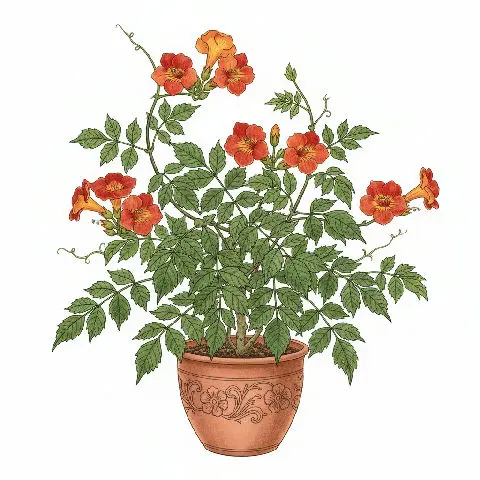
Campsis radicans, widely recognized as Trumpet Vine, Trumpet Creeper, or Cow Itch Vine, is a striking deciduous woody vine belonging to the Bignoniaceae family. Native to the eastern, north-central, and south-central United States, its natural range extends from New Jersey to Ontario and Iowa, and southward to Florida and Texas, where it thrives in thickets, dry woods, disturbed sites, and along fencerows. This robust climber is characterized by its vigorous growth, often reaching lengths of 12 meters or more, utilizing numerous aerial rootlets and twining stems to cling securely to surfaces.
Its foliage consists of opposite, pinnately compound leaves, each typically comprising 7 to 11 coarsely toothed, somewhat shiny, dark green leaflets. The most prominent feature is its spectacular, trumpet-shaped flowers, which bloom in clusters of four to a dozen from July through August. These vibrant yellow-orange to red blooms, up to 8 cm long and 4 cm wide, are a powerful magnet for hummingbirds and butterflies, playing a vital ecological role.
Following flowering, the plant produces distinctive flat, tapered capsules, 8-13 cm long, which split to release numerous winged seeds. Mature stems exhibit light tan, flaky bark and U-shaped bundle scars, aiding in its identification. While highly valued as an ornamental for its beauty and ability to rapidly cover structures, its aggressive growth habit means it can become invasive, displacing desirable vegetation if not diligently managed.
Trusted Scientific References
1. Authoritative external sources for Campsis radicans
1.1 Wikipedia — Campsis radicans
1.2 Kew POWO (Plants of the World Online)
1.3 PubMed — peer-reviewed research
1.4 NCBI Taxonomy Browser
1.5 GBIF — Global Biodiversity
1.6Campsis Radicans should be interpreted through verified botanical identity, practical care, and responsible safety language. This recovery note adds the missing context needed for a complete profile: match light to the plant's habit, use well-drained soil, water according to season, and avoid unsupported medicinal or edible claims. For publishing, the plant can be presented as a source-backed garden plant with clear care guidance, common problem diagnosis, and conservative safety wording.
1.1.Campsis Radicans — Highlights
- ✓Vigorous Deciduous Climber — A robust, woody vine that sheds its leaves seasonally and climbs rapidly.
- ✓Showy Trumpet Flowers — Produces abundant, large, trumpet-shaped flowers in vibrant orange to red hues.
- ✓Hummingbird & Butterfly Attractor — Flowers are a significant nectar source, drawing pollinators like hummingbirds and butterflies.
- ✓Aerial Rootlets — Possesses specialized rootlets along its stems, enabling it to securely cling and climb various surfaces.
- ✓Pinnately Compound Leaves — Characterized by large leaves divided into multiple serrated leaflets, typically 7-11 per leaf.
- ✓Invasive Growth Habit — Known for its aggressive spread and ability to outcompete native vegetation, requiring careful garden management.
- ✓Traditional External Use (Cautioned) — Limited historical use by indigenous North American populations for external applications on skin and joints.
- ✓Known Skin Irritant — Contact with its sap, leaves, or flowers can cause significant skin redness, swelling, and itching.
- ✓Contains Iridoids & Flavonoids — Key phytochemical constituents identified in the plant, alongside other phenolic compounds.
- ✓Native to Southeastern US — Indigenous to a broad region of the eastern and central United States, thriving in diverse habitats.
1.2.Campsis Radicans — Concise Overview
- ✓Vigorous deciduous woody vine native to the southeastern US, known for its rapid growth.
- ✓Features striking trumpet-shaped, orange-to-red flowers that attract hummingbirds and butterflies.
- ✓Valued ornamentally but is highly invasive and requires careful management to prevent ecological disruption.
- ✓Contains phytochemicals like iridoids, flavonoids, and tannins, contributing to its botanical characteristics.
- ✓Historically, Native American tribes used it externally for conditions like skin ailments and joint pain, but with extreme caution.
- ✓Sap contact causes significant skin irritation ('Cow Itch'); internal consumption is toxic and strongly contraindicated.
2.Campsis Radicans — Botanical Identity
3.Campsis Radicans — Vital Statistics
4.Campsis Radicans — Physical Description
5.Campsis Radicans — Ecological Habitat
6.Campsis Radicans — Heritage Uses
7.Campsis Radicans — Key Phytochemicals
- ✓Flavonoids — A diverse group of polyphenolic compounds, including various flavones and flavonols, known for their antioxidant and potential anti-inflammatory activities, contributing to the plant's defense mechanisms.
- ✓Iridoids — Bitter-tasting monoterpenoid glycosides, such as catalpol and other related compounds, which can exhibit a range of biological activities including anti-inflammatory or antimicrobial effects, often linked to plant defense.
- ✓Tannins — A class of astringent polyphenols, primarily found in the bark and leaves, responsible for the plant's potential to irritate skin and for any traditional astringent applications, by binding to proteins.
- ✓Phenolic Acids — Simple phenolic compounds like caffeic acid and ferulic acid, which are known for their antioxidant properties and widespread occurrence in plants, supporting cellular protection.
- ✓Saponins — Glycosides that form a soapy foam in water, potentially contributing to the plant's irritant properties upon contact and possibly having hemolytic activity if ingested, consistent with its toxicity.
- ✓Alkaloids — Nitrogen-containing organic compounds, often with potent physiological effects, present in trace amounts and potentially contributing to the plant's overall toxicity if ingested.
- ✓Triterpenes — A class of diverse compounds derived from a 30-carbon precursor, often found in plant resins and waxes, which can have various biological activities including anti-inflammatory or cytotoxic effects.
- ✓Volatile Oils — Complex mixtures of aromatic compounds, including various terpenes, that contribute to the plant's scent and can possess antimicrobial or irritant properties.
8.Campsis Radicans — Evidence-Based Benefits
- ✓Topical Anti-inflammatory (Traditional) — Historically, certain indigenous North American tribes applied external preparations of Trumpet Vine to alleviate localized swelling and discomfort, particularly associated with joint pain, though this was done with extreme caution due to its irritant properties.
- ✓Dermatological Aid (Folk Medicine) — In some traditional contexts, the plant was used externally for minor skin irritations or conditions, despite its own capacity to cause contact dermatitis, often as a counter-irritant.
- ✓Analgesic Properties (Topical, Traditional) — Indigenous cultures may have employed poultices or compresses made from Campsis radicans for surface pain relief, especially for muscular aches or rheumatic discomfort, strictly for external application.
- ✓Wound Healing Support (External, Historical) — Traditional practices sometimes involved the external application of plant material for minor cuts or abrasions, leveraging putative astringent or antiseptic qualities, always with awareness of potential skin reactions.
- ✓Rheumatic Pain Relief (External, Folk) — Preparations were traditionally used topically on areas affected by rheumatic discomfort, aiming to provide localized soothing or counter-irritation.
- ✓Muscle Soreness Alleviation (Topical, Traditional) — Folk remedies included external rubs or poultices for easing fatigued or sore muscles, emphasizing the external-only nature of such applications.
- ✓Astringent Action (External, Traditional) — The presence of compounds like tannins might have led to traditional topical use for tightening tissues or reducing minor surface bleeding.
- ✓Insect Bite Soothing (External, Speculative) — Given its 'cow-itch' moniker, some traditional uses might have involved external application to alleviate discomfort from insect bites, potentially through a counter-irritant effect, though scientific validation is absent.
- ✓Detoxifying Properties (External, Highly Cautioned Folk Use) — Some historical accounts vaguely suggest external 'drawing' or 'detoxifying' properties for skin issues, but such uses are extremely ill-defined and carry high risk.
8.1.Campsis Radicans — Conditions Traditionally Used For
9.Campsis Radicans — Cautions & Contraindications
9.1.Campsis Radicans — Side Effects & Warnings
- ✓Contact Dermatitis — Direct skin contact with the leaves, flowers, or sap can cause redness, swelling, itching, and a rash, famously earning it the name 'Cow Itch Vine'.
- ✓Gastrointestinal Upset (Ingestion) — Ingestion of any part of the plant is considered mildly toxic and can lead to symptoms such as nausea, vomiting, diarrhea, and stomach cramps.
- ✓Allergic Reactions — Sensitive individuals may experience more severe allergic responses upon contact or accidental ingestion, beyond typical irritant effects.
- ✓Photosensitivity — While not extensively documented for Campsis radicans, some plants containing certain phytochemicals can induce photosensitivity, potentially increasing skin susceptibility to sunburn after contact.
- ✓Invasive Growth — Its aggressive growth habit can lead to it becoming an invasive weed, displacing native vegetation and causing structural damage if not properly managed.
- ✓Systemic Toxicity (Internal) — Due to potential internal toxicity, consumption can lead to more serious systemic effects, making internal use strongly contraindicated.
9.2.Campsis Radicans — Risk Assessment
- ✓Avoid Internal Consumption — Campsis radicans is known to be toxic if ingested; internal use for any purpose is strongly discouraged and potentially harmful.
- ✓External Use with Extreme Caution — Topical application should be approached with great care due to known skin irritant properties; always perform a patch test on a small area first.
- ✓Keep Away from Children and Pets — Ensure the plant is inaccessible to young children and domestic animals to prevent accidental ingestion or contact dermatitis.
- ✓Wear Protective Gear — When handling or pruning Trumpet Vine, wear gloves, long sleeves, and eye protection to prevent sap contact with skin or mucous membranes.
- ✓Consult Healthcare Professional — Individuals with sensitive skin, known allergies, or pre-existing medical conditions should consult a healthcare provider before attempting any traditional topical use.
- ✓Pregnancy and Lactation — Avoid use during pregnancy and breastfeeding due to insufficient safety data and the plant's known toxic properties.
- ✓Responsible Cultivation — Manage its growth diligently in gardens to prevent its invasive spread into natural ecosystems, which can harm local biodiversity.
10.Campsis Radicans — Preparation Methods
- ✓Ornamental Trellis Cover — Widely cultivated to adorn fences, arbors, walls, pillars, or large trellises, leveraging its vigorous climbing habit and spectacular flowering display.
- ✓Managed Groundcover — Can be used as a dense groundcover in specific, controlled landscape settings where its aggressive spread can be carefully contained and monitored.
- ✓Wildlife Attractor — Planted primarily for its ecological value, attracting hummingbirds and various butterflies with its nectar-rich, tubular flowers.
- ✓Traditional Topical Poultice (External Only) — Historically, certain indigenous groups prepared plant material into poultices for external application on skin ailments or joint pain, used with extreme caution due to known irritant properties and never internally.
- ✓Traditional Liniment/Compress (External Only) — Employed in folk medicine as a compress or liniment for external use on localized areas of discomfort, strictly avoiding internal application and always with awareness of potential skin irritation.
- ✓Decorative Winter Interest — The distinctive, cigar-like fruit capsules may be considered decorative, providing visual appeal in the winter landscape after the leaves have fallen.
- ✓Controlled Botanical Specimen — Maintained in botanical gardens or controlled environments for educational purposes or study, necessitating diligent management to prevent its invasive characteristics.
11.Campsis Radicans — Garden Cultivation
- ✓USDA Hardiness Zones — Thrives in USDA hardiness zones 4-10, showcasing broad adaptability to various climates.
- ✓Soil Requirements — Tolerates a wide range of soil conditions from wet to dry, including sand, loam, or clay types, with an optimal pH range of 3.7 to 6.8.
- ✓Light Preference — Prefers full sun exposure for best flowering and vigorous growth, though it can tolerate partial shade.
- ✓Propagation — Easily propagated by stem cuttings, which readily root, and also by seeds, requiring a 60-day cold stratification at 4°C and 30% humidity for optimal germination.
- ✓Management for Aggressive Growth — Requires diligent management, including thinning vines throughout the growing season and cutting back in winter, to prevent its aggressive spread and invasive tendencies.
- ✓Pests and Diseases — Generally robust, but can occasionally be affected by planthoppers, various fungal leaf spots, or mildew, which typically do not cause serious damage.
- ✓Encouraging Root Growth — During active growth, plants may need to be cut back to encourage stronger root development and prevent foliage tangling, especially in young plants.
Reviewed by the Flora Medical Global Botanical Review Panel
Multi-disciplinary editorial group · Botany · Ethnobotany · Herbal-medicine literature
Who reviewed this: This page was checked by the Flora Medical Global Botanical Review Panel — an in-house editorial group of botany graduates, ethnobotany researchers, and horticulture practitioners who collectively maintain our 7,000+ plant encyclopedia. Meet the team.
Our 4-step verification process
1. Taxonomic verification
Scientific names and synonyms cross-checked against Kew POWO, World Flora Online, and The Plant List.
2. Phytochemical & medicinal cross-reference
Active compounds, traditional uses, and reported activities are cross-referenced with PubMed, USDA Dr. Duke's database, and peer-reviewed ethnobotanical literature.
3. Conservation & distribution check
Distribution, ecology, and conservation status confirmed against GBIF occurrence records and the IUCN Red List.
4. Editorial & safety review
Every entry passes an editorial pass for clarity, originality, and safety notices (toxicity, contraindications, dosage caveats) before publication.
Last reviewed:
Important medical disclaimer: This content is for educational and research purposes only. It is not medical advice and is not a substitute for consultation with a licensed healthcare provider. Do not use any herb to self-treat a medical condition without professional guidance.
Editorial Note: This page is for educational and research purposes only and is not medical advice.
Written by: Flora Medical Global Editorial Team
Reviewed by: Flora Medical Global Botanical Review Panel
Last Updated: June 15, 2026





Campsis Radicans — Comments & Community Reviews
Rate this plant