

Medical Disclaimer: This content is for educational purposes only. It is not medical advice. Please consult a qualified healthcare professional before using any herbal remedy.
Safety Overview
1.Carline Thistle — Introduction & Highlights
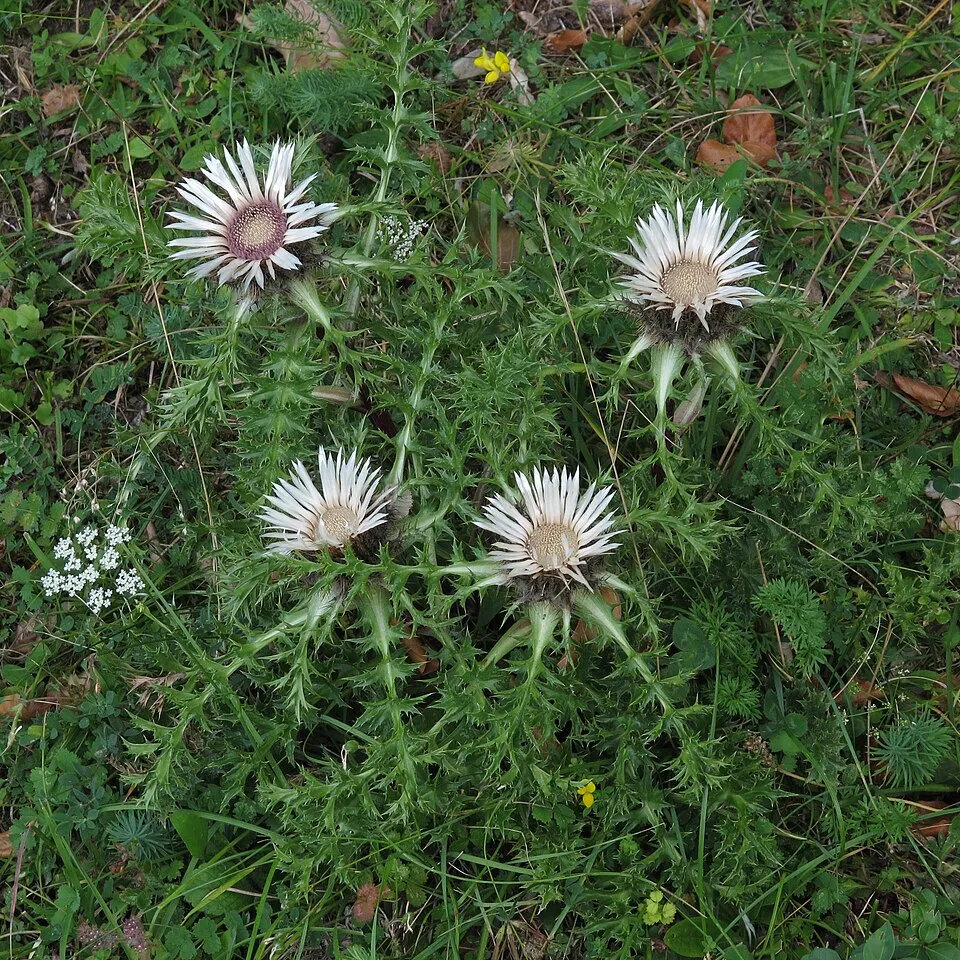
Carline Thistle, scientifically known as Carlina acaulis, is a captivating perennial herb belonging to the expansive Asteraceae family, often called the daisy or sunflower family. This low-growing species typically forms a basal rosette of deeply lobed, pinnatifid leaves that can extend up to 30 centimeters in length. The leaf margins are sharply spiny and the surface is characteristically rough and hairy, adaptations for its survival in harsh environments.
From this rosette emerges a solitary, striking flower head, often appearing stemless (acaulis meaning 'without a stem'), which gives the plant its common name. The impressive flower can span 6 to 10 centimeters in diameter, featuring bright yellow to creamy-white ray florets radiating from a central disc.
A truly distinctive feature is the prominent whorl of stiff, silvery, spine-tipped involucral bracts encircling the flower. These bracts are hygroscopic, meaning they open in dry weather and close in humid conditions, earning the plant common names like 'weather thistle' or 'shepherd's barometer.' When a stem is present, it is usually erect, unbranched, stout, and greenish-grey, supporting the large flower head. Carlina acaulis is indigenous to the mountainous regions of Central and Southern Europe, particularly flourishing in the Alps, Pyrenees, and Carpathians.
Its preferred habitat includes dry, rocky soils, often found in sun-drenched grasslands, alpine pastures, and subalpine meadows at elevations ranging from 1,000 to 2,800 meters. This adaptation to harsh, high-altitude conditions underscores its resilience and ability to thrive where many other plants struggle, aided by a deep taproot system that accesses water and nutrients from considerable depths, supporting its drought tolerance. Taxonomically, it is part of the genus Carlina within the Asteraceae family.
Trusted Scientific References
1. Authoritative external sources for Carlina acaulis
1.1 Wikipedia — Carlina acaulis
1.2 Kew POWO (Plants of the World Online)
1.3 PubMed — peer-reviewed research
1.4 NCBI Taxonomy Browser
1.5 GBIF — Global Biodiversity
1.1.Carline Thistle — Defining Traits
- ✓Basal Rosette Growth — Forms a low-growing cluster of deeply lobed, spiny leaves, often appearing stemless (acaulis).
- ✓Spiny, Lobed Leaves — Distinctive deeply lobed leaves with sharp, spiny margins, contributing to its thistle-like appearance.
- ✓Solitary Flower Head — Features a single, large, striking flower head (6-10 cm diameter) with bright yellow to creamy-white ray florets.
- ✓Hygroscopic Bracts — Silver-white involucral bracts surrounding the flower open in dry weather and close in humid conditions, earning it the 'weather thistle' moniker.
- ✓Alpine Habitat Adaptation — Thrives in dry, rocky, high-altitude environments (1,000-2,800m) of Central and Southern Europe.
- ✓Deep Taproot System — Possesses a robust taproot enabling access to deep water sources, enhancing drought resilience.
- ✓Traditional Digestive Aid — Historically valued in European folk medicine for supporting digestion and alleviating gastrointestinal spasms.
- ✓Antimicrobial Properties — Root extracts are traditionally applied topically for skin conditions and wounds, linked to its bioactive compounds.
- ✓Drought — Tolerant Perennial — A resilient, long-lived herb well-suited for xeriscaping and low-water gardens.
- ✓Medicinal Root — The primary part used in traditional herbal preparations for its various therapeutic properties.
1.2.Carline Thistle — Concise Overview
- ✓Carline Thistle (Carlina acaulis) is a perennial herb from the Asteraceae family, recognized for its distinctive stemless flower and spiny basal leaves.
- ✓Native to European alpine regions, it thrives in dry, rocky soils, showcasing remarkable drought tolerance and resilience.
- ✓Traditionally used in herbal medicine for digestive issues, skin ailments, as a diuretic, and as a general tonic.
- ✓Its phytochemistry includes compounds like polyacetylenes (e.g., carlina oxide), flavonoids, and tannins, contributing to its purported antimicrobial and anti-inflammatory effects.
- ✓Cultivation requires full sun and well-drained soil, making it suitable for xeriscaping or rock gardens with minimal watering needs.
- ✓Caution is advised for pregnant/lactating individuals and those with Asteraceae allergies due to limited modern safety data and potential for allergic reactions.
2.Carline Thistle — Scientific Profile
3.Carline Thistle — Reference Facts
4.Carline Thistle — Structural Profile
5.Carline Thistle — Geographic Distribution
6.Carline Thistle — Cultural & Traditional Roles
7.Carline Thistle — Active Compounds
- ✓Polyacetylenes — Key compounds include Carlina oxide, known for its potent antimicrobial, antifungal, and antibacterial activities, particularly concentrated in the root.
- ✓Flavonoids — Such as luteolin and quercetin, contributing to the plant's antioxidant and anti-inflammatory properties, protecting cells from oxidative stress.
- ✓Tannins — Astringent polyphenolic compounds that provide antiseptic and anti-inflammatory benefits, useful in wound healing and digestive support.
- ✓Sesquiterpene Lactones — Contribute to the plant's bitter taste and may possess anti-inflammatory and potential anticarcinogenic activities.
- ✓Polysaccharides — Including inulin, which acts as a prebiotic, supporting gut health and potentially influencing immune responses.
- ✓Essential Oils — Volatile aromatic compounds present in various parts of the plant, contributing to its characteristic scent and some antimicrobial effects.
- ✓Sterols — Plant sterols are present, which may have cholesterol-lowering properties and support cell membrane integrity.
- ✓Coumarins — A class of organic compounds that can have anticoagulant, anti-inflammatory, and antimicrobial properties.
8.Carline Thistle — Research Insights
- ✓Digestive Aid — Traditionally used to alleviate symptoms of poor digestion, potentially by stimulating bile production and improving gut motility.
- ✓Antispasmodic Properties — Employed to soothe spasms in the esophagus, stomach, and intestines, offering relief from gastrointestinal discomfort.
- ✓Diuretic Action — Acts as a natural diuretic, promoting increased urine output to help reduce water retention and support kidney function.
- ✓General Tonic — Historically taken as a general tonic to invigorate the body and support overall vitality, particularly after periods of illness.
- ✓Diaphoretic Effect — Induces sweating, which is traditionally believed to aid in detoxification and reduce fever symptoms.
- ✓Skin Condition Treatment — Topically applied for various skin ailments, including general skin diseases, pimples, and herpes outbreaks, due to its purported antimicrobial properties.
- ✓Wound Healing — Used externally for rinsing and treating wounds and ulcers, leveraging its traditional antiseptic and astringent qualities to promote recovery.
- ✓Oral Health Support — Applied for toothaches and mouth ulcers, suggesting local analgesic and anti-inflammatory effects.
- ✓Gallbladder Support — Traditionally indicated for gallbladder disease, though specific mechanisms and efficacy require further scientific validation.
- ✓Anti-inflammatory Potential — Contains compounds that may exhibit anti-inflammatory effects, contributing to its use in various traditional remedies.
8.1.Carline Thistle — Health Applications
9.Carline Thistle — Risk Profile
9.1.Carline Thistle — Warnings
- ✓Allergic Reactions — Individuals sensitive to the Asteraceae family (ragweed, daisies, marigolds) may experience allergic responses, including skin rashes or respiratory issues.
- ✓Gastrointestinal Upset — High doses or sensitive individuals might experience mild digestive discomfort, nausea, or diarrhea.
- ✓Skin Irritation — Topical application might cause irritation or contact dermatitis in some individuals, especially with prolonged exposure.
- ✓Unknown Safety Profile — Due to limited scientific studies, the full spectrum of potential side effects is not well-established.
- ✓Drug Interactions — Potential for interaction with medications, especially those affecting digestion or blood clotting, though specific interactions are largely unknown.
- ✓Liver or Kidney Stress — While traditionally used as a tonic, prolonged or excessive use without medical supervision might theoretically burden these organs.
9.2.Carline Thistle — Clinical Safety Notes
- ✓Pregnancy and Lactation — Avoid use during pregnancy and breastfeeding due to insufficient safety data and potential abortifacient properties in some related species.
- ✓Allergic Sensitivity — Contraindicated for individuals with known allergies to plants in the Asteraceae/Compositae family to prevent severe allergic reactions.
- ✓Dosage Guidance — Lack of standardized dosing recommendations necessitates extreme caution; consult a healthcare professional for appropriate use.
- ✓Pre-existing Conditions — Individuals with gallbladder disease, liver conditions, or other chronic health issues should seek medical advice before use.
- ✓Children — Not recommended for use in children due to limited safety research and potential for adverse effects.
- ✓Medical Consultation — Always consult a qualified healthcare provider before incorporating Carline Thistle into any health regimen, especially if on medication.
- ✓Topical Use Caution — Exercise prudence with topical applications, performing a patch test first to check for skin sensitivity.
10.Carline Thistle — Preparation & Dosage
- ✓Root Decoction — Dried Carline Thistle root can be simmered in water to create a decoction, traditionally used internally for digestive support.
- ✓Tincture — An alcoholic extract of the root, allowing for concentrated internal use as a tonic or for specific conditions.
- ✓Poultice/Compress — Freshly crushed or powdered root mixed with a carrier (e.g., water, oil) and applied topically to skin issues or wounds.
- ✓Infused Oil — Roots can be infused in a carrier oil for topical application, particularly for skin conditions or muscle spasms.
- ✓Powdered Root Capsules — Dried and ground root material can be encapsulated for convenient oral consumption, following dosage guidelines.
- ✓Mouthwash/Gargle — A diluted decoction can be used for oral hygiene, addressing toothaches or mouth ulcers.
- ✓Herbal Bath Additive — Infusions can be added to bathwater to soothe widespread skin irritations or as a general invigorating bath.
11.Carline Thistle — Growth Requirements
- ✓Soil Preference — Requires well-drained, sandy, or rocky soils with low fertility, mimicking its natural alpine habitat.
- ✓Sunlight Exposure — Thrives in full sun, needing at least 6-8 hours of direct sunlight daily for optimal growth and flowering.
- ✓Water Requirements — Highly drought-tolerant once established, requiring minimal watering; avoid waterlogging.
- ✓Climate Adaptability — Best suited for temperate climates with distinct seasons, tolerant of cold temperatures and high elevations.
- ✓Propagation — Can be propagated from seed, sown in spring or autumn, or by root division in early spring.
- ✓Maintenance — Generally low maintenance, benefits from occasional weeding and protection from excessive winter moisture in non-native climates.
- ✓Planting Depth — Seeds should be sown shallowly, and young plants should be set at the same depth as they were in their nursery pots.
Reviewed by the Flora Medical Global Botanical Review Panel
Multi-disciplinary editorial group · Botany · Ethnobotany · Herbal-medicine literature
Who reviewed this: This page was checked by the Flora Medical Global Botanical Review Panel — an in-house editorial group of botany graduates, ethnobotany researchers, and horticulture practitioners who collectively maintain our 7,000+ plant encyclopedia. Meet the team.
Our 4-step verification process
1. Taxonomic verification
Scientific names and synonyms cross-checked against Kew POWO, World Flora Online, and The Plant List.
2. Phytochemical & medicinal cross-reference
Active compounds, traditional uses, and reported activities are cross-referenced with PubMed, USDA Dr. Duke's database, and peer-reviewed ethnobotanical literature.
3. Conservation & distribution check
Distribution, ecology, and conservation status confirmed against GBIF occurrence records and the IUCN Red List.
4. Editorial & safety review
Every entry passes an editorial pass for clarity, originality, and safety notices (toxicity, contraindications, dosage caveats) before publication.
Last reviewed:
Important medical disclaimer: This content is for educational and research purposes only. It is not medical advice and is not a substitute for consultation with a licensed healthcare provider. Do not use any herb to self-treat a medical condition without professional guidance.
Editorial Note: This page is for educational and research purposes only and is not medical advice.
Written by: Flora Medical Global Editorial Team
Reviewed by: Flora Medical Global Botanical Review Panel
Last Updated: June 15, 2026





Carline Thistle — Comments & Community Reviews
Rate this plant