


Medical Disclaimer: This content is for educational purposes only. It is not medical advice. Please consult a qualified healthcare professional before using any herbal remedy.
Safety Overview
1.Catuaba — At a Glance
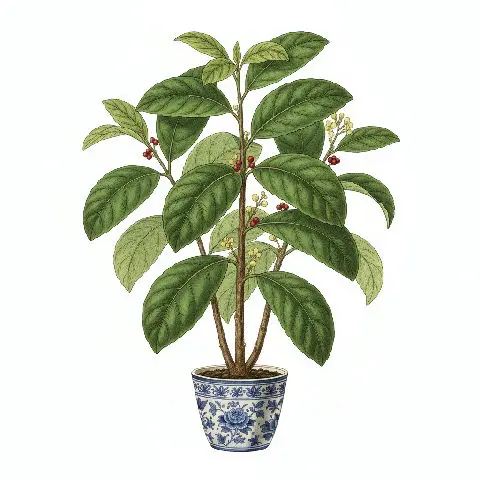
Catuaba, scientifically known as Trichilia catigua, is a prominent medium-sized tree native to the Amazon rainforest and surrounding regions of Brazil, thriving in the warm, humid conditions of tropical climates. This species typically attains heights of up to 15 meters, occasionally reaching taller statures under optimal conditions, forming an integral part of the forest canopy. Its distinct morphological features include dark green, glossy, pinnately compound leaves, a hallmark of the Meliaceae family, which generally measure between 10 to 20 centimeters in length. These leaves are composed of several oval-shaped leaflets arranged in pairs along a central rachis, exhibiting an alternate or subopposite phyllotaxy.
The tree's bark presents a rough, grayish-brown texture, often marked by pronounced longitudinal fissures and furrows that deepen with age, providing a characteristic appearance. During its blooming period, typically from spring through summer, Trichilia catigua produces small, delicate, yellowish-green flowers. These subtly fragrant blossoms are arranged in axillary or terminal panicles or racemes, creating clusters that add to the tree's aesthetic appeal. Following successful pollination, the Catuaba tree develops woody fruit capsules, roughly 4 to 6 centimeters long.
These capsules are ovoid to ellipsoid in shape and, upon maturity, dehisce to release 1 to 3 seeds, often arillate, facilitating dispersal by various forest animals. Ecologically, Trichilia catigua prefers well-drained, sandy to loamy soils, and its presence is vital to the biodiversity of the Amazon, contributing to the forest canopy and providing resources for local fauna. Taxonomically, it belongs to the Meliaceae family, commonly known as the mahogany family, a large and diverse group of flowering plants renowned for their valuable timber species and a wide array of secondary metabolites.
Trusted Scientific References
1. Authoritative external sources for Trichilia catigua
1.1 Wikipedia — Trichilia catigua
1.2 Kew POWO (Plants of the World Online)
1.3 PubMed — peer-reviewed research
1.4 NCBI Taxonomy Browser
1.5 GBIF — Global Biodiversity
1.1.Catuaba — Notable Characteristics
- ✓Indigenous to Amazon Rainforest — Native to Brazil, particularly the Amazon and Atlantic Forest biomes.
- ✓Meliaceae Family Member — Belongs to the mahogany family, known for valuable timber and medicinal species.
- ✓Bark as Primary Medicinal Part — The inner bark is the most commonly used part for traditional remedies and supplements.
- ✓Traditional Aphrodisiac — Historically celebrated for its purported effects on libido and sexual vitality.
- ✓Neuroprotective Potential — Research suggests compounds may support brain health and cognitive function.
- ✓Antioxidant Properties — Rich in compounds that combat oxidative stress and cellular damage.
- ✓Adaptogenic Qualities — Traditionally considered to help the body adapt to stress and reduce fatigue.
- ✓Anxiolytic Effects — Animal studies indicate potential for reducing anxiety and nervousness.
- ✓Anticholinesterase Activity — May inhibit enzymes related to memory and cognitive processes.
- ✓Distinct Phytochemical Profile — Characterized by unique flavalignans and phenylpropanoid derivatives.
1.2.Catuaba — Concise Overview
- ✓Amazonian Botanical — Catuaba (Trichilia catigua) is a medium-sized tree native to the Brazilian Amazon, traditionally valued for its bark.
- ✓Traditional Aphrodisiac — Widely used in folk medicine to enhance sexual arousal, performance, and address fatigue and nervousness.
- ✓Rich in Phytochemicals — Contains flavalignans, phenylpropanoid-substituted epicatechins, and other compounds with antioxidant and potential neuroactive properties.
- ✓Research Limitations — While traditional uses are extensive, robust scientific evidence from human clinical trials is largely insufficient.
- ✓Safety Precautions — Avoid use during pregnancy/breastfeeding; consult a healthcare professional due to limited safety data and potential for adulteration.
- ✓Holistic Tonic — Regarded as a general tonic for vitality, cognitive function, and stress reduction in traditional Brazilian herbalism.
2.Catuaba — Scientific Identity
3.Catuaba — Fact Sheet
4.Catuaba — Physical Description
5.Catuaba — Ecological Habitat
6.Catuaba — Folk Medicine Applications
7.Catuaba — Chemical Profile
- ✓Flavalignans — Key compounds like cinchonain Ib, which is a phenylpropanoid-substituted epicatechin, are found in Catuaba bark. These compounds are associated with antioxidant and antimicrobial activities.
- ✓Tropane Alkaloids — Although more characteristic of Erythroxylum species sometimes confused with Catuaba, certain methylpyrrole tropane alkaloids have been identified in some commercial Catuaba preparations, contributing to their neuroactive properties.
- ✓Phenylpropanoid-Substituted Epicatechins — These complex catechins, such as those found in Trichilia catigua, exhibit potent antioxidant and potentially anti-inflammatory effects, protecting against cellular damage.
- ✓Gamma-Lactones — Minor gamma-lactones have been identified, contributing to the plant's overall phytochemical profile, though their specific medicinal actions are still under investigation.
- ✓Tannins — Present in the bark, tannins contribute to the astringent properties and are known for their antioxidant, anti-inflammatory, and antimicrobial activities, supporting gut health and wound healing.
- ✓Saponins — These compounds are known for their foaming properties and may contribute to immunomodulatory and adaptogenic effects, supporting the body's stress response.
- ✓Resins — Found in the bark, resins contain various bioactive compounds and contribute to the plant's traditional uses, though specific constituents require further elucidation.
- ✓Fatty Acids — While not primary active constituents, various fatty acids are present, supporting cellular health and contributing to the overall nutritional profile of the plant material.
8.Catuaba — Pharmacological Findings
- ✓Enhances Sexual Performance — Traditionally renowned as an aphrodisiac, Catuaba is used to support libido, improve sexual arousal, and address male sexual performance issues, though more robust human clinical trials are needed to confirm these effects.
- ✓Reduces Anxiety and Nervousness — Extracts of Trichilia catigua have shown anxiolytic-like effects in animal models, suggesting a potential to alleviate feelings of nervousness and anxiety by modulating neurotransmitter systems.
- ✓Combats Fatigue and Exhaustion — Catuaba is traditionally employed as a tonic to reduce physical and mental fatigue, potentially by enhancing energy metabolism and improving overall stamina.
- ✓Supports Cognitive Function — Used in folk medicine to improve memory and address forgetfulness, preliminary research suggests Catuaba may have neuroprotective properties and enhance cognitive processes.
- ✓Promotes Restful Sleep — Traditional use includes addressing sleeplessness, with Catuaba believed to have mild sedative qualities that can contribute to improved sleep quality.
- ✓Exhibits Antioxidant Activity — Studies indicate that Catuaba extracts contain compounds with significant antioxidant properties, helping to neutralize free radicals and protect cells from oxidative stress.
- ✓Possesses Anticholinesterase Effects — Research highlights Catuaba's ability to inhibit cholinesterase enzymes, a mechanism relevant to cognitive enhancement and conditions like Alzheimer's disease, suggesting potential for neurodegenerative support.
- ✓Offers Antidepressant-like Effects — Animal studies have demonstrated antidepressant-like activities, potentially linked to dopaminergic mechanisms, suggesting a role in mood regulation and combating depressive symptoms.
- ✓Provides Antimicrobial Protection — Certain chemical constituents in Catuaba have shown activity against various bacteria and viruses, indicating a potential for natural immune support and combating infections.
- ✓May Protect Against Skin Cancer — While evidence is very limited, some traditional uses and preliminary in vitro studies hint at a potential protective effect against certain cellular damage relevant to skin health.
8.1.Catuaba — Health Applications
9.Catuaba — Safety Considerations
9.1.Catuaba — Possible Adverse Reactions
- ✓Insufficient Data — There is not enough reliable scientific information to definitively know the full range of potential side effects of Catuaba when taken orally.
- ✓Unknown Safety Profile — The long-term safety of Catuaba consumption is not well-established due to a lack of comprehensive clinical studies.
- ✓Allergic Reactions — As with any botanical, individuals may experience allergic reactions, such as skin rashes or digestive upset, though specific reports are rare.
- ✓Gastrointestinal Discomfort — Some users might experience mild stomach upset, nausea, or diarrhea, particularly with higher doses or sensitive individuals.
- ✓Interactions with Medications — Potential interactions with prescription drugs, especially those affecting the central nervous system or blood pressure, have not been thoroughly investigated.
- ✓Overdose Effects — The effects of an overdose are unknown due to limited research, emphasizing the importance of adhering to recommended dosages.
9.2.Catuaba — Clinical Safety Notes
- ✓Pregnancy and Breastfeeding — Avoid use during pregnancy and breastfeeding due to insufficient reliable information regarding its safety for both mother and child.
- ✓Lack of Clinical Research — The safety and efficacy of Catuaba in humans have not been extensively studied in controlled clinical trials.
- ✓Consult Healthcare Professional — Always consult a doctor or qualified healthcare provider before starting Catuaba, especially if you have underlying health conditions or are taking medications.
- ✓Children and Adolescents — Catuaba use is not recommended for children and adolescents due to the absence of safety data in these populations.
- ✓Dosage Adherence — Adhere strictly to recommended dosages on product labels, and do not exceed them without professional guidance.
- ✓Purity and Adulteration — Be cautious about the source and purity of Catuaba products, as adulteration with other species (e.g., Erythroxylum spp.) is a known risk, which can introduce different compounds and safety concerns.
10.Catuaba — Usage Guide
- ✓Decoction Preparation — The most common method involves simmering dried Catuaba bark in water for 15-20 minutes to extract its active compounds, traditionally consumed as a tea.
- ✓Tincture Formulation — Catuaba bark can be macerated in alcohol and water for several weeks to create a concentrated liquid extract, used in drops.
- ✓Powdered Bark Encapsulation — Dried and finely ground Catuaba bark is often encapsulated for convenient oral administration, allowing for precise dosing.
- ✓Infusion Method — For less woody parts, or if a milder preparation is desired, Catuaba can be steeped in hot water for a shorter period, similar to making herbal tea.
- ✓Topical Applications — In some traditional practices, Catuaba bark preparations might be used externally, though this is less common for its primary medicinal uses.
- ✓Syrups and Elixirs — Catuaba extracts can be incorporated into herbal syrups or elixirs, often combined with other botanicals for specific health benefits.
- ✓Blending with Other Herbs — Catuaba is frequently combined with other adaptogenic or aphrodisiac herbs to enhance synergistic effects in traditional formulas.
- ✓Dosage Guidelines — Due to insufficient scientific evidence on human dosing, it is crucial to follow product label instructions or consult a qualified herbalist or healthcare practitioner for personalized advice.
11.Catuaba — Cultivation & Care
- ✓Climate Preference — Thrives in tropical and subtropical climates with high humidity and consistent warmth, mimicking its native Amazonian conditions.
- ✓Soil Requirements — Prefers well-drained, fertile, sandy to loamy soils with a slightly acidic to neutral pH (6.0-7.0) to ensure optimal growth and nutrient uptake.
- ✓Light Exposure — Requires full sun to partial shade, especially when young. Mature trees can tolerate full sun, which is conducive to robust growth and flowering.
- ✓Watering Regimen — Needs consistent moisture, particularly during dry spells or establishment phase. Avoid waterlogging, which can lead to root rot.
- ✓Propagation Techniques — Can be propagated from seeds, which require scarification for better germination, or from semi-hardwood cuttings for genetic consistency.
- ✓Pest and Disease Management — Generally robust, but monitor for common tropical pests like scale insects or mealybugs. Maintain good air circulation to prevent fungal issues.
- ✓Fertilization Schedule — Benefit from balanced organic fertilizers during the growing season to support vigorous growth and bark production.
- ✓Harvesting Practices — The medicinal bark is typically harvested from mature trees, ensuring sustainable practices to allow for regrowth and preservation of the species.
Reviewed by the Flora Medical Global Botanical Review Panel
Multi-disciplinary editorial group · Botany · Ethnobotany · Herbal-medicine literature
Who reviewed this: This page was checked by the Flora Medical Global Botanical Review Panel — an in-house editorial group of botany graduates, ethnobotany researchers, and horticulture practitioners who collectively maintain our 7,000+ plant encyclopedia. Meet the team.
Our 4-step verification process
1. Taxonomic verification
Scientific names and synonyms cross-checked against Kew POWO, World Flora Online, and The Plant List.
2. Phytochemical & medicinal cross-reference
Active compounds, traditional uses, and reported activities are cross-referenced with PubMed, USDA Dr. Duke's database, and peer-reviewed ethnobotanical literature.
3. Conservation & distribution check
Distribution, ecology, and conservation status confirmed against GBIF occurrence records and the IUCN Red List.
4. Editorial & safety review
Every entry passes an editorial pass for clarity, originality, and safety notices (toxicity, contraindications, dosage caveats) before publication.
Last reviewed:
Important medical disclaimer: This content is for educational and research purposes only. It is not medical advice and is not a substitute for consultation with a licensed healthcare provider. Do not use any herb to self-treat a medical condition without professional guidance.
Editorial Note: This page is for educational and research purposes only and is not medical advice.
Written by: Flora Medical Global Editorial Team
Reviewed by: Flora Medical Global Botanical Review Panel
Last Updated: June 15, 2026





Catuaba — Comments & Community Reviews
Rate this plant