


Medical Disclaimer: This content is for educational purposes only. It is not medical advice. Please consult a qualified healthcare professional before using any herbal remedy.
Safety Overview
1.Chaga Mushroom — Essential Profile
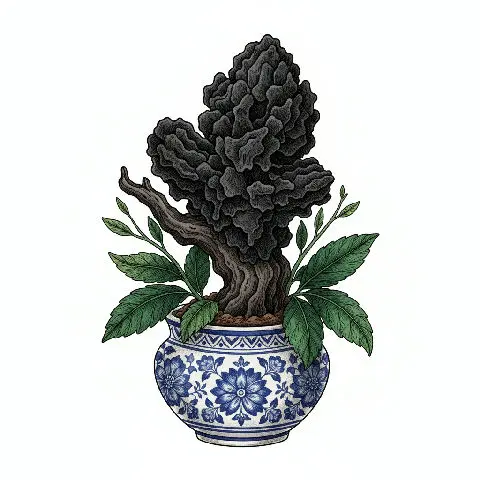
Inonotus obliquus, widely recognized as Chaga mushroom, is a distinctive parasitic fungus predominantly found on the trunks of living birch trees (genus Betula), particularly species like Betula lenta and Betula papyrifera. Its morphology is far from a typical mushroom, forming a sterile conk or sclerotium—a dense, hard, and irregularly shaped mass that protrudes significantly from the host tree. The exterior of the Chaga conk is typically dark, almost black, and deeply fissured, resembling burnt charcoal, a characteristic attributed to its high melanin content.
This contrasts sharply with its internal flesh, which is softer, cork-like, and ranges in color from yellowish-brown to deep orange-brown. These remarkable conks can attain considerable sizes, frequently exceeding 30 centimeters (12 inches) in diameter and weighing several kilograms.
Ecologically, Inonotus obliquus functions as a white-rot fungus, meaning it actively breaks down lignin and cellulose within the host tree, contributing to its gradual decay. It initiates its growth after entering the tree through bark wounds, slowly developing its sclerotium over many years. Chaga mushrooms are indigenous to the temperate and subarctic forests of the Northern Hemisphere, thriving in cold climates across regions such as Russia (especially Siberia), Eastern and Northern Europe, Korea, Northern China, and Canada.
Its preferred habitat is mature birch forests, where it establishes a long-term, albeit parasitic, relationship with its host. Taxonomically, Inonotus obliquus belongs to the family Hymenochaetaceae, a diverse group of fungi known for their wood-decaying properties and often characterized by a poroid hymenophore, although Chaga's sterile conk typically does not produce spores.
Trusted Scientific References
1. Authoritative external sources for Inonotus obliquus
1.1 Wikipedia — Inonotus obliquus
1.2 Kew POWO (Plants of the World Online)
1.3 PubMed — peer-reviewed research
1.4 NCBI Taxonomy Browser
1.5 GBIF — Global Biodiversity
1.1.Chaga Mushroom — Highlights
- ✓Parasitic on Birch Trees — Exclusively grows on living birch trees, absorbing beneficial compounds.
- ✓Distinctive Sclerotium — Forms a hard, black, charcoal-like conk, not a typical gilled mushroom.
- ✓High Melanin Content — Responsible for its dark exterior and potent antioxidant activity.
- ✓Adaptogenic Properties — Helps the body adapt to stress and maintain homeostasis.
- ✓Immune System Modulator — Balances and strengthens the body's natural defenses.
- ✓Rich in Antioxidants — Contains an abundance of polyphenols, melanins, and triterpenes.
- ✓Anti — inflammatory Effects — Supports reduction of systemic inflammation.
- ✓Traditional Medicinal History — Valued for centuries in Siberian, Eastern European, and Asian folk medicine.
- ✓Cold Climate Native — Thrives in subarctic and temperate forests of the Northern Hemisphere.
- ✓Source of Betulinic Acid — Absorbs this potent compound from its birch host.
1.2.Chaga Mushroom — In Brief
- ✓Chaga mushroom (Inonotus obliquus) is a parasitic fungus primarily found on birch trees.
- ✓Renowned for its potent antioxidant, anti-inflammatory, and immune-modulating properties.
- ✓Rich in triterpenoids, polysaccharides (beta-glucans), melanins, and betulinic acid.
- ✓Traditionally used in folk medicine across Northern Hemisphere for diverse health benefits.
- ✓Often consumed as a tea, extract, or powder; dual extraction maximizes compound extraction.
- ✓Caution advised for individuals on blood thinners, diabetes medication, or with kidney issues.
2.Chaga Mushroom — Botanical Identity
3.Chaga Mushroom — Key Data
4.Chaga Mushroom — Physical Description
5.Chaga Mushroom — Origin & Spread
6.Chaga Mushroom — Traditional Uses
7.Chaga Mushroom — Phytochemistry
- ✓Polysaccharides — Predominantly beta-glucans (e.g., (1,3)-(1,6)-β-D-glucans) are known for their potent immune-modulating and adaptogenic effects, supporting overall vitality.
- ✓Triterpenoids — Key compounds include inotodiol, obliquol, and betulinic acid (derived from the birch host), which exhibit anti-inflammatory, antiviral, and potential antitumor activities.
- ✓Melanins — These dark pigments, responsible for Chaga's distinctive black exterior, are powerful antioxidants and offer protective effects against oxidative damage.
- ✓Polyphenols — A diverse group of antioxidant compounds, including various flavonoids and phenolic acids, which contribute to Chaga's free radical scavenging capabilities.
- ✓Sterols — Ergosterol and its derivatives are precursors to Vitamin D and possess immunomodulatory and cytotoxic properties against certain cancer cells.
- ✓Betulin and Betulinic Acid — Absorbed from the birch host, these compounds are extensively studied for their anti-inflammatory, antiviral, and potent anticancer effects.
- ✓Oxalates — Present in varying amounts, these compounds are important to note due to their potential impact on kidney health in high concentrations.
- ✓Minerals — Chaga is a source of essential minerals such as potassium, magnesium, calcium, iron, manganese, and zinc, vital for numerous bodily functions.
- ✓Vitamins — Contains B-complex vitamins and Vitamin D (from ergosterol conversion), contributing to energy metabolism and bone health respectively.
- ✓Superoxide Dismutase (SOD) — An important antioxidant enzyme that helps protect cells from damage caused by superoxide free radicals.
8.Chaga Mushroom — Evidence-Based Benefits
- ✓Antioxidant Support — Chaga mushroom is rich in polyphenols and melanins, which effectively scavenge free radicals, reducing oxidative stress and cellular damage throughout the body.
- ✓Immune System Modulation — The beta-glucans and other polysaccharides in Inonotus obliquus help balance and strengthen the immune response, enhancing the body's ability to fight off pathogens.
- ✓Anti-inflammatory Properties — Triterpenoids like inotodiol contribute to Chaga's ability to reduce inflammation, which can alleviate symptoms associated with various chronic inflammatory conditions.
- ✓Potential Antitumor Activity — Research suggests that compounds such as betulinic acid and triterpenes may induce apoptosis in cancer cells and inhibit tumor growth, particularly in breast, cervical, and skin cancers.
- ✓Antiviral Effects — Certain compounds within Chaga mushroom have demonstrated antiviral properties, potentially inhibiting the replication of various viruses and supporting immune defense.
- ✓Blood Sugar Regulation — Studies indicate that Inonotus obliquus may improve insulin sensitivity and help lower blood glucose levels, offering potential benefits for individuals with type 2 diabetes.
- ✓Gastrointestinal Health — Chaga is traditionally used to support digestive health, potentially by reducing inflammation in the gut lining and promoting a healthy microbiome.
- ✓Adaptogenic Qualities — As an adaptogen, Chaga helps the body adapt to stress, promoting overall balance and resilience against physical and environmental stressors.
- ✓Skin Health Enhancement — The high melanin content not only gives Chaga its dark color but also offers photoprotective properties, potentially supporting skin health and reducing UV damage.
- ✓Cardiovascular Support — By reducing oxidative stress and inflammation, Chaga may contribute to improved cardiovascular health and help maintain healthy lipid profiles.
8.1.Chaga Mushroom — Conditions Traditionally Used For
9.Chaga Mushroom — Safety & Side Effects
9.1.Chaga Mushroom — Caution Notes
- ✓Blood Thinning — Chaga may have anticoagulant properties, potentially increasing the risk of bleeding, especially when combined with blood-thinning medications.
- ✓Hypoglycemia — Individuals with diabetes should monitor blood sugar levels closely as Chaga can lower glucose, potentially causing hypoglycemia when used with anti-diabetic drugs.
- ✓Kidney Stone Risk — Due to its oxalate content, excessive consumption of Chaga may increase the risk of kidney stone formation in susceptible individuals.
- ✓Digestive Upset — Some individuals may experience mild gastrointestinal discomfort, such as nausea or diarrhea, particularly with high doses.
- ✓Allergic Reactions — Although rare, allergic reactions like skin rashes or itching can occur in sensitive individuals.
- ✓Immunosuppression — While often immune-boosting, Chaga's immune-modulating effects could theoretically interact with immunosuppressant medications.
9.2.Chaga Mushroom — Risk Assessment
- ✓Pregnancy and Breastfeeding — Insufficient data exists; pregnant and breastfeeding individuals should avoid Chaga due to unknown risks.
- ✓Autoimmune Diseases — Due to its immune-modulating properties, individuals with autoimmune conditions should consult a healthcare professional before use.
- ✓Anticoagulant Medications — Avoid or use with extreme caution if taking blood thinners like Warfarin, as Chaga may amplify their effects.
- ✓Diabetes Medications — Monitor blood glucose levels carefully if taking antidiabetic drugs, as Chaga can enhance their hypoglycemic action.
- ✓Kidney Disease — Individuals with a history of kidney stones or kidney disease should limit Chaga intake due to its oxalate content.
- ✓Surgery — Discontinue Chaga at least two weeks before any scheduled surgery due to its potential blood-thinning effects.
- ✓Professional Consultation — Always consult a healthcare provider before incorporating Chaga into a health regimen, especially if on medication or with underlying health conditions.
10.Chaga Mushroom — Preparation Methods
- ✓Decoction (Tea) — The most common method involves simmering dried Chaga chunks or powder in water for several hours to extract its beneficial compounds, resulting in a dark, earthy tea.
- ✓Tincture — Alcohol-based extracts are made by soaking Chaga in high-proof alcohol, often followed by a water extraction, to draw out both water-soluble and alcohol-soluble compounds.
- ✓Powdered Supplement — Dried and finely ground Chaga can be added to smoothies, coffee, or other beverages, offering a convenient way to consume its nutrients.
- ✓Dual Extraction — This method combines both hot water decoction and alcohol extraction to ensure a comprehensive spectrum of active compounds is obtained, maximizing potency.
- ✓Topical Application — Chaga extracts or infused oils can be applied topically for skin conditions, leveraging its antioxidant and anti-inflammatory properties.
- ✓Culinary Use — While not a culinary mushroom in the traditional sense, Chaga powder can be incorporated into certain recipes or brewed into a coffee substitute.
- ✓Dosage Guidance — Typical dosages vary based on the form (tea, tincture, extract), but generally range from 1-3 grams of dried Chaga per day, often consumed in cycles.
11.Chaga Mushroom — How to Grow
- ✓Wild Harvesting — Chaga mushroom is primarily wild-harvested from mature birch trees in cold northern climates, a practice requiring careful identification and sustainable methods.
- ✓Inoculation Techniques — Attempts are made to inoculate birch trees with Chaga mycelium, though producing the mature, medicinal sclerotium in a controlled setting is challenging and slow.
- ✓Mycelial Culture — Chaga mycelium can be grown in liquid or solid fermentation systems, yielding biomass rich in some active compounds, but lacking the full spectrum of wild Chaga.
- ✓Substrate Requirements — Successful cultivation on host trees necessitates specific environmental conditions, including appropriate birch species and sufficient humidity.
- ✓Sustainable Practices — Due to slow growth and increasing demand, ethical harvesting involves leaving a portion of the conk to allow for regeneration and preventing over-harvesting.
- ✓Environmental Factors — Cold temperatures and specific forest ecosystems are crucial for the natural development of Inonotus obliquus, mimicking these conditions is complex in cultivation.
Reviewed by the Flora Medical Global Botanical Review Panel
Multi-disciplinary editorial group · Botany · Ethnobotany · Herbal-medicine literature
Who reviewed this: This page was checked by the Flora Medical Global Botanical Review Panel — an in-house editorial group of botany graduates, ethnobotany researchers, and horticulture practitioners who collectively maintain our 7,000+ plant encyclopedia. Meet the team.
Our 4-step verification process
1. Taxonomic verification
Scientific names and synonyms cross-checked against Kew POWO, World Flora Online, and The Plant List.
2. Phytochemical & medicinal cross-reference
Active compounds, traditional uses, and reported activities are cross-referenced with PubMed, USDA Dr. Duke's database, and peer-reviewed ethnobotanical literature.
3. Conservation & distribution check
Distribution, ecology, and conservation status confirmed against GBIF occurrence records and the IUCN Red List.
4. Editorial & safety review
Every entry passes an editorial pass for clarity, originality, and safety notices (toxicity, contraindications, dosage caveats) before publication.
Last reviewed:
Important medical disclaimer: This content is for educational and research purposes only. It is not medical advice and is not a substitute for consultation with a licensed healthcare provider. Do not use any herb to self-treat a medical condition without professional guidance.
Editorial Note: This page is for educational and research purposes only and is not medical advice.
Written by: Flora Medical Global Editorial Team
Reviewed by: Flora Medical Global Botanical Review Panel
Last Updated: June 15, 2026





Chaga Mushroom — Comments & Community Reviews
Rate this plant