


Medical Disclaimer: This content is for educational purposes only. It is not medical advice. Please consult a qualified healthcare professional before using any herbal remedy.
Safety Overview
1.Champaka — Essential Profile
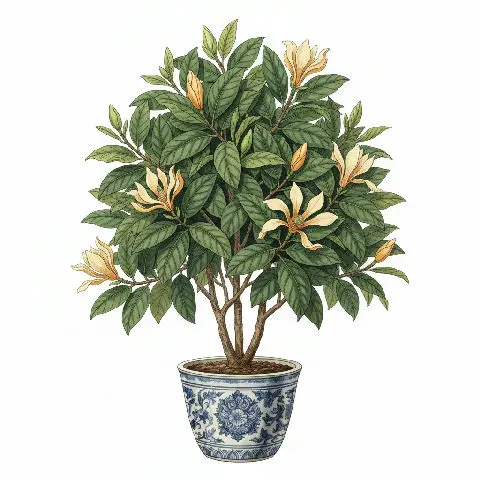
Magnolia champaca, widely recognized as Champaka or the Joy Perfume Tree, is a magnificent evergreen tree native to a vast region spanning from India through southwestern China, Indochina, and into Malesia. This arboreal species thrives in evergreen forests up to 800 meters in altitude, often reaching impressive heights of up to 50 meters (164 feet) with a broad, spreading crown that offers substantial shade.
Its stem is typically straight and columnar, encased in smooth, greyish-brown bark that may develop slight fissures with age. When incised, the bark releases a distinctive aromatic scent due to its rich essential oil content, a characteristic shared with other members of the Magnoliaceae family.
The leaves of Magnolia champaca are arranged spirally, presenting an elliptic to narrowly ovate shape, typically measuring between 10 to 35 cm (4-14 inches) long and 4 to 11 cm (1.5-4.3 inches) wide. They exhibit a glossy dark green upper surface and a lighter green underside, often slightly hairy, contributing to the tree's dense and lush canopy. The most celebrated feature of Champaka is its intensely fragrant flowers.
These exquisite blooms emerge as light yellow and mature into a vibrant orange-yellow hue, approximately 10 cm (4 inches) across. They blossom in clusters from June to September, often with petal edges gracefully curled backward, adorning the tree with their captivating beauty. The intoxicating aroma is a hallmark of the species, making it a prized ingredient in perfumery and a central element in religious offerings across Hindu and Buddhist traditions.
Following the spectacular floral display, the tree produces woody, pale brown fruits adorned with large, cream-colored lenticels. These fruits split open to reveal 2 to 6 seeds, each distinctively covered with a vibrant red or pink fleshy aril and hanging freely on a thin white thread.
This unique seed presentation attracts birds and mammals, facilitating effective seed dispersal throughout its natural habitat.
Trusted Scientific References
1. Authoritative external sources for Magnolia champaca
1.1 Wikipedia — Magnolia champaca
1.2 Kew POWO (Plants of the World Online)
1.3 PubMed — peer-reviewed research
1.4 NCBI Taxonomy Browser
1.5 GBIF — Global Biodiversity
1.1.Champaka — Distinguishing Points
- ✓Majestic evergreen tree, — Majestic evergreen tree, reaching up to 50 meters in height.
- ✓Produces highly fragrant, vibrant orange — yellow flowers.
- ✓Native to India, — Native to India, Southeast Asia, and parts of China.
- ✓Leaves are glossy — Leaves are glossy dark green, elliptic to narrowly ovate.
- ✓Fruits are woody, containing red — arilled seeds.
- ✓Bark emits an — Bark emits an aromatic scent when incised.
- ✓Central to Hindu — Central to Hindu and Buddhist religious offerings.
- ✓Essential oil is — Essential oil is a global perfumery staple.
- ✓Traditionally used for — Traditionally used for a wide array of medicinal purposes.
- ✓Known as the — Known as the 'Joy Perfume Tree' for its intoxicating aroma.
1.2.Champaka — Quick Summary
- ✓Intensely fragrant evergreen tree, native to Southeast Asia, cherished for its blossoms.
- ✓Traditional uses span Ayurveda, Unani, and religious ceremonies for centuries.
- ✓Valued for anti-inflammatory, antimicrobial, and anxiolytic properties.
- ✓Essential oil is a key ingredient in high-end perfumery and aromatherapy.
- ✓Supports menstrual health, digestive comfort, and skin conditions.
- ✓Requires warm, humid climates and well-draining soil for cultivation.
2.Champaka — Scientific Identity
3.Champaka — Key Data
4.Champaka — Botanical Features
5.Champaka — Native Range & Habitat
6.Champaka — Traditional Uses
7.Champaka — Chemical Profile
- ✓Essential Oils — Primarily found in the flowers, rich in compounds like linalool, methyl eugenol, and beta-caryophyllene, responsible for its distinct fragrance and anxiolytic, anti-inflammatory, and antimicrobial actions.
- ✓Alkaloids — Present in the bark and roots, including micheliolide and costunolide, which contribute to its febrifuge and emmenagogue properties, and may have anti-cancer potential.
- ✓Flavonoids — Identified in leaves and flowers, such as quercetin and kaempferol derivatives, known for their antioxidant and anti-inflammatory activities.
- ✓Sesquiterpenes — A diverse group of compounds like alpha-humulene and germacrene D, contributing to the plant's aromatic profile and exhibiting anti-inflammatory and analgesic effects.
- ✓Lignans — Found in various plant parts, these compounds possess antioxidant, anti-inflammatory, and potential anticancer properties.
- ✓Glycosides — Present in the plant, often contributing to its bitter taste and various therapeutic effects, including detoxification and immune modulation.
- ✓Phenolic Acids — Such as gallic acid and caffeic acid, offering antioxidant and anti-inflammatory benefits to the plant's medicinal profile.
- ✓Terpenoids — A broad class of organic compounds, including both mono- and sesquiterpenes, contributing significantly to the plant's fragrance and pharmacological activities like antispasmodic effects.
8.Champaka — Scientific Evidence
- ✓Anti-inflammatory Support — Magnolia champaca flowers and bark contain compounds that help reduce inflammation throughout the body, offering relief in conditions like arthritis.
- ✓Antimicrobial Action — Extracts from various parts of the plant exhibit properties that inhibit the growth of certain microbes, making it useful for combating infections.
- ✓Stress Reduction and Anxiolytic Effects — The essential oil, particularly from the fragrant flowers, is utilized in aromatherapy to calm the nervous system, reduce anxiety, and promote relaxation.
- ✓Menstrual Health Regulation — The root bark possesses emmenagogue properties, traditionally used to stimulate menstrual flow in cases of amenorrhea and alleviate dysmenorrhea.
- ✓Digestive Aid — Flowers and fruits are traditionally used to treat dyspepsia and nausea, helping to soothe digestive discomfort and improve appetite.
- ✓Skin Condition Relief — The plant's anti-inflammatory and antimicrobial qualities make it beneficial for treating skin issues such as boils, itching, and potentially more severe conditions like leprosy in traditional systems.
- ✓Fever Reduction — Traditional medicine employs Champaka's cooling properties and antipyretic compounds to help lower fevers, as seen in conditions like malaria.
- ✓Urinary Tract Comfort — A hot infusion of the flowers is traditionally used to alleviate burning sensations during urination, likely due to its soothing and anti-inflammatory effects on the urinary tract.
- ✓Pain Management — The flowers are used in hot infusions to mitigate joint pain associated with rheumatoid arthritis and osteoarthritis, acting as an analgesic.
8.1.Champaka — Conditions Traditionally Used For
9.Champaka — Safety Considerations
9.1.Champaka — Possible Adverse Reactions
- ✓Allergic Reactions — Some individuals may experience skin irritation or respiratory issues when exposed to the essential oil or pollen.
- ✓Gastrointestinal Upset — High internal doses of Champaka preparations may lead to mild stomach discomfort or nausea.
- ✓Uterine Stimulation — Due to its emmenagogue properties, it could potentially stimulate uterine contractions, making it contraindicated during pregnancy.
- ✓Hypotension Risk — Compounds in Champaka might have a mild hypotensive effect, which could be a concern for individuals with low blood pressure or on blood pressure medication.
- ✓Drug Interactions — Potential interactions with sedatives, blood thinners, or hormone-regulating medications due should be considered.
- ✓Photosensitivity — Rare instances of increased skin sensitivity to sunlight have been reported with topical use of some magnolia species.
- ✓Nausea/Vomiting — Excessive ingestion of certain plant parts, particularly the bark or roots, might induce nausea or vomiting in sensitive individuals.
9.2.Champaka — Safety Profile
- ✓Pregnancy and Lactation — Contraindicated during pregnancy due to potential uterine stimulating effects; consult a healthcare professional before use during lactation.
- ✓Children — Use with caution in children, preferably under medical supervision, as dosage and safety data are limited for pediatric populations.
- ✓Allergies — Individuals with known allergies to plants in the Magnoliaceae family should avoid Champaka to prevent allergic reactions.
- ✓Pre-existing Conditions — Patients with heart conditions, low blood pressure, or hormone-sensitive conditions should use Champaka only under medical guidance.
- ✓Medication Interactions — Consult a physician if taking any prescription medications, especially sedatives, anticoagulants, or hormone therapies, to avoid adverse interactions.
- ✓Topical Application — Perform a patch test before extensive topical application of essential oil or extracts to check for skin sensitivity or irritation.
- ✓Internal Use — Adhere strictly to recommended dosages for internal use, as high concentrations may lead to adverse effects; prolonged use should be monitored by a herbalist.
10.Champaka — Preparation Methods
- ✓Aromatic Infusion — Dried Champaka flowers can be steeped in hot water to create a fragrant tea, often used for its calming and mild digestive benefits.
- ✓Essential Oil Extraction — The highly fragrant flowers are steam-distilled to produce an essential oil, widely used in perfumery and aromatherapy for stress relief and mood enhancement.
- ✓Topical Paste — A paste made from crushed flowers or bark, often mixed with other herbs, can be applied externally to soothe skin irritations, boils, or localized pain.
- ✓Decoction of Bark/Root — The bark or root can be boiled to create a potent decoction, traditionally consumed for fevers, inflammation, or to stimulate menstruation.
- ✓Culinary Flavoring — Fresh Champaka petals are occasionally used to delicately flavor teas, desserts, or certain traditional dishes in Southeast Asian cuisines.
- ✓Herbal Poultice — Crushed fresh leaves or flowers can be prepared as a poultice and applied to the forehead to alleviate headaches or to joints for pain relief.
- ✓Incense and Offerings — The dried flowers are a popular component in incense sticks and are widely used in religious ceremonies for their sacred fragrance.
- ✓Infused Oil — Flowers can be infused into carrier oils like sesame or coconut oil for a fragrant massage oil, beneficial for skin health and relaxation.
11.Champaka — Cultivation & Care
- ✓Site Selection — Plant in a location with full sun to partial shade, ensuring good air circulation for optimal growth and flowering.
- ✓Soil Requirements — Prefers well-draining, fertile, slightly acidic to neutral soil, enriched with organic matter for best results.
- ✓Watering Regimen — Requires moderate watering, especially during dry periods and its establishment phase; avoid waterlogging.
- ✓Temperature and Humidity — Thrives in warm, humid tropical to subtropical climates, sensitive to frost.
- ✓Fertilization — Apply a balanced, slow-release fertilizer in spring and mid-summer to support lush growth and abundant blooms.
- ✓Pruning — Light pruning is recommended to maintain shape, remove dead or damaged branches, and encourage flowering after the bloom season.
- ✓Propagation — Can be propagated by seeds, air layering, or stem cuttings, though seed germination can be slow and erratic.
- ✓Pest and Disease Management — Generally robust, but monitor for common pests like aphids or scale insects, and treat with organic solutions if necessary.
Reviewed by the Flora Medical Global Botanical Review Panel
Multi-disciplinary editorial group · Botany · Ethnobotany · Herbal-medicine literature
Who reviewed this: This page was checked by the Flora Medical Global Botanical Review Panel — an in-house editorial group of botany graduates, ethnobotany researchers, and horticulture practitioners who collectively maintain our 7,000+ plant encyclopedia. Meet the team.
Our 4-step verification process
1. Taxonomic verification
Scientific names and synonyms cross-checked against Kew POWO, World Flora Online, and The Plant List.
2. Phytochemical & medicinal cross-reference
Active compounds, traditional uses, and reported activities are cross-referenced with PubMed, USDA Dr. Duke's database, and peer-reviewed ethnobotanical literature.
3. Conservation & distribution check
Distribution, ecology, and conservation status confirmed against GBIF occurrence records and the IUCN Red List.
4. Editorial & safety review
Every entry passes an editorial pass for clarity, originality, and safety notices (toxicity, contraindications, dosage caveats) before publication.
Last reviewed:
Important medical disclaimer: This content is for educational and research purposes only. It is not medical advice and is not a substitute for consultation with a licensed healthcare provider. Do not use any herb to self-treat a medical condition without professional guidance.
Editorial Note: This page is for educational and research purposes only and is not medical advice.
Written by: Flora Medical Global Editorial Team
Reviewed by: Flora Medical Global Botanical Review Panel
Last Updated: June 15, 2026





Champaka — Comments & Community Reviews
Rate this plant