


Medical Disclaimer: This content is for educational purposes only. It is not medical advice. Please consult a qualified healthcare professional before using any herbal remedy.
Safety Overview
1.Chickweed — Overview
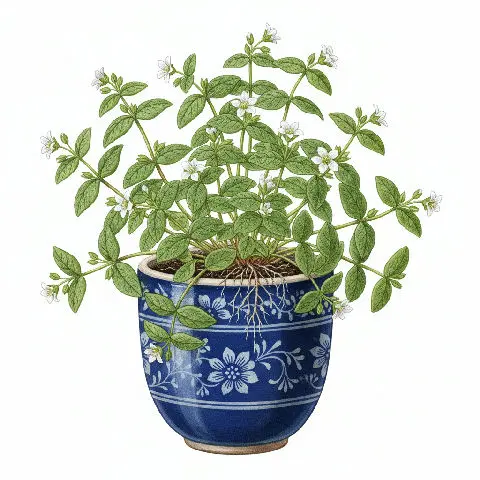
Chickweed, known scientifically as Stellaria media, is an adaptable annual or sometimes perennial herb belonging to the Caryophyllaceae family, globally recognized for its delicate, star-like blossoms and widespread presence. This low-growing plant typically forms dense ground-covering mats with slender, branching stems that can extend up to 30 centimeters. A distinguishing feature of its stems is a unique single line of fine hairs that runs longitudinally along one side, notably shifting its position at each node.
Its leaves are arranged oppositely, exhibiting an ovate to elliptic shape with smooth margins, generally glabrous except for potential ciliate margins in certain varieties. The most iconic characteristic of Stellaria media is its minute, pristine white, star-shaped flowers, which typically emerge from the leaf axils or in terminal cymes. Each flower presents five deeply lobed petals, cleverly creating the illusion of ten petals, centrally surrounding prominent stamens and three styles.
Originally indigenous to Europe and Asia, Chickweed has successfully naturalized across nearly all temperate regions worldwide. It thrives in various disturbed habitats, including verdant meadows, manicured lawns, domestic gardens, cultivated agricultural fields, and along roadsides. It demonstrates a distinct preference for moist, well-drained soils and exhibits remarkable tolerance to a spectrum of light conditions, ranging from full sun to partial shade, underscoring its robust ecological adaptability.
The plant possesses a shallow, fibrous root system, which enables its rapid colonization of new territories. Taxonomically, Stellaria media is classified within the Kingdom Plantae, Order Caryophyllales, Family Caryophyllaceae, Genus Stellaria, and Species Stellaria media.
Trusted Scientific References
1. Authoritative external sources for Stellaria media
1.1 Wikipedia — Stellaria media
1.2 Kew POWO (Plants of the World Online)
1.3 PubMed — peer-reviewed research
1.4 NCBI Taxonomy Browser
1.5 GBIF — Global Biodiversity
1.1.Chickweed — Standout Qualities
- ✓Delicate, star — shaped white flowers with five deeply lobed petals, giving the illusion of ten.
- ✓Characterized by a — Characterized by a distinctive single line of fine hairs along the stem, shifting at each node.
- ✓Forms dense, sprawling — Forms dense, sprawling mats with slender, branching stems up to 30 cm long.
- ✓Adaptable to various — Adaptable to various disturbed habitats, thriving in moist, well-drained soils.
- ✓Contains significant levels — Contains significant levels of antioxidant flavonoids like rutin and quercetin.
- ✓Possesses demulcent mucilage — Possesses demulcent mucilage for soothing irritated mucous membranes.
- ✓Known for its — Known for its mild diuretic and expectorant saponins.
- ✓A nutritious spring — A nutritious spring edible, rich in vitamins A, C, and B-complex, and various minerals.
- ✓Traditionally applied topically — Traditionally applied topically for skin conditions such as eczema and minor burns.
- ✓Recognized for its — Recognized for its 'cooling' properties in traditional herbal systems like Ayurveda.
1.2.Chickweed — At-a-Glance Summary
- ✓Versatile annual herb known for its skin-soothing and anti-inflammatory properties.
- ✓Rich in saponins, flavonoids, and mucilage, contributing to its diverse therapeutic actions.
- ✓Historically used in European folk medicine and Ayurvedic traditions for cooling and healing.
- ✓Offers mild diuretic, digestive, and respiratory support.
- ✓Easily cultivated and consumed fresh, as tea, tincture, or topical preparations.
- ✓Generally safe, but caution advised for pregnant/nursing individuals and those on specific medications.
2.Chickweed — Scientific Profile
3.Chickweed — Botanical Stats
4.Chickweed — Plant Morphology
5.Chickweed — Geographic Distribution
6.Chickweed — Historical Applications
7.Chickweed — Secondary Metabolites
- ✓Saponins — These natural surfactants may promote mild diuretic effects, act as an expectorant by loosening congested mucus, and support healthy cholesterol levels through bile acid binding.
- ✓Flavonoids (Rutin, Quercetin) — Powerful antioxidants that neutralize free radicals, help stabilize capillary walls, and contribute significantly to the plant's anti-inflammatory actions.
- ✓Mucilage — A soothing, carbohydrate-rich gel that forms a protective coating over mucous membranes, providing demulcent relief for irritated throats and the gastrointestinal lining.
- ✓Phytosterols — Plant-based sterols believed to modulate immune responses and contribute to maintaining healthy lipid profiles within the body.
- ✓Vitamins (A, C, B-complex) — Essential nutritional cofactors that play crucial roles in skin repair, collagen production, immune function, and overall cellular metabolic health.
- ✓Minerals (Calcium, Magnesium, Potassium) — Important electrolytes and structural components contributing to bone health, nerve function, muscle contraction, and fluid balance.
- ✓Coumarins — A class of organic compounds that can exhibit anti-inflammatory, antioxidant, and anticoagulant properties, though typically in lower concentrations in chickweed.
- ✓Carotenoids — Pigments like beta-carotene, precursors to Vitamin A, known for their antioxidant activity and role in vision and immune health.
- ✓Fatty Acids — Contains beneficial fatty acids that contribute to the plant's overall nutritional profile and cellular membrane integrity.
- ✓Phenolic Acids — Compounds such as caffeic acid and p-coumaric acid, which possess antioxidant and anti-inflammatory attributes.
8.Chickweed — Modern Studies
- ✓Skin Soothing and Healing — Traditionally used in poultices and salves, chickweed's demulcent mucilage and anti-inflammatory flavonoids help reduce redness, itching, and scaling in conditions like eczema, psoriasis, and minor burns.
- ✓Mild Diuretic Support — Folk traditions and scientific reviews highlight chickweed's ability to gently increase urine output, supporting urinary tract cleansing without unduly stressing the kidneys.
- ✓Digestive Comfort — The plant's mucilaginous polysaccharides form a protective coating in the gastrointestinal tract, aiding in the relief of gastritis, peptic discomfort, and heartburn.
- ✓Respiratory Relief — Early American herbals and preliminary studies suggest that chickweed tea can help loosen bronchial congestion and soothe coughs due to its expectorant saponins.
- ✓Antioxidant Defense — In-vitro assays demonstrate chickweed extracts' potent ability to scavenge free radicals, indicating its potential to combat cellular oxidative stress.
- ✓Weight Management Aid — Anecdotal herbalist notes suggest mild appetite modulation, possibly attributed to saponin-induced satiety signals, though robust human trials are still emerging.
- ✓Bone Health Support — Rich in calcium and vitamin C, chickweed may contribute to maintaining bone matrix integrity; some studies have observed increased osteoblastic activity with its extract.
- ✓Anti-inflammatory Properties — Flavonoids and phytosterols present in chickweed contribute to calming inflammatory pathways by potentially inhibiting certain COX enzymes, offering systemic relief.
- ✓Nutrient Replenishment — As a spring 'greens' salad, chickweed provides a quick source of vitamins (A, C, B-complex) and minerals, helping to replenish nutrients after winter.
- ✓Detoxification Support — In Ayurvedic traditions, chickweed is considered a cooling, Vāta- and Pitta-balancing ingredient, supporting the body's natural cleansing processes by addressing 'ama' (digestive toxins).
8.1.Chickweed — Conditions Traditionally Used For
9.Chickweed — Precautions & Warnings
9.1.Chickweed — Reported Side Effects
- ✓Allergic reactions — Rare but possible, especially in individuals sensitive to the Caryophyllaceae family, presenting as skin rashes or gastrointestinal upset.
- ✓Diuretic effect — May interact with diuretic medications due to its mild diuretic properties, potentially increasing urine output.
- ✓Hypotension — High doses could theoretically lower blood pressure, though this is not commonly reported with typical usage.
- ✓Digestive upset — Excessive consumption may lead to mild gastrointestinal discomfort in sensitive individuals.
- ✓Skin irritation — Though rare, some individuals may experience localized skin irritation when used topically, especially with prolonged application.
9.2.Chickweed — Risk Assessment
- ✓Pregnancy and Lactation — Not recommended without professional medical advice due to insufficient clinical safety data in these populations.
- ✓Kidney Disorders — Individuals with pre-existing kidney conditions should consult a healthcare professional before use due to its mild diuretic action.
- ✓Anticoagulant Medications — Use with caution by individuals taking blood-thinning medications, as coumarins in chickweed could theoretically potentiate effects.
- ✓Allergic Sensitivity — Advise caution for individuals with known allergies to plants in the Caryophyllaceae family.
- ✓Children — Generally considered safe for external use in children, but internal use should be guided by a qualified herbalist or pediatrician.
- ✓Dosage Adherence — Adhere strictly to recommended dosages; always start with a small test dose to assess individual tolerance.
10.Chickweed — How to Use
- ✓Infusion (Tea) — Steep 1-2 teaspoons (2-4g) of dried chickweed or 5-10g fresh leaves in 250ml hot water for 10-15 minutes; strain and consume 2-3 cups daily, ideally between meals.
- ✓Tincture — Administer 20-25 drops (approximately 1 ml) of a 1:5 ratio (herb to 25-30% alcohol) tincture 2-3 times daily, a convenient option for internal use.
- ✓Powder/Capsules — Take 500-1000 mg of finely milled chickweed leaf powder in capsules 1-2 times daily for internal vitamin and mineral support.
- ✓Topical Salve/Ointment — Apply a 5-10% chickweed extract incorporated into a neutral ointment base 2-4 times daily to affected skin for soothing and healing.
- ✓Poultice — Crush fresh chickweed leaves and apply directly to skin irritations, minor burns, or insect bites, securing with a bandage.
- ✓Fresh Greens — Incorporate young, tender chickweed shoots into salads or smoothies as a nutritious spring green, providing vitamins and minerals.
- ✓Cooling Compress — Use a cooled chickweed infusion as a compress applied to sunburnt or inflamed skin for localized relief.
11.Chickweed — Propagation & Care
- ✓Prefers moist, well-drained loamy or sandy soils with a pH between 6.0 and 7.0 for optimal growth.
- ✓Thrives in partial shade to full sun, demonstrating robust adaptability to varying light conditions.
- ✓Propagates readily from seeds, which can be sown directly in early spring or late autumn.
- ✓Requires consistent moisture, especially during dry spells, but avoids waterlogging to prevent root rot.
- ✓Can be cultivated as an annual crop, with multiple harvests possible throughout its growing season.
- ✓Harvest aerial parts (leaves and flowering tops) in early spring when the plant is most succulent and before extensive flowering for peak potency.
- ✓Easily self-seeds and can become established rapidly, sometimes requiring management to prevent overgrowth in garden settings.
Reviewed by the Flora Medical Global Botanical Review Panel
Multi-disciplinary editorial group · Botany · Ethnobotany · Herbal-medicine literature
Who reviewed this: This page was checked by the Flora Medical Global Botanical Review Panel — an in-house editorial group of botany graduates, ethnobotany researchers, and horticulture practitioners who collectively maintain our 7,000+ plant encyclopedia. Meet the team.
Our 4-step verification process
1. Taxonomic verification
Scientific names and synonyms cross-checked against Kew POWO, World Flora Online, and The Plant List.
2. Phytochemical & medicinal cross-reference
Active compounds, traditional uses, and reported activities are cross-referenced with PubMed, USDA Dr. Duke's database, and peer-reviewed ethnobotanical literature.
3. Conservation & distribution check
Distribution, ecology, and conservation status confirmed against GBIF occurrence records and the IUCN Red List.
4. Editorial & safety review
Every entry passes an editorial pass for clarity, originality, and safety notices (toxicity, contraindications, dosage caveats) before publication.
Last reviewed:
Important medical disclaimer: This content is for educational and research purposes only. It is not medical advice and is not a substitute for consultation with a licensed healthcare provider. Do not use any herb to self-treat a medical condition without professional guidance.
Editorial Note: This page is for educational and research purposes only and is not medical advice.
Written by: Flora Medical Global Editorial Team
Reviewed by: Flora Medical Global Botanical Review Panel
Last Updated: June 15, 2026





Chickweed — Comments & Community Reviews
Rate this plant