

Medical Disclaimer: This content is for educational purposes only. It is not medical advice. Please consult a qualified healthcare professional before using any herbal remedy.
Safety Overview
1.Chlorophytum Bonnie — Overview
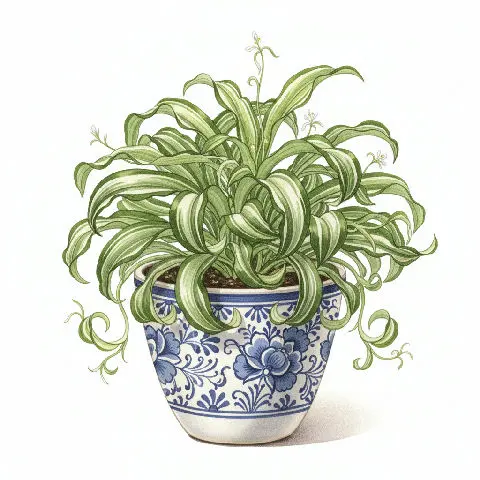
Chlorophytum comosum 'Bonnie', widely recognized as the Curly Spider Plant or Bonnie Spider Plant, is a captivating cultivar of the well-known spider plant, Chlorophytum comosum. Its defining characteristic is its uniquely curled, variegated foliage, which distinctly sets it apart from its straight-leaved counterparts and the parent species. 'Bonnie' emerged through horticultural selection, likely in the mid to late 20th century, specifically cultivated for its exceptional ornamental appeal rather than being a wild discovery.
The broader species, Chlorophytum comosum, is indigenous to the tropical and southern regions of Africa, where it thrives in evergreen and deciduous forests, typically growing as an understory plant or a lithophyte on rocky outcrops, favoring humid and partially shaded conditions. The 'Bonnie' cultivar retains the remarkable resilience and adaptability of its wild ancestors, making it an extraordinarily popular indoor houseplant globally. Botanically, it features relatively short, arching leaves that form a dense rosette.
In contrast to the straight or gently wavy leaves of other cultivars such as 'Vittatum' or 'Variegatum', 'Bonnie' displays a pronounced curl or spiral, contributing to its more compact and bushy aesthetic. The leaves typically showcase a vibrant green margin encircling a creamy white to pale yellow central stripe, though the intensity of variegation can vary.
Trusted Scientific References
1. Authoritative external sources for Chlorophytum comosum bonnie
1.1 Wikipedia — Chlorophytum comosum bonnie
1.2 Kew POWO (Plants of the World Online)
1.3 PubMed — peer-reviewed research
1.4 NCBI Taxonomy Browser
1.5 GBIF — Global Biodiversity
1.6Chlorophytum Bonnie should be interpreted through verified botanical identity, practical care, and responsible safety language. This recovery note adds the missing context needed for a complete profile: match light to the plant's habit, use well-drained soil, water according to season, and avoid unsupported medicinal or edible claims. For publishing, the plant can be presented as a source-backed indoor plant with clear care guidance, common problem diagnosis, and conservative safety wording.
1.1.Chlorophytum Bonnie — Key Features
- ✓Unique Curled Foliage — Distinctive spiraled leaves set 'Bonnie' apart from other spider plant cultivars.
- ✓Variegated Leaves — Features vibrant green margins with a creamy white to pale yellow central stripe.
- ✓Air Purifier — The parent species is recognized by NASA for its effectiveness in cleaning indoor air.
- ✓Produces Plantlets — Easily propagates from the 'spiderettes' that grow on its stolons, allowing for new plants.
- ✓Adaptable Houseplant — Thrives in a wide range of indoor conditions, making it highly versatile.
- ✓Non — Toxic — Safe for households with children and pets, offering peace of mind.
- ✓Low Maintenance — Requires minimal care, making it an excellent choice for novice plant enthusiasts.
- ✓Compact Growth Habit — Exhibits a bushier and more contained appearance compared to straight-leaved varieties.
- ✓Ornamental Value — Highly aesthetic, adding a touch of elegance and natural beauty to interior spaces.
- ✓Drought Tolerant — Possesses a degree of resilience to infrequent watering, forgiving occasional neglect.
1.2.Chlorophytum Bonnie — At-a-Glance Summary
- ✓Chlorophytum 'Bonnie' — A distinctive ornamental cultivar known for its uniquely curled, variegated leaves.
- ✓Parent Species *C. comosum* — Native to tropical Africa, celebrated for its resilience and adaptability.
- ✓Air Purification — The species is widely recognized by NASA for its ability to remove indoor air toxins like formaldehyde.
- ✓Traditional Uses — While limited for the 'Bonnie' cultivar, the parent species has anecdotal uses in African folk medicine.
- ✓Non-Toxic — Generally considered safe for humans and pets, making it an ideal houseplant.
- ✓Easy Care — A popular, low-maintenance indoor plant, suitable for beginners and experienced growers alike.
2.Chlorophytum Bonnie — Systematic Position
3.Chlorophytum Bonnie — Botanical Stats
4.Chlorophytum Bonnie — Structural Profile
5.Chlorophytum Bonnie — Where It Grows
6.Chlorophytum Bonnie — Cultural & Traditional Roles
7.Chlorophytum Bonnie — Secondary Metabolites
- ✓Saponins — Triterpenoid saponins are present in the parent species, Chlorophytum comosum, and are associated with anti-inflammatory, antimicrobial, and adaptogenic activities.
- ✓Flavonoids — Compounds like quercetin and kaempferol derivatives contribute to the plant's antioxidant and anti-inflammatory properties by scavenging free radicals.
- ✓Polysaccharides — These complex carbohydrates are known for their potential immunomodulatory effects, supporting the body's immune responses.
- ✓Phenolic Acids — Including caffeic acid and ferulic acid, these compounds act as potent antioxidants, protecting cells from oxidative damage.
- ✓Phytosterols — Plant steroids found in the species may contribute to its anti-inflammatory actions and have roles in plant defense mechanisms.
- ✓Alkaloids — While generally in minor concentrations, various alkaloids may be present, contributing to diverse biological activities within the plant.
- ✓Vitamins — Trace amounts of essential vitamins are present, supporting the plant's metabolic processes and overall health.
- ✓Minerals — Essential micronutrients such as potassium, calcium, and magnesium are absorbed from the soil, vital for plant growth and health.
- ✓Volatile Organic Compounds (VOCs) — The plant's ability to absorb and metabolize indoor air pollutants like formaldehyde and xylene is a key constituent-related function, though these are external compounds the plant processes.
- ✓Carotenoids — Pigments like beta-carotene are present, contributing to the plant's coloration and acting as antioxidants.
8.Chlorophytum Bonnie — Research Insights
- ✓Air Purification — The parent species, Chlorophytum comosum, is renowned for its ability to filter indoor air, effectively removing volatile organic compounds (VOCs) like formaldehyde and xylene.
- ✓Anti-inflammatory Support — Research on Chlorophytum comosum extracts suggests potential anti-inflammatory properties, attributed to compounds such as saponins and flavonoids.
- ✓Antioxidant Activity — The species exhibits antioxidant effects, helping to neutralize free radicals and reduce oxidative stress within the body.
- ✓Antimicrobial Properties — Studies indicate that extracts from Chlorophytum comosum may possess antimicrobial capabilities, potentially inhibiting the growth of certain bacteria and fungi.
- ✓Wound Healing — In traditional African folk medicine, the leaves of Chlorophytum comosum have been anecdotally used topically to aid in the healing of minor cuts and skin irritations.
- ✓Immunomodulatory Effects — Polysaccharides and other compounds found in the species may support immune system modulation, enhancing the body's natural defenses.
- ✓Digestive Aid — Some traditional uses of Chlorophytum comosum suggest it may act as a mild digestive tonic, assisting with minor gastrointestinal discomfort.
- ✓Diuretic Action — Anecdotal evidence from traditional practices points to the species having mild diuretic properties, potentially aiding in fluid balance.
- ✓Stress Reduction — As an indoor plant, Chlorophytum Bonnie contributes to a calming environment, with studies showing that interacting with houseplants can reduce psychological and physiological stress.
- ✓Humidification — Indoor plants naturally release moisture into the air through transpiration, contributing to improved indoor humidity levels, which can benefit respiratory health.
- ✓Ornamental Therapeutic Value — The aesthetic appeal and ease of care of 'Bonnie' provide psychological benefits, enhancing mood and well-being in living spaces.
8.1.Chlorophytum Bonnie — Therapeutic Indications
9.Chlorophytum Bonnie — Adverse Effects
9.1.Chlorophytum Bonnie — Warnings
- ✓Minor Gastrointestinal Upset — Ingestion of large quantities of Chlorophytum comosum, though generally non-toxic, may lead to mild stomach upset, vomiting, or diarrhea in sensitive individuals or pets.
- ✓Skin Irritation — Very rare instances of contact dermatitis have been reported from handling the sap of the parent species in highly sensitive individuals.
- ✓Allergic Reactions — While uncommon, individuals with extreme plant sensitivities might experience mild allergic responses.
- ✓Pesticide Residue — If plants are treated with chemical pesticides, ingestion could pose a risk; ensure any plant used for purported medicinal purposes is organically grown.
- ✓Overwatering Issues — Incorrect cultivation leading to root rot can cause plant health issues, indirectly affecting its environmental benefits.
- ✓No Known Drug Interactions — Currently, there are no well-documented significant drug interactions associated with Chlorophytum comosum.
9.2.Chlorophytum Bonnie — Toxicity Assessment
- ✓Non-Toxic to Humans and Pets — Chlorophytum Bonnie, like its parent species, is generally considered non-toxic to cats, dogs, and humans by organizations like the ASPCA.
- ✓Mild Ingestion Effects — Although non-toxic, consuming large amounts may cause mild stomach upset or irritation, so it's best to discourage ingestion.
- ✓Skin Contact — Direct skin contact with the plant is typically safe, with allergic reactions being extremely rare.
- ✓Pregnancy and Lactation — There is insufficient scientific data to recommend medicinal use during pregnancy or lactation; ornamental use is considered safe.
- ✓Children — Keep out of reach of very young children to prevent accidental ingestion, though adverse effects are expected to be minimal.
- ✓Pesticide Use Caution — If considering any form of traditional application, ensure the plant has not been treated with harmful pesticides or chemicals.
- ✓Consult a Professional — Always consult a healthcare professional before attempting any internal medicinal use, especially given the limited specific research on the 'Bonnie' cultivar.
10.Chlorophytum Bonnie — Preparation & Dosage
- ✓Ornamental Houseplant — The primary use of Chlorophytum Bonnie is as an indoor decorative plant, enhancing aesthetic appeal.
- ✓Air Purification — Place the plant in indoor spaces to leverage its air-filtering capabilities, as demonstrated by the parent species, Chlorophytum comosum.
- ✓Topical Applications (Species) — For the parent species, Chlorophytum comosum, leaves have been used traditionally as poultices for skin irritations; this is not recommended for the 'Bonnie' cultivar without specific research.
- ✓Decoctions/Infusions (Species) — Historically, decoctions from Chlorophytum comosum roots have been used in some folk medicine for internal ailments, but this is not advised for the 'Bonnie' cultivar due to lack of specific data and potential risks.
- ✓Research Extracts — Extracts from the Chlorophytum comosum species are used in scientific studies to investigate its pharmacological properties.
- ✓Not for Self-Medication — Due to the lack of specific medicinal research on the 'Bonnie' cultivar and general safety concerns, internal medicinal use is not recommended.
- ✓Educational Display — Used in botanical gardens and educational settings to showcase horticultural diversity and plant adaptability.
11.Chlorophytum Bonnie — Growth Requirements
- ✓Light — Provide bright, indirect light; direct sunlight can scorch the delicate leaves of Chlorophytum Bonnie.
- ✓Watering — Keep the soil consistently moist but never waterlogged; allow the top inch of soil to dry out between waterings.
- ✓Soil — Use a well-draining, rich potting mix that retains some moisture, ideally with organic matter.
- ✓Humidity — Prefers moderate to high humidity; misting regularly or placing the pot on a pebble tray can be beneficial.
- ✓Temperature — Thrives in average room temperatures between 65-80°F (18-27°C); avoid sudden temperature fluctuations.
- ✓Propagation — Easily propagated from the plantlets (spiderettes) that grow on long stolons; simply snip and root in water or moist soil.
- ✓Fertilizing — Feed monthly during the active growing season (spring and summer) with a balanced liquid fertilizer diluted to half strength.
- ✓Pests — Generally resistant, but occasionally susceptible to spider mites, mealybugs, and scale insects; inspect regularly.
Reviewed by the Flora Medical Global Botanical Review Panel
Multi-disciplinary editorial group · Botany · Ethnobotany · Herbal-medicine literature
Who reviewed this: This page was checked by the Flora Medical Global Botanical Review Panel — an in-house editorial group of botany graduates, ethnobotany researchers, and horticulture practitioners who collectively maintain our 7,000+ plant encyclopedia. Meet the team.
Our 4-step verification process
1. Taxonomic verification
Scientific names and synonyms cross-checked against Kew POWO, World Flora Online, and The Plant List.
2. Phytochemical & medicinal cross-reference
Active compounds, traditional uses, and reported activities are cross-referenced with PubMed, USDA Dr. Duke's database, and peer-reviewed ethnobotanical literature.
3. Conservation & distribution check
Distribution, ecology, and conservation status confirmed against GBIF occurrence records and the IUCN Red List.
4. Editorial & safety review
Every entry passes an editorial pass for clarity, originality, and safety notices (toxicity, contraindications, dosage caveats) before publication.
Last reviewed:
Important medical disclaimer: This content is for educational and research purposes only. It is not medical advice and is not a substitute for consultation with a licensed healthcare provider. Do not use any herb to self-treat a medical condition without professional guidance.
Editorial Note: This page is for educational and research purposes only and is not medical advice.
Written by: Flora Medical Global Editorial Team
Reviewed by: Flora Medical Global Botanical Review Panel
Last Updated: June 15, 2026





Chlorophytum Bonnie — Comments & Community Reviews
Rate this plant