
Medical Disclaimer: This content is for educational purposes only. It is not medical advice. Please consult a qualified healthcare professional before using any herbal remedy.
Safety Overview
1.Conophytum — Botanical Snapshot
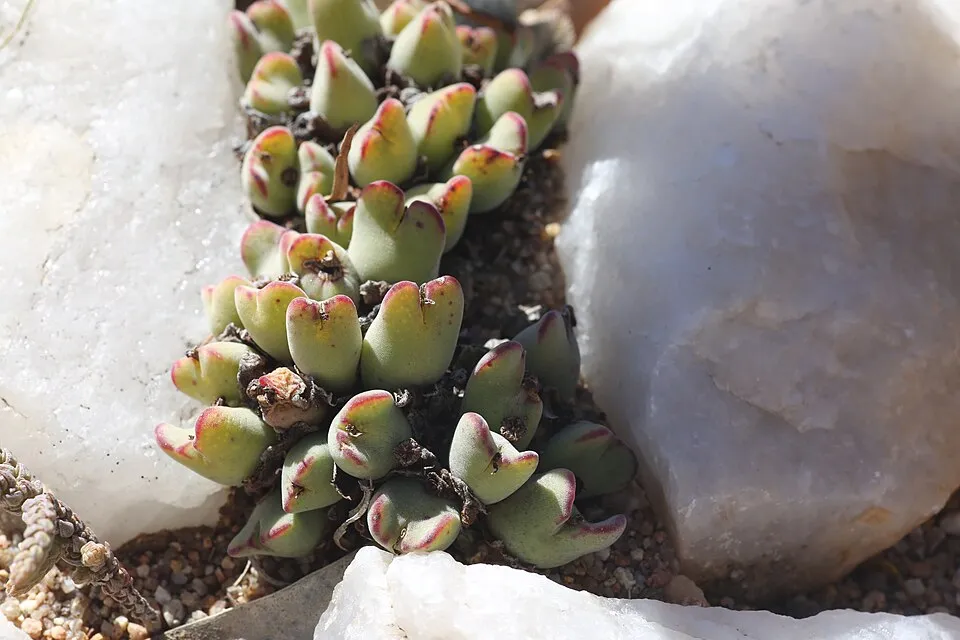
Conophytum bilobum, affectionately known as 'Knees', 'Rabbit Ears', or 'Living Pebble', is a captivating succulent endemic to the arid landscapes of Southern Africa, particularly the lower valleys of the Orange River, Bushmanland, and regions near Bitterfontein. This diminutive perennial belongs to the Aizoaceae family, specifically the Ruschioideae subfamily and Ruschieae tribe, a lineage renowned for its extreme adaptations to harsh desert environments. Its botanical name, bilobum, aptly describes its most striking feature: a pair of deeply cleft, opposite, and partly fused fleshy leaves that form a heart-shaped or rabbit-eared body.
These specialized leaves, which can reach up to 3 inches (7 cm) in height and 1.2 inches (3 cm) in width, serve as efficient reservoirs for water and nutrients, crucial for survival in its native habitat. The leaf surfaces can be smooth or finely papillate, displaying a spectrum of colors from yellowish-green to glaucous, or even pinkish to reddish, often adorned with darker green dots, prominent red keels, and distinctive windowed patches flanking the fissure zone.
Conophytum bilobum exhibits a unique growth and dormancy cycle, a key xerophytic adaptation. It actively grows during the cooler, wetter months from autumn through spring. As the scorching, dry summer approaches, the plant enters a period of dormancy, during which the older leaf pair shrivels to form a protective, papery sheath around the newly developing leaves, effectively minimizing water loss.
This 'restructuring' mechanism is vital for its resilience. The plant produces diurnal, often bright yellow flowers, sometimes appearing in shades of orange, pinkish, or white, typically blooming in the fall and reaching about 1 inch (2.5 cm) in diameter. Historically, Conophytum species have been cherished as botanical curiosities since the 18th century, with formal taxonomic descriptions emerging as botanists explored the rich Cape Floral Kingdom.
Trusted Scientific References
1. Authoritative external sources for Conophytum bilobum
1.1 Wikipedia — Conophytum bilobum
1.2 Kew POWO (Plants of the World Online)
1.3 PubMed — peer-reviewed research
1.4 NCBI Taxonomy Browser
1.5 GBIF — Global Biodiversity
1.1.Conophytum — Notable Characteristics
- ✓Distinctive Bi — lobed Leaves — Fused, fleshy leaves that resemble knees, rabbit ears, or living pebbles.
- ✓Xerophytic Adaptations — Highly specialized morphological and physiological traits for survival in arid, desert conditions.
- ✓Unique Dormancy Cycle — Enters dormancy in hot, dry summers, forming a protective papery sheath around new growth.
- ✓Native to Southern Africa — Indigenous to specific arid regions of the Orange River valley and Bushmanland.
- ✓Ornamental Value — Highly prized by succulent enthusiasts and collectors for its unusual beauty.
- ✓Aizoaceae Family Member — Part of a diverse plant family known for its extreme succulence and adaptations.
- ✓Diurnal Yellow Flowers — Produces small, bright yellow (sometimes orange, pink, or white) flowers, typically in autumn.
- ✓Compact Growth Habit — A small, low-growing plant, making it ideal for miniature landscapes and container culture.
- ✓Water — Storing Leaves — Fleshy leaves are efficient reservoirs for water and stored nutrients, enabling drought survival.
- ✓Low Maintenance (with specific care) — Relatively easy to care for once its unique seasonal growth and dormancy needs are understood.
1.2.Conophytum — Quick Summary
- ✓Conophytum bilobum is a unique succulent from Southern Africa with distinctive bi-lobed, fused leaves.
- ✓Commonly known as 'Living Pebble', 'Knees', or 'Rabbit Ears' due to its characteristic shape.
- ✓Exhibits a specialized dormancy cycle, adapting to extreme arid desert environments for survival.
- ✓Primarily valued as an ornamental plant; specific medicinal uses are not scientifically documented or traditionally widespread.
- ✓Requires bright light, extremely well-draining soil, and careful watering tailored to its active and dormant periods.
- ✓Prized by succulent collectors for its aesthetic appeal, drought resilience, and fascinating biological adaptations.
2.Conophytum — Botanical Identity
3.Conophytum — Fact Sheet
4.Conophytum — Botanical Description
5.Conophytum — Native Range & Habitat
6.Conophytum — Traditional Uses
7.Conophytum — Key Phytochemicals
- ✓Alkaloids — These nitrogen-containing compounds are common in plants, often having significant pharmacological activity, though their specific profile and concentration in Conophytum bilobum are not documented.
- ✓Flavonoids — A class of polyphenolic compounds known for antioxidant and anti-inflammatory properties, likely present in C. bilobum as general plant pigments and protective agents against environmental stressors.
- ✓Terpenoids — A diverse group of organic compounds contributing to plant fragrance, flavor, and defense mechanisms, potentially synthesized by Conophytum bilobum for ecological roles in its arid habitat.
- ✓Saponins — Glycosides that can form a stable foam in water, sometimes possessing medicinal properties, whose presence and specific types in C. bilobum would require specific phytochemical analysis.
- ✓Mucilage — Polysaccharide-rich viscous substances responsible for water retention in succulents, crucial for Conophytum bilobum's survival in arid environments and a potential source of hydrating agents.
- ✓Betacyanins — Pigments responsible for red-violet coloration in some Aizoaceae species, distinct from anthocyanins, possibly present in C. bilobum's reddish forms, offering antioxidant potential.
- ✓Organic Acids — Various organic acids are involved in plant metabolism and stress responses, likely present in Conophytum bilobum to regulate pH and facilitate physiological processes.
- ✓Phytosterols — Plant sterols structurally similar to cholesterol, found in plant cell membranes, which may be present in C. bilobum as essential components for cellular function and membrane stability.
- ✓Polysaccharides — Complex carbohydrates that form the structural components of plant cells and contribute significantly to water storage, abundantly present in Conophytum bilobum's fleshy tissues.
- ✓Waxes and Cuticular Lipids — Surface lipids providing a protective barrier against water loss and UV radiation, essential for Conophytum bilobum's survival in its harsh, sun-drenched habitat.
8.Conophytum — Scientific Evidence
- ✓Potential Skin Hydration — Like many succulents, Conophytum bilobum stores water in its fleshy leaves, suggesting hypothetical use for mucilage-derived skin moistening, though specific studies are absent for this species.
- ✓Hypothetical Wound Care Support — Some succulent species possess compounds that aid in minor wound healing; Conophytum bilobum might theoretically contain such properties, awaiting scientific investigation.
- ✓General Well-being (Ethnobotanical Context) — Indigenous groups in Southern Africa have historically used various succulents for general health, implying C. bilobum could have been part of broader ethnomedicinal practices, though not specifically documented.
- ✓Antioxidant Properties (Speculative) — Many plants produce antioxidants to protect themselves from environmental stress; Conophytum bilobum in its harsh habitat might contain such compounds, requiring phytochemical analysis.
- ✓Anti-inflammatory Potential (Undocumented) — Certain plant metabolites exhibit anti-inflammatory effects; the presence of such compounds in C. bilobum is currently unknown but could be a subject for future research.
- ✓Antimicrobial Activity (Theoretical) — Plants often develop defenses against pathogens; Conophytum bilobum may possess compounds with antimicrobial properties, a hypothesis yet to be tested for this specific species.
- ✓Environmental Stress Adaptation Insights — The plant's robust survival mechanisms in arid zones suggest an ability to synthesize protective compounds, which could hypothetically inspire biomimetic applications.
- ✓Minor Ailment Relief (Traditional Inference) — Without specific documentation for C. bilobum, its use for minor ailments would fall under broader traditional succulent applications, where general soothing or mild effects might be observed.
- ✓Ethnobotanical Interest — The plant's unique adaptations and presence in traditional lands highlight its potential ethnobotanical significance, even if specific medicinal uses are not widely recorded.
- ✓Ornamental and Horticultural Value — While not medicinal, its primary 'benefit' is its aesthetic appeal and ease of cultivation for succulent enthusiasts, offering psychological well-being through gardening.
8.1.Conophytum — Therapeutic Indications
9.Conophytum — Cautions & Contraindications
9.1.Conophytum — Caution Notes
- ✓Ingestion Toxicity (Potential) — As Conophytum bilobum is not traditionally consumed or studied for edibility, ingestion is not recommended and could potentially lead to unknown toxic reactions or gastrointestinal upset.
- ✓Allergic Reactions — Direct contact with plant sap or tissues might cause mild skin irritation or allergic reactions in sensitive individuals, though specific allergens are not documented for this species.
- ✓Gastrointestinal Discomfort — If consumed, the high mucilage content or other unknown compounds could cause digestive issues such as bloating, nausea, or diarrhea in some individuals.
- ✓Pet Toxicity — Keep Conophytum bilobum away from pets, as ingestion by animals could lead to adverse effects, similar to many ornamental plants not intended for consumption.
- ✓Choking Hazard — The small, fleshy bodies of the plant could pose a choking hazard, particularly for small children or pets, if accidentally ingested whole.
9.2.Conophytum — Safety Profile
- ✓Non-Edible Classification — Conophytum bilobum is considered an ornamental plant and should not be ingested; its safety for human consumption is entirely unestablished and not recommended.
- ✓Skin Contact — Generally safe for handling, but individuals with sensitive skin should exercise caution to avoid potential mild irritation from plant sap, though reports are rare.
- ✓Child and Pet Safety — It is advisable to keep the plant out of reach of children and pets to prevent accidental ingestion, as potential toxicity is largely unknown.
- ✓No Known Drug Interactions — Due to a complete lack of documented medicinal use and pharmacological studies, there are no known drug interactions, but this does not imply safety for consumption.
- ✓Research Gap — The comprehensive safety profile for Conophytum bilobum remains largely unresearched, particularly concerning any form of internal or prolonged external use.
- ✓External Use Caution — Any hypothetical external application should be approached with extreme caution, starting with a small patch test due to unknown allergenic potential.
10.Conophytum — Usage Guide
- ✓Ornamental Cultivation — Primarily cultivated as a unique ornamental succulent for specialized succulent collections, rock gardens, or container gardening due to its distinctive morphology.
- ✓Botanical Study — Utilized in botanical research to investigate extreme xerophytic adaptations, Crassulacean Acid Metabolism (CAM) photosynthesis, and unique growth cycles in arid environments.
- ✓Seed Propagation — Seeds can be sown in a sterile, well-draining substrate for propagation, requiring specific temperature, light, and moisture conditions for successful germination.
- ✓Division for Propagation — Mature clumps can be carefully divided to create new plants, ensuring each separated body has sufficient roots and a healthy structure to establish independently.
- ✓Horticultural Display — Valued for its aesthetic appeal in miniature landscapes, terrariums, and artistic succulent arrangements, complementing other small arid-adapted plants.
- ✓Educational Specimen — Serves as an excellent educational tool for illustrating plant adaptations, biodiversity, and the unique characteristics of the Aizoaceae family to students and plant enthusiasts.
- ✓Conservation Efforts — Cultivation in botanical gardens and by private collectors contributes to the ex-situ conservation of this species, particularly in light of potential habitat pressures.
11.Conophytum — Garden Cultivation
- ✓Light — Requires bright light but avoid intense, direct midday sunlight to prevent sunburn; ideally, a spot receiving a few hours of full sun in cooler periods of the day is best.
- ✓Soil — Thrives in a highly porous, well-draining growing medium, such as a commercial succulent soil mix or a custom blend with ample inorganic components like pumice or perlite.
- ✓Watering — During its dormancy period (typically late spring through summer), water sparingly or not at all; resume deep watering in fall as growth begins, allowing the soil to dry completely between waterings.
- ✓Fertilizing — Conophytum bilobum are light feeders; generally, no fertilizer is needed if repotted every two years; otherwise, apply a diluted, balanced succulent fertilizer at the start of the growth period and just before flowering.
- ✓Repotting — Benefits from repotting every 2 to 4 years, depending on the pot's size and the plant's growth rate; the optimal time for repotting is at the beginning of its active growing season in autumn.
- ✓Propagation — Easily propagated by division of mature clumps, carefully separating individual bodies with intact roots; can also be grown from fresh seeds, which requires specific germination conditions.
- ✓Hardiness — Best suited for USDA hardiness zones 10b to 11b, tolerating temperatures from 35°F (1.7°C) to 50°F (10°C); must be protected from frost and prolonged cold temperatures.
Reviewed by the Flora Medical Global Botanical Review Panel
Multi-disciplinary editorial group · Botany · Ethnobotany · Herbal-medicine literature
Who reviewed this: This page was checked by the Flora Medical Global Botanical Review Panel — an in-house editorial group of botany graduates, ethnobotany researchers, and horticulture practitioners who collectively maintain our 7,000+ plant encyclopedia. Meet the team.
Our 4-step verification process
1. Taxonomic verification
Scientific names and synonyms cross-checked against Kew POWO, World Flora Online, and The Plant List.
2. Phytochemical & medicinal cross-reference
Active compounds, traditional uses, and reported activities are cross-referenced with PubMed, USDA Dr. Duke's database, and peer-reviewed ethnobotanical literature.
3. Conservation & distribution check
Distribution, ecology, and conservation status confirmed against GBIF occurrence records and the IUCN Red List.
4. Editorial & safety review
Every entry passes an editorial pass for clarity, originality, and safety notices (toxicity, contraindications, dosage caveats) before publication.
Last reviewed:
Important medical disclaimer: This content is for educational and research purposes only. It is not medical advice and is not a substitute for consultation with a licensed healthcare provider. Do not use any herb to self-treat a medical condition without professional guidance.
Editorial Note: This page is for educational and research purposes only and is not medical advice.
Written by: Flora Medical Global Editorial Team
Reviewed by: Flora Medical Global Botanical Review Panel
Last Updated: June 15, 2026





Conophytum — Comments & Community Reviews
Rate this plant