
Medical Disclaimer: This content is for educational purposes only. It is not medical advice. Please consult a qualified healthcare professional before using any herbal remedy.
Safety Overview
1.Coronilla Varia — Overview
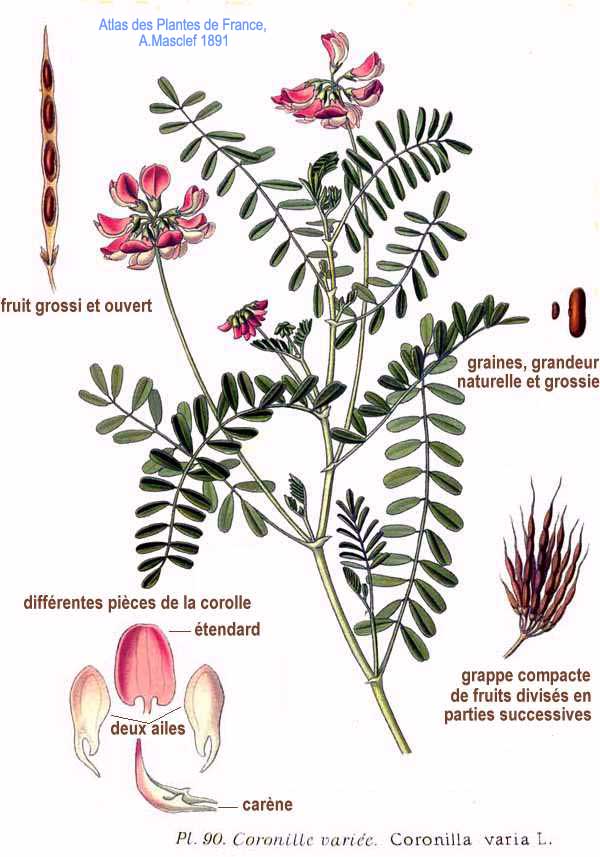
Coronilla varia, widely recognized as Crown Vetch or Purple Crown Vetch, is a robust perennial herbaceous plant belonging to the Fabaceae (legume) family. Originating from Europe, Asia, and northern Africa, this species has been extensively introduced globally, particularly in North America, where it is now classified as an invasive species due to its aggressive growth habit.
The plant typically grows as a sprawling vine, reaching heights of 30 to 90 centimeters (1 to 3 feet), and forms dense groundcover through its extensive rhizomatous root system. Its foliage consists of delicate, pinnately compound leaves, each composed of 12 to 25 small, ovate to lanceolate leaflets, giving the plant a fine-textured appearance.
A defining characteristic of Coronilla varia is its distinctive flower clusters, which are dense, rounded umbels resembling small crowns—hence its common name. These showy flowers, typically ranging in color from pink to purple or white, bloom profusely from late spring through the autumn months, serving as a significant nectar source for various pollinators, including bees. Following the flowering period, slender, segmented seed pods develop.
Crown Vetch is remarkably adaptable, thriving in a wide array of conditions from full sun to partial shade and tolerating diverse, well-drained soil types, including sandy, loamy, and clay substrates. Its vigorous root system and ability to fix nitrogen contribute to its success in colonizing disturbed areas such as roadsides, embankments, and abandoned fields. While effective for erosion control, its rapid spread and competitive nature pose a considerable threat to native plant communities, leading to ecological imbalances in many introduced regions.
Its resilience and minimal care requirements allow it to establish dense monocultures if not carefully managed.
Trusted Scientific References
1. Authoritative external sources for Coronilla Varia
1.1 Wikipedia — Coronilla Varia
1.2 Kew POWO (Plants of the World Online)
1.3 PubMed — peer-reviewed research
1.4 NCBI Taxonomy Browser
1.5 GBIF — Global Biodiversity
1.1.Coronilla Varia — Key Features
- ✓Scientific Name — Coronilla varia (syn. Securigera varia)
- ✓Common Names — Crown Vetch, Purple Crown Vetch
- ✓Plant Family — Fabaceae (Legume Family)
- ✓Native Range — Europe, Asia, Northern Africa
- ✓Growth Habit — Vining, spreading perennial herbaceous plant
- ✓Flower Characteristics — Pink to white, crown-like clusters (umbels)
- ✓Leaf Structure — Pinnately compound with 12-25 small leaflets
- ✓Primary Toxicity — Contains neurotoxic and cardiotoxic nitropropanol glycosides
- ✓Main Applications — Erosion control, ruminant livestock forage
- ✓Invasive Potential — Highly invasive in many introduced regions, outcompeting native flora
1.2.Coronilla Varia — Quick Summary
- ✓Invasive perennial groundcover native to Europe, Asia, and Africa.
- ✓Characterized by pink to white crown-like flower clusters and pinnately compound leaves.
- ✓Contains toxic nitropropanol glycosides, poisonous to humans and non-ruminant animals.
- ✓Primarily used for erosion control and as forage for specific ruminant livestock.
- ✓NOT safe for human consumption or medicinal use due to high toxicity.
- ✓Spreads aggressively via rhizomes and seeds, requiring careful management.
2.Coronilla Varia — Scientific Profile
3.Coronilla Varia — Reference Facts
4.Coronilla Varia — Structural Profile
5.Coronilla Varia — Where It Grows
6.Coronilla Varia — Ethnobotanical Uses
7.Coronilla Varia — Bioactive Constituents
- ✓Nitropropanol Glycosides — These are the primary toxic compounds in Coronilla varia, notably coronillin, coronarian, and karakin, which are metabolized into toxic nitro compounds that interfere with oxygen transport and can cause neurological and cardiac issues in non-ruminants.
- ✓Flavonoids — A diverse group of polyphenolic compounds, including derivatives of quercetin and kaempferol, are present. These compounds are typically associated with antioxidant, anti-inflammatory, and potential cardioprotective activities in other plants, but their therapeutic application from Coronilla varia is outweighed by its toxicity.
- ✓Phenolic Compounds — Various phenolic acids and tannins are found, contributing to the plant's natural defense mechanisms and exhibiting in vitro antioxidant properties.
- ✓Saponins — These glycosides are present and are responsible for the frothing observed when plant material is agitated in water, potentially playing a role in plant defense against pathogens and herbivores.
- ✓Coumarins — A class of organic compounds known for diverse biological activities, some with anticoagulant or phototoxic effects, may be present in trace amounts, contributing to the plant's overall phytochemical profile.
- ✓Alkaloids — While not the dominant secondary metabolites, trace amounts of various alkaloids may occur, which can have significant physiological effects, although their specific contribution to Coronilla varia's toxicity is less pronounced than nitropropanol glycosides.
- ✓Carbohydrates — Essential structural and storage polysaccharides are integral to the plant's metabolic processes, providing energy and structural support.
- ✓Lipids — Fatty acids and other lipid components are present in plant tissues, crucial for cell membrane integrity and energy storage.
- ✓Amino Acids and Proteins — The building blocks for plant enzymes and structural components, providing nutritional value, particularly in its use as forage for tolerant ruminants.
- ✓Minerals and Vitamins — Coronilla varia contains essential minerals and vitamins, such as Vitamin C, which are vital for general plant health but do not mitigate the plant's inherent toxicity for human consumption.
8.Coronilla Varia — What Research Suggests
- ✓Historical Use for Gastrointestinal Support — Traditionally, some cultures believed certain preparations of Coronilla varia could alleviate stomach ailments and digestive discomforts, though modern scientific research does not support safe human internal use due to its inherent toxicity.
- ✓Traditional Antiseptic Properties — Extracts were historically applied topically to minor wounds for their purported antiseptic qualities, suggesting an awareness of its compounds' potential to inhibit microbial growth, but systemic absorption risks make this practice unsafe.
- ✓Anti-inflammatory Actions (Traditional) — In certain traditional practices, Coronilla varia was used to address various inflammatory conditions, possibly attributed to its flavonoid and phenolic content, but internal human application is strictly contraindicated.
- ✓Respiratory Issue Relief (Traditional) — Anecdotal evidence from some traditional systems mentioned its use for respiratory complaints, implying a historical belief in its capacity to ease breathing or reduce symptoms, yet this is not a recommended modern therapeutic use.
- ✓Overall Vitality Enhancement (Traditional) — Historically, some formulations incorporating Coronilla varia were thought to promote general well-being and vitality, although contemporary understanding emphasizes its toxic nature, rendering such uses unsafe.
- ✓Erosion Control and Soil Stabilization — Modernly, it has been widely planted for its exceptional ability to prevent soil erosion on slopes, embankments, and disturbed lands, forming a robust ground cover with its extensive rhizomatous root system.
- ✓Nitrogen Fixation — As a member of the Fabaceae family, Crown Vetch forms symbiotic relationships with soil bacteria, enabling it to fix atmospheric nitrogen, thereby enriching soil fertility and benefiting neighboring plants.
- ✓Forage for Ruminant Livestock — Coronilla varia is tolerated and utilized as a forage crop for ruminant animals such as cattle, goats, and sheep, whose specialized digestive systems can detoxify its harmful compounds, making it a valuable feed source in specific agricultural contexts.
- ✓Pollinator Attraction — Its abundant pink and white flowers provide a consistent and rich source of nectar for various pollinators, including bees, throughout its extended blooming period, supporting local insect biodiversity.
- ✓Ecological Rehabilitation (Limited Contexts) — In severely degraded or barren landscapes where other vegetation struggles to establish, its aggressive growth can initiate plant cover and contribute to initial stages of ecological succession, though careful management is crucial to prevent invasiveness.
8.1.Coronilla Varia — Therapeutic Indications
9.Coronilla Varia — Adverse Effects
9.1.Coronilla Varia — Caution Notes
- ✓Gastrointestinal Distress — Ingestion by humans, horses, or other non-ruminant animals can lead to severe symptoms including nausea, vomiting, abdominal pain, diarrhea, and colic.
- ✓Cardiac Irregularities — The nitropropanol glycosides present can induce cardiotoxic effects, potentially causing irregular heartbeats and other serious cardiovascular complications.
- ✓Neurological Symptoms — Toxicity may manifest as weakness, incoordination, tremors, and even paralysis, particularly observed in horses, due to the neurotoxic actions of its compounds.
- ✓Respiratory Depression — Severe poisoning can result in difficulty breathing, labored respiration, and in extreme cases, respiratory failure, posing a life-threatening risk.
- ✓Liver and Kidney Damage — Chronic or acute exposure to the toxins can lead to significant damage to hepatic and renal tissues, impairing the function of these vital organs.
- ✓Skin Irritation — Direct contact with the plant sap or foliage may cause mild skin irritation or dermatitis in sensitive individuals.
- ✓Abortion in Livestock — While generally tolerated by ruminants, excessive consumption by pregnant livestock has been associated with an increased risk of abortion.
9.2.Coronilla Varia — Clinical Safety Notes
- ✓Highly Toxic to Humans — Coronilla varia contains dangerous nitropropanol glycosides that are poisonous to humans; ingestion can cause severe illness or be fatal.
- ✓Avoid All Ingestion — It is absolutely imperative to refrain from consuming any part of the plant, including leaves, flowers, seeds, or roots, in any form or preparation.
- ✓Not for Pregnant or Nursing Individuals — Due to its established toxicity, pregnant or breastfeeding women must strictly avoid all contact with and potential ingestion of Coronilla varia.
- ✓Keep Away from Children and Pets — Ensure the plant is completely inaccessible to children and all non-ruminant pets, especially horses, to prevent accidental poisoning.
- ✓Handle with Protective Gear — When handling the plant, particularly during gardening or landscaping activities, wear protective gloves to prevent potential skin irritation.
- ✓Consult Veterinarian for Livestock — While ruminants tolerate it, always consult a qualified veterinarian regarding the appropriate use and safe consumption levels for animal forage.
- ✓Do Not Use in Herbal Remedies — Despite any historical mentions, Coronilla varia should never be incorporated into herbal remedies, supplements, or any form of self-medication for human use.
10.Coronilla Varia — Application Forms
- ✓Erosion Control Planting — Primarily utilized for stabilizing disturbed soils on steep embankments, roadsides, and slopes, where its aggressive root system effectively prevents soil runoff and degradation.
- ✓Livestock Forage (Ruminants Only) — Cultivated as a forage crop for ruminant animals such as cattle, goats, and sheep, which possess the digestive capacity to safely metabolize its toxic compounds; strictly contraindicated for horses and other non-ruminants.
- ✓Land Reclamation — Employed in projects aimed at reclaiming barren or highly degraded lands, where its ability to establish in poor soils and fix nitrogen helps to initiate revegetation and improve soil quality.
- ✓Green Manure (Controlled Application) — In specific agricultural contexts, it can be grown and then tilled into the soil as a green manure crop to enhance soil structure and nitrogen content, followed by appropriate crop rotation and management.
- ✓Traditional Topical Applications (Extreme Caution) — Historically, some cultures might have used poultices or washes externally for certain ailments, but even topical use should be approached with extreme caution due to potential skin irritation and the risk of systemic absorption of toxic compounds.
- ✓NEVER for Human Consumption — It is unequivocally critical that Coronilla varia is toxic to humans and must never be ingested or used in any culinary preparations or herbal remedies for internal human use.
- ✓Habitat Restoration (Managed Contexts) — Can be considered in highly specific, controlled habitat restoration efforts in severely disturbed sites where its invasive tendencies can be rigorously managed, providing initial ground cover where other plants might fail.
11.Coronilla Varia — Propagation & Care
- ✓Site Selection — Choose locations where its aggressive spreading can be either contained or where its rapid ground cover is specifically desired for erosion control, avoiding proximity to sensitive native ecosystems.
- ✓Soil Preference — Exhibits high adaptability, thriving in a wide range of well-drained soil types, including sandy, loamy, and clay, and tolerating various pH levels and low nutrient availability.
- ✓Light Requirements — Performs optimally in full sun, which promotes denser growth and more abundant flowering, but can also tolerate partial shade conditions.
- ✓Watering — Highly drought-tolerant once established, requiring minimal supplemental irrigation; overwatering should be avoided to prevent root rot and other moisture-related issues.
- ✓Fertilization — Generally does not require additional fertilization due to its nitrogen-fixing capabilities, which naturally enrich the soil; excess nutrients can promote unwanted vigorous growth.
- ✓Propagation — Easily propagated from seeds, which may benefit from scarification to aid germination, or through division of its extensive rhizomatous root system for quick establishment.
- ✓Maintenance — Low maintenance once established, but requires vigilant monitoring and active management to prevent its invasive spread into unintended areas.
- ✓Pest and Disease Resistance — Shows strong natural resistance to most common insect pests and plant diseases, contributing to its hardiness and competitive advantage.
Reviewed by the Flora Medical Global Botanical Review Panel
Multi-disciplinary editorial group · Botany · Ethnobotany · Herbal-medicine literature
Who reviewed this: This page was checked by the Flora Medical Global Botanical Review Panel — an in-house editorial group of botany graduates, ethnobotany researchers, and horticulture practitioners who collectively maintain our 7,000+ plant encyclopedia. Meet the team.
Our 4-step verification process
1. Taxonomic verification
Scientific names and synonyms cross-checked against Kew POWO, World Flora Online, and The Plant List.
2. Phytochemical & medicinal cross-reference
Active compounds, traditional uses, and reported activities are cross-referenced with PubMed, USDA Dr. Duke's database, and peer-reviewed ethnobotanical literature.
3. Conservation & distribution check
Distribution, ecology, and conservation status confirmed against GBIF occurrence records and the IUCN Red List.
4. Editorial & safety review
Every entry passes an editorial pass for clarity, originality, and safety notices (toxicity, contraindications, dosage caveats) before publication.
Last reviewed:
Important medical disclaimer: This content is for educational and research purposes only. It is not medical advice and is not a substitute for consultation with a licensed healthcare provider. Do not use any herb to self-treat a medical condition without professional guidance.
Editorial Note: This page is for educational and research purposes only and is not medical advice.
Written by: Flora Medical Global Editorial Team
Reviewed by: Flora Medical Global Botanical Review Panel
Last Updated: June 15, 2026





Coronilla Varia — Comments & Community Reviews
Rate this plant