
Medical Disclaimer: This content is for educational purposes only. It is not medical advice. Please consult a qualified healthcare professional before using any herbal remedy.
Safety Overview
1.Corydalis Lutea — Overview
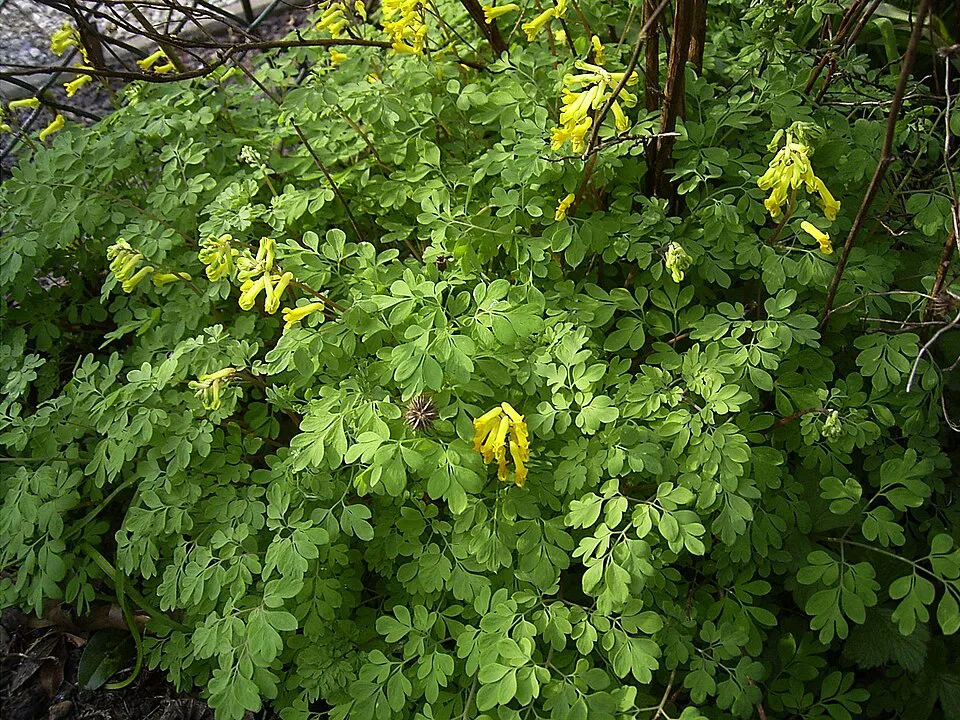
Corydalis lutea, commonly known as Yellow Corydalis or Yellow Fumitory, is a charming, short-lived perennial herbaceous plant belonging to the Fumariaceae family. Native to the southern Alps of Europe, it thrives in rocky crevices and shaded walls, often self-seeding readily to form attractive mounds of delicate foliage. This species typically grows to a height of 30 to 45 centimeters (12 to 18 inches), though it can be shorter, forming neat, compact clumps. Its leaves are finely dissected, resembling those of a maidenhair fern or bleeding heart, with a vibrant light green to blue-green hue.
The pinnately compound leaves feature three lobes, appearing pale green on the upper surface and glaucous below. Throughout a remarkably long blooming season, from late spring until the first frost, Corydalis lutea produces abundant bright golden-yellow flowers. These irregular, tubular flowers, approximately 2.5 to 5 cm (1-2 inches) long, are arranged in racemes containing 6 to 16 individual blossoms, each characterized by a distinctive spur at the back. After flowering, slender, dehiscent capsules develop, which eventually burst to scatter the seeds.
This hardy plant is suitable for USDA zones 5a-8b, preferring well-drained, nutrient-rich soils with a pH between 6.0 and 7.0. While it enjoys full sun for at least 6-8 hours daily, it can also tolerate partial shade, especially in hotter climates, where consistent soil moisture helps prevent summer dormancy.
Trusted Scientific References
1. Authoritative external sources for Corydalis Lutea
1.1 Wikipedia — Corydalis Lutea
1.2 Kew POWO (Plants of the World Online)
1.3 PubMed — peer-reviewed research
1.4 NCBI Taxonomy Browser
1.5 GBIF — Global Biodiversity
1.6Corydalis Lutea should be interpreted through verified botanical identity, practical care, and responsible safety language. This recovery note adds the missing context needed for a complete profile: match light to the plant's habit, use well-drained soil, water according to season, and avoid unsupported medicinal or edible claims. For publishing, the plant can be presented as a source-backed garden plant with clear care guidance, common problem diagnosis, and conservative safety wording.
1.1.Corydalis Lutea — Defining Traits
- ✓Striking Yellow Blooms — Produces abundant bright golden-yellow flowers from late spring to frost.
- ✓Delicate Fern — like Foliage — Features finely cut, light green to blue-green leaves that form neat mounds.
- ✓Self — Seeding Habit — Readily self-seeds, making it excellent for naturalizing in rock gardens or walls.
- ✓Extended Bloom Period — Offers a prolonged display of flowers throughout much of the growing season.
- ✓Cold and Heat Tolerant — Hardy in zones 5a-8b, showing resilience to varying temperatures.
- ✓Medicinal Alkaloids — Contains isoquinoline alkaloids, characteristic of the Corydalis genus, with known pharmacological activities.
- ✓Traditional Pain Relief — Other Corydalis species are historically valued for their potent analgesic and anti-inflammatory effects.
- ✓Low Maintenance Perennial — Easy to cultivate in well-drained soil with minimal care requirements.
- ✓Attracts Pollinators — Its vibrant flowers can attract bees and other beneficial insects to the garden.
- ✓Adaptable Growth — Thrives in both full sun and partial shade, adapting to various garden environments.
1.2.Corydalis Lutea — In Brief
- ✓Ornamental Charm — Corydalis lutea is primarily cherished for its vibrant yellow flowers and delicate foliage, making it a popular garden perennial.
- ✓Medicinal Genus — The Corydalis genus, particularly C. yanhusuo, is renowned in traditional medicine for its analgesic, anti-inflammatory, and sedative properties.
- ✓Key Phytochemistry — Rich in isoquinoline alkaloids like tetrahydropalmatine, which are responsible for many of its pharmacological actions.
- ✓Traditional Uses — Employed in TCM and other systems for pain, nerve damage, mood support, and gastrointestinal issues.
- ✓Cultivation Ease — Corydalis lutea is easy to grow, self-seeding readily in well-drained soil and partial to full sun.
- ✓Safety Caution — Contraindicated in pregnancy and requires careful use due to potential side effects and drug interactions.
2.Corydalis Lutea — Scientific Profile
3.Corydalis Lutea — Quick Facts
4.Corydalis Lutea — Plant Morphology
5.Corydalis Lutea — Geographic Distribution
6.Corydalis Lutea — Historical Applications
7.Corydalis Lutea — Bioactive Constituents
- ✓Isoquinoline Alkaloids — These are the primary active compounds in the Corydalis genus, including tetrahydropalmatine (THP), dehydrocorydaline, protopine, and allocryptopine. THP is particularly noted for its analgesic, sedative, and anxiolytic effects, while others contribute to anti-inflammatory and cytotoxic activities.
- ✓Flavonoids — Present in many plant species, flavonoids in Corydalis contribute to its antioxidant and anti-inflammatory properties, protecting cells from oxidative stress.
- ✓Terpenoids — These compounds, encompassing a broad range of structures, can exhibit various biological activities such as anti-inflammatory, antimicrobial, and potentially cytotoxic effects.
- ✓Essential Oils — While less prominent in some Corydalis species, essential oils can contribute to the plant's aroma and may possess mild antimicrobial or soothing properties.
- ✓Protopine — An isoquinoline alkaloid found in Corydalis, known for its potential to affect dopamine receptors and contribute to sedative and analgesic actions.
- ✓Allocryptopine — Another alkaloid, often co-occurring with protopine, which may have anti-inflammatory and antispasmodic effects.
- ✓Sanguinarine — A quaternary ammonium alkaloid with documented antimicrobial and anti-inflammatory properties, though also associated with toxicity in higher doses.
- ✓Berberine — While more characteristic of other genera, some Corydalis species may contain berberine, known for its antimicrobial, anti-inflammatory, and metabolic regulatory effects.
8.Corydalis Lutea — Research Insights
- ✓Analgesic Properties — Certain Corydalis species, notably C. yanhusuo, are highly valued for their potent pain-relieving effects, acting on various pain pathways, including neuropathic pain.
- ✓Anti-inflammatory Action — Extracts from the Corydalis genus exhibit anti-inflammatory properties, potentially mitigating swelling and discomfort associated with inflammatory conditions.
- ✓Antioxidant Support — The plant contains compounds that may help neutralize free radicals, contributing to cellular protection and overall health.
- ✓Antimicrobial Activity — Some Corydalis species have demonstrated activity against certain microbes, suggesting potential in addressing bacterial or fungal concerns.
- ✓Mild Sedative Effects — Traditionally, Corydalis has been used as a mild sedative and tranquilizer, promoting relaxation and aiding in the management of mild mental and emotional disturbances.
- ✓Mood Regulation — There is some traditional belief and preliminary research suggesting Corydalis may offer support for mild depression and anxiety by influencing neurotransmitter systems.
- ✓Nerve Damage Relief — Historically, Corydalis has been applied to address severe nerve damage and associated pain, though more scientific evidence is needed.
- ✓Tremor Reduction — In traditional practices, Corydalis was sometimes used to alleviate limb tremors, indicating a potential neuro-modulatory effect.
- ✓Blood Pressure Modulation — Certain compounds within the Corydalis genus may contribute to lowering blood pressure, though this requires further investigation and careful dosing.
- ✓Gastrointestinal Spasmolysis — Corydalis has been traditionally employed to relax spasms in the small intestine, potentially easing digestive discomfort and cramping.
8.1.Corydalis Lutea — Health Applications
9.Corydalis Lutea — Precautions & Warnings
9.1.Corydalis Lutea — Reported Side Effects
- ✓Gastrointestinal Upset — High doses may lead to nausea, vomiting, or diarrhea.
- ✓Sedation and Drowsiness — Due to its sedative properties, it can cause drowsiness, impacting driving or operating machinery.
- ✓Muscle Spasms and Tremors — Excessive intake of Corydalis has been reported to induce spasms and muscle tremors.
- ✓Hypotension — May lower blood pressure, which could be problematic for individuals already on antihypertensive medication.
- ✓Liver Toxicity — Prolonged or very high doses, particularly of certain alkaloid-rich species, might pose a risk to liver health.
- ✓Allergic Reactions — Sensitive individuals may experience allergic reactions, such as skin rashes or respiratory symptoms.
- ✓Central Nervous System Depression — When combined with other sedatives or alcohol, Corydalis can potentiate CNS depression.
9.2.Corydalis Lutea — Risk Assessment
- ✓Pregnancy — It is UNSAFE to take Corydalis during pregnancy as it may induce uterine contractions and increase the risk of miscarriage.
- ✓Breastfeeding — Insufficient reliable information is available regarding the safety of Corydalis during breastfeeding; therefore, avoidance is recommended.
- ✓Drug Interactions — May interact with sedatives, blood pressure medications, and blood thinners; consult a healthcare professional before use.
- ✓Dosage Importance — Natural products are not always safe, and appropriate dosing is crucial; always follow expert guidance or product labels.
- ✓Pre-existing Conditions — Individuals with liver disease, heart conditions, or blood pressure issues should exercise extreme caution or avoid use.
- ✓Professional Consultation — Always consult a healthcare provider or qualified herbalist before using Corydalis, especially for medicinal purposes.
- ✓Long-term Use — Long-term safety data for Corydalis is limited, and prolonged use should be undertaken with caution and under supervision.
10.Corydalis Lutea — Preparation & Dosage
- ✓Decoction — For medicinal Corydalis species, dried tubers or roots are simmered in water to create a potent tea, traditionally used for pain relief or sedation.
- ✓Tincture — Alcoholic extracts of the root or rhizome are prepared, allowing for concentrated dosing and extended shelf life, often used for chronic pain or emotional support.
- ✓Powdered Form — Dried Corydalis material can be ground into a fine powder and encapsulated or mixed with liquids for internal consumption, common in traditional Chinese medicine (TCM).
- ✓Topical Poultice — In some traditional systems, crushed fresh or rehydrated dried root material is applied externally as a poultice for localized pain or inflammatory conditions.
- ✓Herbal Combinations — Corydalis is frequently combined with other herbs in traditional formulas to enhance its therapeutic effects or mitigate potential side effects, such as with Angelica dahurica for pain.
- ✓Standardized Extracts — Modern applications may involve standardized extracts, ensuring consistent levels of active alkaloids like tetrahydropalmatine for specific therapeutic outcomes.
- ✓External Washes — Infusions or diluted tinctures can be used as external washes for skin conditions believed to benefit from its antimicrobial or anti-inflammatory properties.
11.Corydalis Lutea — Growth Requirements
- ✓Soil Preference — Thrive in well-drained, nutrient-rich soil with a pH range of 6.0 to 7.0.
- ✓Light Requirements — Prefers full sun exposure for at least 6-8 hours a day, but tolerates partial shade, especially in hot climates.
- ✓Watering Schedule — Requires regular watering, particularly during dry spells, to maintain consistent soil moisture and prevent summer dormancy.
- ✓Temperature and Hardiness — Hardy in USDA zones 5a-8b; plants may die back to the ground in cold winters or during hot, dry summers but often resume growth in favorable conditions.
- ✓Propagation — Readily self-seeds, often establishing itself in cracks and crevices; can also be propagated by division in spring or fall.
- ✓Growth Habit — Forms neat mounds of delicate foliage; ideal for rock gardens, borders, or naturalizing in woodland settings.
- ✓Maintenance — Low maintenance; deadheading spent flowers can encourage more blooms, though allowing some to go to seed facilitates self-propagation.
Reviewed by the Flora Medical Global Botanical Review Panel
Multi-disciplinary editorial group · Botany · Ethnobotany · Herbal-medicine literature
Who reviewed this: This page was checked by the Flora Medical Global Botanical Review Panel — an in-house editorial group of botany graduates, ethnobotany researchers, and horticulture practitioners who collectively maintain our 7,000+ plant encyclopedia. Meet the team.
Our 4-step verification process
1. Taxonomic verification
Scientific names and synonyms cross-checked against Kew POWO, World Flora Online, and The Plant List.
2. Phytochemical & medicinal cross-reference
Active compounds, traditional uses, and reported activities are cross-referenced with PubMed, USDA Dr. Duke's database, and peer-reviewed ethnobotanical literature.
3. Conservation & distribution check
Distribution, ecology, and conservation status confirmed against GBIF occurrence records and the IUCN Red List.
4. Editorial & safety review
Every entry passes an editorial pass for clarity, originality, and safety notices (toxicity, contraindications, dosage caveats) before publication.
Last reviewed:
Important medical disclaimer: This content is for educational and research purposes only. It is not medical advice and is not a substitute for consultation with a licensed healthcare provider. Do not use any herb to self-treat a medical condition without professional guidance.
Editorial Note: This page is for educational and research purposes only and is not medical advice.
Written by: Flora Medical Global Editorial Team
Reviewed by: Flora Medical Global Botanical Review Panel
Last Updated: June 15, 2026





Corydalis Lutea — Comments & Community Reviews
Rate this plant