


Medical Disclaimer: This content is for educational purposes only. It is not medical advice. Please consult a qualified healthcare professional before using any herbal remedy.
Safety Overview
1.Crown of Thorns — Introduction & Highlights
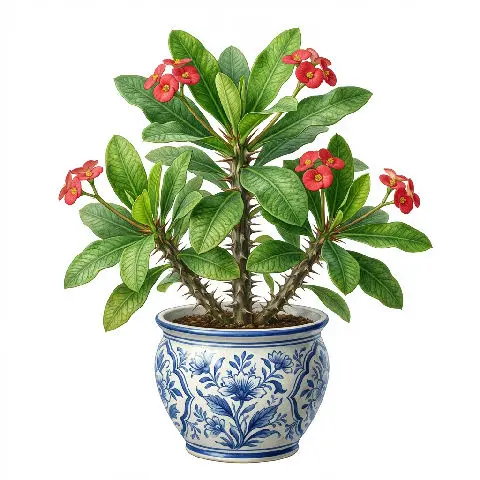
Euphorbia milii, commonly recognized as the Crown of Thorns, Christ Plant, or Christ Thorn, is a distinctive species of flowering plant belonging to the spurge family, Euphorbiaceae. Native to the arid regions of Madagascar, this resilient succulent subshrub has gained global popularity as an ornamental houseplant since its introduction to Europe in 1826. Its morphology is characterized by densely spined, woody stems, which serve as water storage organs, allowing it to thrive in drought-prone environments.
The small, obovate leaves are typically shed during periods of environmental stress or drought, a common adaptation for succulents. The true flowers of Euphorbia milii are inconspicuous and greenish, but they are dramatically framed by pairs of showy, petal-like bracts, known as cyathia, which are the plant's primary visual appeal. These bracts exhibit a wide spectrum of colors, including vibrant reds, pinks, yellows, oranges, and whites, with numerous cultivars developed for their varied hues and forms.
The common name ‘Crown of Thorns’ is steeped in religious lore, suggesting its stems were used for the crown worn by Jesus Christ, a narrative that enhances its cultural and symbolic significance, especially during Christian observances. Taxonomically, the species name honors Baron Milius, who facilitated its cultivation in France. While primarily valued for its ornamental appeal, traditional folk medicine in certain regions has explored its uses, albeit with significant caution due to its characteristic milky, toxic sap.
Trusted Scientific References
1. Authoritative external sources for Euphorbia milii
1.1 Wikipedia — Euphorbia milii
1.2 Kew POWO (Plants of the World Online)
1.3 PubMed — peer-reviewed research
1.4 NCBI Taxonomy Browser
1.5 GBIF — Global Biodiversity
1.6Crown of Thorns should be interpreted through verified botanical identity, practical care, and responsible safety language. This recovery note adds the missing context needed for a complete profile: match light to the plant's habit, use well-drained soil, water according to season, and avoid unsupported medicinal or edible claims. For publishing, the plant can be presented as a source-backed indoor plant with clear care guidance, common problem diagnosis, and conservative safety wording.
1.1.Crown of Thorns — Standout Qualities
- ✓Succulent, thorny shrub with thick, water — storing stems.
- ✓Displays showy, colorful — Displays showy, colorful bracts that resemble flowers, in various hues.
- ✓Native to Madagascar, adapted to arid and semi — arid environments.
- ✓Contains a milky, — Contains a milky, highly toxic latex (sap) rich in irritant diterpenoids.
- ✓Renowned for its — Renowned for its resilience and ability to bloom almost continuously.
- ✓Holds significant religious — Holds significant religious and cultural symbolism as the 'Crown of Thorns'.
- ✓Numerous ornamental cultivars — Numerous ornamental cultivars exist, offering a wide range of colors and forms.
- ✓Subject of ongoing — Subject of ongoing pharmacological research into its complex phytochemistry.
- ✓Considered a relatively low — maintenance houseplant in appropriate climates.
- ✓Requires full sun and well — drained soil for optimal growth and flowering.
1.2.Crown of Thorns — Quick Summary
- ✓Euphorbia milii, or Crown of Thorns, is a thorny succulent from Madagascar, known for its vibrant bracts and religious symbolism.
- ✓Its milky sap is highly toxic, containing irritant diterpenoids like phorbol esters, causing severe dermatitis and gastrointestinal distress if ingested.
- ✓Modern research explores its phytochemicals for potential anti-inflammatory, antimicrobial, and anticancer properties, primarily in laboratory settings.
- ✓Traditional topical uses for skin ailments existed but are not recommended due to the sap's extreme irritancy and danger.
- ✓Primarily valued as an ornamental houseplant due to its resilience and continuous blooming, requiring careful handling.
- ✓Internal medicinal use is strictly contraindicated due to its poisonous nature.
2.Crown of Thorns — Taxonomic Classification
3.Crown of Thorns — Reference Facts
4.Crown of Thorns — Morphological Account
5.Crown of Thorns — Where It Grows
6.Crown of Thorns — Historical Applications
7.Crown of Thorns — Secondary Metabolites
- ✓Diterpenoids — This is a predominant class, including miliirol, euphorbon, and various tigliane-type and ingenane-type phorbol esters, which are responsible for both potential therapeutic activities and the plant's significant toxicity.
- ✓Triterpenoids — Compounds like cycloartanes and other euphorboids contribute to the plant's chemical profile, with some showing anti-inflammatory and cytotoxic potential in research.
- ✓Flavonoids — Various flavonoid glycosides, such as those related to quercetin, are present, imparting antioxidant and potentially anti-inflammatory effects.
- ✓Lignans — These phenylpropanoid derivatives, including compounds like (+)-syringaresinol, have been identified and are being investigated for their antioxidant and potential anticancer properties.
- ✓Steroids — Phytosterols are found in the plant, common in many plant species and contributing to overall plant physiology.
- ✓Phenolic Acids — General phenolic acids are present, contributing to the plant's broad antioxidant capacity.
- ✓Latex (Milky Sap) — The characteristic white latex contains a high concentration of irritant diterpenoids, particularly phorbol esters, which are potent skin and mucous membrane irritants.
- ✓Volatile Compounds — While less prominent, a range of volatile organic compounds may be present in trace amounts, contributing to the plant's defense mechanisms.
8.Crown of Thorns — Research Insights
- ✓Anti-inflammatory Potential — Research indicates that diterpenoids found in Euphorbia milii extracts may possess anti-inflammatory properties, potentially modulating inflammatory pathways.
- ✓Antimicrobial Activity — In vitro studies have shown that extracts of Crown of Thorns exhibit inhibitory effects against certain bacteria and fungi, suggesting potential as a natural antimicrobial agent.
- ✓Anticancer Research — Specific diterpenoid compounds isolated from Euphorbia milii have demonstrated cytotoxic effects against various cancer cell lines in laboratory settings, opening avenues for future drug development.
- ✓Antioxidant Effects — The presence of flavonoids and phenolic compounds contributes to the plant's antioxidant capacity, which may help neutralize free radicals and reduce oxidative stress.
- ✓Wound Healing (Traditional Topical, CAUTION) — Historically, in some folk medicine systems, diluted preparations were applied topically to minor skin lesions; however, this carries significant risk due to the sap's irritant nature.
- ✓Analgesic Properties (Potential) — Linked to its anti-inflammatory effects, there is a theoretical potential for pain relief, though direct evidence for safe medicinal use is lacking and not recommended.
- ✓Immunomodulatory Insights — Some Euphorbia species are known for immune-modulating compounds, and E. milii may contain similar constituents that warrant further investigation.
- ✓Traditional Skin Ailments (High CAUTION) — Certain indigenous practices have cautiously used the plant for various skin conditions, but the severe irritancy of the latex makes this application highly dangerous for self-treatment.
8.1.Crown of Thorns — Indications & Uses
9.Crown of Thorns — Adverse Effects
9.1.Crown of Thorns — Warnings
- ✓Dermatitis — Contact with the milky sap can cause severe skin irritation, characterized by redness, itching, swelling, and blistering, especially in sensitive individuals.
- ✓Eye Irritation — If sap enters the eyes, it can lead to intense pain, inflammation, temporary blindness, and corneal damage, requiring immediate medical attention.
- ✓Gastrointestinal Distress — Ingestion of any part of the plant, especially the sap, causes severe nausea, vomiting, diarrhea, abdominal pain, and burning sensations in the mouth and throat.
- ✓Oral Cavity Irritation — Swelling of the lips, tongue, and throat can occur upon ingestion, potentially leading to difficulty breathing.
- ✓Allergic Reactions — Individuals with pre-existing allergies or sensitivities may experience more severe contact dermatitis or systemic allergic responses.
- ✓Systemic Toxicity — Large ingestions can lead to more serious systemic effects, although fatalities are rare, medical intervention is crucial.
- ✓Thorn Injuries — The sharp thorns can cause painful punctures, leading to localized swelling and potential for secondary bacterial infections.
9.2.Crown of Thorns — Risk Assessment
- ✓Toxic Sap — The plant's milky latex contains potent irritant diterpenoids (phorbol esters) that are highly toxic upon contact or ingestion.
- ✓Ingestion Contraindicated — Never ingest any part of Euphorbia milii; it is poisonous and can cause severe gastrointestinal and systemic reactions.
- ✓Topical Use Highly Discouraged — Direct skin application is not recommended due to the risk of severe dermatitis, blistering, and allergic reactions.
- ✓Protective Gear — Always wear gloves and eye protection when handling, pruning, or repotting the plant to prevent sap exposure.
- ✓Keep Away from Children and Pets — Ensure the plant is placed out of reach of curious children and pets who might accidentally ingest it.
- ✓Pregnancy and Lactation — Contraindicated for pregnant and nursing women due to potential toxicity and lack of safety data.
- ✓Sensitive Individuals — Individuals with sensitive skin, allergies, or a history of dermatitis should avoid any contact with the plant.
10.Crown of Thorns — How to Use
- ✓Topical Poultices (EXTREME CAUTION) — Historically, in some traditional practices, diluted sap or crushed plant material was applied topically for skin ailments; however, this carries immense risk of severe skin irritation and is not recommended.
- ✓Decoctions for External Use (HIGH CAUTION) — Some folk traditions prepared external washes from boiled plant parts for skin issues, but the inherent toxicity of the sap makes this method highly perilous and discouraged.
- ✓Research Extracts — Laboratory-prepared extracts (e.g., ethanol, methanol) are used in scientific studies to isolate and test specific phytochemicals for potential pharmacological activities.
- ✓Isolated Compounds for Drug Development — Specific diterpenoids and other compounds are isolated and purified for detailed pharmacological research, aiming for future pharmaceutical applications.
- ✓Tinctures (RESEARCH ONLY) — While tinctures can be made, they are strictly for laboratory research purposes and are absolutely not for home or internal medicinal use due to the plant's toxicity.
- ✓NEVER Internal Use — Due to the highly toxic nature of the milky sap, Crown of Thorns should never be ingested in any form for medicinal purposes, as it can cause severe gastrointestinal distress and systemic toxicity.
- ✓Traditional External Application (EXPERT SUPERVISION ONLY) — Any historical or traditional external application should only be considered under the guidance of highly experienced herbalists with extreme caution, prioritizing patient safety.
11.Crown of Thorns — Growth Requirements
- ✓Sunlight — Euphorbia milii thrives in full, direct sun for optimal flowering, though some hybrids can tolerate part shade with reduced bloom.
- ✓Temperature — Prefers average room temperatures (65-75°F / 18-24°C) and can survive down to 35°F (2°C), but must be brought indoors before frost.
- ✓Watering — Allow the soil to dry thoroughly between deep waterings for the species; many hybrids may require more frequent watering akin to tropical foliage plants.
- ✓Soil — Requires a rich, well-drained planting medium, ideally a commercial cactus mix amended with additional perlite, pumice, sharp sand, or a small amount of composted manure.
- ✓Fertilization — Fertilize lightly in spring and summer with a balanced fertilizer; over-fertilization can lead to vigorous vegetative growth at the expense of flowers and it is sensitive to boron.
- ✓Pruning — Prune to maintain shape and size, cutting stems back to axillary buds to encourage branching; use a knife that is easily cleaned as the sap will gum up shears.
- ✓Repotting — Repot only when the plant outgrows its container, preferably in spring or summer during active growth, using a well-draining mix.
- ✓Outdoor Acclimation — When moving outdoors for summer, gradually acclimate to higher light levels to prevent sunburn and ensure good air circulation to prevent fungal issues.
Reviewed by the Flora Medical Global Botanical Review Panel
Multi-disciplinary editorial group · Botany · Ethnobotany · Herbal-medicine literature
Who reviewed this: This page was checked by the Flora Medical Global Botanical Review Panel — an in-house editorial group of botany graduates, ethnobotany researchers, and horticulture practitioners who collectively maintain our 7,000+ plant encyclopedia. Meet the team.
Our 4-step verification process
1. Taxonomic verification
Scientific names and synonyms cross-checked against Kew POWO, World Flora Online, and The Plant List.
2. Phytochemical & medicinal cross-reference
Active compounds, traditional uses, and reported activities are cross-referenced with PubMed, USDA Dr. Duke's database, and peer-reviewed ethnobotanical literature.
3. Conservation & distribution check
Distribution, ecology, and conservation status confirmed against GBIF occurrence records and the IUCN Red List.
4. Editorial & safety review
Every entry passes an editorial pass for clarity, originality, and safety notices (toxicity, contraindications, dosage caveats) before publication.
Last reviewed:
Important medical disclaimer: This content is for educational and research purposes only. It is not medical advice and is not a substitute for consultation with a licensed healthcare provider. Do not use any herb to self-treat a medical condition without professional guidance.
Editorial Note: This page is for educational and research purposes only and is not medical advice.
Written by: Flora Medical Global Editorial Team
Reviewed by: Flora Medical Global Botanical Review Panel
Last Updated: June 15, 2026





Crown of Thorns — Comments & Community Reviews
Rate this plant