

Medical Disclaimer: This content is for educational purposes only. It is not medical advice. Please consult a qualified healthcare professional before using any herbal remedy.
Safety Overview
1.Diervilla Lonicera — Introduction & Highlights
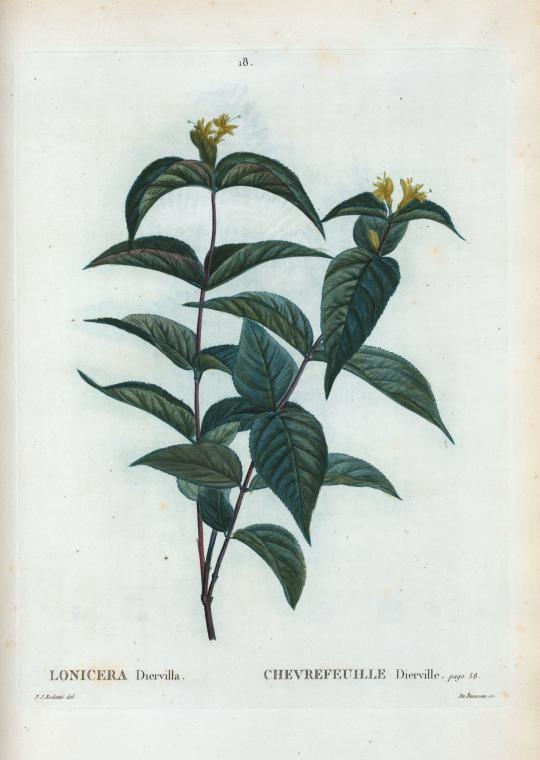
Diervilla lonicera, commonly known as bush honeysuckle or northern bush honeysuckle, is a resilient deciduous shrub belonging to the family Caprifoliaceae. This species is endemic to the temperate woodlands, rocky outcrops, and open areas of eastern North America, spanning from Newfoundland west to Manitoba and south to North Carolina and Iowa. It typically forms a rounded, multi-stemmed bush, reaching heights of 0.3 to 1.2 meters (1 to 4 feet) and spreading up to 1.5 meters (5 feet) wide, characterized by arching branches that contribute to its graceful, airy habit. The root system is fibrous and extensive, aiding in its adaptability to various soil conditions and contributing to its utility in erosion control. The bark on mature stems is a light grayish-brown, often exhibiting shallow fissures or exfoliating in thin strips, while young twigs are smooth and reddish-brown.
Its leaves are simple, opposite, and elliptical to ovate-lanceolate, measuring approximately 5 to 10 cm (2 to 4 inches) in length, with finely serrated margins and a prominent midrib. The adaxial surface is a vibrant dark green, while the abaxial surface is slightly paler, often with a subtle pubescence along the veins. In autumn, the foliage transforms into a striking display of golden yellow, adding significant ornamental value to landscapes. The flowers of Diervilla lonicera are a key distinguishing feature, appearing in terminal or axillary cymes from late spring to early summer. Each flower is tubular to funnel-shaped, initially bright yellow, gradually deepening to a yellow-orange or reddish hue as it ages.
They are bilaterally symmetrical, typically about 2 cm (0.8 inches) long, with five distinct lobes. The flowers are rich in nectar, making them highly attractive to a diverse array of pollinators, including various species of bees, butterflies, and occasionally hummingbirds. Following successful pollination, the plant produces small, inconspicuous, ovoid to oblong seed capsules, typically 6-8 mm long, which persist into winter.
Trusted Scientific References
1. Authoritative external sources for Diervilla lonicera
1.1 Wikipedia — Diervilla lonicera
1.2 Kew POWO (Plants of the World Online)
1.3 PubMed — peer-reviewed research
1.4 NCBI Taxonomy Browser
1.5 GBIF — Global Biodiversity
1.1.Diervilla Lonicera — Defining Traits
- ✓Scientific Name — Diervilla lonicera
- ✓Common Names — Bush Honeysuckle, Northern Bush Honeysuckle, Dwarf Bush Honeysuckle
- ✓Family — Caprifoliaceae (Honeysuckle Family)
- ✓Native Range — Eastern North America (from Newfoundland to Manitoba, south to North Carolina and Iowa)
- ✓Growth Habit — Deciduous shrub, typically 0.3-1.2 meters (1-4 feet) tall, with arching branches.
- ✓Flowers — Bright yellow to yellow-orange, tubular, appearing in late spring to early summer, nectar-rich.
- ✓Foliage — Simple, opposite, elliptical to ovate-lanceolate, vibrant dark green, turning golden yellow in autumn.
- ✓Ecological Role — Important pollinator attractor (bees, butterflies, hummingbirds) and wildlife habitat provider.
- ✓Medicinal Status — Limited to no documented traditional or modern medicinal use for human health.
- ✓Environmental Utility — Excellent for erosion control, soil stabilization, and native plant restoration.
1.2.Diervilla Lonicera — In Brief
- ✓Diervilla lonicera is a native North American deciduous shrub, often called Northern Bush Honeysuckle.
- ✓Valued primarily for its ecological contributions and ornamental appeal in landscapes.
- ✓Provides essential nectar for pollinators and offers vital habitat for local wildlife.
- ✓Highly effective for soil stabilization, making it excellent for erosion control projects.
- ✓Lacks established traditional or modern medicinal uses, distinguishing it from the Lonicera genus.
- ✓Not recommended for internal consumption; its utility is almost exclusively environmental and horticultural.
2.Diervilla Lonicera — Systematic Position
3.Diervilla Lonicera — Reference Facts
4.Diervilla Lonicera — Plant Morphology
5.Diervilla Lonicera — Geographic Distribution
6.Diervilla Lonicera — Ethnobotanical Uses
7.Diervilla Lonicera — Bioactive Constituents
- ✓Specific phytochemical research for Diervilla lonicera is limited compared to its Lonicera relatives. However, general plant chemistry suggests the presence of common plant compounds:
- ✓Flavonoids — Likely present in leaves and flowers, contributing to their pigmentation and offering potential general antioxidant activity, though specific flavonoid profiles are not well-detailed for Diervilla lonicera.
- ✓Tannins — Expected to be found in the bark and leaves, potentially imparting mild astringent properties, which is a common characteristic across many plant species.
- ✓Phenolic Acids — A general class of compounds such as chlorogenic acid, typically present in plant tissues, contributing to antioxidant defense and structural integrity.
- ✓Saponins — While potentially present in trace amounts, specific concentrations and types for Diervilla lonicera are not thoroughly documented, unlike some Lonicera species where they require caution upon ingestion.
- ✓Carotenoids — Responsible for the vibrant yellow coloration of the flowers and the striking golden-yellow autumn foliage, acting as accessory pigments in photosynthesis and as antioxidants.
- ✓Lignans — Structural polymers found in plant cell walls, providing rigidity and support, and sometimes exhibiting diverse biological activities in other plant species.
- ✓Volatile Organic Compounds (VOCs) — Contribute to the subtle, pleasant scent of the flowers, playing a role in attracting pollinators, though not as intensely fragrant as true Lonicera honeysuckles.
- ✓Chlorophylls — The primary photosynthetic pigments abundant in the leaves, essential for the plant's energy production and green coloration.
- ✓Sugars and Nectars — Produced generously in the flowers to attract and reward pollinators, providing a vital energy source for visiting insects and hummingbirds.
8.Diervilla Lonicera — Modern Studies
- ✓Diervilla lonicera, despite its common name 'bush honeysuckle', is distinct from the Lonicera genus (true honeysuckles) and lacks extensive documented traditional or modern medicinal uses for human health. Its primary benefits are ecological and horticultural.
- ✓Ecological Nectar Source — Provides abundant nectar from its bright yellow flowers, actively supporting local bee, butterfly, and hummingbird populations, crucial for regional ecosystem health and biodiversity.
- ✓Habitat Provision — Offers dense cover and nesting sites for small birds and various wildlife, enhancing the ecological value of natural and cultivated landscapes.
- ✓Soil Stabilization — Its robust, fibrous, and widespread root system is highly effective in preventing soil erosion, making it valuable for land reclamation, slopes, and embankments.
- ✓Ornamental Value — Cultivated widely for its attractive, long-lasting yellow-to-orange flowers and striking golden-yellow autumn foliage, significantly enhancing aesthetic appeal in gardens and public spaces.
- ✓Adaptability for Restoration — Due to its hardiness and tolerance to a wide range of soil conditions and light exposures, it is an excellent candidate for ecological restoration projects and revegetation efforts.
- ✓Potential Astringent Properties — While not clinically studied for Diervilla lonicera, many plants in the Caprifoliaceae family contain tannins, suggesting a hypothetical potential for mild astringent effects, though internal use is not recommended.
- ✓Hypothetical Antioxidant Support — Similar to many deciduous shrubs, Diervilla lonicera likely contains various flavonoids and phenolic compounds, which may offer general antioxidant activity, but specific research and quantification are limited.
- ✓Low Maintenance Landscaping — Once established, this shrub requires minimal care, making it a sustainable and practical choice for gardeners seeking resilient native plants.
- ✓Carbon Sequestration — As a woody shrub, it contributes to atmospheric carbon dioxide absorption and storage, playing a role in local climate regulation and environmental health.
8.1.Diervilla Lonicera — Health Applications
9.Diervilla Lonicera — Risk Profile
9.1.Diervilla Lonicera — Reported Side Effects
- ✓Due to the limited research on Diervilla lonicera, specific side effects from human ingestion are not well-documented. However, general plant ingestion precautions apply:
- ✓Gastrointestinal Upset — Ingestion of plant parts, particularly in large quantities, may cause mild stomach upset, nausea, or vomiting due to non-specific plant compounds like tannins or saponins.
- ✓Allergic Reactions — Individuals sensitive to plants in the Caprifoliaceae family may experience contact dermatitis or other allergic responses upon skin exposure.
- ✓Lack of Medicinal Safety Data — There are no established safety profiles or dosage recommendations for the internal medicinal use of Diervilla lonicera in humans, making any internal application risky.
- ✓Confusion with Toxic Species — The common name 'bush honeysuckle' can lead to confusion with potentially toxic Lonicera species, necessitating careful and accurate botanical identification.
- ✓Unknown Drug Interactions — Due to the absence of phytochemical and pharmacological studies, potential interactions with prescription medications are unknown and should be assumed to exist, hence avoidance is advised.
9.2.Diervilla Lonicera — Safety Profile
- ✓Diervilla lonicera is primarily an ornamental and ecological plant, with no established medicinal uses for humans. Safety information is thus based on general plant handling and the absence of known severe toxicity.
- ✓Not for Internal Medicinal Use — Diervilla lonicera is not recognized as a medicinal plant for internal consumption and lacks safety data for such applications. Avoid ingesting any part of the plant.
- ✓Pregnancy and Lactation — Avoid use during pregnancy and lactation due to insufficient research on its effects and lack of established safety.
- ✓Children — Keep out of reach of children to prevent accidental ingestion, as specific pediatric safety data is unavailable.
- ✓Allergic Individuals — Use caution if you have known allergies or sensitivities to plants in the Caprifoliaceae family, as contact dermatitis may occur.
- ✓Accurate Identification — Ensure correct botanical identification to avoid confusion with other, potentially toxic, native or invasive honeysuckle species (Lonicera genus).
- ✓External Use Precaution — While not traditionally widely used, if attempting external application of plant extracts, perform a patch test on a small skin area to check for sensitivity.
10.Diervilla Lonicera — How to Use
- ✓Diervilla lonicera is predominantly used for its ecological benefits and ornamental value in landscaping, rather than for medicinal purposes.
- ✓Landscape Planting — Ideal for naturalized areas, woodland gardens, hedges, borders, or mass plantings due to its attractive flowers and foliage.
- ✓Erosion Control — Plant on slopes, embankments, or disturbed sites where its dense, fibrous root system can effectively stabilize soil and prevent runoff.
- ✓Wildlife Garden Inclusion — Incorporate into pollinator gardens to attract bees, butterflies, and hummingbirds, and into wildlife habitats to provide cover and nesting sites for small animals.
- ✓Native Plant Restorations — Utilize in ecological restoration projects to re-establish native flora, enhance biodiversity, and support local ecosystems.
- ✓Horticultural Display — Employ its striking golden-yellow autumn foliage for seasonal interest in mixed shrub borders or as a specimen plant.
- ✓Cautionary Note on Ingestion — While generally considered low toxicity, Diervilla lonicera is not recommended for internal consumption due to a lack of established medicinal safety or efficacy data.
- ✓Educational Gardens — An excellent choice for botanical gardens, arboretums, and schoolyards to showcase native North American shrubs and their ecological roles.
11.Diervilla Lonicera — Growing Guide
- ✓Site Selection — Diervilla lonicera thrives in full sun to partial shade, preferring at least 4-6 hours of direct sunlight daily for optimal flowering and foliage color.
- ✓Soil Requirements — Adaptable to a wide range of soil types, including sandy, loamy, or clayey, but requires well-drained conditions; tolerates poor soils.
- ✓Planting — Plant in spring or fall; dig a hole twice as wide as the root ball and just as deep, ensuring the top of the root ball is level with the surrounding soil.
- ✓Watering — Requires moderate watering, especially during its establishment period (first year); once mature, it is drought-tolerant and needs less frequent irrigation.
- ✓Pruning — Prune in late winter or early spring before new growth emerges to remove dead, damaged, or weak stems; can be rejuvenated by cutting back older, woody stems to the ground every few years.
- ✓Fertilization — Generally not necessary in average to fertile soils; if growth appears stunted, a balanced, slow-release granular fertilizer can be applied in early spring.
- ✓Propagation — Easily propagated from softwood cuttings taken in early summer or from seeds, which typically benefit from a period of cold stratification to break dormancy.
- ✓Pest and Disease Resistance — Highly resistant to most common garden pests and diseases, making it a low-maintenance and robust landscape plant.
Reviewed by the Flora Medical Global Botanical Review Panel
Multi-disciplinary editorial group · Botany · Ethnobotany · Herbal-medicine literature
Who reviewed this: This page was checked by the Flora Medical Global Botanical Review Panel — an in-house editorial group of botany graduates, ethnobotany researchers, and horticulture practitioners who collectively maintain our 7,000+ plant encyclopedia. Meet the team.
Our 4-step verification process
1. Taxonomic verification
Scientific names and synonyms cross-checked against Kew POWO, World Flora Online, and The Plant List.
2. Phytochemical & medicinal cross-reference
Active compounds, traditional uses, and reported activities are cross-referenced with PubMed, USDA Dr. Duke's database, and peer-reviewed ethnobotanical literature.
3. Conservation & distribution check
Distribution, ecology, and conservation status confirmed against GBIF occurrence records and the IUCN Red List.
4. Editorial & safety review
Every entry passes an editorial pass for clarity, originality, and safety notices (toxicity, contraindications, dosage caveats) before publication.
Last reviewed:
Important medical disclaimer: This content is for educational and research purposes only. It is not medical advice and is not a substitute for consultation with a licensed healthcare provider. Do not use any herb to self-treat a medical condition without professional guidance.
Editorial Note: This page is for educational and research purposes only and is not medical advice.
Written by: Flora Medical Global Editorial Team
Reviewed by: Flora Medical Global Botanical Review Panel
Last Updated: June 15, 2026





Diervilla Lonicera — Comments & Community Reviews
Rate this plant