
Medical Disclaimer: This content is for educational purposes only. It is not medical advice. Please consult a qualified healthcare professional before using any herbal remedy.
Safety Overview
1.Dipladenia Garden — Introduction & Highlights
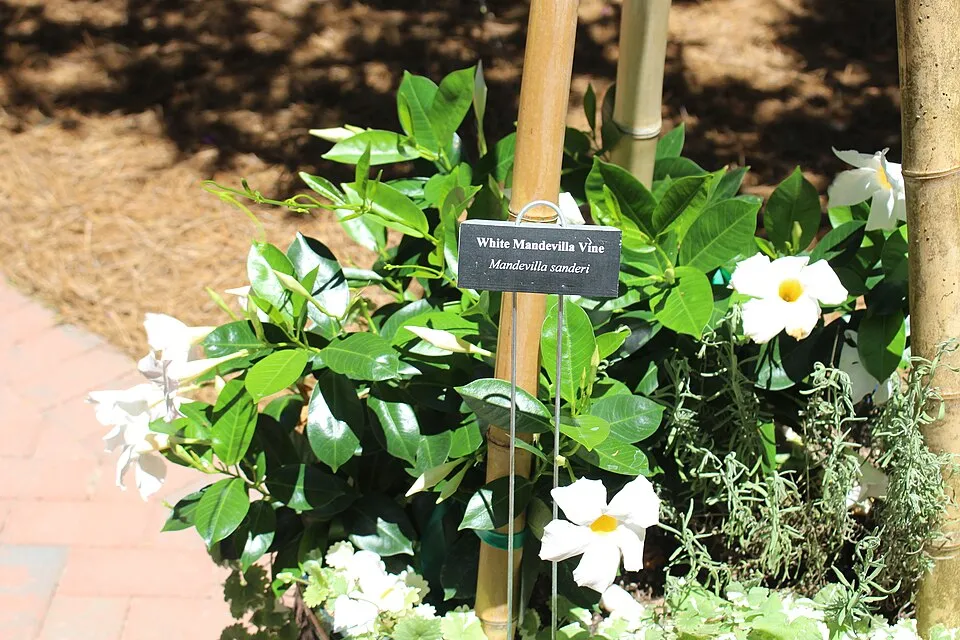
Mandevilla sanderi, commonly known in horticulture as Dipladenia or Brazilian Jasmine, is a captivating perennial vine belonging to the Apocynaceae family, native to the tropical and subtropical regions of South America, particularly Brazil. This species is renowned for its striking ornamental appeal, characterized by a vigorous, twining growth habit that can reach impressive lengths, often requiring structural support like trellises or arbors to showcase its full splendor. The foliage consists of glossy, dark green, ovate to elliptical leaves, typically arranged oppositely along the stems and measuring approximately 4 to 8 inches in length.
Its most celebrated feature is the profusion of large, trumpet-shaped, five-petaled flowers, which bloom from spring through fall. These vibrant blossoms commonly appear in shades of pink, white, or red, often with a contrasting yellow throat, and are highly attractive to various pollinators, including hummingbirds, bees, and butterflies. While Mandevilla sanderi is distinctly a climbing vine, it is frequently confused with or marketed alongside shrub-like cultivars also broadly termed 'Dipladenia,' which share similar floral characteristics but exhibit a more compact, upright growth.
This plant thrives in well-drained, organically rich soils and prefers warm, humid conditions with ample sunlight, though it can exhibit some adaptability to drier climates once established.
Trusted Scientific References
1. Authoritative external sources for Mandevilla sanderi Garden
1.1 Wikipedia — Mandevilla sanderi Garden
1.2 Kew POWO (Plants of the World Online)
1.3 PubMed — peer-reviewed research
1.4 NCBI Taxonomy Browser
1.5 GBIF — Global Biodiversity
1.6Dipladenia Garden should be interpreted through verified botanical identity, practical care, and responsible safety language. This recovery note adds the missing context needed for a complete profile: match light to the plant's habit, use well-drained soil, water according to season, and avoid unsupported medicinal or edible claims. For publishing, the plant can be presented as a source-backed garden plant with clear care guidance, common problem diagnosis, and conservative safety wording.
1.1.Dipladenia Garden — Standout Qualities
- ✓Vining Growth Habit — A strong climber that twines around supports, ideal for vertical garden displays.
- ✓Showy Trumpet Flowers — Large, vibrant blooms in pink, red, or white, with a prolonged flowering season.
- ✓Glossy Dark Green Foliage — Attractive, leathery leaves provide a lush backdrop to the flowers.
- ✓Pollinator Attractor — Flowers draw hummingbirds, bees, and butterflies, enhancing garden biodiversity.
- ✓Tropical Origin — Native to South America, thriving in warm, humid conditions.
- ✓Container Adaptability — Excellent for pots, hanging baskets, and patio decoration.
- ✓Tender Perennial — Can be overwintered indoors in cooler climates or grown as an annual.
- ✓Milky Sap — Contains a latex sap that can be irritating to skin and mucous membranes.
- ✓Ornamental Primary Use — Valued almost exclusively for its aesthetic contribution to landscapes.
- ✓Apocynaceae Family Member — Shares characteristics with other plants in this diverse botanical family.
1.2.Dipladenia Garden — Quick Summary
- ✓Mandevilla sanderi is a vibrant, tropical vining plant, widely known as Dipladenia, prized for its ornamental value.
- ✓Produces showy, trumpet-shaped flowers in pink, red, or white, attracting pollinators from spring to fall.
- ✓Belongs to the Apocynaceae family, characterized by glossy foliage and a milky sap that can cause skin irritation.
- ✓Requires full sun, well-drained soil, and support for its climbing habit; often treated as an annual in colder climates.
- ✓Contains alkaloids, flavonoids, and saponins, with potential but unverified traditional medicinal uses in related species.
- ✓Caution is advised due to potential toxicity from ingestion and skin irritation from sap; primarily for external ornamental enjoyment.
2.Dipladenia Garden — Scientific Profile
3.Dipladenia Garden — Quick Facts
4.Dipladenia Garden — Morphological Account
5.Dipladenia Garden — Where It Grows
6.Dipladenia Garden — Ethnobotanical Uses
7.Dipladenia Garden — Bioactive Constituents
- ✓Alkaloids — Various indole alkaloids, characteristic of the Apocynaceae family, are present, potentially contributing to the plant's defense mechanisms and exhibiting diverse pharmacological activities, some of which may be potent.
- ✓Flavonoids — A rich array of flavonoids, including flavonol glycosides like quercetin and kaempferol derivatives, are found, primarily responsible for the plant's antioxidant, anti-inflammatory, and pigmentary properties.
- ✓Saponins — Triterpenoid saponins are identified, contributing to the plant's emulsifying and foaming properties, and in some species, demonstrating immunomodulatory or hypocholesterolemic effects.
- ✓Phenolic Acids — Compounds such as caffeic acid, chlorogenic acid, and p-coumaric acid are detected, acting as significant antioxidants and contributing to the plant's overall protective phytochemical profile.
- ✓Terpenoids — Both mono- and sesquiterpenoids are present, often responsible for the plant's aromatic qualities and contributing to its defense against herbivores and pathogens.
- ✓Cardiac Glycosides — While not extensively quantified for Mandevilla sanderi, this class of compounds is characteristic of the Apocynaceae family and can exert significant effects on cardiac muscle, necessitating careful handling.
- ✓Phytosterols — Beta-sitosterol and stigmasterol are common plant sterols found, known for their potential to lower cholesterol and exhibit anti-inflammatory properties.
- ✓Tannins — Hydrolyzable and condensed tannins are likely present, contributing to astringent properties and offering protective effects against oxidative stress and microbial activity.
8.Dipladenia Garden — Modern Studies
- ✓Ornamental Value — Primarily cultivated for its aesthetic appeal, Mandevilla sanderi enhances gardens, patios, and landscapes with its vibrant, long-lasting blooms, contributing to mental well-being through horticultural therapy.
- ✓Potential Antioxidant Properties — The presence of flavonoids suggests Mandevilla sanderi may offer antioxidant effects, helping to neutralize free radicals and protect cells from oxidative damage, a common mechanism in many plant-derived compounds.
- ✓Hypothetical Anti-inflammatory Effects — Saponins and certain flavonoids found in the plant's chemical profile are often associated with anti-inflammatory activity in other botanical species, though specific research on Mandevilla sanderi is limited.
- ✓Traditional Analgesic Use (Related Species) — While not directly attributed to Mandevilla sanderi, some related Mandevilla species have been traditionally used for pain relief, suggesting a potential area for future pharmacological investigation.
- ✓Antimicrobial Potential (Exploratory) — Alkaloids and other secondary metabolites common in the Apocynaceae family can exhibit antimicrobial properties, potentially inhibiting the growth of certain bacteria or fungi in in vitro studies.
- ✓Cardiotonic Activity (Family Trait) — The Apocynaceae family is known for producing cardiac glycosides, which can influence heart function; however, the presence and safety of such compounds in Mandevilla sanderi for therapeutic use require extensive validation.
- ✓Diuretic Action (Traditional Context) — In some traditional medicine systems utilizing plants from this genus, diuretic effects have been reported, which could be attributed to certain saponins or flavonoids promoting urine excretion.
- ✓Wound Healing Support (Traditional Inference) — Based on ethnomedicinal uses of other Mandevilla species for skin conditions and wound care, Mandevilla sanderi might possess compounds that aid in tissue regeneration or provide antiseptic benefits.
- ✓Insect Attractant for Pollinators — The plant's showy flowers and nectar production are highly effective in attracting beneficial pollinators, playing a vital ecological role in garden ecosystems.
- ✓Air Purification (General Plant Benefit) — Like many plants, Mandevilla sanderi contributes to local air quality by absorbing carbon dioxide and releasing oxygen, enhancing the immediate environment.
8.1.Dipladenia Garden — Conditions Traditionally Used For
9.Dipladenia Garden — Risk Profile
9.1.Dipladenia Garden — Warnings
- ✓Skin Irritation — The milky sap characteristic of Mandevilla sanderi and the Apocynaceae family can cause skin irritation or allergic reactions upon contact, leading to redness, itching, or dermatitis.
- ✓Gastrointestinal Upset — Ingestion of any part of the plant can lead to gastrointestinal distress, including nausea, vomiting, and diarrhea, due to potentially toxic compounds.
- ✓Cardiac Toxicity (Potential) — As a member of the Apocynaceae family, Mandevilla sanderi may contain cardiac glycosides, which can be cardiotoxic if ingested, affecting heart rhythm and function.
- ✓Allergic Reactions — Individuals sensitive to plants in the Apocynaceae family may experience allergic symptoms beyond skin irritation, such as respiratory issues, if exposed to plant particles.
- ✓Unknown Long-term Effects — Due to limited research on its medicinal properties and safety, the long-term effects of exposure or ingestion are largely unknown and potentially hazardous.
- ✓Toxicity to Pets and Livestock — The plant is considered toxic to animals if ingested, potentially causing severe health issues or fatalities, requiring careful placement away from pets.
9.2.Dipladenia Garden — Clinical Safety Notes
- ✓Strictly Ornamental — Mandevilla sanderi is primarily cultivated as an ornamental plant; it is not recommended for internal consumption or self-medication due to potential toxicity.
- ✓Avoid Ingestion — Keep all parts of the plant away from children, pets, and livestock to prevent accidental ingestion, which can lead to serious health consequences.
- ✓Handle with Care — Wear gloves when pruning or handling the plant to avoid skin contact with the milky sap, which can cause irritation or allergic reactions.
- ✓Consult Professionals — If considering any traditional or unverified medicinal use, always consult a qualified healthcare professional or medical herbalist first.
- ✓Research Limitations — The specific medicinal properties and safety profile of Mandevilla sanderi are not extensively studied or scientifically validated; exercise extreme caution.
- ✓Symptoms of Poisoning — Seek immediate medical attention if ingestion is suspected or if symptoms like nausea, vomiting, diarrhea, or cardiac irregularities occur after contact.
10.Dipladenia Garden — Application Forms
- ✓Ornamental Landscaping — Primarily utilized as an attractive climbing vine for garden beds, pergolas, fences, and walls, providing vibrant color and tropical ambiance.
- ✓Container Planting — Ideal for pots, hanging baskets, and mixed containers, especially for patios and balconies where its vining or cascading habit can be showcased.
- ✓Trellis Training — Guide young stems onto trellises or stakes to encourage upward growth and create a striking vertical display of flowers and foliage.
- ✓Ground Cover (Limited) — Can be allowed to sprawl as a ground cover in frost-free zones, though its vining nature is typically better managed with support.
- ✓Traditional External Poultice (Hypothetical) — In traditional practices for related species, crushed leaves or roots might be prepared as a poultice for external application on minor skin irritations or wounds, though specific efficacy for M. sanderi is unverified.
- ✓Traditional Decoction (Hypothetical Internal) — If internal use were considered based on related species, a decoction of root or leaf material might be prepared, but this is not recommended for M. sanderi due to unknown toxicity and lack of scientific validation.
- ✓Repotting — Repot container plants annually or biennially into a slightly larger pot with fresh potting mix to refresh nutrients and provide root space.
11.Dipladenia Garden — Propagation & Care
- ✓Sunlight — Ensure at least 6 hours of direct sunlight daily for optimal flowering; partial shade is beneficial in extremely hot climates to prevent leaf scorching.
- ✓Soil — Plant in well-drained, organically rich soil that retains consistent moisture but avoids waterlogging; a slightly acidic to neutral pH is preferred.
- ✓Watering — Maintain consistent soil moisture, especially for container-grown plants; allow the top inch of soil to dry slightly between waterings, but never let it completely dry out.
- ✓Support Structure — Provide a sturdy trellis, arbor, or other support for this climbing vine to twine around, encouraging vertical growth and abundant blooms.
- ✓Fertilization — Feed actively growing plants every 2-4 weeks with a balanced, water-soluble fertilizer formulated for flowering plants to support continuous blooming.
- ✓Pruning — Prune to shape the plant, remove spent flowers, and encourage new growth, as Mandevilla sanderi flowers on new wood; it tolerates heavy pruning well.
- ✓Overwintering — In frost-prone regions, treat as an annual or overwinter indoors as a houseplant by reducing water and light, then restarting growth in spring.
- ✓Pest Management — Monitor for common pests like spider mites, mealybugs, and aphids, treating with insecticidal soap or horticultural oil as needed.
Reviewed by the Flora Medical Global Botanical Review Panel
Multi-disciplinary editorial group · Botany · Ethnobotany · Herbal-medicine literature
Who reviewed this: This page was checked by the Flora Medical Global Botanical Review Panel — an in-house editorial group of botany graduates, ethnobotany researchers, and horticulture practitioners who collectively maintain our 7,000+ plant encyclopedia. Meet the team.
Our 4-step verification process
1. Taxonomic verification
Scientific names and synonyms cross-checked against Kew POWO, World Flora Online, and The Plant List.
2. Phytochemical & medicinal cross-reference
Active compounds, traditional uses, and reported activities are cross-referenced with PubMed, USDA Dr. Duke's database, and peer-reviewed ethnobotanical literature.
3. Conservation & distribution check
Distribution, ecology, and conservation status confirmed against GBIF occurrence records and the IUCN Red List.
4. Editorial & safety review
Every entry passes an editorial pass for clarity, originality, and safety notices (toxicity, contraindications, dosage caveats) before publication.
Last reviewed:
Important medical disclaimer: This content is for educational and research purposes only. It is not medical advice and is not a substitute for consultation with a licensed healthcare provider. Do not use any herb to self-treat a medical condition without professional guidance.
Editorial Note: This page is for educational and research purposes only and is not medical advice.
Written by: Flora Medical Global Editorial Team
Reviewed by: Flora Medical Global Botanical Review Panel
Last Updated: June 15, 2026





Dipladenia Garden — Comments & Community Reviews
Rate this plant