
Medical Disclaimer: This content is for educational purposes only. It is not medical advice. Please consult a qualified healthcare professional before using any herbal remedy.
Safety Overview
1.Dirca Palustris — Essential Profile
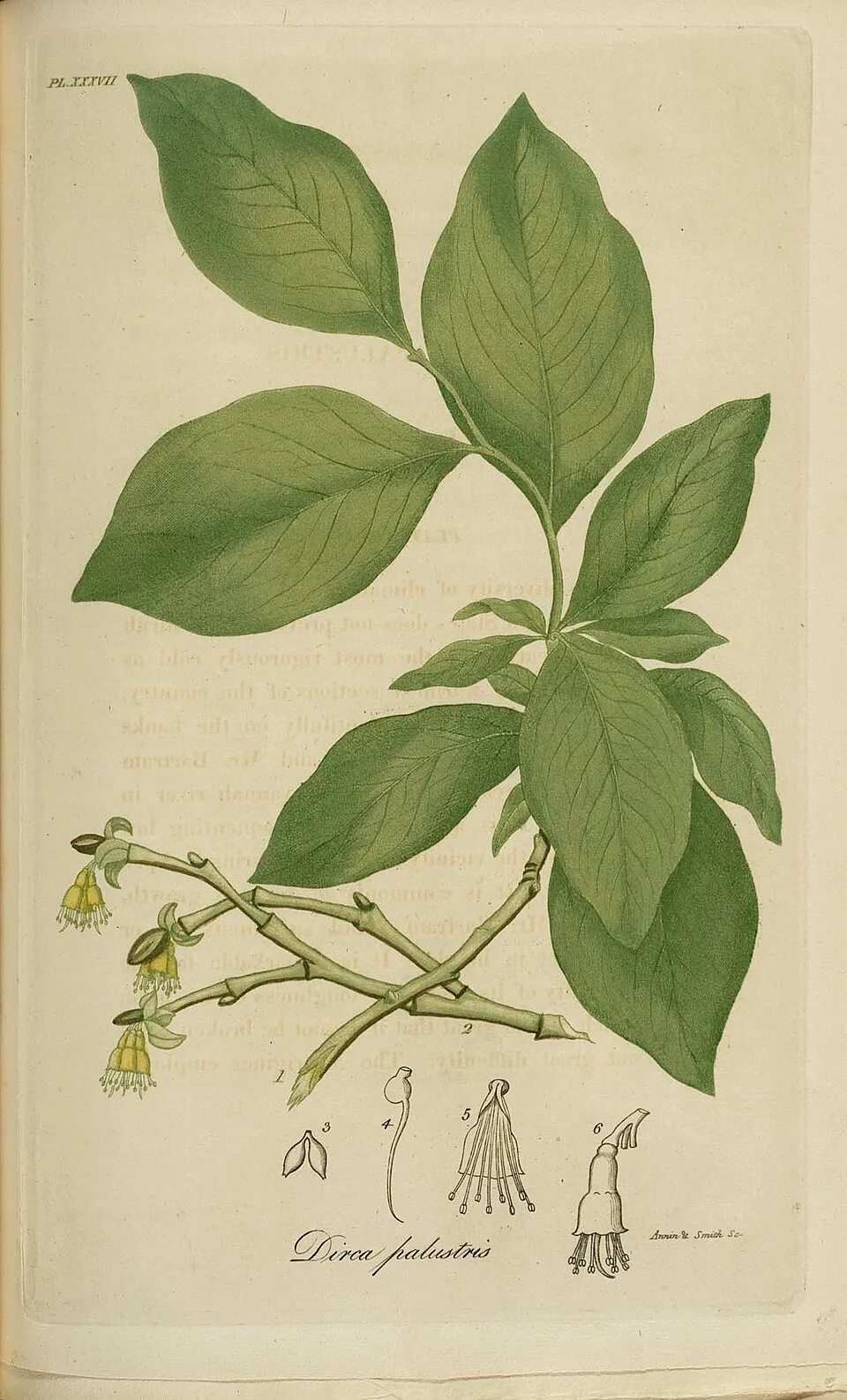
Dirca palustris, universally known as Eastern Leatherwood, is a distinctive and resilient deciduous shrub indigenous to the rich, moist understories of woodlands and floodplains throughout eastern North America, spanning from Canada to the southeastern United States. This fascinating member of the Thymelaeaceae family, which also encompasses the genus Daphne, is recognized for its unique morphological attributes and significant ecological contributions. Typically growing to a height of 1 to 2 meters, though occasionally reaching taller dimensions, its slow growth rate contributes to its impressive longevity within its natural habitat.
The leaves are simple, alternately arranged, and broadly oval to elliptical, measuring up to 10 cm in length. They feature a smooth, entire margin and a noticeable petiole, emerging as a vibrant, glossy light green in spring, maturing to a deeper attractive green, and finally transforming into a brilliant yellow in autumn, adding considerable ornamental appeal.
The most remarkable characteristic of Dirca palustris is its exceptionally flexible and pliable stems. These are enveloped by a thin, grayish-brown bark that exfoliates in narrow, tough strips, a feature that inspired its common name, 'Leatherwood.' Despite its apparent thinness, this bark possesses extraordinary tensile strength, a property historically valued by indigenous peoples for practical non-medicinal applications such as tying and crafting rudimentary cordage. The plant develops a shallow, fibrous root system that effectively stabilizes soil, particularly in its preferred moist environments.
In early spring, often before the leaves fully unfurl, Dirca palustris produces small, bell-shaped, pale yellow flowers. These hermaphroditic blooms are borne in clusters of two to four at the nodes, emitting a subtle fragrance that attracts early-season pollinators like solitary bees and flies, thus playing a crucial role in the ecosystem. By late summer, these flowers develop into small, ellipsoidal drupes, initially green and later ripening to a pale greenish-yellow.
It is important to note that these fruits are not considered palatable for human consumption due to their acrid taste and inherent toxicity.
Trusted Scientific References
1. Authoritative external sources for Dirca palustris
1.1 Wikipedia — Dirca palustris
1.2 Kew POWO (Plants of the World Online)
1.3 PubMed — peer-reviewed research
1.4 NCBI Taxonomy Browser
1.5 GBIF — Global Biodiversity
1.1.Dirca Palustris — Distinguishing Points
- ✓Common Names — Leatherwood, Leatherbark, Wicopy.
- ✓Family — Thymelaeaceae, known for flexible bark.
- ✓Habitat — Rich, moist woodlands, floodplains of eastern North America.
- ✓Bark — Highly flexible, pliable, grayish-brown, peeling in tough strips.
- ✓Leaves — Simple, alternate, oval to elliptical, turning bright yellow in autumn.
- ✓Flowers — Small, pale yellow, bell-shaped, appearing in early spring before leaves.
- ✓Fruits — Small, ellipsoidal drupes, ripening greenish-yellow, and toxic.
- ✓Growth — Slow-growing, long-lived deciduous shrub, reaching 1-2 meters.
- ✓Toxicity — Fruits, roots, and bark are toxic; bark can cause contact dermatitis.
- ✓Ethnobotanical Use — Bark historically used by Native Americans for cordage.
1.2.Dirca Palustris — Quick Summary
- ✓Native deciduous shrub known as Eastern Leatherwood.
- ✓Unique flexible bark historically used for cordage.
- ✓Flowers in early spring, before leaves, attracting pollinators.
- ✓Fruits and roots are toxic, causing irritation and gastrointestinal distress.
- ✓Primarily valued for ornamental and ecological benefits, not medicinal.
- ✓Requires moist, shady woodland conditions for optimal growth.
2.Dirca Palustris — Scientific Identity
3.Dirca Palustris — Vital Statistics
4.Dirca Palustris — Physical Description
5.Dirca Palustris — Origin & Spread
6.Dirca Palustris — Traditional Uses
7.Dirca Palustris — Phytochemistry
- ✓Flavonoids — Compounds like quercetin and kaempferol derivatives are likely present, contributing to antioxidant activity and plant pigmentation, although specific roles in Dirca palustris are not well-studied.
- ✓Coumarins — Possible presence of simple coumarins which can have various biological activities, including anticoagulant and photosensitizing effects, often found in the Thymelaeaceae family.
- ✓Diterpenoids — This family is known for producing irritant and toxic diterpenoids, such as daphnane-type orthoesters, which are responsible for the plant's acrid taste and skin irritation properties.
- ✓Tannins — Astringent compounds, potentially in the bark, contributing to its durability and resistance to decay, and historically used in tanning processes.
- ✓Saponins — Possible occurrence of triterpenoid saponins, which can cause irritation and foaming, contributing to the plant's toxicity.
- ✓Polysaccharides — Structural carbohydrates in the cell walls, contributing to the plant's robust and flexible bark structure.
- ✓Fatty Acids — Essential components of plant membranes and energy storage, present in seeds and other plant tissues.
- ✓Volatile Organic Compounds — Responsible for the subtle fragrance of the flowers, attracting early pollinators.
- ✓Alkaloids — While less common in Thymelaeaceae, trace amounts of nitrogenous compounds cannot be entirely ruled out without specific phytochemical analysis.
8.Dirca Palustris — Scientific Evidence
- ✓Bark Pliability — Historically valued by Indigenous peoples for crafting robust cordage and tying materials, highlighting its unique tensile strength and flexibility for non-medicinal applications.
- ✓Ecological Nectar Source — Provides vital early spring nectar for pollinators such as solitary bees and flies, supporting local biodiversity and ecosystem health.
- ✓Soil Stabilization — Its extensive shallow, fibrous root system plays an important role in preventing soil erosion, particularly in its native moist woodland habitats.
- ✓Ornamental Value — Offers significant aesthetic appeal through its vibrant light green spring foliage, deep green summer leaves, and striking yellow fall color, suitable for native plant landscaping.
- ✓Potential Bioactive Compound Research — As a member of the Thymelaeaceae family, it may contain novel chemical compounds that could be investigated for non-ingestive applications, such as in material science or as natural pesticides, rather than direct human consumption.
- ✓Habitat Indicator Species — The presence of Dirca palustris often indicates a healthy, rich, and moist woodland ecosystem, serving as a valuable ecological marker.
- ✓Wildlife Food Source (Limited) — While toxic to humans, its fruits may contribute to the diet of certain birds and small mammals, fulfilling a specific niche in the local food web.
- ✓Botanical Education — Its distinctive features, like the 'leatherwood' bark and unique growth habit, make it an intriguing subject for botanical study and educational purposes.
- ✓Conservation Interest — As a native and somewhat rare shrub, it is a subject of interest for conservation efforts aimed at preserving eastern North American woodland biodiversity.
- ✓Traditional Craft Material — Beyond simple cordage, the bark's durable and flexible properties could have inspired a range of historical craft uses, demonstrating its versatility as a natural resource.
8.1.Dirca Palustris — Reported Uses
9.Dirca Palustris — Safety Considerations
9.1.Dirca Palustris — Caution Notes
- ✓Contact Dermatitis — Direct skin exposure to the bark can cause irritation and allergic reactions in sensitive individuals.
- ✓Gastrointestinal Distress — Ingestion of fruits, roots, or other plant parts can lead to symptoms such as nausea, vomiting, abdominal pain, and diarrhea due to their toxic compounds.
- ✓Oral Irritation — The acrid taste and irritant compounds can cause burning sensations and irritation in the mouth and throat upon ingestion.
- ✓Systemic Toxicity — While generally considered low severity, large quantities ingested could potentially lead to more serious systemic effects.
- ✓Allergic Reactions — Beyond contact dermatitis, individuals may experience other allergic responses to pollen or plant compounds.
- ✓Avoidance of Children and Pets — Due to its toxic nature, Dirca palustris should be planted in areas inaccessible to curious children and pets.
9.2.Dirca Palustris — Risk Assessment
- ✓Ingestion is Toxic — All parts of Dirca palustris, particularly the fruits and roots, are considered toxic and should never be ingested by humans or pets.
- ✓Skin Irritant — Direct contact with the bark can cause contact dermatitis; wearing gloves is recommended when handling the plant.
- ✓Not for Medicinal Use — Due to its inherent toxicity and lack of established therapeutic benefits, Dirca palustris is not suitable for any form of medical herbalism or self-medication.
- ✓Handle with Caution — Exercise care when pruning or working with the plant to avoid contact with sap or broken tissues.
- ✓Educate Others — Inform individuals, especially children, about the plant's toxic nature and the importance of not consuming its parts.
- ✓Emergency Protocol — In case of accidental ingestion or severe skin reaction, seek immediate medical attention and consult a poison control center.
- ✓Keep Away from Livestock — Ensure that grazing animals do not have access to Dirca palustris, as it can be harmful to them.
10.Dirca Palustris — Usage Guide
- ✓Ornamental Planting — Primarily used as an attractive native shrub in shade gardens, woodland borders, or naturalized areas for its unique form and fall color.
- ✓Ethnobotanical Crafting — Historically, the tough, pliable bark was utilized by Native Americans for making cordage, ties, and baskets due to its exceptional strength.
- ✓Ecological Restoration — Employed in native plant restoration projects to stabilize soil and enhance biodiversity in woodland ecosystems.
- ✓Wildlife Habitat Enhancement — Planted to provide early spring nectar for pollinators and, to a limited extent, fruits for certain wildlife species.
- ✓Botanical Study — Used in botanical gardens and educational institutions for research and demonstration of native flora.
- ✓Safe Handling — Due to potential skin irritation and toxicity, always wear gloves when handling the bark or other plant parts, and avoid ingestion.
- ✓Non-Medicinal Application — Emphatically, Dirca palustris is not recommended for any internal medicinal use due to its inherent toxicity.
11.Dirca Palustris — Cultivation & Care
- ✓Site Selection — Prefers partial to full shade, mimicking its natural understory habitat in rich, moist woodlands.
- ✓Soil Requirements — Thrives in humus-rich, well-drained to moist soils, ideally with a slightly acidic to neutral pH, often found on calcareous or mafic rock formations.
- ✓Watering — Requires consistently moist soil, especially during establishment; avoid waterlogging but ensure adequate hydration.
- ✓Propagation — Can be propagated by seed, though germination can be slow and erratic, or by careful division of suckers from established plants.
- ✓Growth Rate — Known for its slow growth, requiring patience for significant development, but rewarding with longevity.
- ✓Maintenance — Generally low maintenance, requiring minimal pruning to remove dead or damaged branches; avoid heavy fertilization.
- ✓Pest and Disease Resistance — Shows good resistance to most common pests and diseases, contributing to its hardiness in native settings.
Reviewed by the Flora Medical Global Botanical Review Panel
Multi-disciplinary editorial group · Botany · Ethnobotany · Herbal-medicine literature
Who reviewed this: This page was checked by the Flora Medical Global Botanical Review Panel — an in-house editorial group of botany graduates, ethnobotany researchers, and horticulture practitioners who collectively maintain our 7,000+ plant encyclopedia. Meet the team.
Our 4-step verification process
1. Taxonomic verification
Scientific names and synonyms cross-checked against Kew POWO, World Flora Online, and The Plant List.
2. Phytochemical & medicinal cross-reference
Active compounds, traditional uses, and reported activities are cross-referenced with PubMed, USDA Dr. Duke's database, and peer-reviewed ethnobotanical literature.
3. Conservation & distribution check
Distribution, ecology, and conservation status confirmed against GBIF occurrence records and the IUCN Red List.
4. Editorial & safety review
Every entry passes an editorial pass for clarity, originality, and safety notices (toxicity, contraindications, dosage caveats) before publication.
Last reviewed:
Important medical disclaimer: This content is for educational and research purposes only. It is not medical advice and is not a substitute for consultation with a licensed healthcare provider. Do not use any herb to self-treat a medical condition without professional guidance.
Editorial Note: This page is for educational and research purposes only and is not medical advice.
Written by: Flora Medical Global Editorial Team
Reviewed by: Flora Medical Global Botanical Review Panel
Last Updated: June 15, 2026





Dirca Palustris — Comments & Community Reviews
Rate this plant