
Medical Disclaimer: This content is for educational purposes only. It is not medical advice. Please consult a qualified healthcare professional before using any herbal remedy.
Safety Overview
1.Echeveria Elegans Garden — Essential Profile
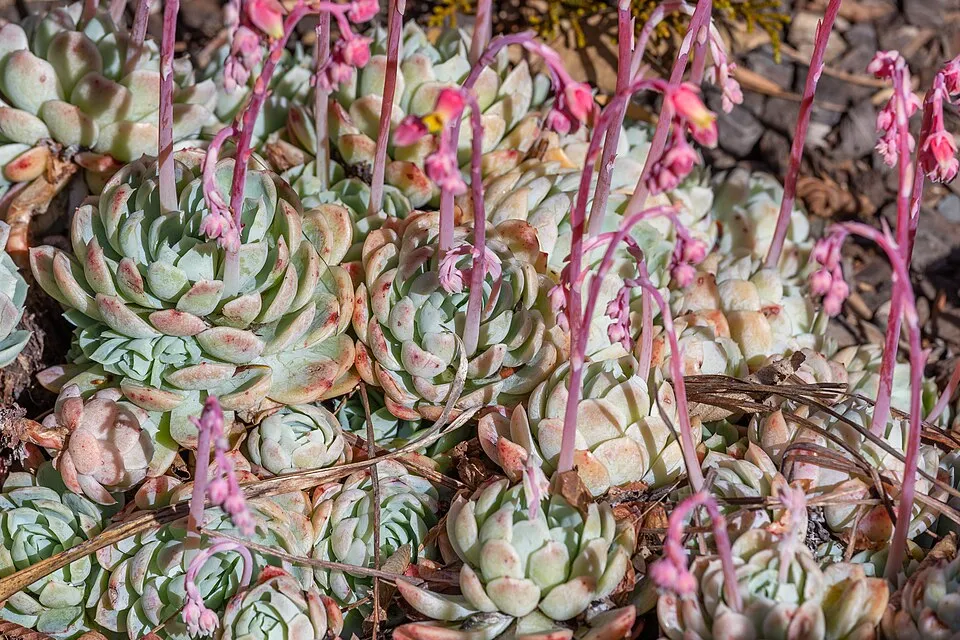
Echeveria elegans, commonly known as Mexican Gem, Mexican Ghost Plant, Mexican Hens and Chicks, or White Mexican Rose, is a stunning perennial succulent belonging to the Crassulaceae family. Native to the arid and semi-arid regions of Northeastern Mexico, this captivating plant forms compact rosettes of thick, spoon-shaped, pale green to glaucous blue-green leaves. These leaves often develop attractive pink, purple, or peachy-white tinges along their margins or tips, especially when exposed to ample sunlight or cooler temperatures.
The plant typically grows in clumps, producing numerous offsets or 'pups' around the base, creating a dense, mat-forming habit. From late winter through summer, Echeveria elegans sends up slender, arching flower stalks, reaching modest heights, adorned with delicate, bell-shaped flowers that display vibrant hues of pink, coral, or yellow. Each flower measures approximately 1-2 centimeters.
Adapted to its native sub-tropical environment, it thrives in well-drained, gritty soils and prefers full sun to partial shade, demonstrating remarkable drought tolerance. While primarily celebrated globally as an ornamental houseplant, a focal point in rock gardens, or a distinctive container specimen, its robust nature and appealing aesthetics make it a garden favorite in suitable climates.
Trusted Scientific References
1. Authoritative external sources for Echeveria Elegans Garden
1.1 Wikipedia — Echeveria Elegans Garden
1.2 Kew POWO (Plants of the World Online)
1.3 PubMed — peer-reviewed research
1.4 NCBI Taxonomy Browser
1.5 GBIF — Global Biodiversity
1.6Echeveria Elegans Garden should be interpreted through verified botanical identity, practical care, and responsible safety language. This recovery note adds the missing context needed for a complete profile: match light to the plant's habit, use well-drained soil, water according to season, and avoid unsupported medicinal or edible claims. For publishing, the plant can be presented as a source-backed garden plant with clear care guidance, common problem diagnosis, and conservative safety wording.
1.1.Echeveria Elegans Garden — Notable Characteristics
- ✓Rosette — forming perennial succulent with fleshy leaves.
- ✓Native to the arid and semi — arid regions of Northeastern Mexico.
- ✓Leaves display pale green to glaucous blue — green hues, often with pinkish tips.
- ✓Produces slender flower stalks with delicate, bell — shaped pink or coral flowers.
- ✓Highly drought — tolerant and adapted to low-water conditions.
- ✓Popular as an — Popular as an ornamental houseplant, in rock gardens, or container arrangements.
- ✓Propagates easily from — Propagates easily from leaf cuttings, stem cuttings, or offsets (pups).
- ✓Prefers bright, indirect — Prefers bright, indirect light to full sun and extremely well-drained soil.
- ✓Traditionally recognized in — Traditionally recognized in folk medicine for potential anti-inflammatory and cooling effects.
- ✓Generally considered non — toxic to common household pets.
1.2.Echeveria Elegans Garden — At-a-Glance Summary
- ✓Echeveria elegans is a popular rosette-forming succulent native to Northeastern Mexico.
- ✓Valued globally for its striking ornamental appeal in gardens and as a houseplant.
- ✓Traditionally noted for potential anti-inflammatory, cooling, diuretic, and digestive properties.
- ✓Thrives in well-drained soil, bright light, and is highly drought-tolerant.
- ✓Considered non-toxic for common pets, making it a safe choice for homes.
- ✓Medicinal efficacy and specific chemical constituents require further scientific research.
2.Echeveria Elegans Garden — Nomenclature & Classification
3.Echeveria Elegans Garden — Vital Statistics
4.Echeveria Elegans Garden — Botanical Description
5.Echeveria Elegans Garden — Origin & Spread
6.Echeveria Elegans Garden — Folk Medicine Applications
7.Echeveria Elegans Garden — Key Phytochemicals
- ✓Flavonoids — Compounds like quercetin and kaempferol are potentially present, known for their antioxidant, anti-inflammatory, and protective cellular activities.
- ✓Triterpenoids — These secondary metabolites, common in many succulents, may contribute to the plant's defense mechanisms and could possess anti-inflammatory properties.
- ✓Phenolic Acids — Such as caffeic acid and ferulic acid, which are potent antioxidants that help neutralize free radicals and support overall plant health.
- ✓Mucilage — A polysaccharide gel found in succulent leaves, providing demulcent and soothing properties, often associated with skin and digestive benefits.
- ✓Organic Acids — Including malic acid, a key component in Crassulacean Acid Metabolism (CAM) photosynthesis, which helps the plant efficiently store carbon dioxide.
- ✓Phytosterols — Plant sterols like beta-sitosterol may be present, known for their potential to support healthy inflammatory responses.
- ✓Saponins — Glycosides that can exhibit surfactant properties and various biological activities, though their specific role in Echeveria elegans requires further investigation.
- ✓Anthocyanins — Pigments responsible for the pink or purple coloration in leaves, offering additional antioxidant benefits and UV protection.
8.Echeveria Elegans Garden — Pharmacological Findings
- ✓Anti-inflammatory Support — Traditionally, in Ayurvedic practices, Echeveria elegans has been utilized in decoctions for its reputed anti-inflammatory properties, aiming to soothe various internal and external inflammations.
- ✓Cooling Properties — Traditional Chinese Medicine (TCM) regards this succulent for its 'cooling' energetic properties, suggesting its use to help alleviate conditions associated with excess heat, such as fevers.
- ✓Diuretic Effects — Historically, the plant has been noted for its mild diuretic action, potentially assisting the body in expelling excess fluids and supporting urinary tract health when consumed as an infusion.
- ✓Digestive Aid — Unani practitioners have valued Echeveria elegans for its reputed benefits in promoting digestive comfort, often recommending it as a gentle aid for indigestion due to its subtle aromatic qualities.
- ✓Skin Soothing — Applied topically in some folk traditions, crushed leaves or extracts have been used to calm irritated skin, reduce redness, and provide a soothing effect on minor abrasions.
- ✓Antioxidant Potential — While specific research is limited, many succulents contain phenolic compounds and flavonoids, which contribute to antioxidant activity that may protect cells from oxidative stress.
- ✓Hydration Support — As a succulent, its water-rich leaves could traditionally be consumed in small quantities to provide hydration, particularly in arid regions where water sources are scarce.
- ✓Minor Wound Healing — Building on its traditional skin-soothing applications, some folk practices suggest its mucilaginous content may contribute to the gentle support of minor cuts and scrapes.
8.1.Echeveria Elegans Garden — Therapeutic Indications
9.Echeveria Elegans Garden — Cautions & Contraindications
9.1.Echeveria Elegans Garden — Caution Notes
- ✓Allergic Reactions — Rare, but individuals sensitive to plants in the Crassulaceae family may experience mild skin irritation or contact dermatitis upon direct contact with the sap.
- ✓Gastrointestinal Upset — While generally considered non-toxic, ingestion of large quantities could potentially lead to mild digestive discomfort, such as nausea or stomach upset, in sensitive individuals.
- ✓Skin Sensitivity — Direct exposure to plant juices might cause temporary redness or itching in predisposed individuals, particularly with prolonged contact.
- ✓Contamination Risk — If plant material is sourced from unknown origins or wild-harvested, there is a risk of pesticide residues or environmental pollutants.
- ✓Drug Interactions — Hypothetically, large doses used medicinally could interfere with diuretic or anti-inflammatory medications, though specific data is currently lacking.
9.2.Echeveria Elegans Garden — Risk Assessment
- ✓Generally Non-Toxic — Echeveria elegans is widely recognized as non-toxic for common household pets, including dogs, cats, and horses, making it a safe ornamental choice.
- ✓Limited Human Research — There is insufficient scientific evidence from human clinical trials to definitively establish the safety and efficacy of Echeveria elegans for medicinal purposes.
- ✓Pregnancy and Lactation — Due to the lack of comprehensive safety data, internal use is not recommended for pregnant or breastfeeding individuals without explicit medical advice.
- ✓Children — Exercise caution with any internal administration in children; topical application should be patch-tested on a small area of skin first.
- ✓Consultation Recommended — Always consult with a qualified healthcare professional or experienced herbalist before using Echeveria elegans for medicinal applications, especially if you have pre-existing health conditions or are on medication.
- ✓Quality Assurance — Ensure any plant material intended for internal use is organically grown and verified free from pesticides, herbicides, or heavy metal contamination.
10.Echeveria Elegans Garden — Preparation Methods
- ✓Decoction — Traditionally prepared by simmering fresh or dried leaves in water for 10-15 minutes, used for its reputed anti-inflammatory effects.
- ✓Herbal Infusion — Dried leaves steeped in hot water for 5-10 minutes to create a mild tea, often consumed for its traditional cooling or diuretic properties.
- ✓Topical Poultice — Crushed fresh leaves applied directly to the skin as a poultice, traditionally used to soothe irritations, minor burns, or insect bites.
- ✓Tincture — While less common, a hydro-alcoholic extract could be prepared from the leaves, allowing for concentrated internal use under professional guidance.
- ✓Juiced Extract — Fresh leaves might be juiced in some traditional practices for immediate consumption, particularly for digestive support or general wellness.
- ✓Ornamental Display — Primarily cultivated for its aesthetic appeal in gardens, containers, and indoor settings, requiring no specific preparation for this use.
- ✓Infused Oil — Leaves could potentially be infused into a carrier oil (e.g., olive oil) for topical application as a soothing balm, though this is not a widely documented traditional method.
11.Echeveria Elegans Garden — Garden Cultivation
- ✓Soil Requirements — Prefers extremely well-drained soil; use a specialized succulent or cactus potting mix to prevent root rot.
- ✓Light Exposure — Thrives in full sun to partial shade, requiring at least 6 hours of bright, indirect light daily for vibrant coloration and compact growth.
- ✓Watering Schedule — Water sparingly and deeply, allowing the soil to dry out completely between waterings; overwatering is the most common cause of decline.
- ✓Temperature and Humidity — Best suited for sub-tropical climates; protect from frost and temperatures below 5°C (41°F); tolerates average household humidity.
- ✓Propagation — Easily propagated from leaf cuttings, stem cuttings, or by dividing the offsets ('pups') that naturally form around the mother plant's base.
- ✓Container Growing — Excellent choice for shallow containers, terrariums, or rock gardens due to its compact size and drought tolerance.
- ✓Fertilization — Fertilize minimally, if at all, during the active growing season (spring and summer) using a diluted, balanced liquid fertilizer formulated for succulents.
Reviewed by the Flora Medical Global Botanical Review Panel
Multi-disciplinary editorial group · Botany · Ethnobotany · Herbal-medicine literature
Who reviewed this: This page was checked by the Flora Medical Global Botanical Review Panel — an in-house editorial group of botany graduates, ethnobotany researchers, and horticulture practitioners who collectively maintain our 7,000+ plant encyclopedia. Meet the team.
Our 4-step verification process
1. Taxonomic verification
Scientific names and synonyms cross-checked against Kew POWO, World Flora Online, and The Plant List.
2. Phytochemical & medicinal cross-reference
Active compounds, traditional uses, and reported activities are cross-referenced with PubMed, USDA Dr. Duke's database, and peer-reviewed ethnobotanical literature.
3. Conservation & distribution check
Distribution, ecology, and conservation status confirmed against GBIF occurrence records and the IUCN Red List.
4. Editorial & safety review
Every entry passes an editorial pass for clarity, originality, and safety notices (toxicity, contraindications, dosage caveats) before publication.
Last reviewed:
Important medical disclaimer: This content is for educational and research purposes only. It is not medical advice and is not a substitute for consultation with a licensed healthcare provider. Do not use any herb to self-treat a medical condition without professional guidance.
Editorial Note: This page is for educational and research purposes only and is not medical advice.
Written by: Flora Medical Global Editorial Team
Reviewed by: Flora Medical Global Botanical Review Panel
Last Updated: June 15, 2026





Echeveria Elegans Garden — Comments & Community Reviews
Rate this plant