
Medical Disclaimer: This content is for educational purposes only. It is not medical advice. Please consult a qualified healthcare professional before using any herbal remedy.
Safety Overview
1.Gillenia — Essential Profile
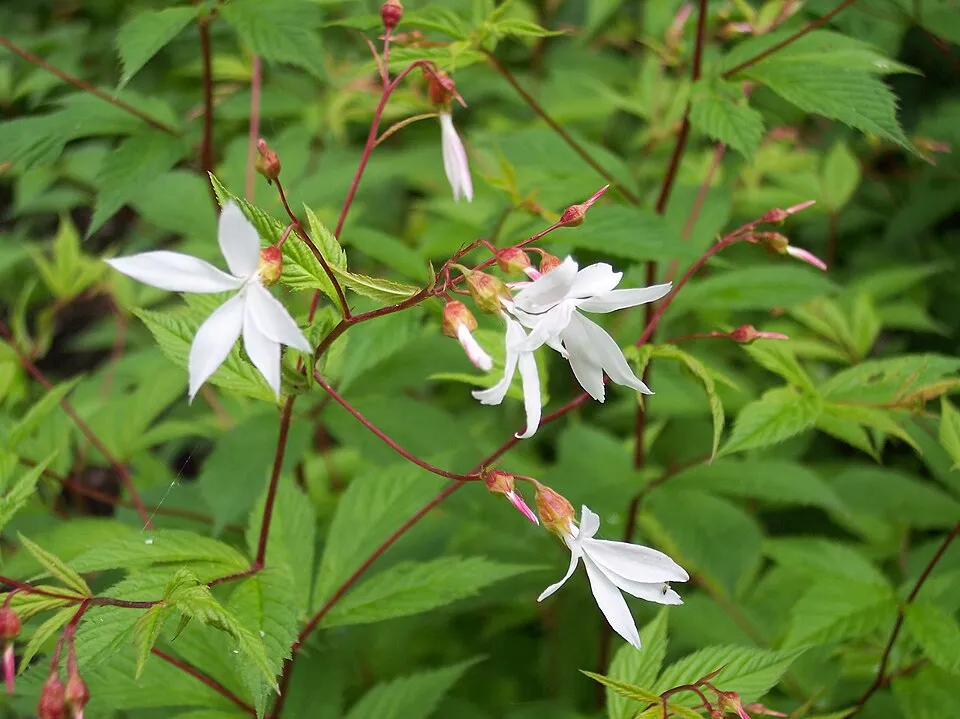
Gillenia trifoliata, commonly known as Bowman's Root or Indian Physic, is an elegant, long-lived perennial herb belonging to the Rosaceae family, native to the deciduous woodlands and open savannas of eastern North America. Its geographical range extends from southern Ontario, Canada, southward through the eastern United States to Georgia and west to Michigan. This graceful plant typically forms soft, billowy clumps, growing 2 to 3 feet tall from a robust, woody rootstock, with an approximate spread of 1.5 to 3 feet at maturity.
The slender, reddish stems are adorned with attractive, trifoliate leaves that are finely cut and serrated, emerging with a bronze tint in spring before maturing to an olive-green with reddish petioles. In late spring to early summer (typically June), Gillenia trifoliata produces delicate white to pale pink star-shaped flowers, each with five pointed petals, arranged in loose panicles on wiry red peduncles. These ethereal blooms appear to dance in the slightest breeze, adding a unique textural interest.
After the petals fall, the persistent red calyxes provide continued ornamental appeal. In autumn, the foliage transforms into striking shades of burgundy, orange, and reddish-bronze, ensuring seasonal interest that can extend into the winter months with its upright, wire-like stems and unique seedheads. Bowman's Root thrives as an understory plant, softening hard edges in naturalistic borders and woodland gardens while providing ecological value to native bees, moths, and butterflies.
Trusted Scientific References
1. Authoritative external sources for Gillenia trifoliata
1.1 Wikipedia — Gillenia trifoliata
1.2 Kew POWO (Plants of the World Online)
1.3 PubMed — peer-reviewed research
1.4 NCBI Taxonomy Browser
1.5 GBIF — Global Biodiversity
1.6Gillenia should be interpreted through verified botanical identity, practical care, and responsible safety language. This recovery note adds the missing context needed for a complete profile: match light to the plant's habit, use well-drained soil, water according to season, and avoid unsupported medicinal or edible claims. For publishing, the plant can be presented as a source-backed garden plant with clear care guidance, common problem diagnosis, and conservative safety wording.
1.1.Gillenia — Notable Characteristics
- ✓Native Perennial — Indigenous to eastern North American woodlands, offering ecological benefits.
- ✓Ornamental Value — Features delicate white star-shaped flowers and striking reddish-bronze autumn foliage.
- ✓Rosaceae Family Member — Part of the diverse rose family, known for its beauty and utility.
- ✓Potent Medicinal History — Traditionally used as a powerful emetic and purgative, hence 'Indian Physic'.
- ✓Woody Rootstock — Grows from a robust, long-lived woody root system.
- ✓Deer Resistant — Generally unpalatable to deer due to its inherent toxicity.
- ✓Pollinator Friendly — Attracts native bees, moths, and butterflies, contributing to local biodiversity.
- ✓Adaptable Growth — Thrives in part shade to dappled sun with moist, well-drained soil.
- ✓Long Seasonal Interest — Provides visual appeal from spring emergence through late autumn foliage and winter structure.
- ✓Unique Texture — Offers an airy, billowy form that adds fine texture to garden designs.
1.2.Gillenia — Concise Overview
- ✓Gillenia trifoliata is a native perennial of eastern North America, known as Bowman's Root or Indian Physic.
- ✓Belongs to the Rosaceae family, featuring delicate white flowers and attractive autumn foliage.
- ✓Historically revered by Native Americans and early settlers as a powerful emetic and purgative.
- ✓Contains saponins, tannins, and resins, responsible for its potent medicinal actions.
- ✓Requires extreme caution and is not recommended for self-medication due to high toxicity.
- ✓Valued ornamentally for its airy presence and seasonal interest in woodland gardens.
2.Gillenia — Scientific Identity
3.Gillenia — Vital Statistics
4.Gillenia — Botanical Features
5.Gillenia — Native Range & Habitat
6.Gillenia — Folk Medicine Applications
7.Gillenia — Chemical Profile
- ✓The therapeutic, albeit potent and toxic, effects of Gillenia trifoliata are attributed to a complex mixture of phytochemicals, primarily concentrated in its rootstock.
- ✓Saponins — These triterpenoid glycosides are considered the primary active compounds responsible for the plant's powerful emetic and purgative effects, acting as irritants to the gastrointestinal mucosa.
- ✓Tannins — Both hydrolyzable and condensed tannins are present, contributing astringent properties that can cause tissue contraction and may modulate the overall physiological response.
- ✓Resins — Complex resinous compounds are found in the root, which are thought to act synergistically with saponins to enhance the plant's drastic emetic and purgative actions.
- ✓Bitter Principles — Various bitter compounds are present, which in very small quantities might stimulate digestive secretions, but in larger doses contribute to the plant's emetic properties.
- ✓Flavonoids — These phenolic compounds typically offer antioxidant and anti-inflammatory activities, though their contribution to Bowman's Root's primary medicinal actions is considered secondary.
- ✓Phenolic Acids — Derivatives like gallic acid or caffeic acid may be present, contributing to general antioxidant capacity.
- ✓Alkaloids — While not a primary class for its main actions, minor alkaloidal compounds might exist, influencing its overall pharmacological profile.
- ✓Volatile Oils — Trace amounts of volatile organic compounds may be present, contributing to the plant's characteristic aroma and potentially minor physiological effects.
8.Gillenia — Scientific Evidence
- ✓Historically, Gillenia trifoliata was a significant medicinal plant, particularly valued by Native American tribes and early European settlers for its potent properties. Modern use is strongly cautioned due to its toxicity and the availability of safer alternatives.
- ✓Emetic Action — Traditionally, the root was used as a powerful emetic, inducing vomiting to expel toxins or unwanted substances from the stomach, especially in cases of poisoning.
- ✓Purgative Effect — In larger doses, Bowman's Root served as a drastic purgative, effectively clearing the bowels and addressing severe constipation.
- ✓Laxative Properties — When administered in smaller, carefully controlled doses, it was employed as a milder laxative to promote regular bowel movements.
- ✓Diaphoretic Agent — This herb was traditionally utilized to induce sweating, aiding in the reduction of fevers and supporting the body's natural detoxification processes.
- ✓Expectorant Support — Historical accounts suggest its use in respiratory conditions to help loosen and expel phlegm, acting as an expectorant.
- ✓Anti-rheumatic Use — Native American traditional medicine sometimes employed Gillenia trifoliata to alleviate symptoms associated with rheumatism and joint pain.
- ✓Fever Reducer — Its diaphoretic action contributed to its traditional application in managing various febrile conditions.
- ✓Digestive Aid — In very small, tonic doses, it was believed to stimulate digestion and address certain digestive complaints, though this use was secondary to its more drastic actions.
- ✓Detoxification Support — The combined emetic and purgative actions made it a historical choice for perceived internal cleansing and detoxification.
8.1.Gillenia — Therapeutic Indications
9.Gillenia — Cautions & Contraindications
9.1.Gillenia — Possible Adverse Reactions
- ✓The potent nature of Gillenia trifoliata means it carries significant risks, and adverse effects can be severe and dangerous.
- ✓Severe Vomiting — Large doses reliably induce intense and prolonged vomiting, leading to distress and potential complications.
- ✓Drastic Purgation — Causes severe diarrhea and bowel evacuation, which can be difficult to control.
- ✓Dehydration — Excessive vomiting and diarrhea can rapidly lead to significant fluid loss and dehydration.
- ✓Electrolyte Imbalance — Severe fluid loss can disrupt the body's electrolyte balance, potentially leading to cardiac issues or other serious health problems.
- ✓Abdominal Cramps and Pain — Intense gastrointestinal distress, including severe stomach cramps, is a common adverse reaction.
- ✓Gastric Irritation — The active compounds can cause significant irritation and inflammation of the gastrointestinal lining.
- ✓Cardiovascular Effects — In severe cases of overdose or electrolyte imbalance, adverse cardiovascular effects are possible.
9.2.Gillenia — Safety Profile
- ✓Gillenia trifoliata is a highly potent and potentially toxic plant; its medicinal use requires extreme caution and is generally not recommended for self-medication.
- ✓High Toxicity — Considered toxic due to its strong emetic and purgative actions, which can lead to severe dehydration and electrolyte imbalance.
- ✓Professional Guidance Required — Any consideration of internal use must be under the direct supervision of a highly experienced and qualified medical herbalist or physician.
- ✓Contraindications — Absolutely contraindicated in pregnancy, lactation, infants, young children, the elderly, and individuals with gastrointestinal disorders (e.g., IBD, ulcers), heart conditions, kidney disease, or severe dehydration.
- ✓Drug Interactions — May interact dangerously with diuretics, laxatives, cardiac medications (e.g., digoxin), and any drugs affecting electrolyte balance or gastrointestinal motility.
- ✓Overdose Risk — The margin between a therapeutic dose (even historically) and a toxic dose is very narrow, making overdose a significant risk.
- ✓Not for Prolonged Use — Due to its drastic effects, it was never intended for prolonged or chronic administration in traditional medicine.
- ✓External Use Caution — Even external applications should be approached with caution due to potential skin irritation or systemic absorption.
10.Gillenia — Preparations & Uses
- ✓Due to its potent and potentially dangerous effects, the internal use of Gillenia trifoliata is not recommended in modern herbalism without expert supervision. The following methods are for historical and educational context only.
- ✓Decoction of Root — Historically, dried root pieces were boiled in water to create a potent decoction, used orally to induce vomiting or purgation.
- ✓Powdered Root — The dried root was sometimes ground into a fine powder, which could be mixed with water or other liquids for ingestion, allowing for more precise (though still dangerous) dosing.
- ✓Infusion for Mild Effects — In traditional practices, very small quantities of the root might have been infused in hot water for a less drastic laxative or tonic effect, requiring extreme caution.
- ✓External Poultices — While primarily internal, some traditional practices might have explored external applications, though details are scarce and not widely documented.
- ✓Dosage Adjustment — Traditional healers carefully adjusted dosage; small amounts were used as a laxative, while larger quantities were employed for severe emetic or purgative actions.
- ✓Harvest Timing — Roots were typically harvested in late autumn or early spring when the plant's energy reserves were concentrated in the underground portions, enhancing potency.
- ✓Traditional Combinations — Historical accounts suggest it was sometimes combined with other herbs to modulate its effects or address specific symptoms, always with great caution.
- ✓Preparation for Specific Ailments — Depending on the ailment (e.g., fever, constipation, suspected poisoning), the method and strength of preparation would be varied by experienced practitioners.
11.Gillenia — Cultivation & Care
- ✓Soil Preference — Bowman's Root thrives in moist, well-drained, humus-rich soil, but is adaptable to various soil types as long as drainage is adequate and organic matter is incorporated.
- ✓Light Requirements — Performs best in part shade to dappled shade, mimicking its native woodland understory habitat; can tolerate full sun if soil moisture is consistently maintained.
- ✓Water Needs — Requires average moisture, especially during establishment; young plants should be kept consistently moist to support vigorous growth.
- ✓Planting & Spacing — Plant in spring or fall, allowing ample space (1.5-3 feet spread) to accommodate its billowy, multi-stemmed mature form.
- ✓Establishment Time — This plant can take time to establish its extensive root system, but once settled, it is remarkably long-lived and low-maintenance.
- ✓Maintenance — Generally low-maintenance; minor staking or support may be needed if grown in deep shade where it might become leggy; deadheading is not required as the red calyxes are ornamental.
- ✓Pest and Disease Resistance — Highly resistant to most common pests and diseases, and notably deer resistant due to its inherent toxicity.
- ✓Propagation — Can be propagated by seed (requires cold stratification) or by division of mature clumps in early spring or fall.
Reviewed by the Flora Medical Global Botanical Review Panel
Multi-disciplinary editorial group · Botany · Ethnobotany · Herbal-medicine literature
Who reviewed this: This page was checked by the Flora Medical Global Botanical Review Panel — an in-house editorial group of botany graduates, ethnobotany researchers, and horticulture practitioners who collectively maintain our 7,000+ plant encyclopedia. Meet the team.
Our 4-step verification process
1. Taxonomic verification
Scientific names and synonyms cross-checked against Kew POWO, World Flora Online, and The Plant List.
2. Phytochemical & medicinal cross-reference
Active compounds, traditional uses, and reported activities are cross-referenced with PubMed, USDA Dr. Duke's database, and peer-reviewed ethnobotanical literature.
3. Conservation & distribution check
Distribution, ecology, and conservation status confirmed against GBIF occurrence records and the IUCN Red List.
4. Editorial & safety review
Every entry passes an editorial pass for clarity, originality, and safety notices (toxicity, contraindications, dosage caveats) before publication.
Last reviewed:
Important medical disclaimer: This content is for educational and research purposes only. It is not medical advice and is not a substitute for consultation with a licensed healthcare provider. Do not use any herb to self-treat a medical condition without professional guidance.
Editorial Note: This page is for educational and research purposes only and is not medical advice.
Written by: Flora Medical Global Editorial Team
Reviewed by: Flora Medical Global Botanical Review Panel
Last Updated: June 15, 2026





Gillenia — Comments & Community Reviews
Rate this plant